
Choosing between AI visibility tools in 2026 means navigating three problems at once: prices that changed last quarter, vendors grading their own homework, and measurements of an answer engine that rarely says the same thing twice.
This comparison takes all three seriously. Engine coverage is reported per tier instead of per marketing claim, and our own bias is disclosed upfront: we build one of these tools. Which tracker you need depends on your team, budget, and how much accuracy skepticism you bring. If you would rather start with the free, manual method before buying, we cover how to track brand mentions in AI search by hand.
The Best AI Visibility Tools at a Glance
Prices and engine coverage below were checked against each vendor's live pricing page in September 2026 - several of these vendors (Ahrefs Brand Radar, Semrush, ZipTie, AthenaHQ) repriced or repackaged within the last quarter, and pricing in this category moves in weeks, not months.
| Tool | Best for | Engines at entry tier | Entry price | Free option |
|---|---|---|---|---|
| Profound | Enterprise depth | 3 on trial (ChatGPT, Gemini, AI Overviews); 9 on Enterprise | Custom Enterprise (no self-serve brand tier) | 7-day free trial |
| Semrush AI Visibility Toolkit | Existing Semrush users | 5 (ChatGPT, AI Overviews, AI Mode, Gemini, Perplexity) | From $99/mo per domain (standalone), or bundled into SEO + AI Search plans | Free checker + trial |
| Ahrefs Brand Radar | Benchmarking on big prompt data | All platforms via Custom Prompts (Claude included) | Bundled from Ahrefs Lite up (not the $29 Starter); Index $199/mo per platform, $699/mo for all platforms | Custom Prompts free on Lite+ |
| SE Visible | SEO + AI in one stack | ChatGPT, Gemini, AI Mode, AI Overviews, Perplexity | $99/mo | 10-day trial |
| Peec AI | European teams, agencies | Pick 3 of 6; more as add-ons | €85/mo | Free trial |
| Otterly.ai | Budget monitoring | 4 (AIO, ChatGPT, Perplexity, Copilot) | $29/mo ($25 annual) | Free trial |
| Rankscale | Budget breadth | 10 surfaces (incl. Claude, DeepSeek, Mistral) | €20/mo | Pro trial |
| Scrunch AI | Enterprise + AI-readable delivery | 4 (Core); 9 on Enterprise | $250/mo | 7-day trial |
| AthenaHQ | Agencies (unlimited seats) | 11 models | $295/mo (~$245 annual) | Free credit tier |
| Writesonic | Content teams adding tracking | 3 platforms | $79/mo billed annually | Free trial |
| geotoolbox (that's us) | Reachability + tracking in one | 3 (ChatGPT, Perplexity, AI Overviews); all 8 on Pro and Scale | From $99/mo ($79 annual) | 7-day trial + free checkers |
The category goes by several names - AI search visibility tools, LLM visibility tools, AI brand visibility trackers, AI visibility tracking tools - but they all answer one question: when someone asks ChatGPT, Gemini, Perplexity, or Google's AI Overviews about your category, does your brand show up, and who gets cited instead? If you're new to the space, our AI visibility guide covers the fundamentals. With ChatGPT at 900 million weekly users as of February 2026, that question stopped being optional.
How We Evaluated (and Why You Should Distrust Every List Like This)
Full disclosure: we build geotoolbox, one of the tools on this list. Factor that in when you read our entry.
Check the current page-one results for "ai visibility tools" and you'll find a pattern: Profound's list ranks Profound first. Frase's list ranks Frase first. GrowthOS ranks GrowthOS first. Backlinko's list puts Semrush at the top, and Backlinko is owned by Semrush - to its credit it discloses that, though in the footer, after the ranking. The vendor lists carried no conflict-of-interest note at all when we checked in July 2026. The category is young enough that vendor listicles dominate the query, and AI engines cite those same listicles back to you when you ask them for recommendations.
So instead of pretending neutrality, we did three things you can check:
- Every price was verified against the vendor's live pricing page in September 2026. Where a widely repeated number was wrong, we say so - AI answers and half the listicles ranking for this query still quote stale figures.
- Engine coverage is reported per tier, not per marketing page. "Tracks 10 engines" often means "tracks 10 engines on the custom-priced enterprise plan, and exactly one on the plan you can actually buy."
- Claims are separated into tested and reported. Where we could not verify a vendor claim directly, it is attributed, not asserted.
Buyers already know this. As Paul Dyer, CEO of the agency /prompt, put it to Digiday, "If you use three different tools and give them the same prompts, you get three different answers." He's right, and we cover why in the accuracy section below.
One scope note: this page compares AI visibility trackers specifically. If you want the whole GEO stack (trackers plus content, technical, and authority tools grouped by job), that's our guide to the best generative engine optimization tools.
Before You Pay: Make Sure AI Can Read Your Site
There is a step before tracking that no tool vendor leads with, because there's no subscription in it: check whether AI crawlers can fetch your site at all.
GPTBot, ClaudeBot, and PerplexityBot need to fetch your pages to learn what your brand does; on the Google side, Google-Extended is the robots token governing Gemini training and grounding, while AI Overviews and AI Mode ride regular Googlebot. A robots.txt rule copied from a 2023 template, an over-eager WAF or bot-protection layer, or a JavaScript-only render can make you invisible to several engines at once. In our experience running crawler scans, this failure mode is common and expensive: teams pay $300+ a month to track engines whose crawlers their own CDN has been blocking the whole time. The dashboard says "zero mentions" and everyone starts rewriting content, when the actual fix is one firewall rule.
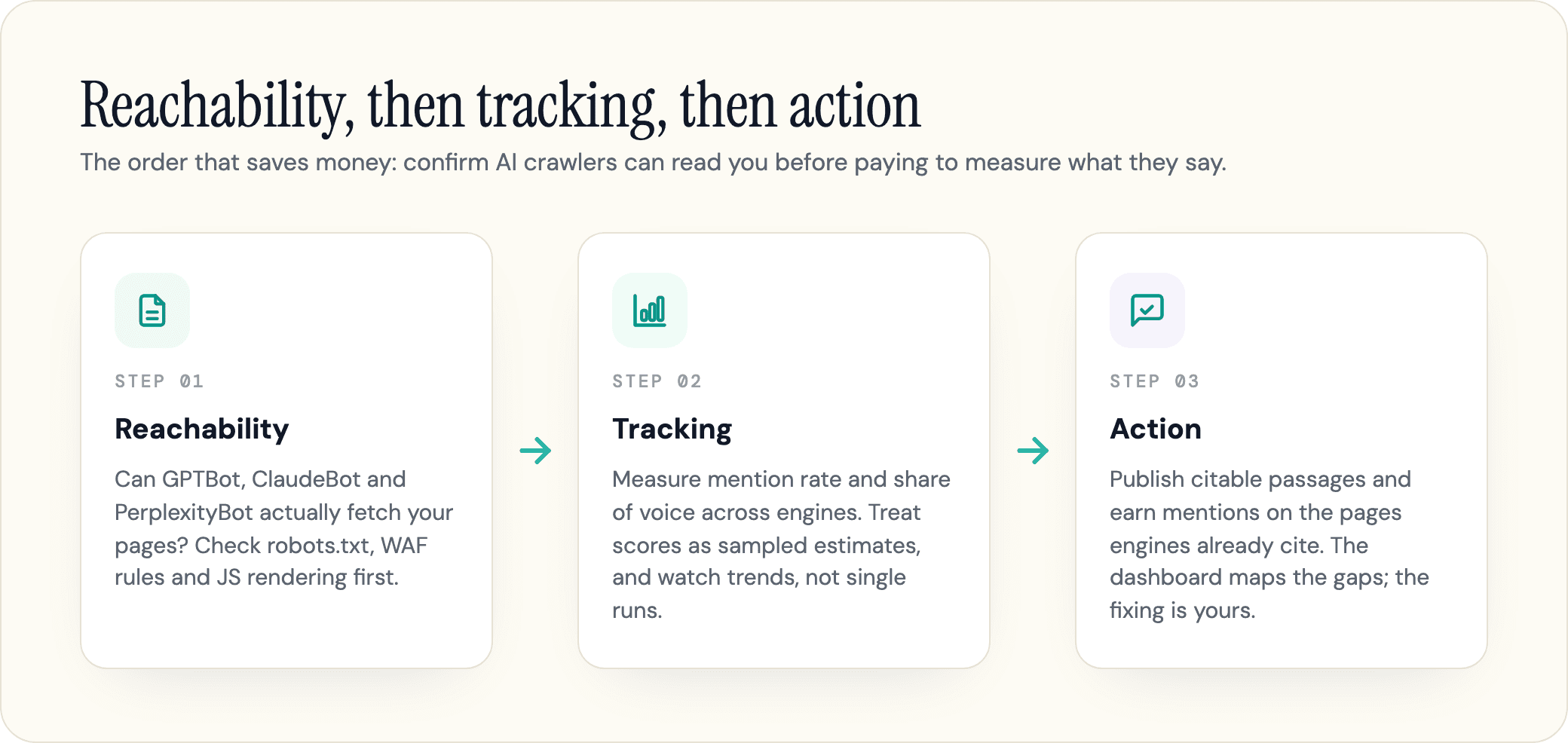
Two minutes catches the obvious blockers. Run your domain through our free AI Crawler Checker, which tests real fetches from the major AI crawlers against your live site. If something is blocked, fix that before you spend a dollar on monitoring. We wrote up the full mechanics in our guide to AI crawlers.
Reachable? Good. Now the trackers themselves.
The 11 Best AI Visibility Tools in 2026
Ordered by how we'd shortlist for a typical in-house or agency SEO team, weighing verified cost against engine coverage, whether reachability is covered, and how far the entry tier actually gets you. We list ourselves last on purpose, outside that ordering; the disclosure above applies, and the price-per-prompt table further down puts our number next to everyone else's so you can judge it rather than take our word. Full entries went only to tools with a public, verifiable pricing page - custom-quote-only vendors (Brandlight, Conductor, AIclicks) are out by that rule, not by quality.
1. Profound
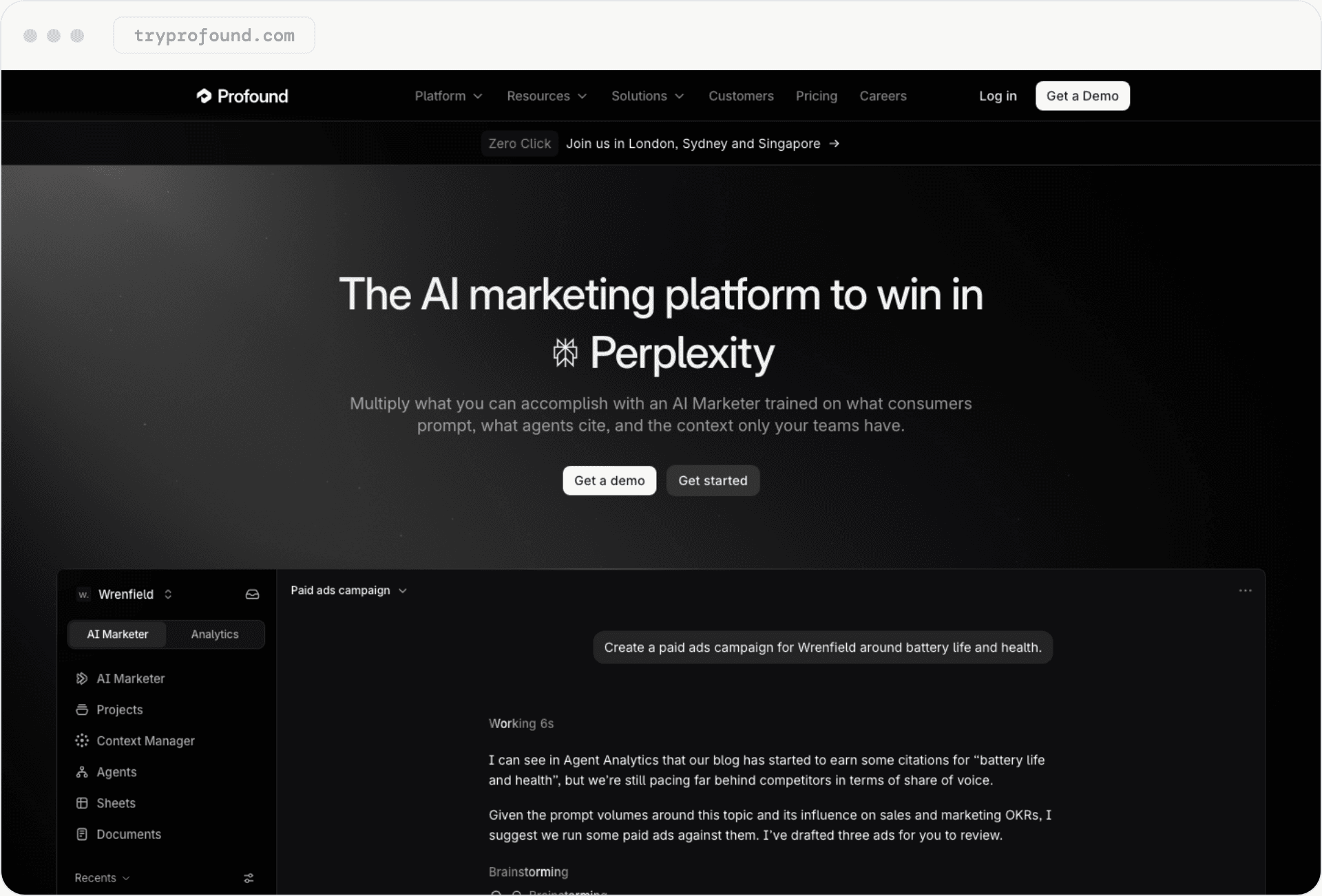
Best for: enterprises and larger agencies.
Profound is the enterprise reference point in this category, and the tier gap is the thing to understand before you buy. Per Profound's pricing page, it no longer sells a self-serve brand tier at all: a free 7-day trial tracks ChatGPT, Gemini and Google AI Overviews, with 50 prompts a day. The full engine list - nine, adding Perplexity, Copilot, Claude, DeepSeek, Exa Search and Google's AI Mode - is enterprise-only, custom-priced, and Grok is not on it.
What you get for it: browser-level answer collection that mimics real user sessions rather than leaning on APIs, a large conversation-volume dataset, crawler analytics, and agency workspaces. Well-funded and shipping fast. If the budget is enterprise-sized and you need depth plus compliance boxes ticked, it earns the shortlist.
What works:
- collects answers at the browser level, mimicking real user sessions
- nine engines on the Enterprise plan
What doesn't:
- no self-serve brand tier
- Grok is not covered, even on Enterprise
Watch for: the three-engine trial surprising teams who expected full multi-engine coverage without an Enterprise contract.
2. Semrush AI Visibility Toolkit
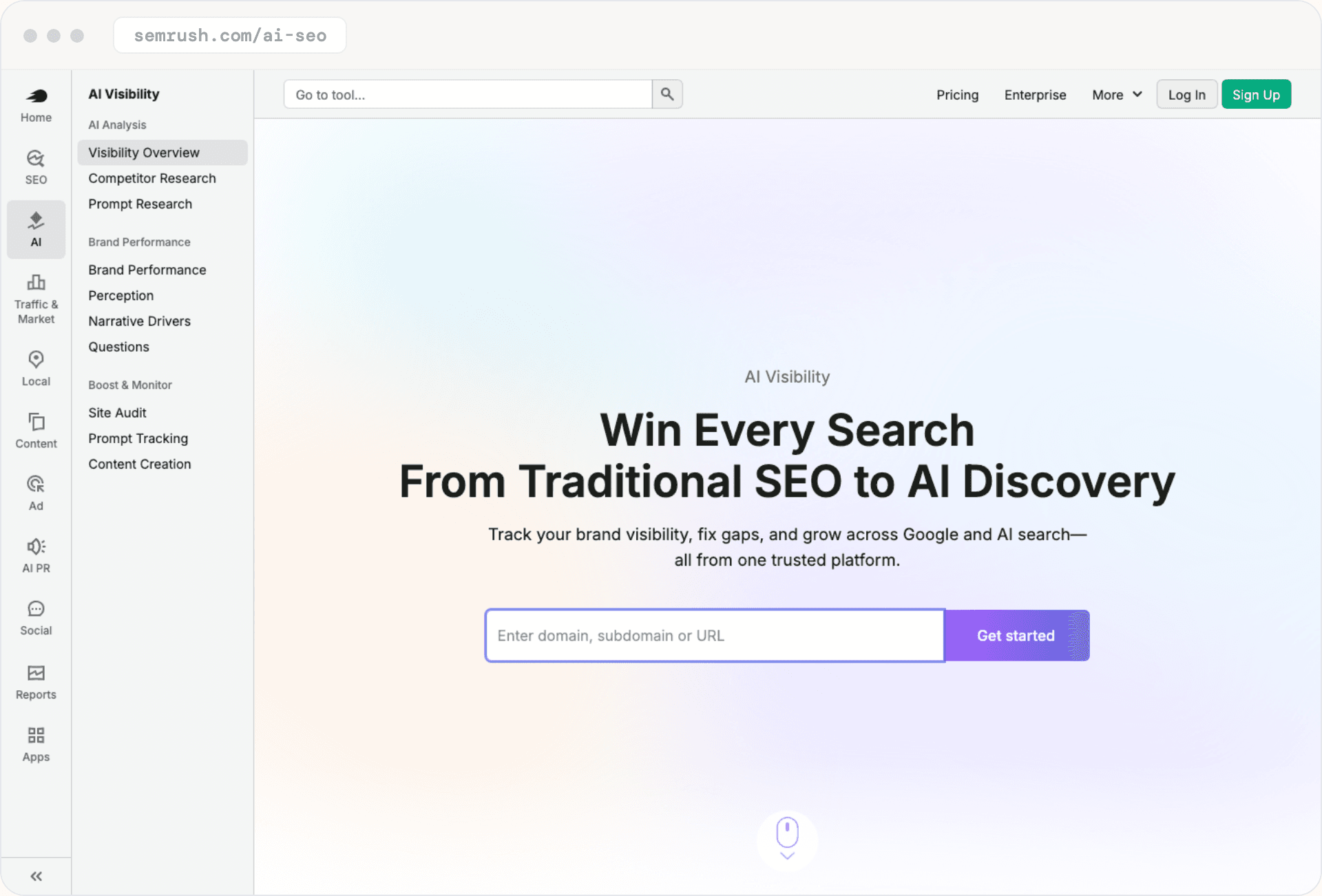
Best for: teams already paying for Semrush (bundled route) or anyone who wants AI visibility on its own without the rest of the suite (standalone route).
Semrush now sells AI visibility two ways, and which one you want depends on whether you already pay for the suite. The standalone AI Visibility toolkit is still sold by the domain - Base is $99/month billed annually (25 tracked prompts daily, 300 AI visibility reports a day, mentions from ChatGPT, Google AI, Gemini, and Perplexity) - functionally the same product this article originally priced, just moved to a new URL, not retired. If you're already in Semrush or want the rest of the suite anyway, the SEO + AI Search plans fold visibility tracking into the SEO tiers instead: the entry SEO tier already includes AI-search performance tracking and custom-prompt reports, and the dedicated Starter SEO + AI Search tier adds daily prompt tracking starting around 50 prompts, scaling to roughly 200 on the top tier, with Grok and Claude still reserved for enterprise and annual billing saving up to 17% over monthly. Mentions, quote-level sentiment scoring, share of voice, and citation sources feed directly into the same workspace as your keyword and content data either way, and a free AI Visibility Checker plus a trial give you a snapshot before you commit. If you are choosing the underlying suite first, our Semrush vs Ahrefs comparison tests their core keyword and traffic data on real sites, and our hands-on Semrush review covers the full suite's pricing and accuracy.
Semrush is also the tool with the most corporate momentum behind it: Adobe closed its Semrush acquisition in April 2026 and launched "Adobe Brand Visibility" on Semrush's visibility data that June - which tells you where this category is headed: into the big marketing suites.
Watch for: the standalone toolkit and the bundled plans are priced and sold on separate pages - compare both before assuming one is cheaper.
3. Ahrefs Brand Radar
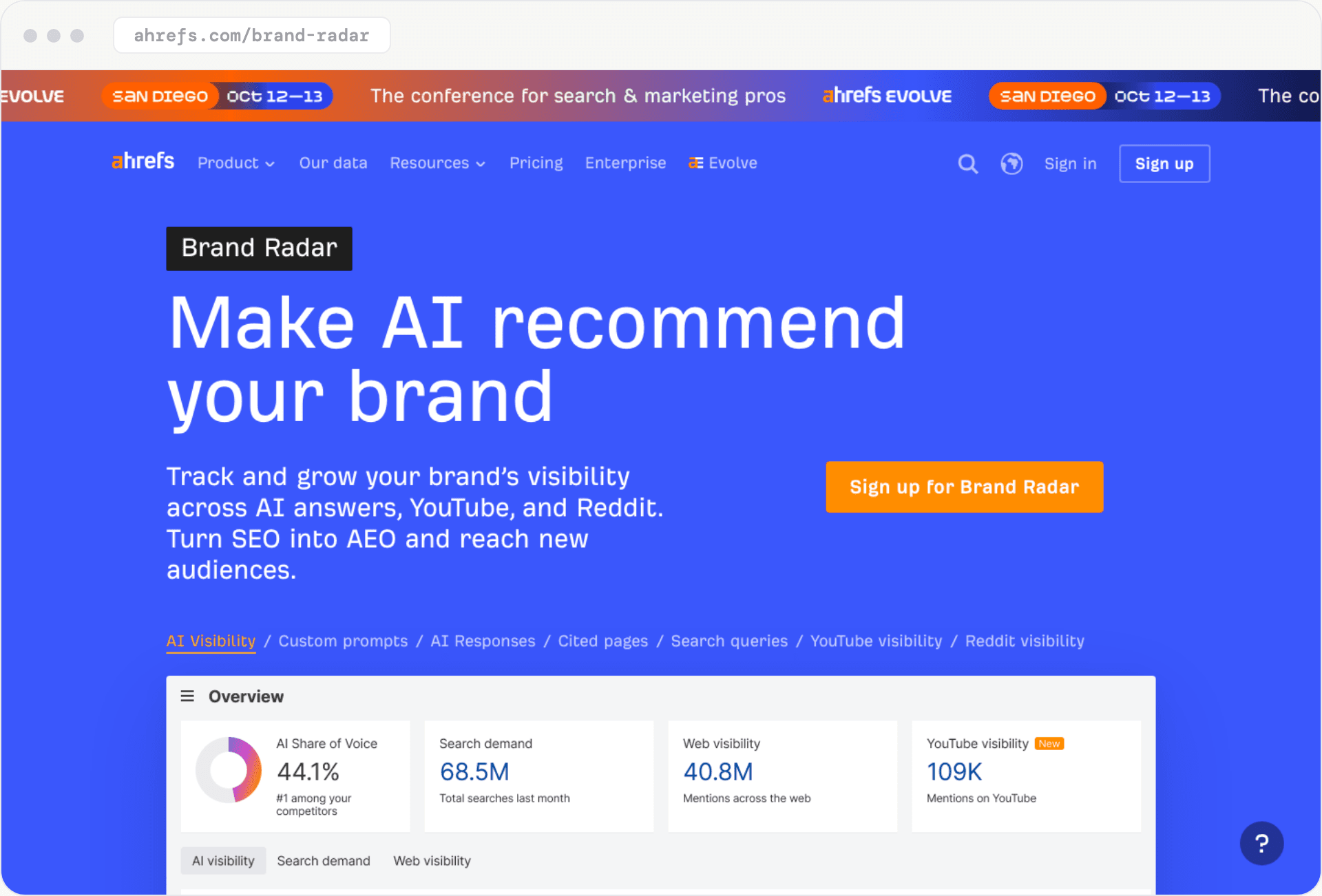
Best for: brands that want visibility measured against real prompt demand.
Brand Radar's pitch is scale: 448M+ prompts (by its product page's count) underpinning the benchmarking data. Ahrefs has since split it into two products: Custom Prompts, which tracks the exact questions you configure and is bundled into every Ahrefs plan from Lite ($129/month) up, though not the $29 Starter, with larger check-based packages priced separately for heavier use; and the AI Visibility Index, which opens the full 448M+ prompt corpus and is sold per platform at $199 a month, or $699 a month for all platforms. Custom Prompts covers every platform plus Claude. YouTube, TikTok, and Reddit tracking are free while in beta.
That prompt corpus is the differentiator. Instead of only sampling the prompts you configure, you can benchmark against demand-weighted prompt data, which softens the small-sample problem that budget tools have. The trade-off is price and focus: it's a benchmarking instrument more than an action platform, with no crawler-side analysis.
Watch for: widely circulated stale labels - Ahrefs repackaged Brand Radar in 2026, and the "Select Platforms" and "All Platforms" tier labels you'll still see in roundups are gone, but the prices survived: the Index is $199 a month per platform and $699 a month for all platforms. Check the live page before you budget.
4. SE Visible
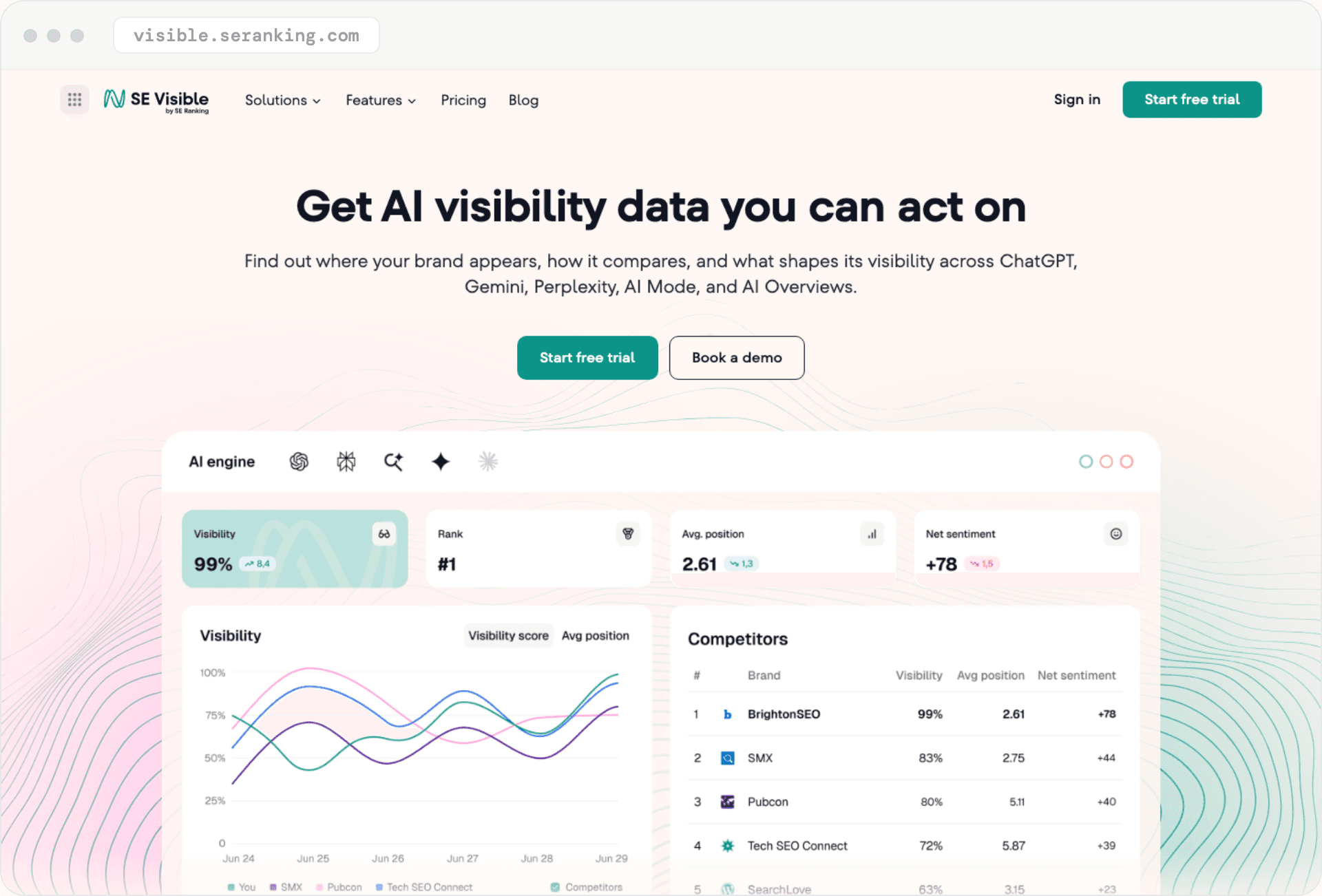
Best for: teams that want SEO and AI visibility side by side without enterprise pricing.
SE Ranking spun its AI tracking into a standalone product, SE Visible, and it's one of the better mid-market values: $99/month entry (Core $189, Plus $355) covering ChatGPT, Gemini, Google AI Mode, AI Overviews, and Perplexity, with a 10-day trial. If you'd rather keep one bill, the classic SE Ranking AI Search add-on route still exists (€63.20 a month annually, or $71.20 if the page serves you dollars, on top of an SE Ranking plan) and includes the SE Visible dashboard.
Watch for: fewer engines and regions than the dedicated enterprise tools; confirm your markets are covered.
5. Peec AI
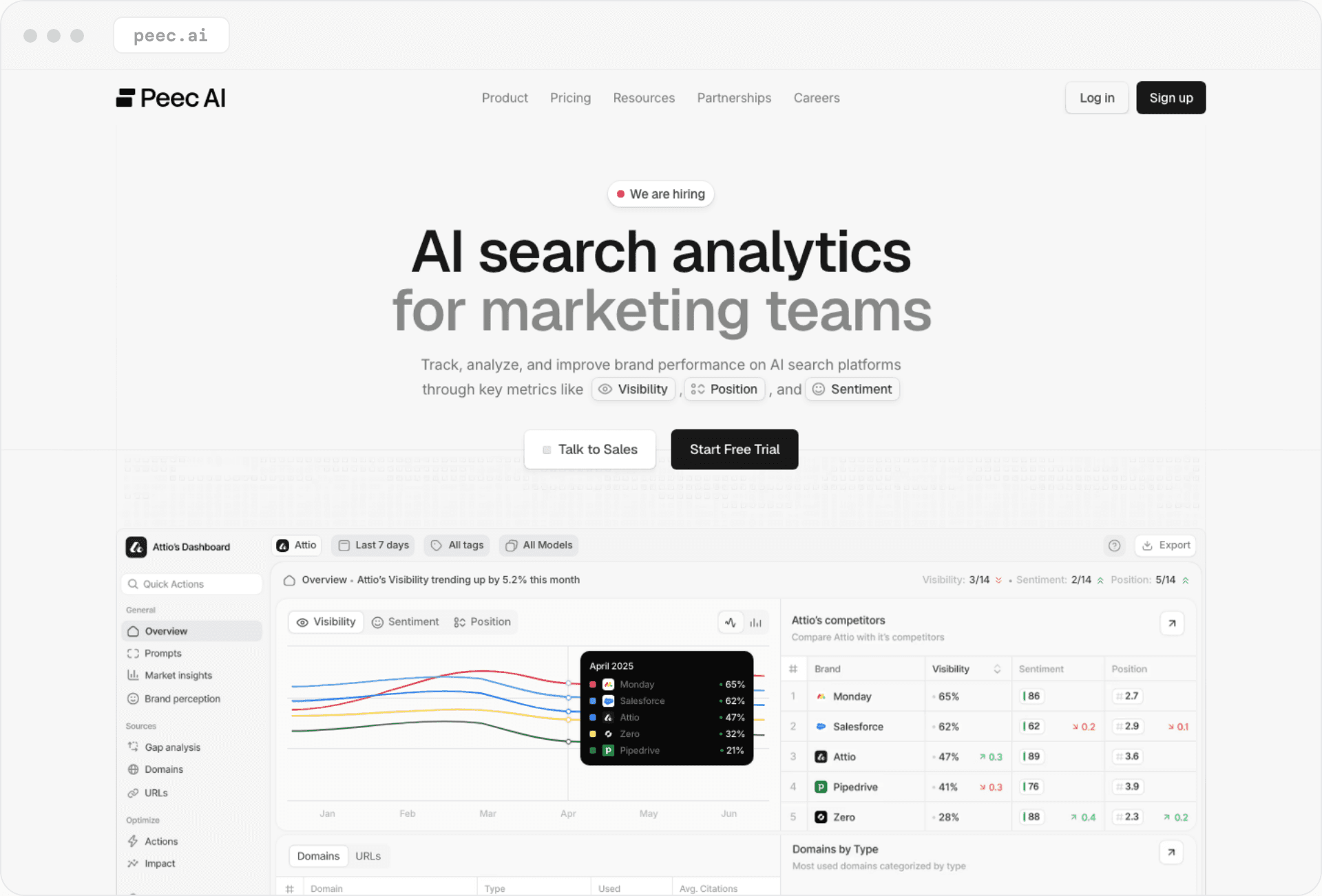
Best for: European teams and agencies tracking multiple countries.
Peec is the European favorite: clean UX, daily tracking, and country-specific visibility that most US-built tools handle poorly. Starter is 85 euros/month with 50 prompts and one project; Pro is 205 euros (150 prompts), Advanced 425 euros. You pick 3 of 6 engines at entry, with the rest available as paid add-ons - price those before comparing it against flat-rate rivals.
Peec is backed by a $21M Series A (November 2025), which lowers the vanish-overnight risk that haunts small tools here, even if funding guarantees nothing about roadmap fit.
What works:
- clean UX with daily tracking
- country-specific visibility
What doesn't:
- only three engines at entry
- Starter is one project and 50 prompts
Watch for: engine add-ons quietly inflating the effective monthly cost.
6. Otterly.ai
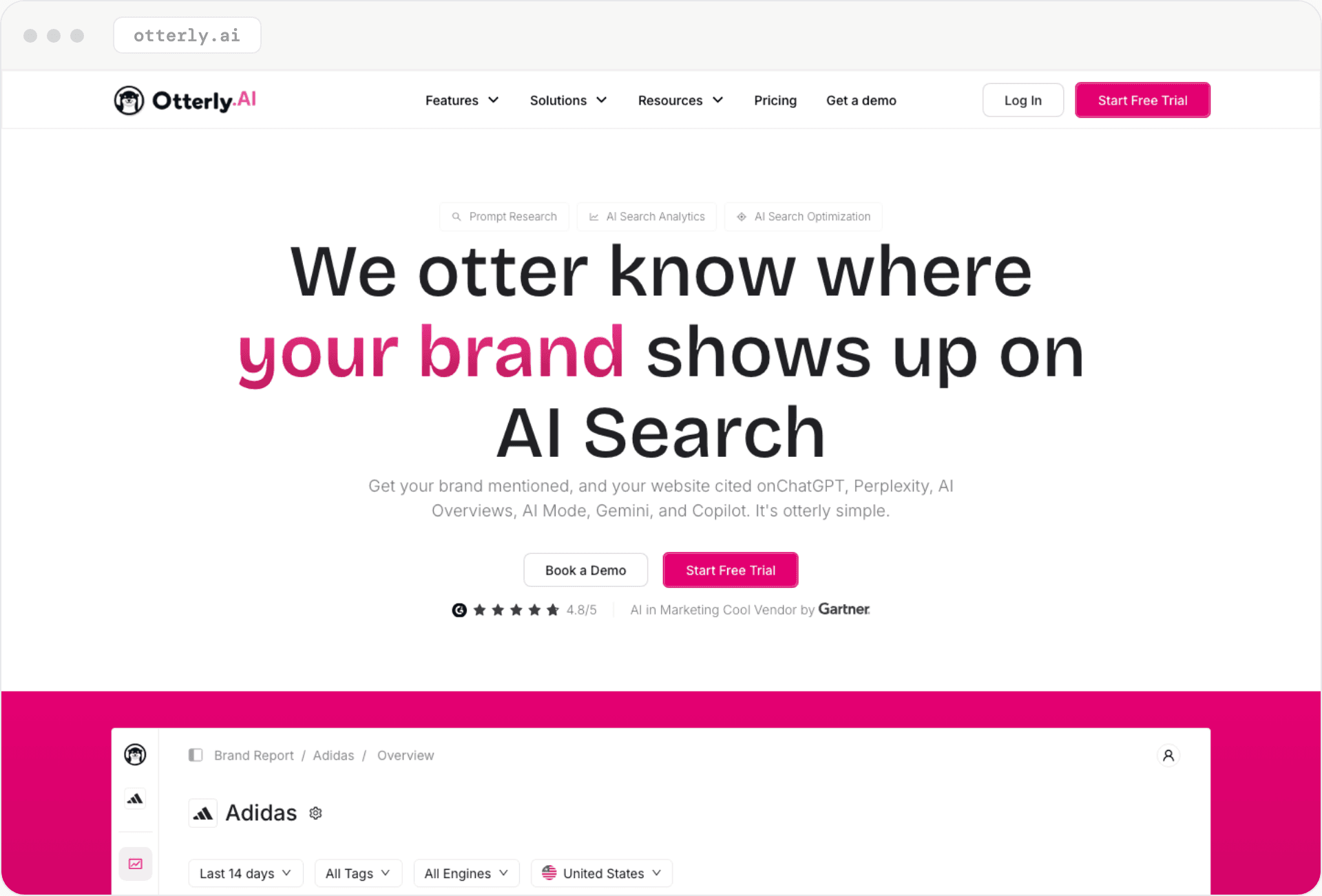
Best for: SMBs and first-time buyers wanting the safest budget pick.
The budget pick that shows up in nearly every credible roundup, for good reason. Lite is $29/month ($25 billed annually) - the most widely vetted tracker under $30 - covering AI Overviews, ChatGPT, Perplexity, and Copilot at entry, with Gemini, AI Mode, and Claude as add-ons. Standard at $189 and Premium at $489 raise the prompt ceilings. There's a free trial, and the SEO-keyword-to-prompt conversion makes setup quick.
What works:
- $29/month entry ($25 billed annually)
- SEO keywords convert to prompts for quick setup
What doesn't:
- Gemini, AI Mode and Claude cost extra
- the next tier up (Standard) is $189/month
Watch for: tight prompt caps at entry, and monitoring-only output - it tells you where you stand, not what to do next.
7. Rankscale
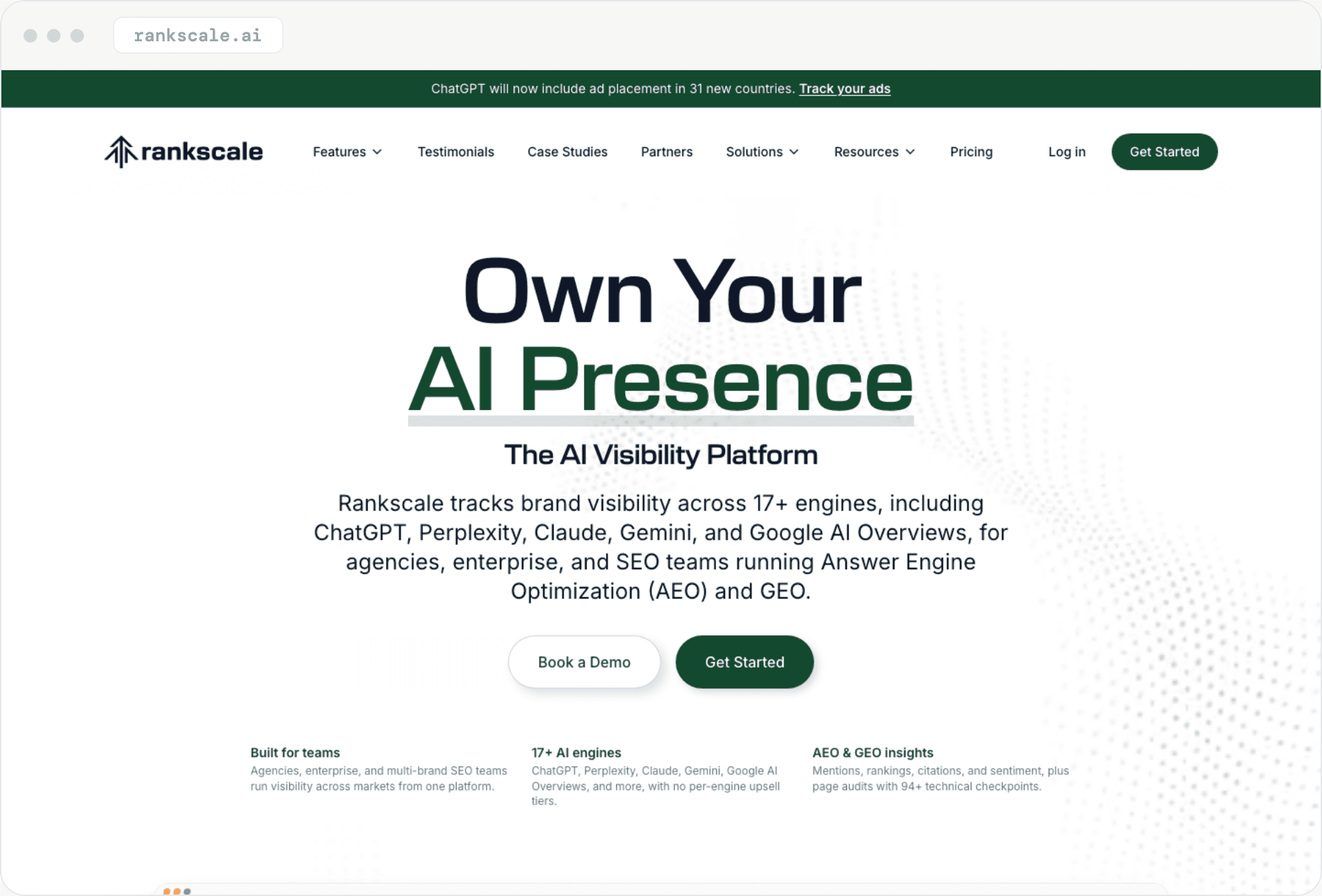
Best for: budget-conscious teams that specifically need broad engine coverage.
The widest engine coverage per dollar on this list. Essentials starts at $20/month and Pro at $99 ($84 billed annually), tracking ten surfaces on every plan - ChatGPT, Perplexity, Google's AI Mode, AI Overviews and Gemini, Claude, DeepSeek, Mistral, Grok, and Copilot - coverage that costs enterprise money elsewhere. You can try Pro free.
At this price the trade-offs are predictable: lighter reporting, smaller team features, and less methodological transparency than the big platforms. But if the question is "can I see whether Claude and DeepSeek mention us without a four-figure contract," this is currently the shortest path.
What works:
- ten surfaces tracked, from $20/month
- free Pro trial
What doesn't:
- lighter reporting and fewer team features
- less methodological transparency than the big platforms
Watch for: shallow analytics compared to mid-market tools.
8. Scrunch AI
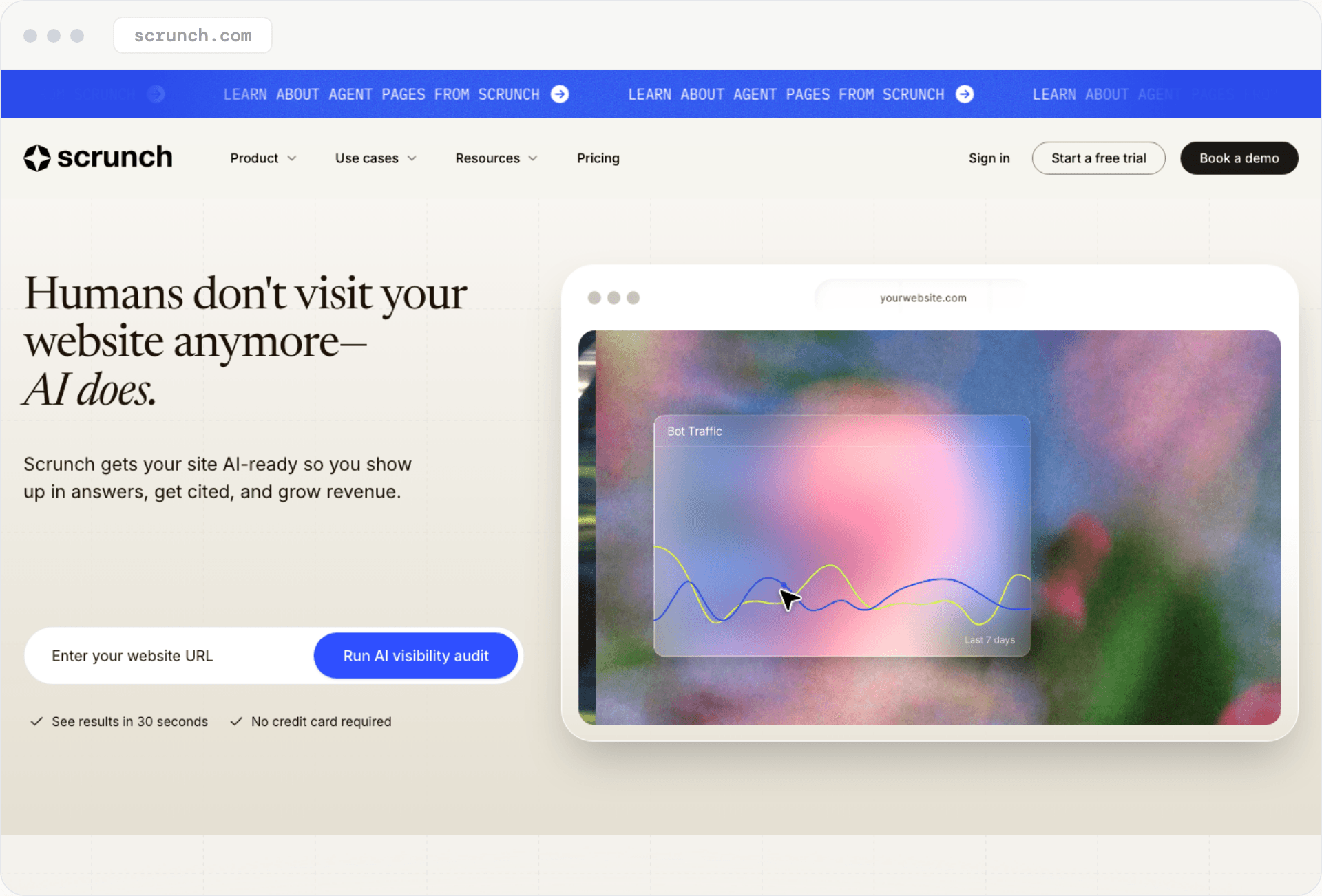
Best for: enterprise sites with technical rendering problems.
Scrunch pairs tracking with something no one else on this list does: its Agent Experience Platform (AXP) serves a structured, AI-readable version of your site to crawlers like GPTBot and ClaudeBot without touching your human-facing pages - a real fix for JavaScript-heavy sites that engines parse badly. Pricing here deserves its own caveat, and it proves this article's point about verifying vendor pages: Scrunch repackaged repeatedly through 2026 and briefly A/B-tested two lineups, but its pricing page has since settled on a $250/month self-serve Core plan covering four engines (ChatGPT, Perplexity, AI Overviews, Copilot) and gating AXP to Enterprise, with a custom-priced Enterprise tier covering nine engines. Entry is $250/month on a 7-day trial, with SOC 2 compliance. Confirm the current lineup on their page before you commit.
Sitecore acquired Scrunch in June 2026 (Bloomberg reported roughly $225M), positioning it inside a larger DXP play - more consolidation evidence, and worth factoring into a long-term contract decision.
What works:
- AXP serves AI crawlers a readable version of your site
- SOC 2 compliance
What doesn't:
- $250/month entry covers four engines
- AXP is Enterprise-only
Watch for: post-acquisition roadmap shifts.
9. AthenaHQ
Best for: agencies putting whole teams into one tool.
A platform agencies like for a structural reason: unlimited seats on every plan. Starter is $295/month ($245 billed annually) on a credit system with 3,600 credits a month, covering 11 models: ChatGPT, Perplexity, AI Overviews, AI Mode, Gemini, Claude, Copilot, Grok, DeepSeek, Meta AI, and Mistral, plus an action center that turns gaps into tasks. A free Essential tier ($25 of credit, five engines) lets you test before paying, though API access and extra credits are paid add-ons on top of Starter.
What works:
- unlimited seats on every plan
- 11 models plus an action center
What doesn't:
- $295/month at Starter ($245 billed annually)
- API access and extra credits are paid add-ons
Watch for: credit burn - broad prompt sets consume credits faster than the sticker price suggests.
10. Writesonic
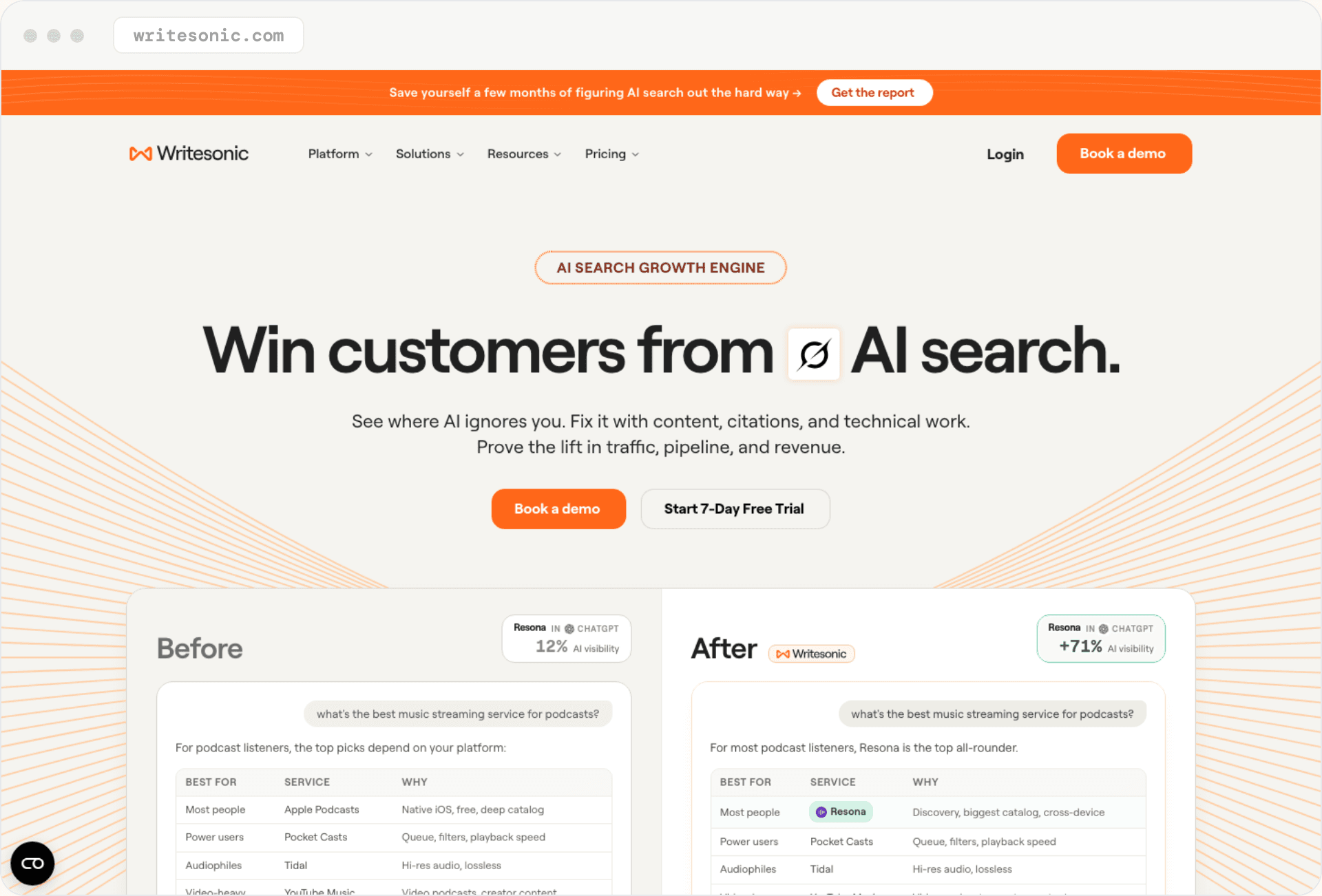
Best for: content teams who want tracking bolted onto production.
The content-platform route into tracking. Writesonic folds brand monitoring into a writing product at $79/month billed annually ($99 monthly), with deeper layers like sentiment analysis and crawler analytics gated to higher tiers. Self-serve plans track 3 platforms - fine for a content team's first look at AI visibility, thin for serious multi-engine measurement.
What works:
- tracking bundled into a writing product at $79/month billed annually
- fine for a content team's first look at AI visibility
What doesn't:
- self-serve plans track only three platforms
- sentiment and crawler analytics sit on higher tiers
Watch for: mention-frequency trends standing in for precise measurement, and the 3-platform ceiling outside enterprise.
11. geotoolbox
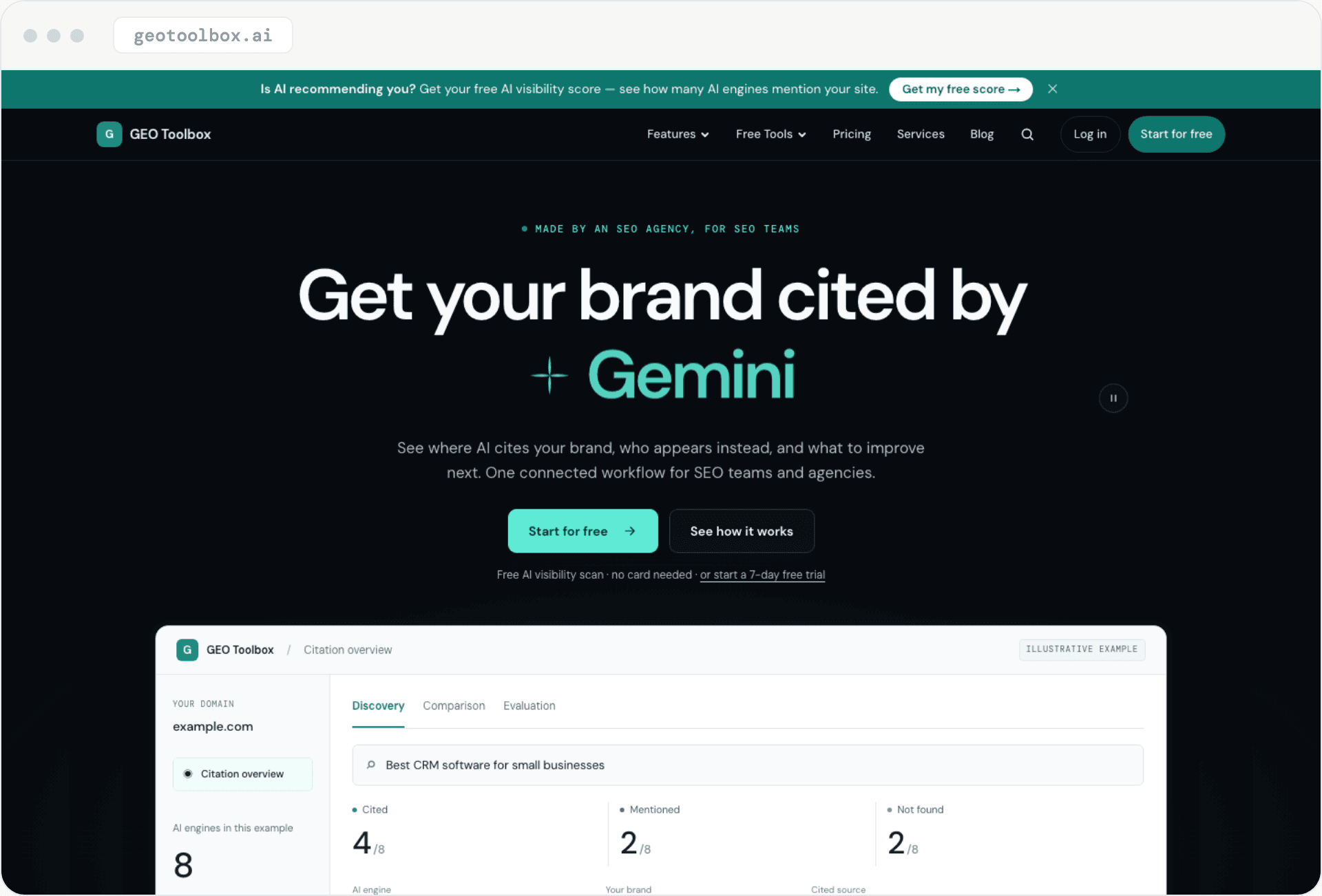
Best for: teams that want reachability checks, tracking, and AI-traffic analytics on one bill.
geotoolbox is our AI visibility platform, built around a premise most of the category skips: reachability comes before tracking. Every plan pairs brand-mention and share of voice tracking with a GEO scan, Agent Readiness scan, competitor benchmarking, and AI-traffic analytics (GSC impression views plus GA4 referral behavior), so you see whether engines can read you, whether they mention you, and what the resulting visits do, in one place. Higher tiers add Citation Interceptor, which flags the third-party pages engines cite in your category so you can go earn a mention there, plus content briefs and article generation. See the domain overview for how the pieces fit.
Engines: 8 total - ChatGPT, Perplexity, Google AI Overviews, Google AI Mode, Gemini, Claude, Bing Copilot, and Grok. Starter runs 3 (ChatGPT, Perplexity, AI Overviews); Scale runs all 8.
Pricing: per our pricing page, Starter is $99/month ($79/month billed annually) with 50 prompts across three engines and a 7-day free trial. All 8 engines start on the Pro plan at $399/month ($319 billed annually); Scale, at $999/month ($799 billed annually), scales that to 25 brands.
What works:
- Citation Interceptor flags the third-party pages engines cite (higher tiers)
- eight engines in total
What doesn't:
- Starter tracks one brand, 50 prompts and three engines
- all eight engines start on the $399/month Pro plan
Watch for: the same entry-versus-full-coverage gap we flag on Profound above (Pro pools 150 prompts). We're also a newer entrant than Semrush or Ahrefs.
Also on the Radar
Worth knowing but not full entries: ZipTie (usage-based rather than tiered - you pick engines, prompt volume and cadence, with presets from $35.63/month across seven engines, plus strong technical indexation audits), and the free one-shot graders - HubSpot's AI Search Grader (free check across ChatGPT, Perplexity, and Gemini, no account needed), Semrush's free AI Visibility Checker, and Mangools' AI Search Grader (free, seven models with an account). Free graders are snapshots, not monitoring, but they're the right first step before any subscription.
Which Tools Track Which Engines (Coverage Matrix)
The question every buyer asks next - which of these tools actually tracks the engine I care about - has no clean answer on any vendor's page, because coverage moves with the tier you buy. This matrix maps entry-tier coverage (●), higher-tier or paid add-on (○), and not offered or not publicly listed (—), drawn from the per-tool pricing checks above (verified September 2026). "AI Overviews" and "AI Mode" are Google's two generative surfaces.
| Tool | ChatGPT | AI Overviews | AI Mode | Gemini | Perplexity | Copilot | Claude | Grok | DeepSeek | Mistral |
|---|---|---|---|---|---|---|---|---|---|---|
| Profound | ● | ● | ○ | ● | ○ | ○ | ○ | — | ○ | — |
| Semrush AI Toolkit | ● | ● | ● | ● | ● | — | ○ | ○ | — | — |
| Ahrefs Brand Radar* | ● | ● | ● | ● | ● | ● | ● | — | — | — |
| SE Visible | ● | ● | ● | ● | ● | — | — | — | — | — |
| Otterly.ai | ● | ● | ○ | ○ | ● | ● | ○ | — | — | — |
| Rankscale | ● | ● | ● | ● | ● | ● | ● | ● | ● | ● |
| AthenaHQ | ● | ● | ● | ● | ● | ● | ● | ● | ● | ● |
| HubSpot AI Search Grader | ● | — | — | ● | ● | — | — | — | — | — |
| geotoolbox | ● | ● | ○ | ○ | ● | ○ | ○ | ○ | — | — |
● entry tier · ○ higher tier or paid add-on · — not offered or not publicly listed. Profound's ● marks its free brand Trial; everything else it offers brands is custom Enterprise, and its pricing page lists no Grok tracking on any plan. *Ahrefs Brand Radar covers all these platforms through Custom Prompts (Claude included, at 8 checks per update) and, per platform, through the AI Visibility Index, with Google's AI Overviews and AI Mode counting as one surface. HubSpot AI Search Grader is a free one-shot grader (ChatGPT, Perplexity, Gemini), not a tiered subscription tracker - listed here for coverage comparison only. Three tools aren't gridded because they don't publish per-engine coverage: Peec AI (three models of your choice at entry, more on Enterprise), Scrunch AI (4 engines at entry on Core, 9 on Enterprise), and Writesonic (3 self-serve platforms, not publicly enumerated).
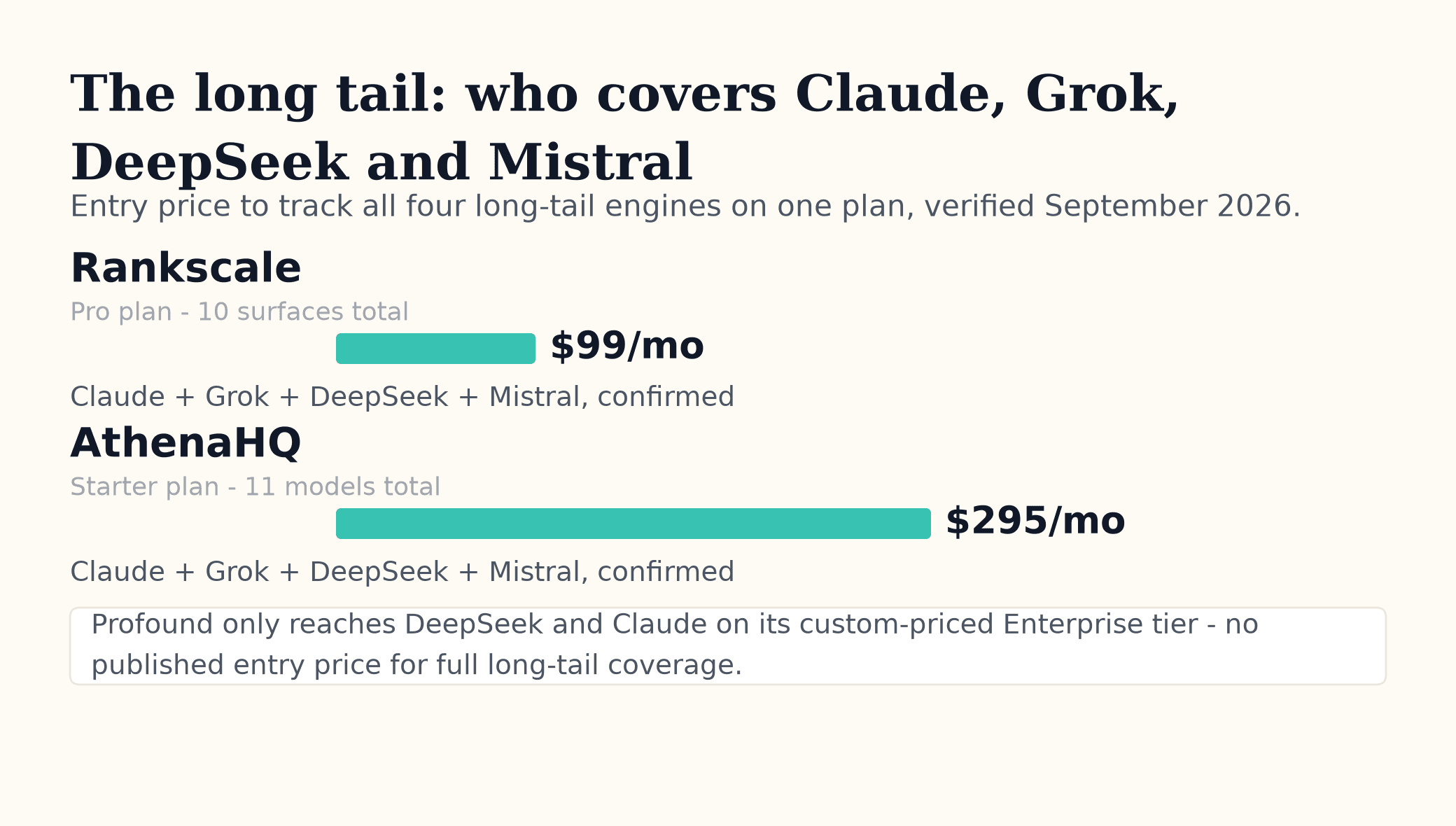
Reading the matrix. For ChatGPT visibility, coverage is table stakes - every subscription tracker here includes it at entry, so the real differentiator is collection method, not whether it's covered. For Google AI Overviews and AI Mode together on a buyable tier, Semrush AI Toolkit, SE Visible, Ahrefs Brand Radar, Rankscale and AthenaHQ track both; geotoolbox and Otterly cover AI Overviews at entry with AI Mode higher up. For Bing Copilot - the surface behind Microsoft's answers - Otterly, Ahrefs Brand Radar, Rankscale and AthenaHQ include it at entry; and because Copilot grounds its answers off the Bing index, keeping your site crawlable and indexed in Bing matters as much as which tracker you pick. For the long-tail engines - Claude, Grok, DeepSeek and Mistral - that separate broad trackers from the rest, Rankscale covers all four on its $99 Pro plan (ten surfaces), and AthenaHQ now matches that spread across eleven publicly named models on its $295 Starter tier - the two cheapest routes to the long tail by some distance - with Profound reaching DeepSeek and Claude only on enterprise. Because cross-engine agreement is low - 91% of cited URLs appear in only one engine, per the accuracy section - the engine column matters: strong visibility in ChatGPT does not carry over to Gemini or Perplexity, so track the engines that matter to you directly.
LLM SEO Tools: Tracking Is Half the Job
Search for LLM SEO tools and you'll get lists that mix three genuinely different product types. It's worth separating them, because "we do LLM SEO" can mean any of these:
Trackers measure LLM visibility directly - brand mentions, citations, sentiment - which is everything above. Content-side tools optimize what you publish so models want to cite it; Surfer, Frase, and Clearscope all added AI-citation layers to their content editors in the past year, and our roundup of the best content optimization tools covers that side. Technical tools deal with whether models can read you at all: crawler access, rendering, structured markup, and the still-debated llms.txt proposal.
Some platforms straddle categories - AthenaHQ and Writesonic bolt content generation onto tracking, Scrunch bolts delivery infrastructure onto it. That's not a flaw, but it explains the confusing pricing spread: you're often paying for a second product category you may not need. Decide which of the three jobs you're hiring LLM SEO tools for first, then compare within that lane.
How Accurate Are AI Visibility Tools, Really?
Here's the section every vendor list skips. The short answer: AI visibility scores are sampled estimates of a random process, and any tool that presents them as rankings is overselling.
The numbers are stark. SparkToro's research had 600 volunteers run 12 different prompts through each of 3 tools a combined 2,961 times across ChatGPT, Claude, and Google's AI: there was less than a 1-in-100 chance of getting the same brand list twice, and roughly 1-in-1,000 of getting the same order. Cross-engine agreement is just as thin - Kevin Indig's analysis of 3.7 million citations, with a 20,000-prompt random sample behind the headline figures, found 91% of cited URLs appear in exactly one engine, and only 2.37% in all three. Strong visibility in one engine transfers poorly to the others - measure each engine separately rather than trusting a blended score.
There's also a collection-method gap the sales demos don't mention. Tools gather answers via APIs, via browser sessions that mimic real users, or via hybrid sampling - and logged-in consumer ChatGPT does not answer like the API. Practitioners on Reddit keep rediscovering this: the tool says you're absent, a real signed-in session shows you present, or vice versa.
Ask any vendor two questions before buying: how do you collect answers, and how many runs per prompt make up one data point? A third worth adding: whether they capture multi-turn conversations or only the first answer, since real buyers ask follow-ups.
What to do with that:
- Track frequency, not position. "Mentioned in 62 of 100 runs" is a real metric; "ranked #3" is noise. SparkToro's own data shows mention frequency stays fairly stable even while individual lists scramble.
- Demand sample sizes. A starter plan sampling 10-25 prompts weekly, once per prompt, is a coin-flip detector. For trend reliability, more runs of fewer prompts usually beats one run of many.
- Watch trends across weeks, not day-to-day wobble.
The cost side deserves the same normalization. Entry prices run from $20 to $295 a month, but the prompt allowances behind them spread just as wide (all prices checked September 2026):
| Tool | Entry price/mo | Prompts included | $ per prompt/mo | Engines at entry |
|---|---|---|---|---|
| Rankscale | €20 | varies by plan | - | 10 |
| Otterly.ai | $29 | 15 prompts (Lite) | ~$1.93 | 4 |
| Peec AI | €85 | 50 prompts | ~€1.70 | base set |
| Profound | No self-serve brand tier | 50/day, free trial only | n/a (free) | 3 on trial |
| Semrush (standalone toolkit) | $99 | 25 prompts (Base) | ~$3.96 | 5 |
| AthenaHQ | $295 | credit-based | - | 11 |
| geotoolbox | $79 (annual) | 50 prompts/brand | ~$1.58 | 3 |
Ahrefs Brand Radar is omitted from this table because its AI Visibility Index is corpus-based rather than prompt-metered, so it doesn't reduce to a comparable per-prompt figure. Semrush's bundled SEO + AI Search plans have the same problem, but its standalone AI Visibility toolkit (above) is metered by the prompt, so it's included.
Read the per-prompt column against the engine column: Profound no longer has a paid self-serve brand tier to compare - only a free trial; Peec's 1.70 euros buys three of your choosing. Per-prompt cost only means something multiplied by engines covered and refresh frequency - which is exactly the math vendors' pricing pages make hard.
How to Choose (by Team, Budget, and Stage)
The verdicts, plainly:
Solo operators and SMBs: Rankscale (€20, shown as $20 outside the euro zone — the same number either way) if you need engine breadth, Otterly ($29) if you want the most proven budget tracker for brand mentions, geotoolbox Starter ($79 annual, after a 7-day free trial) if you want reachability checks and AI-traffic analytics in the same bill. All three cost less per month than one hour of consulting.
Agencies: the deciding features are seats and client workspaces, not engines. AthenaHQ's unlimited seats, Peec's project structure, and Profound's agency mode are the three built for this. Add per-client costs carefully - seat and brand-workspace ceilings multiply fast across a book of clients.
Enterprise: Profound and Scrunch for depth and compliance, Ahrefs Brand Radar for demand-weighted benchmarking, Semrush-Adobe if procurement already loves the suite. This is also where doing it in-house stops being crazy - see our breakdown of GEO services vs software for when to buy tooling versus hire the job out, and the best AI SEO agencies guide if you decide to hire.
Whatever the segment, run the same three TCO checks before signing: (1) which engines are add-ons rather than included, (2) where the prompt or credit wall sits and what the next tier costs, and (3) how often data refreshes - weekly refresh at a daily-refresh price is a quiet 7x difference in data volume.
What AI Visibility Tools Cannot Do
No tracker, at any price, can guarantee you a mention, edit what a model already learned, or make sampled measurements behave like deterministic rankings. The same prompt can produce different answers for different users in the same hour. Anyone selling certainty in this category is selling past what the technology does.
What tracking buys you is a map of absence: which prompts you're missing from, who gets cited instead, and which sources feed those citations. Acting on the map is a separate job - publishing citable content, earning brand mentions on the pages engines pull from, and keeping your site technically readable to crawlers. We walk through that loop in how to track AI visibility, and how to turn the raw counts into a comparable metric in our AI visibility score guide.
Buy the dashboard for the map. Budget separately for the fixing.
Frequently Asked Questions
What is the best AI visibility tool?
There is no single best - and any list that says otherwise is usually ranking its own product, which is why we list ours last (we build geotoolbox). The short version: match the tool to your segment and budget, then run the three TCO checks from the how-to-choose section before signing anything.
How much do AI visibility tools cost in 2026?
Free one-shot graders at $0; real monitoring starts low (Rankscale at €20, Otterly at $29, geotoolbox at $79 annual); mid-market runs roughly $85-295 (Peec's 85-euro entry, Scrunch, AthenaHQ). Semrush prices AI visibility either standalone ($99/month per domain) or bundled into its SEO + AI Search plans, Ahrefs includes Custom Prompts free in every plan from Lite up with its AI Visibility Index priced separately, and custom Profound tiers price by quote. Verified against vendor pricing pages, September 2026.
Are there free AI visibility tools?
Yes, three kinds: one-shot graders (HubSpot AI Search Grader, Semrush AI Visibility Checker, Mangools AI Search Grader), free tiers or trials of paid tools (geotoolbox's 7-day trial, AthenaHQ's free Essential tier, Ahrefs' Custom Prompts on any plan from Lite up), and DIY - a GA4 referral filter catches traffic clicking through from ChatGPT and Perplexity, and costs nothing.
How do you evaluate an AI visibility tracking platform?
Score every tool on five things, in this order. (1) Engine coverage at the tier you'll actually buy - not the enterprise sticker; the coverage matrix above shows where the entry-tier lines fall. (2) Collection method - API, logged-in browser session, or hybrid - because logged-in consumer ChatGPT answers differently from the API, so a tool that only hits the API can report you absent when a real session shows you present. (3) Runs per prompt, since one run per prompt is a coin-flip, not a measurement. (4) Reachability - whether it checks that AI crawlers can fetch your site at all, or only tracks mentions. (5) True cost - per prompt × engines covered × refresh frequency, not the headline price. A platform that wins on sticker price but samples once a week at entry may be too noisy for reliable trend detection; weigh it against the accuracy and how-to-choose sections before you commit.
Where to Start
Not with a subscription. Run the free checks first: confirm AI crawlers can reach your site, then grab a one-shot visibility snapshot to see where you stand. Ten minutes, zero dollars, and you'll know whether your problem is reachability, visibility, or neither.
If the snapshot shows gaps worth tracking, pick the tier that matches how you'll act on the data - and if you want the reachability check, the tracking, and the AI-traffic analytics in one place, that's the exact gap we built geotoolbox to fill. Start with the free AI readiness check and see what the engines see.
Sources
- SparkToro: "AIs are highly inconsistent when recommending brands or products" - Rand Fishkin, January 2026 -
sparktoro.com/blog/new-research-ais-are-highly-inconsistent-when-recommending-brands-or-products-marketers-should-take-care-when-tracking-ai-visibility - Growth Memo: "The Consensus Gap" - Kevin Indig, May 2026 -
growth-memo.com/p/the-consensus-gap - TechCrunch: "ChatGPT reaches 900M weekly active users" - February 2026 -
techcrunch.com/2026/02/27/chatgpt-reaches-900m-weekly-active-users - Google Search Central: "Introducing Search Generative AI performance reports in Search Console" - June 2026 -
developers.google.com/search/blog/2026/06/gen-ai-performance-reports - Digiday: "Marketers question expensive AI visibility tools as inconsistent results fuel skepticism" - May 2026 -
digiday.com/marketing/marketers-question-expensive-ai-visibility-tools-as-inconsistent-results-fuel-skepticism - Adobe newsroom: "Adobe completes Semrush acquisition" - April 2026 -
news.adobe.com/news/2026/04/adobe-completes-semrush-acquisition - TechCrunch: "Peec AI raises $21M Series A" - November 2025 -
techcrunch.com/2025/11/17/as-consumers-ditch-google-for-chatgpt-peec-ai-raises-21m-to-help-brands-adapt - Sitecore newsroom: "Sitecore acquires Scrunch" - June 2026 -
sitecore.com/company/newsroom/press-releases/2026/06/sitecore-acquires-scrunch-to-help-brands-influence-discovery--and-buying-decisions
Every source above is also hyperlinked inline where its claim appears in the article. Tool pricing and engine coverage were verified against each vendor's live pricing page in September 2026.