
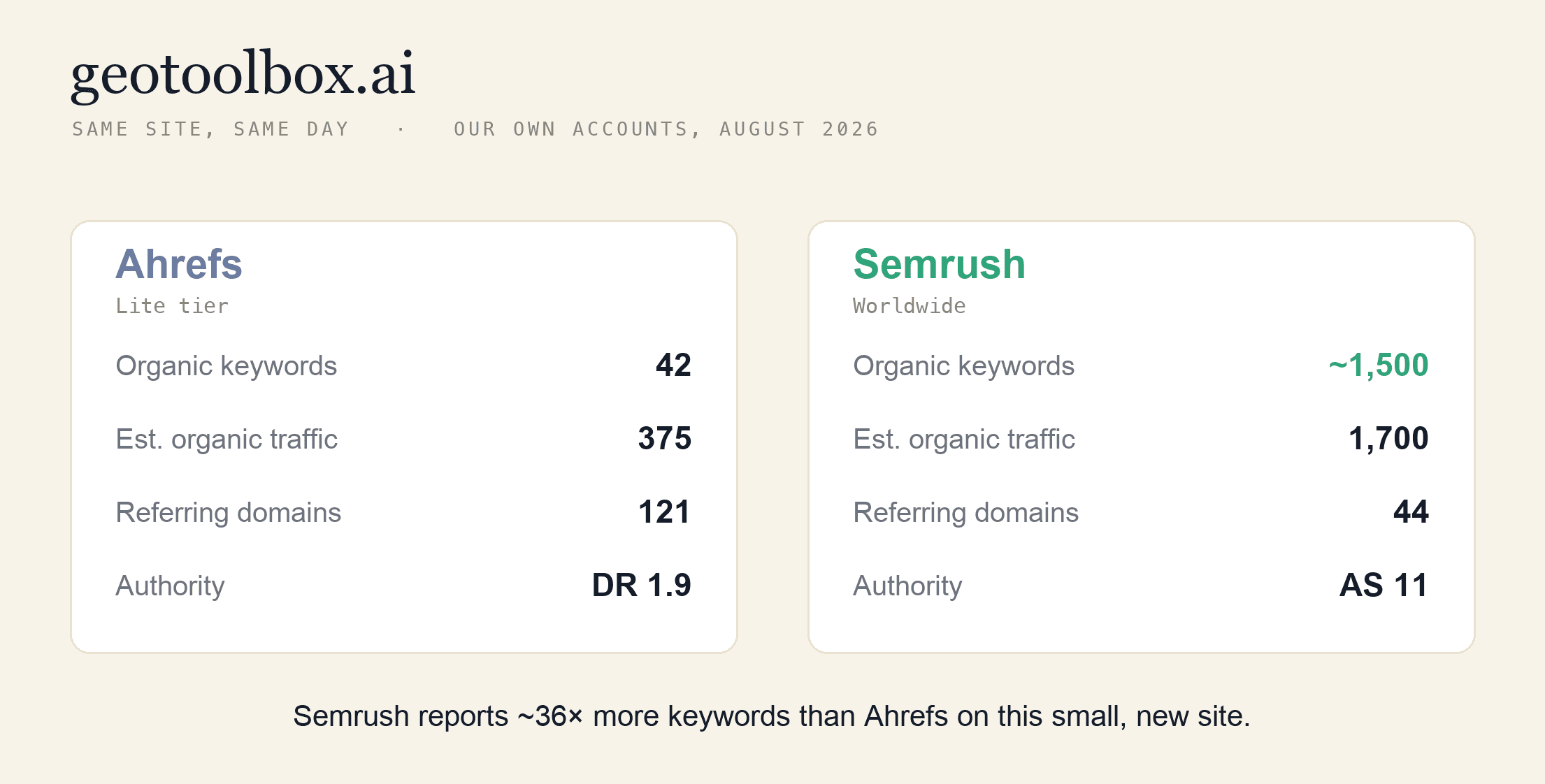
Most Semrush vs Ahrefs comparisons hand you a feature checklist and a winner. This one starts with a problem you have probably seen yourself: point both tools at the same website on the same day and the numbers don't match. Not by a little. On one of our sites, Ahrefs reports 42 organic keywords and Semrush reports about 1,500.
So we ran the test on real sites. Both tools, on three sites we manage, first in July 2026 and again on August 1, cross-checked against the one source that isn't an estimate: Google Search Console. Running it twice tells you how stable each tool's numbers are; the Search Console check tells you which of them ran closer to reality.
Semrush vs Ahrefs: The Short Answer
Semrush is the all-in-one marketing platform of the two — SEO, AI visibility, paid search, content, local, and social in one account — and the better default for most buyers. Ahrefs is the focused specialist's tool, built around backlinks and organic research. If your work spans channels, or you run an agency, a marketing team, or a young site you want to watch grow, pick Semrush; it also reported far more ranking keywords on every site we tested, though broader coverage is not better accuracy. Pick Ahrefs if you are the SEO specialist in the room, the person whose whole job is links, rankings, and site audits, and you value a cleaner interface and more conservative numbers over breadth. If Semrush is where you land, the 7-day free trial is enough time to run every test in this article on your own site.
A couple of things hold no matter which you choose. First, the tools will disagree, often dramatically, because they track different keyword databases, SERPs, and traffic models. Second, neither number is the truth. For your own Google traffic, Google Search Console is the closest thing to ground truth, and both tools are best treated as competitive-intelligence estimates, not measurement. The rest of this article shows how far apart they run on our own sites.
We Ran Both Tools on the Same Three Sites
We pulled fresh numbers from our own paid Ahrefs and Semrush accounts for three sites we manage: geotoolbox.ai (our own small, new AI-visibility tool) plus two client sites we have kept anonymous — an established, mid-size manufacturer and a large marketplace. Same domains, same day, first in mid-July 2026 and again on August 1. Here is what each tool said about organic keywords on the August pull.
How we pulled this, so you can weigh it. Three sites is an illustration, not a study. Ahrefs figures are all-locations (our account is on the Lite tier, but plan tier limits row exports, not the headline counts, which come from the dashboard overview). Semrush's keyword figures use its worldwide database for geotoolbox and its US database for the two US-focused sites (the page counts below are Ahrefs all-locations against Semrush's US database). That scope is not perfectly matched, so treat the exact multipliers below as rough direction. The direction is what holds up.
Update, September 2026
geotoolbox.ai has kept growing since this test. As of mid-September, Ahrefs reports 194 organic keywords (about 4.6x the July figure) and Semrush reports roughly 5,300 (up from ~1,500) - the same widening-gap pattern, now at a larger scale. Actual Google Search Console clicks have grown from 382 a month to roughly 3,700. The twist: it's now Ahrefs's traffic estimate that lands almost exactly on that real number, while Semrush's estimate has slipped below it - a reminder that which tool reads closer to reality isn't fixed, it can flip as a site matures. The rest of this article, including the twelve-day test below, reflects the original July-August 2026 pull; we're leaving those numbers as the worked example and noting the update here rather than rewriting the methodology around a moving target.
| Site | Size | Ahrefs organic keywords | Semrush organic keywords | Semrush ÷ Ahrefs |
|---|---|---|---|---|
| geotoolbox.ai | Small / new | 42 | ~1,500 | ~36x |
| Client A — manufacturer | Mid-size | 374 | ~2,000 | ~5.3x |
| Client B — marketplace | Large | 26,600 | 76,000 | ~2.9x |
One thing holds across all three: Semrush reports more keywords on every site, even on the two where it was restricted to a single US database. The size of the gap is where we are more cautious. In our sample it was widest on the smallest site (about 36 times) and narrower on the large one (about three times), which fits the idea that Semrush's database catalogs more of the long-tail and low-volume terms a young site picks up first. But that gradient rests on three points, and Semrush ran worldwide on the smallest site while restricted to the US on the two larger ones — a scope difference that happens to track site size — so test it on your own accounts before you rely on it.
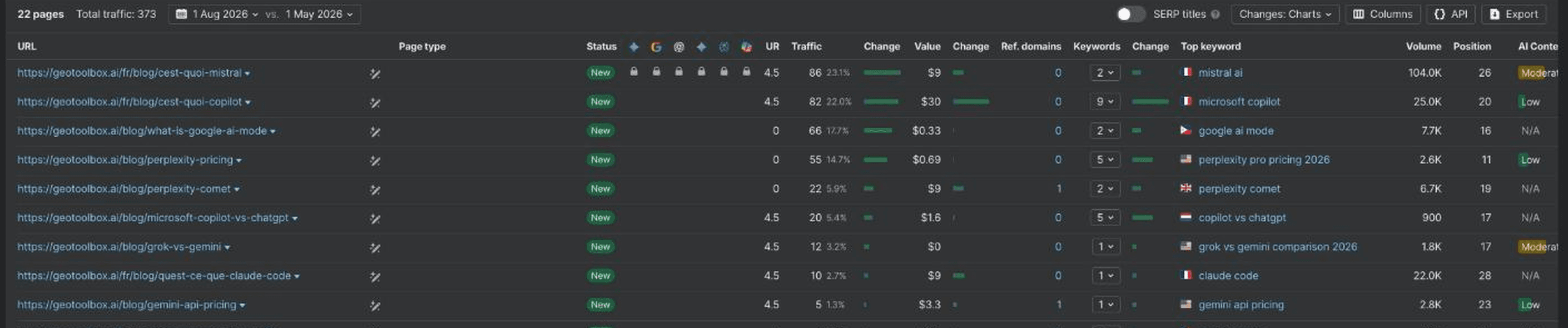
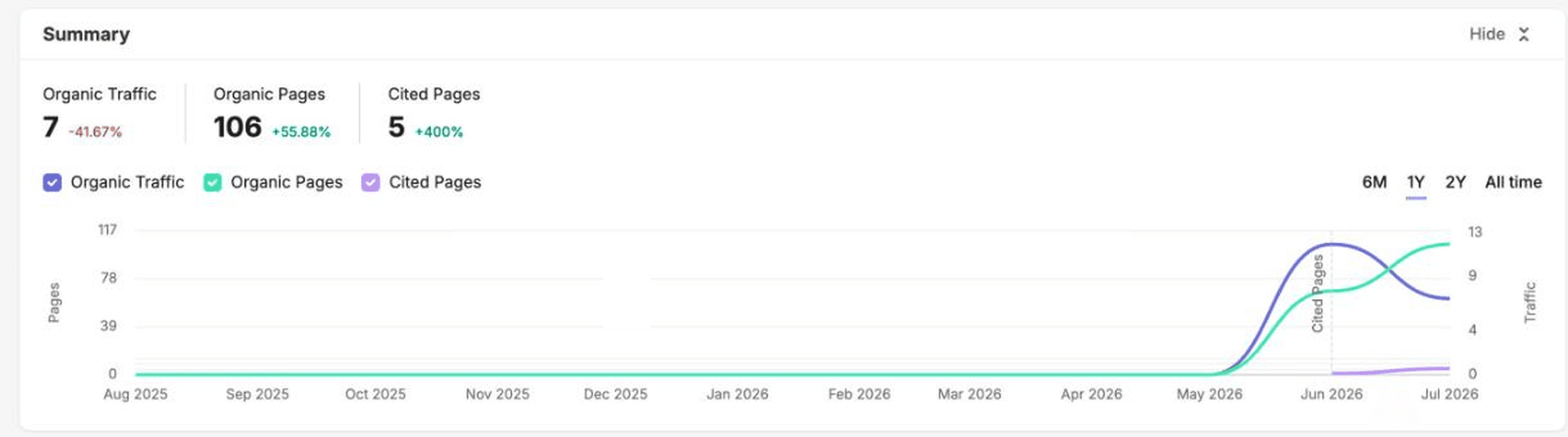
The same pattern shows up in pages, with a caveat worth stating plainly because geotoolbox.ai publishes in both English and French. Ahrefs's all-locations report surfaces 22 ranking pages; Semrush's US database shows 106 (its US index does not see the site's French pages at all); and Google Search Console had around 225 URLs indexed in July — a count spanning every English and French blog post, glossary entry, and feature page the site published at the time, not 225 articles. These are not the same measurement — ranking pages in one geographic scope versus Google's full multilingual index — so read them as three differently-framed slices of one site, not a clean ratio. What they agree on is the part that matters: no third-party tool sees the whole footprint, and Search Console comes closest to the full picture.
The reason is structural: each tool tracks a different universe of keywords, countries, and SERPs, on different refresh schedules and with different thresholds for what counts as a ranking keyword. A keyword count is database coverage, not verified visibility, accurate live positions, or traffic. Which raises the obvious question.
The Same Test, Twelve Days Later: How Each Tool's Numbers Move
Over twelve days, Semrush added roughly 400 keywords (+36%) and 14 ranking pages for our test site while Ahrefs added seven keywords (+20%) and two pages — and Ahrefs sharply revised its traffic estimate downward. A single same-day snapshot hides that kind of movement, so we kept both accounts pointed at geotoolbox.ai and re-pulled everything on August 1. (The client sites moved too, but a young site is where the difference between the two tools is most visible, so that is the one under the microscope.)
| geotoolbox.ai | Ahrefs (Jul 20) | Ahrefs (Aug 1) | Semrush (Jul 20) | Semrush (Aug 1) |
|---|---|---|---|---|
| Organic keywords | 35 | 42 | ~1,100 | ~1,500 |
| Ranking pages | 20 | 22 | 92 | 106 |
| Authority score | DR 1.7 | DR 1.9 | AS 7 | AS 11 |
| Referring domains | 64 | 121 | 27 | 44 |
| Est. organic traffic | ~1,500 | 375 | ~1,000 | 1,700 |
Both tools grew their picture of the site over the window; what differs is resolution. Semrush's catalog registered the site's recent publishing as hundreds of new keyword entries and a visible Authority Score move from 7 to 11, while Ahrefs's stricter thresholds recorded the same period as a handful of keywords. (DR and AS are separate proprietary scales that don't convert, so read each tool's movement only against itself.) If you publish weekly and want the dashboard to reflect that work while it is happening, Semrush is the one that shows it.
Ahrefs has two answers of its own, though. Its backlink crawler was the faster mover, going from 64 to 121 referring domains for the site against Semrush's 27 to 44, exactly what you would expect from the stronger link index. And its traffic estimate dropped from about 1,500 to 375, which looks erratic in isolation; hold that thought, because the next section, where both tools meet Search Console, is where it resolves.
On this site, over this window, the trade reads: Semrush shows you the progress first; Ahrefs waits for proof, then corrects hard. One site is not a pattern, but it is the behavior to watch for. For a new site owner deciding whether the content plan is working, the tool that registers movement is the more useful weekly companion, as long as you keep treating the traffic number as a model, not a meter.
Coverage Isn't Accuracy: What Google Search Console Showed
The extra keywords Semrush reports could be real reach or pure noise. To find out which, we pulled the actual clicks Google Search Console recorded for each site over the same 30-day window. GSC counts the real Google organic clicks your site received, not visits from every channel, which makes it the best first-party benchmark for exactly the thing the tools are trying to estimate.
| Site | Ahrefs estimated traffic | Semrush estimated traffic | GSC actual clicks (30 days) |
|---|---|---|---|
| geotoolbox.ai | 375 | ~1,700 | 382 |
| Client A — manufacturer | 2,700 | 5,100 | 3,703 |
| Client B — marketplace | 316,000 | 397,300 | 83,499 |
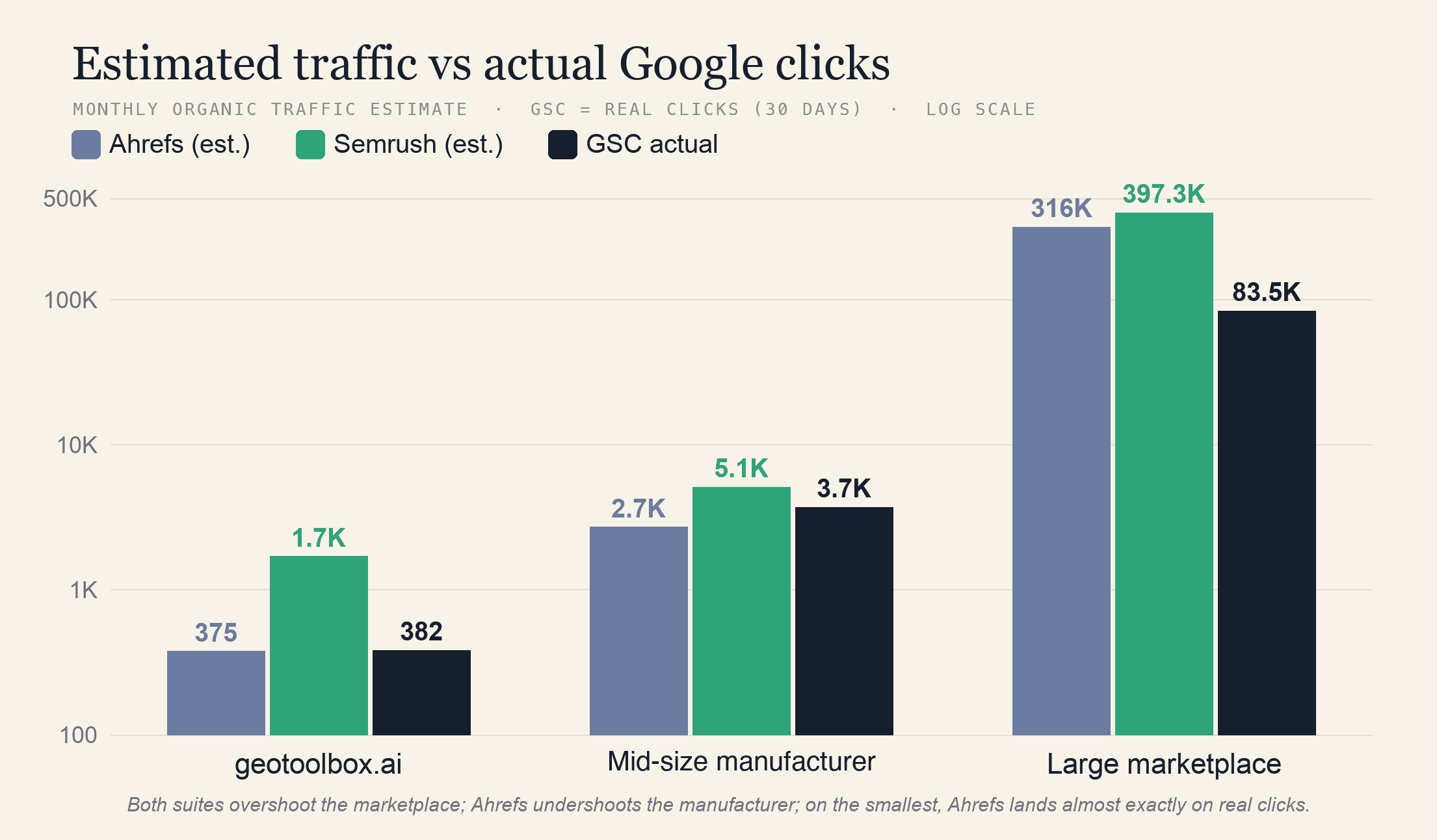
The gaps are large. Note that these tool estimates are modeled monthly organic traffic while GSC is actual clicks over 30 days, so the two are not a perfect like-for-like; the point is the size of the gap, not a precise error rate. On the large site both tools ran 3.8 and 4.8 times over Google's 83,499 clicks: Ahrefs estimated 316,000 and Semrush 397,300. The mid-size manufacturer split them, with Ahrefs undershooting (2,700 vs 3,703 real) while Semrush ran high at 5,100. And the smallest site is where the August re-pull got interesting: Ahrefs, which had estimated around 1,500 in July, revised down to 375 — within a handful of clicks of the real 382 — while Semrush's 1,700 estimate sat about 4.5 times above reality. Semrush read higher than Ahrefs on all three sites, and Ahrefs ran closer to Search Console on all three — dramatically so on the smallest — at the cost of that big mid-July swing.
None of that makes either tool bad. It makes their "organic traffic" a modeled estimate, not a click counter. It also matches the most-cited public test on the question: a 2022 study in which Ahrefs checked its own US organic traffic estimates against Google Search Console on 1,635 websites and found a median deviation of 49.52% for Ahrefs and 68.36% for Semrush. One caveat, since we are the Semrush affiliate: Ahrefs ran and published that study, so read it as an interested party's finding, not a neutral referee. Its direction still lines up with what we saw — Semrush read higher on all three of our sites, and in that 2022 sample its estimates deviated more — and with what practitioners repeat constantly: the estimates are useful for spotting trends and comparing competitors, never for reporting your own traffic. For that, open Search Console.
The gap has a narrow practical use. Your own site's ratio of real Search Console clicks to a tool's estimate can roughly sanity-check that tool's number for a competitor, but only a competitor of similar size and market. Emphasis on rough: our three test sites show the error swinging from a near-exact match to nearly a five-times overshoot, so a ratio borrowed from one site will not transfer cleanly to a site of a different size or age. It is a gut check at best.
Keyword Research: Database Breadth vs Click Realism
The personality split shows up hardest here. Semrush's Keyword Magic Tool is built for breadth. It returns huge lists grouped into topic clusters with search intent attached, plus a Personal Keyword Difficulty score tuned to your domain. If your job is to find every angle on a topic and map coverage, Semrush surfaces more to work with, the breadth behind the larger keyword counts we saw.
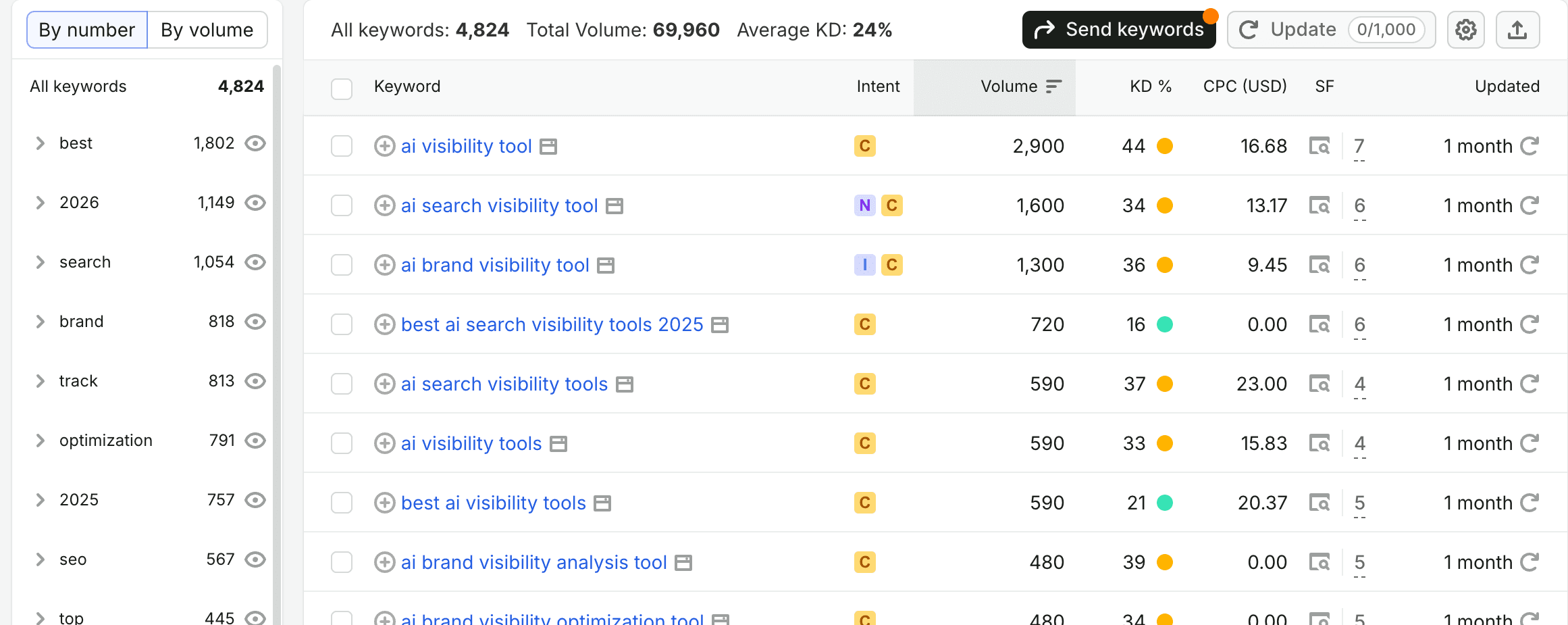
Ahrefs Keywords Explorer is built for realism. Its signature metric is Traffic Potential: Ahrefs's estimate of the monthly organic traffic the current top-ranking page for a term gets from every keyword it ranks for, not just the head keyword's volume. It also reports a Clicks metric, its estimate of the average monthly search-result clicks a keyword generates, which accounts for zero-click searches as well as searches that produce several clicks. On a query where an AI Overview or featured snippet eats most of the clicks, that distinction is the difference between chasing a keyword and skipping it.
The database-size debate is mostly noise. Comparison articles quote keyword-database figures for the same tool that differ severalfold depending on who is writing, which tells you these numbers are unreliable marketing counts, not audited facts. Both tools index tens of billions of keywords; that is plenty. What differs is philosophy: Semrush is usually described as the more expansive, higher-volume counter and Ahrefs as the lower, more conservative one, which is the shape our own three-site test showed. Both approaches are defensible, and the AI answers you see today increasingly repeat both sets of figures as if they were settled, which they are not.
Verdict: Semrush for breadth and content planning, Ahrefs for judging whether a keyword will actually send clicks.
Backlinks: Where Ahrefs Still Earns Its Reputation
Ahrefs built its name on backlinks, and it is still the default for link work, but the "bigger index" story has flipped on paper. By each vendor's own self-reported (and take-with-salt) count, Semrush now advertises the larger raw number — around 43 trillion links, against the external-backlinks history Ahrefs publishes on its own big-data page — though the two are counted under different definitions, so treat both as marketing figures. In a third-party ten-domain test, Style Factory found Semrush reported more referring domains on nine of them, including Amazon (4.4 million vs Ahrefs's 2.2 million).
Then look at our own smallest site and it flips the other way. For geotoolbox.ai, Ahrefs finds 121 referring domains and Semrush finds 44, and over our two-pull window Ahrefs picked up the site's new links faster (the movement table above has the exact deltas). Same site, and the tool with the "smaller" index found nearly three times as many referring domains. The counts disagree in both directions, and raw index size tells you very little.
Practitioners often reach for a neutral yardstick here: Cloudflare Radar's bot directory, which ranks crawlers by the traffic Cloudflare actually observes across its network. When we checked on August 7, 2026, AhrefsBot was the highest-placed SEO crawler on the list at number 13 overall by traffic volume, one place ahead of Semrush's backlink crawler, SemrushBotBacklinks, at 14. It is a snapshot, and the order moves.
What separates them is quality and history. Ahrefs refreshes its link index constantly and keeps years of historical data, and its crawler has long been the practitioner favorite for link audits, disavow work, and finding a competitor's best links. A huge index full of dead or spammy links is worse than a smaller, cleaner one. If backlinks are the core of your work, Ahrefs remains the safer default, and our best link building platforms guide covers the outreach tools that sit on top of whichever index you use. If you want backlinks as one part of a wider suite, Semrush's data is now genuinely competitive on volume.
Everything Else: Audits, Rank Tracking, PPC, Local, Content
Outside keywords and links, the split is simpler: Semrush does more things, Ahrefs does fewer things with a cleaner interface. This is the all-in-one platform versus focused specialist trade-off, and it decides most purchases.
| Job | Ahrefs | Semrush | Edge |
|---|---|---|---|
| Site audit | Clean, solid technical crawl | Broader issue coverage and guided fixes, in our use | Semrush |
| Rank tracking | Google, desktop and mobile; weekly by default on lower tiers | Daily updates; Google, Bing, and more | Semrush |
| Paid search / PPC | Basic ad data | Full PPC, ad history, keyword gap | Semrush |
| Local SEO | Not a focus | Listings, review, map-pack tools (add-on) | Semrush |
| Content tools | Basic AI writing helpers | SEO Writing Assistant, content templates | Semrush |
| Ease of use | Cleaner, faster to learn | Powerful but a steeper curve | Ahrefs |
The table reads as a Semrush sweep, and on feature count it is one. But breadth has a cost: Semrush's local, agency, and AI features are often paid add-ons on top of the base plan, and the interface carries the weight of doing everything. Ahrefs does less on purpose, and people who live in it every day tend to prefer that focus. If your work is genuinely just organic search and links, you are paying for modules you will never open. Bing rank tracking is one concrete example: Semrush documents it and Ahrefs Rank Tracker does not, which our Bing rank tracker comparison checks tool by tool.
One ownership change is worth knowing before you commit. Semrush is now an Adobe company: Adobe completed its acquisition on April 28, 2026, and says it will fold Semrush's data into its enterprise marketing stack. If your team already runs on Adobe, that direction is a genuine plus for the all-in-one case. Some practitioners in SEO forums went the other way after the announcement, renewing with Ahrefs — now the only independent of the two — on pricing-and-roadmap wariness under new ownership. Neither reaction changes what the tools measure today, but it is part of the 2026 buying picture.
AI Search Visibility: Where Semrush Pulled Ahead in 2026
This is a big reason Semrush now wins the "which one platform" question on integration and entry price for anyone whose audience is moving into AI answers. With a growing share of searches ending inside an AI answer instead of a blue link, whether you show up when ChatGPT, Gemini, or Google's AI Mode answers a question in your market is no longer a bonus metric. Both tools track it. They do not do it the same way.
Semrush's answer is the AI Visibility Toolkit, and it is the better-packaged, better-integrated of the two. It scores your brand with an AI Visibility Score (a 0–100 benchmark of how often AI answers mention you versus the median of your top competitors) and a Share of Voice percentage, across ChatGPT, Google AI Mode, Google AI Overviews, Gemini, and Perplexity, per Semrush's plan documentation. Prompt Research surfaces the prompts worth owning and who competes on them; a cited-sources breakdown shows which pages the engines actually pull from; daily Prompt Tracking follows 25 custom prompts so you can benchmark competitors and watch shifts over time; and since Semrush's 2026 repositioning the toolkit has grown into a full AI Visibility section of the app, with brand-performance, perception, and brand-sentiment reports alongside the tracking. If you already run a Semrush SEO plan, that AI layer is a separate purchase (pricing below); Semrush One is the name for the three bundles that sit above the standalone SEO plan — Starter, Pro+ and Advanced — and each folds the AI layer in rather than charging for it separately. Either way it sits in the same account as your keyword, backlink, and content data, which is the unified AI-plus-SEO pitch.
Ahrefs answers with Brand Radar, and on raw engine coverage it is actually the wider of the two: it indexes the same ChatGPT / AI Overviews / AI Mode / Gemini / Perplexity set plus Microsoft Copilot (and free-while-in-beta discovery surfaces YouTube, TikTok, and Reddit), backed by a prompt index Ahrefs puts at over 456 million monthly prompts as of September 2026, with its own competitor benchmarking and custom prompt tracking. That width comes with two asterisks: Grok is not on the current Brand Radar product page (Ahrefs's help documentation still lists its index as paused), and Claude is available for custom prompts only, not as one of the six fully indexed platforms — it also burns extra checks per query. Where Brand Radar loses is packaging and price.
| AI-visibility feature | Semrush AI Visibility Toolkit | Ahrefs Brand Radar |
|---|---|---|
| Engines tracked | ChatGPT, Google AI Mode + AI Overviews, Gemini, Perplexity | Same set plus Copilot, Grok (index currently paused), and Claude (and discovery surfaces like TikTok) |
| Brand score | AI Visibility Score (0–100) + Share of Voice | Mentions and share metrics |
| Prompt tracking | Daily, 25 custom prompts on the base AI-toolkit tier | Daily or monthly, quota depends on package |
| Competitor benchmarking | Yes, plus brand sentiment | Yes |
| Cited-source breakdown | Yes | Yes |
| Cost to actually use it | $99/mo per domain (same price monthly or annually), or bundled into the Semrush One tiers (Starter, Pro+, Advanced) | Small daily prompt quota now bundled into every Ahrefs plan from Lite up; custom prompt tracking in packages from $50/mo (then $100 and $250/mo), or the AI Visibility Index from $199/mo per platform — $699/mo for every platform |
Two caveats before you read that table as a clean Semrush sweep. First, the AI Visibility Toolkit is sold separately — it is not folded into Pro, Guru, or Business, so it is a real line on the bill; where it wins is packaging and the entry price for the full visibility suite, not broader engine coverage. Note the units differ, too: Semrush's $99 is per domain and multiplies across a client roster, while Ahrefs's Brand Radar runs $50/mo for its entry custom-prompt package (rising through $100 and $250/mo) and prices its AI Visibility Index per platform from $199/mo, or $699/mo for every platform, so a multi-brand agency should run its own math. Second, both tools model AI visibility with simulated prompts rather than watching real user sessions, so treat their scores the way you treat their traffic estimates: excellent for your own trend line and for comparing competitors, not a literal count of every time a human saw your name. (One small asterisk from our own account: the toolkit's Distribution by LLM panel showed data for four of the five documented engines — Perplexity had nothing for our domain yet.)
We also ran this layer on a site we own. Point both tools at the same brand and they surface AI citations a Google-clicks report never registers. geotoolbox.ai earns around 380 Google clicks a month after roughly two and a half months of publishing — still a tiny number — yet both tools flag it turning up in AI answers.
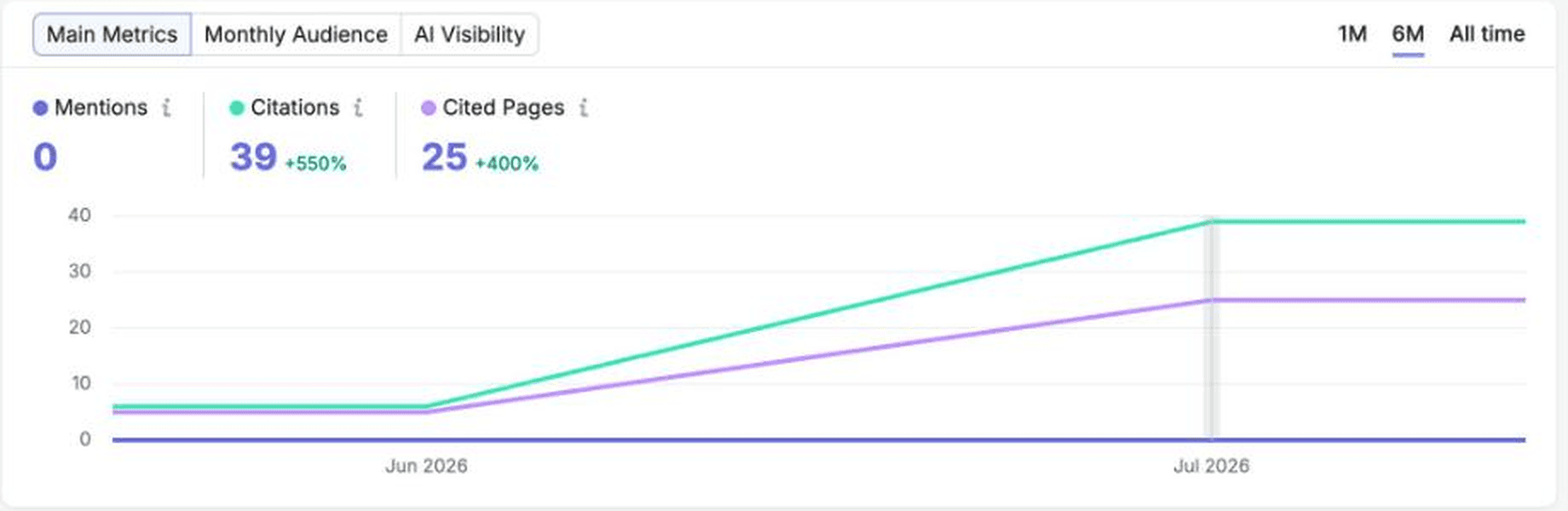
The counts, as of August 1: Ahrefs logged 95 ChatGPT responses across 15 of its pages, up from 29 across 9 in July. Semrush's AI Visibility Toolkit logged 39 citations across 25 cited pages, up from 31 across 19. Ahrefs's Site Explorer overview also now carries a free per-platform AI index, a genuinely useful addition that showed 108 Copilot and 64 Perplexity responses for the same site. Those are different units and don't compare head-to-head, but together they make the point concrete: for an AI-first brand, keyword count is a progress signal, while whether engines actually cite you is a separate question that AI-visibility tools are built to measure.
Then we pulled the same site's first-party data from Bing Webmaster Tools, whose AI Performance report logs citations made inside Microsoft's Copilot ecosystem. It counted 15,300 citations across an average of 24 cited pages in three months — orders of magnitude above the 95 responses and 39 citations the two suites logged. Bing calls its own figure a sample, and it covers a different engine, period, and unit than the suites' simulated prompts, so this is not a scoreboard. What it shows is scope: the suites sample a fixed prompt set across their engine panels (Ahrefs's includes Copilot, but samples it), while Bing logs live citations inside its own ecosystem. No single source sees everything.
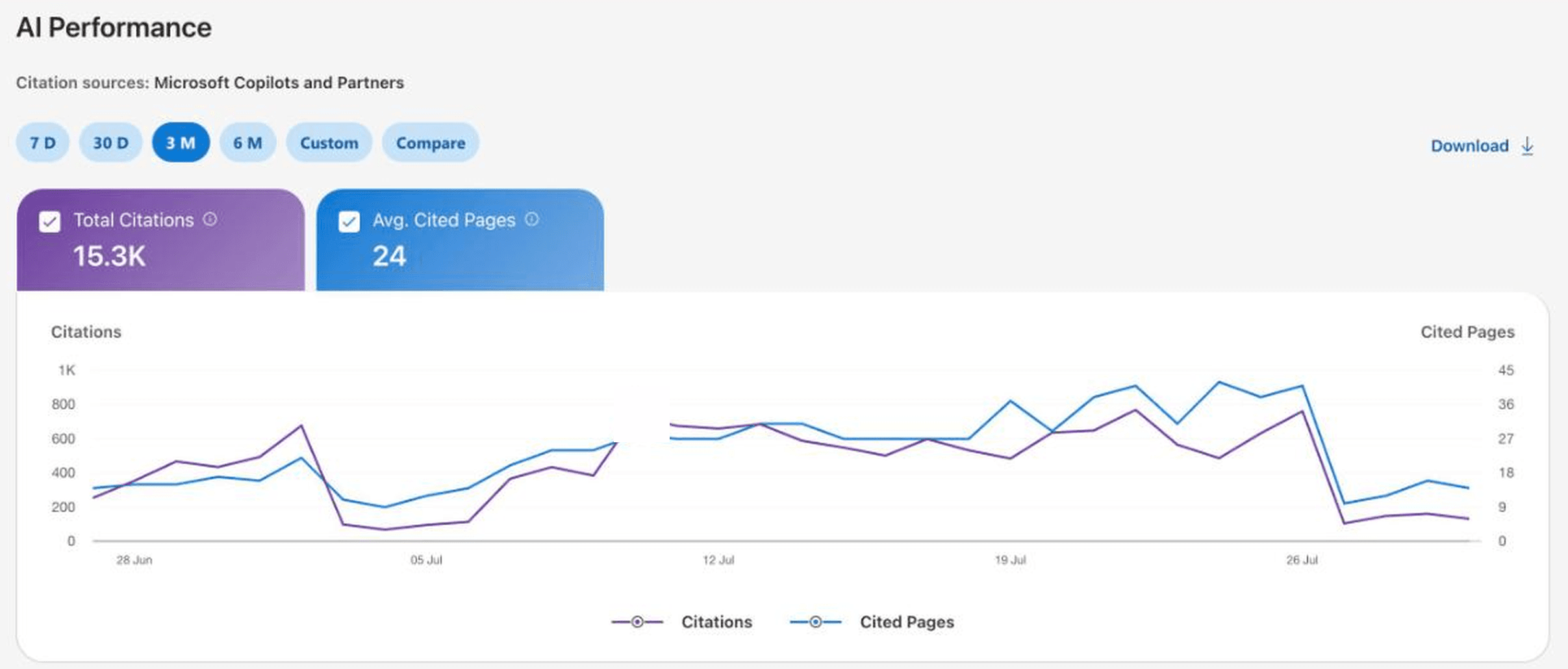
So the workflow is the one this article keeps arriving at: lean on the suites (Semrush's toolkit or Ahrefs's) to track your trend and watch competitors, and cross-check against the first-party data the platforms now report. The AI Performance report in Bing Webmaster Tools counts citations in Copilot, AI-generated summaries in Bing and select partner AI integrations. The generative AI performance report in Google Search Console counts impressions in AI Overviews and AI Mode, and reached all websites worldwide as of August 31, 2026. Add an independent cross-engine read, and remember that citations and impressions are different units and each source is its own partial slice. To go deeper on the AI side specifically, we cover how to read AI share of voice, why engines fan one prompt into dozens of sub-questions (exactly why wide keyword coverage still helps here), and how the dedicated AI visibility tools stack up.
Pricing: What You'll Actually Pay in 2026
Sticker prices are close at every tier. The real difference is what sits on top: Ahrefs's cheaper plans meter usage with credits, while Semrush charges add-ons for extra users, local, and AI visibility. Here are the core plans, verified against each vendor's pricing page in August 2026. Confirm current numbers before you buy, since both change often.
| Tier | Ahrefs | Semrush (SEO) |
|---|---|---|
| Cheapest full plan | Lite, $129/mo (limited Starter from $29) | Pro (now sold as "SEO"), $139/mo |
| Mid | Standard, $249/mo | Guru, $249.95/mo (off public pricing, see below) |
| High | Advanced, $449/mo | Business, $499.95/mo (off public pricing, see below) |
| Free / trial | Ahrefs Free, formerly Ahrefs Webmaster Tools (own verified sites); no time-boxed trial | 7-day free trial + limited free account |
A few things the table hides. Semrush's public pricing page — now titled "SEO & AI Search Plans and Pricing" — shows only an entry "SEO" plan (the classic Pro renamed, and repriced from $139.95 to $139) next to its One bundles; Guru and Business no longer appear on public pricing and persist in the docs and for existing subscribers. Our full Semrush review breaks down what that changes. Ahrefs's entry Lite plan is affordable but credit-metered (1,000 credits per user), and those credits burn fast in a deep research session, while its higher tiers move to unlimited credits but keep other export and project limits. Semrush's headline price is the base; extra seats are a paid add-on, and its AI Visibility Toolkit is a separate line item at $99/mo per domain, the same price on either billing term, or bundled into the Semrush One tiers (Starter, Pro+ and Advanced), which now sit beside the standalone SEO plan in place of the old Pro/Guru/Business ladder, so an agency's real bill climbs above the sticker. Both suites discount annual billing (Semrush by up to about 17%). And Ahrefs offers no classic time-boxed free trial (its free access is Ahrefs Free, the renamed Webmaster Tools, for sites you own), which matters if you want to test before committing.
If Semrush's breadth is the fit and you want to run this same three-site test on your own accounts, its SEO Toolkit starts at $139 a month (less billed annually) and there is a 7-day free trial to try it first. On a tight budget, start with our best free SEO tools guide before paying for either; our Semrush alternatives and Ahrefs alternatives guides compare cheaper and more focused options by job.
So Which One Should You Buy?
Match the tool to how you work rather than to a scoreboard. If Semrush is the direction you are leaning, our full Semrush review goes deeper on its 2026 pricing, the AI Visibility Toolkit, and the billing complaints worth knowing before you subscribe.
| If you are a... | Pick | Why |
|---|---|---|
| New or small site owner | Start free, then Semrush | Begin with Search Console and Keyword Planner (free). When you pay, Semrush shows far more of your early presence, useful for direction, though that bigger number is what its database sees, not visits you are getting. Ahrefs has a limited $29 Starter plan, but for real research both suites' full plans cost about the same. |
| SEO specialist or link builder | Ahrefs | If SEO is the whole job — link audits, disavows, organic research, technical crawls — the focused tool wins: cleaner interface, trusted backlink data, conservative numbers, nothing you won't open. |
| Agency, marketing team, or generalist | Semrush | SEO, PPC, content, local, AI visibility, and reporting in one vendor ecosystem (some as paid add-ons) beats stitching separate tools together. If you'd rather hire the work out, start with our best AI SEO agencies guide. |
| AI-first / GEO-focused site | Semrush + its AI Visibility Toolkit | One vendor covers the search layer and the AI-answer layer: Visibility Score, Share of Voice, and daily prompt tracking beside the SEO data. |
The plain verdict: for most people buying one tool in 2026, Semrush is the default, because most of them are not pure SEOs. It is the all-in-one marketing platform of the pair, it shows a small site more of its own footprint sooner — remembering that broader coverage is not better accuracy — and its AI-visibility layer comes from the same vendor as everything else. Ahrefs is the better buy for the SEO specialist: if you spend your days in backlink profiles and organic research and want conservative numbers in an uncluttered tool, its focus is exactly the point. Neither will report your real traffic, so keep Search Console open next to whichever you choose.
One last thing, because it is the reason we ran this test at all. If your visibility is moving into AI answers, the tool question is only half of it. Of the two, Semrush has pushed AI visibility furthest into its platform: its AI Visibility Toolkit pulls citation tracking, Share of Voice, and daily prompt monitoring into the same account as the SEO data. For a site like ours, whose Google clicks are tiny but whose name turns up in AI answers, that layer is the one worth watching most. Run the 7-day Semrush trial to pull your own numbers, then check them against Search Console and an independent AI-citation read — the disagreement between the three tells you more than any single tool will.
Frequently Asked Questions
Which is better, Semrush or Ahrefs?
For most people buying one tool, Semrush is the better pick because it is an all-in-one marketing platform: SEO, paid search, content, local, and AI visibility in one account, and it surfaces more keywords on every site we tested. Ahrefs is better for SEO specialists whose work is led by backlinks and organic research and who prefer a cleaner interface with more conservative numbers. Neither reports your real traffic, so pair whichever you choose with Google Search Console.
Why do Semrush and Ahrefs show different keyword counts for the same site?
Because they track different keyword databases, update schedules, and definitions of a ranking keyword. Semrush cataloged more terms on every site we tested; we did not test which query types drove the difference. In our data the gap ranged from about 3 times more on a large site to 36 times more on a small new site. On our smallest site the gap widened between pulls (31x to 36x, with Semrush adding roughly 400 keywords to Ahrefs's seven); on the two larger sites it narrowed slightly.
Does Semrush track AI search visibility?
Yes. Semrush's AI Visibility Toolkit tracks how your brand appears across ChatGPT, Google AI Mode and AI Overviews, Gemini, and Perplexity, with an AI Visibility Score, Share of Voice, Prompt Research, cited-source breakdowns, and daily tracking of 25 custom prompts for competitor benchmarking. It is priced separately ($99/mo per domain, the same price monthly or annually, or bundled into the Semrush One tiers — Starter, Pro+ and Advanced), not part of the standard SEO plans. Ahrefs offers similar tracking through Brand Radar across an even wider engine set (it adds Copilot, plus free-while-in-beta discovery surfaces YouTube, TikTok, and Reddit, and Claude for custom prompts only); every Ahrefs plan from Lite up now bundles a small daily prompt quota, with custom prompt tracking from $50/mo and an AI Visibility Index priced per platform from $199/mo, or $699/mo for every platform.
Do you need both Semrush and Ahrefs?
Most people do not. The overlap is large, and one tool plus Google Search Console covers the core job. Teams that do serious link building sometimes keep Ahrefs for its backlink index alongside Semrush for everything else, but paying for two full subscriptions is a cost most solos should skip.
More Questions
Can you trust Semrush's traffic numbers?
Trust them for relative comparison and trend direction, not as literal visits. In our August 2026 test across three sites, Semrush's organic-traffic estimate ran higher than Ahrefs's on all three and overshot actual Google Search Console clicks on each; Ahrefs overshot the largest site badly too, but landed within a few clicks of reality on our smallest site after a sharp downward revision. Both tools model traffic from rankings and click curves; only Search Console counts your real clicks.
Sources
- How Accurate Are the Search Traffic Estimations in Ahrefs? (New Research) - Ahrefs (Tim Soulo), May 2022 -
ahrefs.com/blog/traffic-estimations-accuracy - Semrush Features for AI Visibility (engine coverage by plan) - Semrush, checked September 17, 2026 -
semrush.com/kb/1626-ai-visibility-features - SEO & AI Search plans and pricing (replaced the SEO Classic plans page) - Semrush, checked August 3, 2026 -
semrush.com/pricing/seo-ai-search/ - AI Visibility Toolkit (features and pricing) - Semrush, August 2026 -
semrush.com/kb/1493-ai-visibility-toolkit - Brand Radar (AI-visibility features, coverage, and pricing) - Ahrefs, August 2026 -
ahrefs.com/brand-radarandhelp.ahrefs.com/en/articles/11064852-what-is-brand-radar-and-how-to-use-it - Adobe Completes Semrush Acquisition - Adobe press release, April 28, 2026 -
news.adobe.com/news/2026/04/adobe-completes-semrush-acquisition - Bot traffic directory, ranked by traffic volume - Cloudflare Radar, August 2026 -
radar.cloudflare.com/bots/directory - AI Performance report (first-party AI-citation data for geotoolbox.ai; Bing labels the figures a sample of overall activity, sourced from Microsoft Copilots and partners) - Bing Webmaster Tools, August 2026 -
bing.com/webmasters - Ahrefs Pricing - Ahrefs, August 2026 -
ahrefs.com/pricing - Ahrefs vs Semrush (2026) - Which Should You Use? (10-domain referring-domain test) - Style Factory, updated September 2, 2026 -
stylefactoryproductions.com/blog/ahrefs-vs-semrush - Google Search Console (ground-truth click data) - Google -
search.google.com/search-console/about - Generative AI performance report (Search) and its launch post, June 3, 2026 (rolled out to all websites worldwide as of August 31, 2026) - Google Search Central Blog and Search Console Help -
developers.google.com/search/blog/2026/06/gen-ai-performance-reportsandsupport.google.com/webmasters/answer/16984139 - First-party account data for geotoolbox.ai and two anonymized client sites, pulled from our own Ahrefs, Semrush, Bing Webmaster Tools, and Google Search Console accounts, July 20 and August 1, 2026.