
What Is Jev?
Jev is the first model from TypeSafe AI, announced on September 15, 2026, and it does not chat. Send it a question and it will not write you a sentence. It returns a typed decision instead: a chosen option, a score, or a yes/no probability, each one paired with a confidence number.
TypeSafe calls this category a System One model - AI built to make fast, structured decisions that software can act on directly, not text a person reads. Jev is the company's first public release in that category, and as of this writing it is in early access, gated behind a waitlist.
The founder is Diogo Almeida, a former OpenAI researcher. TypeSafe's own team page says he "co-invented RLHF and InstructGPT, the methods that lead to ChatGPT and GPT4." That framing runs a little hot on "co-invented": on the original InstructGPT paper, he's one of nine people the paper itself marks as a primary author, out of twenty authors total - a real, verified distinction, just short of sole invention.
He's separately credited as a GPT-4 contributor. TypeSafe was co-founded with Erik Gafni and Sasha Sheng, raised a $40 million seed round led by DCVC, and spent two years in stealth before this launch.
The name is a small joke with a point behind it. TypeSafe named the model after William Stanley Jevons, the economist behind the Jevons paradox: the observation, first made about 19th-century steam engines, that making a resource more efficient tends to increase total consumption of it rather than shrink it.
TypeSafe's bet is that cheaper, faster AI decisions will not just save money on the automation people already do. It will create automation that was never worth doing at LLM prices in the first place - scoring every row in a spreadsheet instead of a sample, checking every AI agent action instead of trusting it, and so on.
How Jev Is Different from ChatGPT or Claude
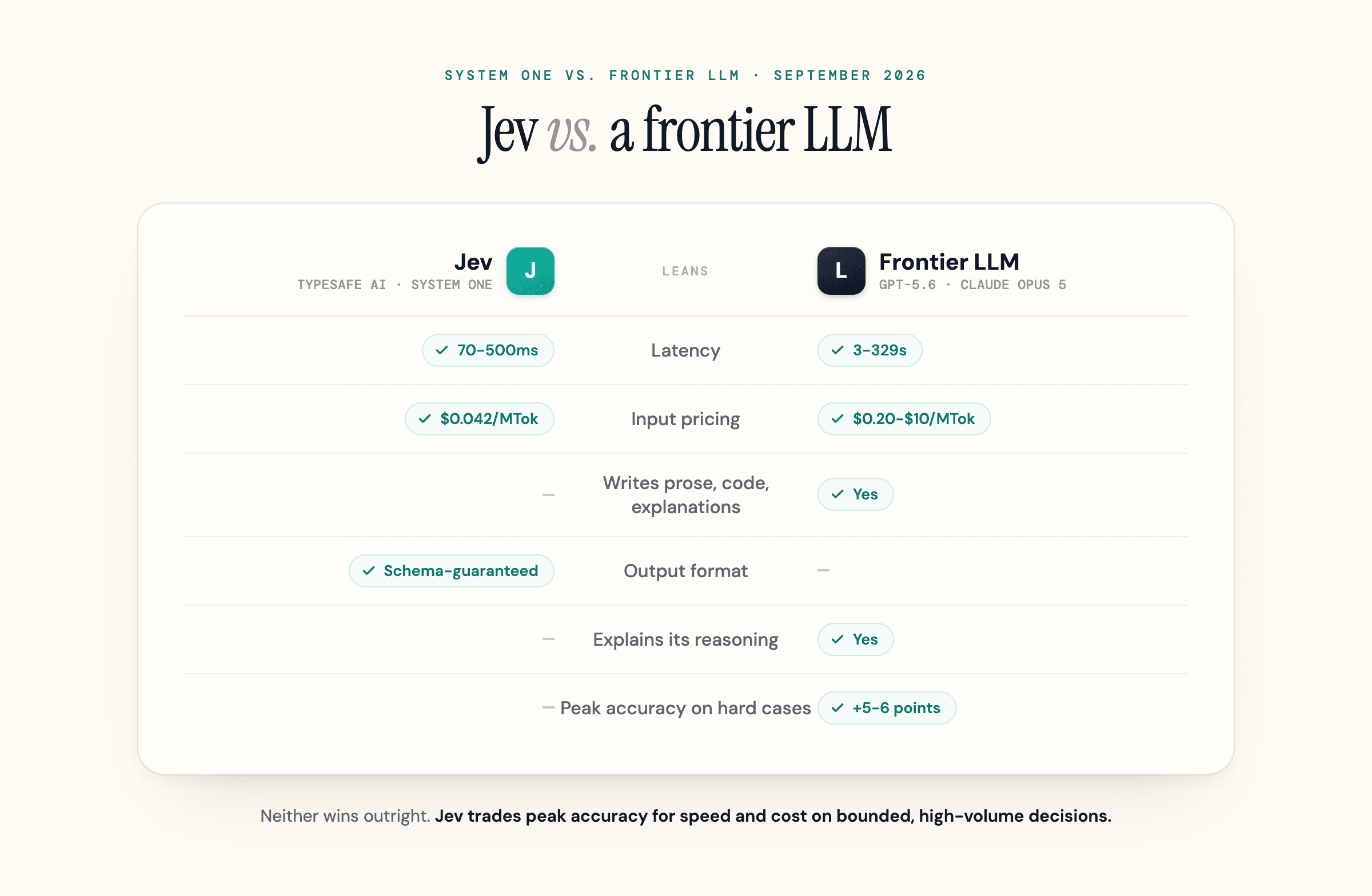
A standard transformer model generates a response one token at a time, feeding each new token back in as context for the next. That is why a long ChatGPT answer visibly streams in and why response time scales with how much the model has to say.
Jev skips that loop entirely. It uses a parallel, non-autoregressive architecture that evaluates every question in a single pass and returns all the typed answers at once, which is most of where its speed advantage comes from.
The company frames the split using Daniel Kahneman's distinction between fast, intuitive thinking and slow, deliberate thinking. A chain-of-thought reasoning model working through a multi-step problem is doing the slow kind.
TypeSafe's argument is that most software decisions - route this ticket, flag this transaction, score this review - never needed the slow kind, and building every automation on a model designed for it wastes both time and money.
Jev exposes exactly three answer types, called primitives: Choice picks from a fixed list of options, Score returns a value on a defined numeric scale, and Noul answers a yes/no question with a probability attached.
Choice and Score responses come with a calibrated confidence number; Noul returns a probability instead. Every possible output is defined in the request schema before the call runs - there is no field Jev can invent that was not already declared.
Adapted from TypeSafe's own comparison, with the last two rows added:
| Dimension | Jev | A frontier LLM (e.g. GPT-5.6, Claude) |
|---|---|---|
| Output | Typed value from a predefined schema | Free-form text you parse yourself |
| Generation | Parallel, single pass | Sequential, token by token |
| Latency | 70-500 milliseconds | 3-329 seconds |
| Input pricing | $0.042 per million tokens | $0.20-$10 per million tokens |
| Can write prose, code, or an explanation | No | Yes |
| Self-hostable / open weights | No - hosted API only | Varies by model |
That last row matters more than it looks. Jev stays proprietary and hosted, unlike an open-weight model you could download and run yourself.
It's reachable through TypeSafe's own endpoint and, as of launch week, also listed on Vercel's AI Gateway at the same $0.042 input / free output pricing. If your use case needs on-device inference or a model you control end to end, Jev is not on the table regardless of price or which gateway serves it.
RLCD: The Training Method Behind Jev
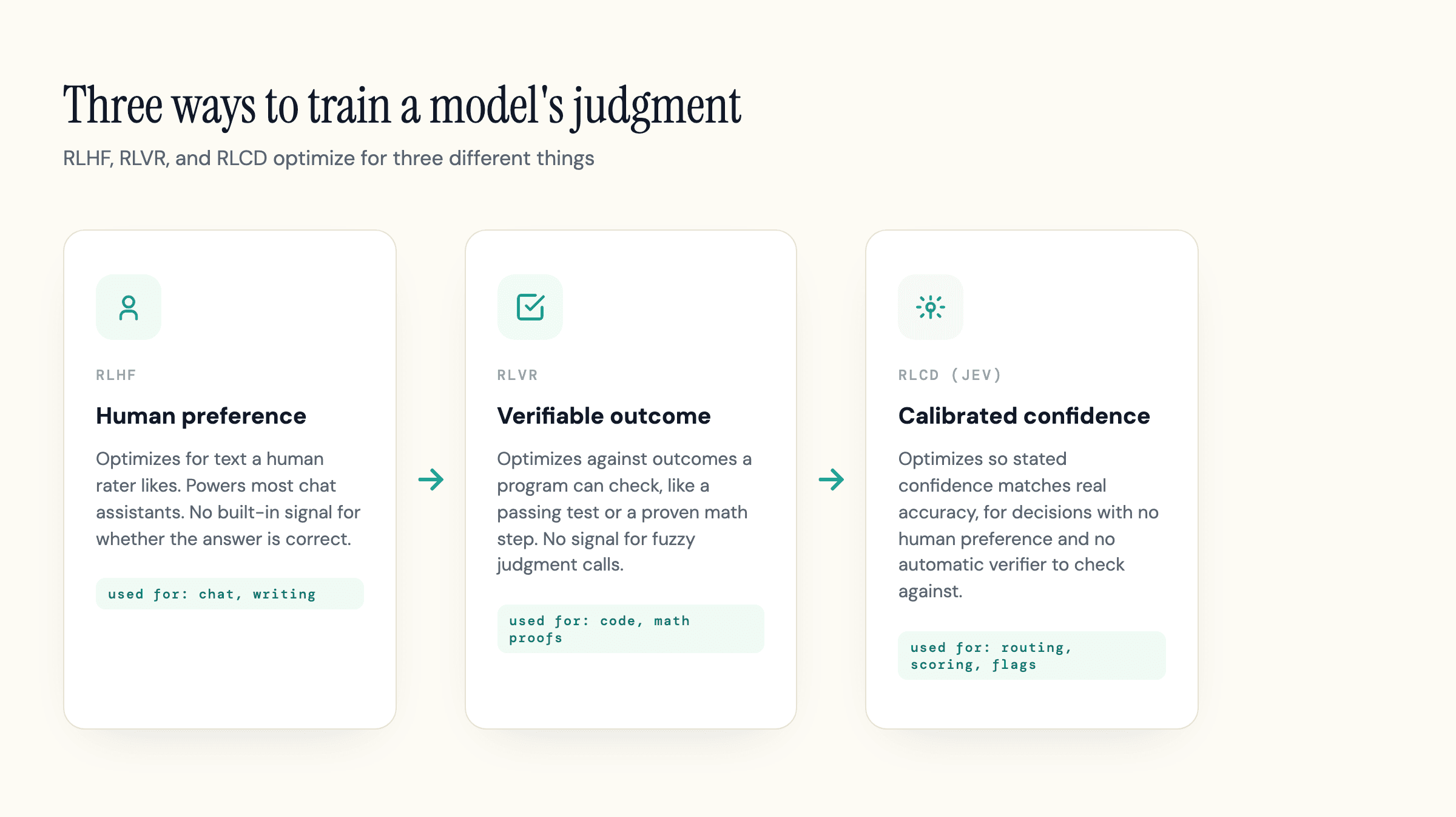
TypeSafe trained Jev with a method it calls Reinforcement Learning for Calibrated Decisions, or RLCD, and draws a direct line between it and two training approaches most people building with AI already know.
RLHF, the method behind most chat assistants, optimizes for responses a human rater prefers - it rewards text that reads well, not text that is provably correct. RLVR optimizes against outcomes a program can verify, like a passing test or a checked math proof.
RLCD is TypeSafe's answer for everything in between: decisions with no human preference to chase and no automatic verifier to check against, like whether a support ticket is urgent or whether an invoice looks fraudulent.
What RLCD trains the model to do is match its stated confidence to its real accuracy. Calibration in this sense is a population-level property, not a promise about any single answer: of every decision Jev makes at 80% confidence, roughly 80% should turn out correct.
A model can be well calibrated and still not very accurate - hedging at exactly the base rate would technically calibrate fine while being useless - so calibration and accuracy have to be read separately, never as a single number.
Here is the honest limit on how much of that can be verified from outside: TypeSafe has not published the reward function, the model architecture, the training procedure, or the calibration methodology behind RLCD.
There is no public calibration curve and no independently reproducible paper describing how it works, as of this writing. Every claim about how well-calibrated Jev is currently rests on TypeSafe's own reporting.
Does Jev Actually Never Hallucinate?
TypeSafe's marketing says Jev cannot hallucinate. TypeSafe's own launch post adds the qualifier that matters: "our number is not empirical. Schema matching is guaranteed, thus we can confidently add 0% into the plots." That is a precise claim, and it is narrower than it sounds.
What is actually guaranteed is the shape of the output, not its correctness. Because every possible answer is declared in the schema before the call runs, Jev cannot return a field that was not defined or a value type that does not match.
TypeSafe says this is structurally guaranteed, the same way a type checker can reject an invalid program state without proving the program's behavior is correct - though since TypeSafe hasn't published the architecture, outsiders can't verify which layer enforces that guarantee.
What is not guaranteed is that the answer Jev picks, from the valid options available, is the right one.
TypeSafe's own published evaluation shows exactly this gap. Across four workflows it built to test Jev - security incidents, agent-trace review, invoice processing, and customer service - Jev agreed with a reference answer 67.8% of the time on average, against GPT-5.6 Sol's 74.1% and Claude Opus 5's 73.1%.
That reference answer is itself an average of two frontier models, one from OpenAI and one from Anthropic - TypeSafe says outright that this "biases answers towards" those two families and likely undersells both Jev's and DeepSeek's models relative to them. Keep that caveat in mind for every accuracy gap in this piece.
The workflow-level gap is not even, either: on invoice processing specifically, Jev landed at 61.8% agreement against Sol's 79.1% - a 17-point difference on a workflow where wrong calls can carry direct financial consequences.
DataCamp's write-up of the same launch reports the comparison error rates TypeSafe drew from OpenRouter's routing data (TypeSafe's own caveat: OpenRouter routing may bias these specific numbers): OpenAI's Luna and Terra returned invalid structured output 0.58% of the time, Opus 5 did so 5.73% of the time, and Claude Haiku 4.5 did so 45.5% of the time.
GPT-5.6 Sol, specifically on tool calls rather than structured output, failed 17.0% of the time.
Against that baseline, Jev's 0% on both measures is a structural guarantee, not a measured result - the schema simply cannot produce those failure shapes, which is a real advantage in never breaking the format, not in never being wrong.
The one-line version: Jev cannot hallucinate a malformed answer. It can absolutely disagree with the reference answer, and TypeSafe's own numbers say it will, on the order of 1 time in 3, more often than that on invoices specifically.
What Jev Costs, and When It Actually Pays Off
TypeSafe's homepage headline is "444.6x cheaper," alongside a companion "193.6x faster." Both numbers depend entirely on which model you compare Jev against, and the gap moves a lot.
(The 444.6x itself comes from unrounded per-case costs; the published evaluation figures below round to 440x against Claude Opus 5, the closest comparison to the homepage claim.) On raw per-case latency alone, Jev answers in 0.4 seconds against Terra's 10.1, Sol's 23.3, and Opus 5's 37.8. The table below uses TypeSafe's own per-case cost figures from its four-workflow evaluation:
| Compared to | Cost multiple | Accuracy gap vs. Jev | Illustrative break-even (equal-error-cost assumption) |
|---|---|---|---|
| GPT-5.6 Terra | 76x cheaper | 0.1 points (near-tie) | ~$30 per case |
| GPT-5.6 Sol | 209x cheaper | 6.3 points | ~$1.32 per case |
| Claude Opus 5 | 440x cheaper | 5.3 points | ~$3.31 per case |
The break-even column is the useful number, and it is simple to derive: divide the extra dollars you would spend per case on the pricier model by the extra fraction of cases it gets right.
Against Terra, on these four vendor-created workflows the two are close enough on accuracy that Jev has the better cost result under the table's assumptions - there is barely any accuracy to buy, though that may not transfer to other workloads.
Against Sol or Opus 5, the math changes: if a wrong decision in your workflow costs only about a dollar to catch and fix (a misrouted support ticket, say), Jev's cost advantage wins outright.
If a wrong decision costs a lot more than that (an unflagged fraudulent invoice), the accuracy gap can be worth paying for.
TypeSafe hedges its own pricing, too: "we can't prove it isn't subsidized," the company writes, adding that it expects the rate to fall further rather than rise. Treat $0.042 per million input tokens as today's number, not a permanent one.
What People Are Already Running Into
The Hacker News discussion on the launch post ran to more than 470 comments within two days, and the pushback cuts deeper than the press coverage did. The most common objection: typed, schema-constrained decisions from a model are not a new idea.
Commenters pointed to GLiNER and zero-shot classifiers in the BERT family, along with structured-output and constrained-decoding features already built into OpenAI's and Anthropic's own APIs. The concept is arguably old; the packaging is new - a dedicated, purpose-trained model with its own hosted API and a training method built specifically around calibration.
That packaging question got a fast, concrete answer. Within hours of the launch - reportedly about two hours of build time - developer Harsha Gundala published Qwen-2.5-1B-RLCD on Hugging Face. Precision matters here, because the headline version ("someone reproduced it already") overstates it: Gundala's project does not retrain a model using TypeSafe's RLCD method.
It is an inference-time trick - evaluating every field of a JSON schema in parallel and reusing a single key-value cache - bolted onto an existing, un-retrained Qwen2.5 model. On an M4 Max chip it cut latency 5.6x to 7.0x versus standard token-by-token decoding, with 100% schema validity.
The sharper point it makes: some of Jev's speed and type-safety advantage may be achievable through architecture and engineering alone, separate from whatever TypeSafe's undisclosed RLCD training actually contributes on top.
Early users hit Jev's limits fast, too. Threads on the launch post describe running into its 32,000-token context window, and at least one developer's category list ran to around a hundred to a thousand options - past what a single Choice question, capped at 255, can hold.
One early-access team that used Jev to grade 6,003 rubric checks found DeepSeek's V4.1 Flash agreed with the other LLM judges slightly more often than Jev did, at $260 versus $160 per million graded answers - a reminder that "cheapest" and "best value for this workload" are not always the same model.
Does ChatGPT or Gemini Even Know Jev Exists Yet?
Two days after launch, we at geotoolbox ran the same question - "what is Jev by TypeSafe AI?" - through four engines, once with live web access and once without, where the model allowed turning it off.
This is one test run per engine, not a controlled benchmark, but the pattern was clear. Every web-connected engine got it right: ChatGPT, Gemini, Perplexity, and Claude with search enabled all correctly described Jev as TypeSafe's non-chat System One model, and most named RLCD and the Jevons paradox reference without prompting.
Turning web access off is where it splits. Asked the same question with search disabled, Gemini did not say it lacked information - it confidently answered "Devin by Cognition AI," a real but entirely different product, and separately conflated TypeSafe AI with an unrelated company of the same name that renamed itself years ago.
Claude, asked the identical question with search off, gave a very different answer: it said it was not familiar with a company or model by that name and asked for more context rather than guessing.
Both models were missing the same information. Only one of them told us that.
That gap is the practical argument behind agent-readiness work: a model with no live retrieval into your site or your announcement does not know you exist, and the failure mode is not always a polite "I don't know." Sometimes it is a confident, wrong answer, delivered with the same tone as a correct one.
Is Jev a Decision Layer or an Answer Engine? Why It Matters
Jev does not produce anything a person reads or an AI Overview cites. It scores, classifies, and routes, invisibly, inside someone else's application - a support ticket gets tagged, a transaction gets flagged, a database row gets a probability attached. Its output is consumed by software first, not written for a person to read directly.
That is a different job from what a generative answer engine does, and it splits AI visibility work into separate problems. Being reachable and well-structured enough for a generative engine to cite your page in an answer is one job.
Being reachable and well-structured enough for a decision-layer-style system to correctly classify your content is a different, hypothetical-but-plausible job, with different failure modes - and it would happen without anyone ever reading a word you wrote. Nothing here claims Jev itself currently crawls or classifies websites; the point is the category of AI infrastructure it represents.
If more of the AI infrastructure making judgments about your site starts looking like Jev instead of like a chatbot, the question worth asking is not just "can an AI cite me." It is whether your site gives that kind of system enough clean, structured signal to classify it correctly in the first place. That is the gap geotoolbox's free AI readiness check is built to find.
Frequently Asked Questions
What does "Jev" stand for?
It is not an acronym. TypeSafe named the model after the Jevons paradox, the economic observation that making a resource more efficient tends to increase total consumption of it rather than reduce it - the company's bet on what cheaper AI decisions will do to demand.
Is Jev open source, or can I self-host it?
No. Jev is a proprietary model available through TypeSafe's hosted API and Vercel's AI Gateway, currently gated behind an early-access waitlist. There is no open-weight release and no announced self-hosting path.
Should I use Jev or train my own classifier?
It depends on your data and volume. A classifier you train yourself on your own labeled examples can beat Jev on accuracy for one narrow, well-defined task, at the cost of collecting that training data and maintaining the model.
Jev needs no training-data labeling to call, using its three supported primitives, in exchange for the accuracy gap this article documents - though you'll still want representative evaluation data to confirm it's accurate enough for your workload. Volume, category stability, labeling cost, and required accuracy all factor in: benchmark both approaches on your own data before committing.
Can I use Jev today?
It launched in early access on September 15, 2026, gated behind a waitlist. Access is through TypeSafe's API at api.typesafe.ai/v1/systemone, with official Python and JavaScript SDKs.
Sources
- Introducing System One Models & Jev - TypeSafe AI Blog, September 15, 2026 -
typesafe.ai/blog/introducing-system-one-models-and-jev - TypeSafe AI homepage - TypeSafe AI -
typesafe.ai - TypeSafe AI team page - TypeSafe AI -
typesafe.ai/team - Jev evaluation results - TypeSafe AI -
evals.typesafe.ai - Jev API documentation - TypeSafe AI -
docs.typesafe.ai - Training language models to follow instructions with human feedback (InstructGPT) - Ouyang et al., OpenAI, March 2022 -
arxiv.org/abs/2203.02155 - TypeSafe AI Raises $40M in Seed Funding - FinSMEs, September 16, 2026 -
finsmes.com/2026/09/typesafe-ai-raises-40m-in-seed-funding.html - Vercel AI Gateway model catalog - Vercel -
ai-gateway.vercel.sh - Jev: The Language Model That Won't Talk - Anthony Maio, Substack, September 2026 -
anthonymaio.substack.com/p/jev-the-language-model-that-wont - Introducing System One Models and Jev (discussion thread) - Hacker News, September 15, 2026 -
news.ycombinator.com/item?id=49717558 - Qwen-2.5-1B-RLCD model card - Harsha Gundala, Hugging Face -
huggingface.co/harshatheg/Qwen-2.5-1B-RLCD - GLiNER: Generalist Model for Named Entity Recognition - urchade, GitHub -
github.com/urchade/GLiNER - Verification is the Bottleneck - Good Start Labs, September 2026 -
goodstartlabs.com/research/verification-is-the-bottleneck - System One Models: Jev - DataCamp -
datacamp.com/blog/system-one-models-jev