
Perplexity is worth the attention: one Seer Interactive analysis of a single client found its referral traffic converted at about 10.5 percent, against roughly 1.76 percent for Google organic (ChatGPT ran higher still, at 15.9 percent). So the demand for a good Perplexity rank tracker is real, and so is the noise around it. Search "best Perplexity rank tracker" and you get a wall of lists that each crown the author's own tool. This one is grouped by what the tools actually do, tells you where the free options end, and says plainly which one is ours.
Geotoolbox, the site you are reading this on, makes an AI-visibility tool. We have included it below, placed it in the category it actually fits, and not ranked it first. Pricing and engine coverage were checked against each vendor's own pages in July 2026 (AthenaHQ, Otterly, Peec AI, Ahrefs Brand Radar and SE Ranking re-verified August 2026), and the Perplexity mechanics against Perplexity's crawler docs and peer-reviewed measurement research. Pricing changes often, so confirm the current number on each vendor's site before you buy.
What a Perplexity Rank Tracker Actually Tracks
Start with the thing most tool pages skip: Perplexity does not rank pages one through ten. It runs a live search, reads a handful of pages, and synthesizes an answer that cites roughly three to five of them. A study of 21,143 citations across ChatGPT, Google, and Perplexity found Perplexity cites more sources per answer than ChatGPT, but there is still no fixed "position 1." So a "Perplexity rank tracker" is not tracking a rank. It is tracking whether you show up in the cited set, and how often.
That splits into two things a tool measures, and you should know which you are buying:
- Citations are the numbered, clickable source links under an answer. They drive referral traffic.
- Mentions are when Perplexity names your brand in the text with no link. They build awareness but send no clicks.
A good tracker separates the two, because "we got mentioned" and "we got the click" are different outcomes. On top of that, the useful ones report your citation rate (how often you appear for a prompt set), share of voice against named competitors, answer sentiment, which specific URLs earn the citation, who replaces you when you are absent, and how much the results move run to run. If a dashboard shows a single visibility score with no method behind it, treat that as a red flag, not a metric.
What no tracker can give you is a guaranteed placement or a stable leaderboard. Perplexity's cited set shifts every run. That is how the product works, and no tracker changes it. For the broader picture of measuring this across engines, we cover the full AI-visibility measurement stack separately; here the focus is Perplexity and the tools built for it.
How Perplexity Rank Tracking Differs from Google Rank Tracking
Three differences change what you should expect from a tool.
It searches live, and it favors fresh pages. Unlike a model answering from training data, Perplexity fetches current pages for most answers and leans hard on recency. A page updated last month can displace one that has ranked on Google for years. The freshest clear answer wins, whatever its Google position.
The same prompt gives different answers. Ask twice and the cited sources can change by time, location, personalization, and which model variant ran. That is how Perplexity works, and a statistical study of AI-search visibility put numbers on it: citation results behave like samples from a distribution across repeated runs, so a single check gives a misleadingly precise picture. A tracker earns its price by sampling a prompt set on a schedule and reporting the trend, rather than telling you where you sit at 3pm on a Tuesday. It is also why the answer to a query fans out into many sub-answers that no single lookup captures.
Ranking on Google does not carry over. Plenty of pages that own the Google result never get cited by Perplexity, because Perplexity has to be able to lift a clean, attributable claim from the page. A strong ranking with the answer buried under three paragraphs of throat-clearing loses to a shorter page that states the fact in the first line. Which leads to the check almost every tool skips.
Check This Before You Buy Any Tracker: Can PerplexityBot Even Reach You?
Here is the trap. A tracker reports "you are not cited." You assume it is a content problem and start rewriting. But there is a step before content: Perplexity has to be able to reach the page at all.
Perplexity uses two agents, and its official crawler documentation names both. PerplexityBot is the crawler that surfaces and links pages in Perplexity's search results. Perplexity-User is the agent that visits a page in real time when someone asks a question. If your robots.txt blocks PerplexityBot, if a bot-protection rule or a WAF challenges it, if the answer only renders after JavaScript, or if the page is slow to respond, you can be doing everything right on content and still be invisible. There is also a gap between being fetched and being cited: a page can be crawled and still never make the answer.
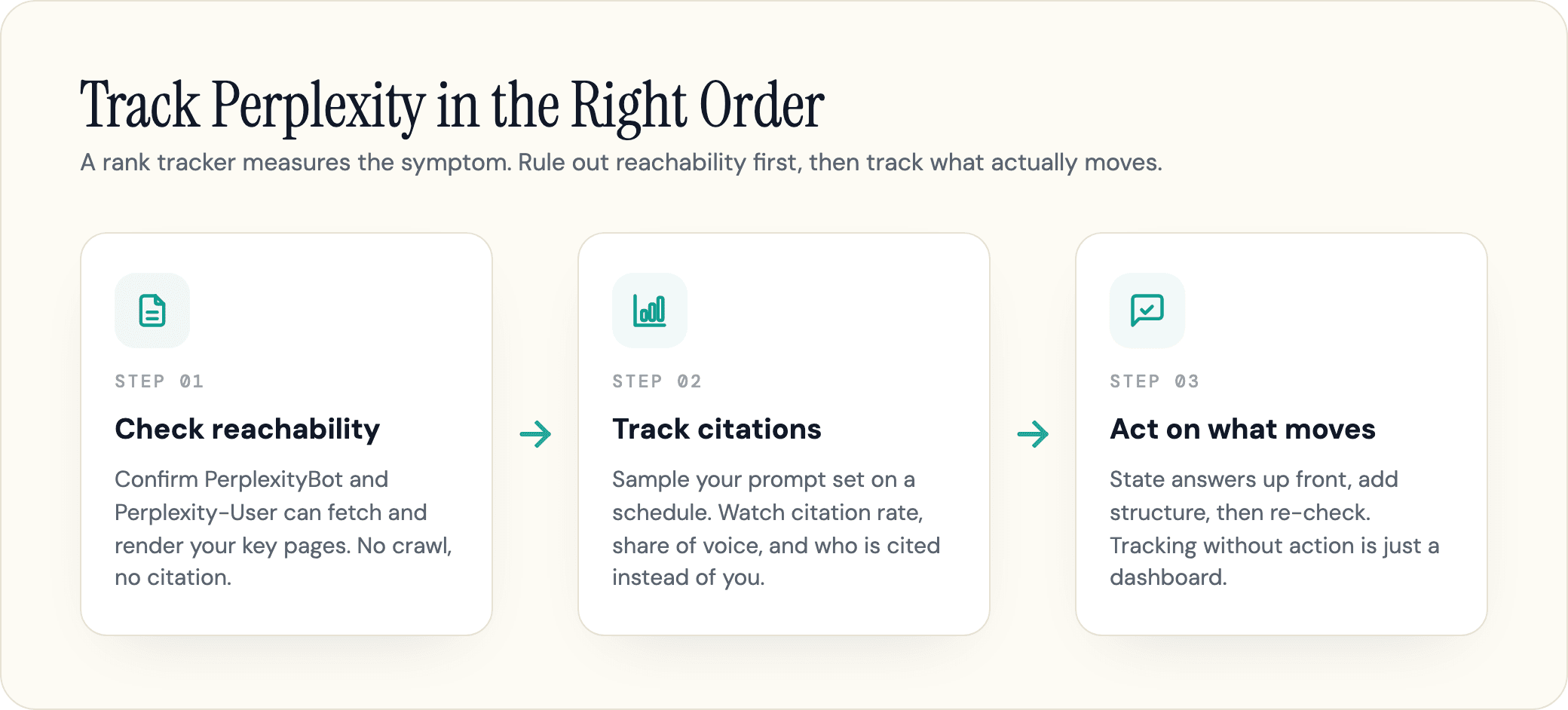
In our experience, this is where a surprising number of "we are not showing up in AI" cases actually resolve, and it is the cheapest thing to rule out first, because a paid tracker cannot fix a reachability block, it can only keep reporting the symptom. Confirm the bots can fetch and render your key pages before you spend on tracking. You can do that in a minute with our free AI Crawler Checker, which tests whether PerplexityBot and the other AI agents can actually load your page. One caveat from Perplexity's own docs: Perplexity-User "generally ignores robots.txt," so a robots block stops the indexing crawler (PerplexityBot) but not the live fetcher, and it is not a privacy control.
The Best Perplexity Rank Trackers, Compared
One thing to know before the list: many of the guides you will find are published by a tracker vendor, and the vendor-run ones reliably rank their own product at number one. So here is our disclosure up front, and geotoolbox is not sitting at the top of this table. The tools are grouped by what they actually do, with the one detail buyers get burned on called out: whether Perplexity is in the plan you are pricing, or gated behind a much higher tier.
| Tool | Category | Perplexity included | Free option | Paid from | Best for |
|---|---|---|---|---|---|
| Otterly.ai | Dedicated tracker | Base plan | Trial | ~$29/mo | Budget multi-engine monitoring |
| Keyword.com | Dedicated tracker | Base plan | Trial | ~$24.50/mo | Lowest-cost, model-specific checks |
| Peec AI | Dedicated tracker | Base plan | — | From €70/mo annual | Competitive benchmarking |
| Rankability | Dedicated tracker | Base plan | Trial | ~$99/mo | Source-level citation detail |
| ZipTie | Dedicated tracker | Base plan | Trial | ~$69/mo | Turning tracking into action |
| Nightwatch | Dedicated tracker | Base plan | 14-day trial | ~€79/mo | Pairing Google ranks with AI citations |
| Scrunch AI | Enterprise tracker | Base plan | 7-day trial | ~$250/mo | Multi-brand / enterprise |
| AthenaHQ | Enterprise tracker | Base plan | Free tier ($25 credit) | ~$295/mo ($245 annual) | Self-serve, no sales call |
| Profound | Enterprise tracker | Enterprise (brands) or agency client workspaces | 7-day trial (no Perplexity) | Custom Enterprise | Large-team citation analytics |
| Semrush AI Visibility | SEO-suite add-on | Base plan | Free checker | ~$99/mo | Existing Semrush users |
| SE Ranking | SEO-suite add-on | Add-on | Trial | ~$89/mo add-on (€79 in the EU) | Agencies wanting white-label |
| Ahrefs Brand Radar | SEO-suite add-on | Add-on | Free checker | $199+/platform ($699 all) | Existing Ahrefs users |
| HubSpot AEO Grader | Free grader | One-off grade | Free | ~$50/mo ongoing | A one-off snapshot |
| Geotoolbox | Reachability + tracking | Starter tier | 7-day trial + free tools | From $99/mo ($79 annual) | Fixing why you are not cited, then tracking |
Pricing checked July 2026; AthenaHQ, Otterly, Peec AI, Ahrefs Brand Radar and SE Ranking re-verified August 2026. Confirm the current tier on each vendor's site.
Dedicated Perplexity Trackers
These run prompt sets across AI engines and report where you get cited. Otterly.ai is a popular budget pick, with plans from around $29 a month and Perplexity in the base tier; the lever on price is how many prompts you track. Keyword.com is the lowest-cost dedicated option and can check specific Perplexity model variants, which matters if you care about Sonar versus Pro results. Peec AI leans into competitor benchmarking and multilingual coverage from €70 a month on annual billing (€85 month to month). Rankability is strong on source-level detail, showing the exact URLs Perplexity cites, at $99 a month with Perplexity in the base plan. ZipTie ($69) puts more weight on telling you what to change, not just what happened. Nightwatch pairs long-standing Google rank tracking with AI visibility and keeps Perplexity on its entry tier from about €79 a month, so it suits teams that want AI citations sitting next to their classic rankings.
Enterprise Trackers
Scrunch AI targets multi-brand and enterprise monitoring from around $250 a month. AthenaHQ is self-serve from roughly $295 a month, or about $245 billed annually, and it has a genuinely free Essential tier ($25 credit) so you can see your standing before paying. Profound is the name buyers ask about most, and it is where the tier structure matters: it no longer sells a self-serve brand plan at all. A free 7-day trial covers ChatGPT, Gemini and Google AI Overviews only, and for brands Perplexity is on custom Enterprise only, priced on a quote; agencies can also get it in the client workspaces of Agency Growth, $99/month base plus $399/month per full client workspace (add-on) (per its pricing page, September 2026). If Perplexity is your priority, price the plan that actually includes it, not the headline number.
SEO Suites With an AI Add-On
If you already pay for a suite, you may not need a separate subscription. Semrush AI Visibility tracks Perplexity alongside the other engines from about $99 a month standalone and plugs into the keyword data you already use. SE Ranking's AI Search add-on runs about $89 a month on top of a base plan and brings the white-label reporting agencies like; its standalone SE Visible product runs closer to $189. Ahrefs Brand Radar ties AI mentions to Ahrefs' backlink data, but the AI layer runs about $199 a month per platform for selected platforms or $699 for all of them, on top of a base Ahrefs plan, so the all-in climbs quickly and it makes sense mainly if you already live in Ahrefs. For the wider set of tools that span more than Perplexity, see our best GEO tools guide, and if xAI's assistant or Microsoft's is on your list, the sibling Grok rank tracker comparison, Copilot rank tracker comparison, and AI Mode rank tracker comparison are built the same way.
Where Geotoolbox Fits (and Where It Doesn't)
Ours is not a Perplexity specialist. Geotoolbox tracks Perplexity as one of eight engines a single scan covers, so it fits teams who want Perplexity in context with ChatGPT, Gemini, Google AI Overviews and the rest rather than in isolation. And unlike Profound and the Ahrefs and SE Ranking add-ons, Perplexity is included at the entry price: it is one of the three engines on the $99 Starter tier ($79 billed annually, after a 7-day free trial), where Profound, for comparison, tracks Perplexity only on custom Enterprise for brands, or through its agency plan ($99/month base plus $399/month per client workspace). The full eight-engine set sits on higher tiers. Where it differs from most trackers is that it starts one step earlier. The same account checks whether the AI crawlers can reach your pages, then a GEO Scan shows whether each engine cites you and gives a 0 to 100 visibility score, with a running brand-monitoring dashboard once you track over time. If your problem is "why am I not cited," that reachability-first order is the point.
Is There a Free Way to Track Perplexity?
Yes, with a caveat: the free methods are manual, and most "free" tools are one-off snapshots, not tracking.
The genuinely free method is your own analytics. Perplexity sends a referrer, so you can filter for perplexity.ai (and the Comet browser's referrer) in GA4 to see the traffic it drives. Pair that with a short list of your priority prompts run by hand every week or two, and you have a zero-cost baseline. The blind spot: when someone copies your URL out of an answer instead of clicking the citation, that visit lands in analytics as direct traffic, so referral numbers understate the channel. Treat the analytics figure as a floor, not the full picture.
Free graders are the other option, and they are useful for a single read. HubSpot's AEO Grader and similar tools score your AI presence once at no cost, but a grade is a photo, not a security camera; it will not tell you that you lost a citation last week. Our own free layer sits here too: the AI Crawler Checker and AI-readiness score are free, and paid tracking — Perplexity included from Starter — opens with a 7-day free trial. The short version: the free tools get you a baseline and a reachability check, while scheduled Perplexity tracking with history and competitor share is what you pay for.
What to Look for in a Perplexity Rank Tracker
Once you are comparing paid tools, these are the things that separate a real tracker from a dashboard with a nice logo:
- It captures the actual cited URLs, not just a yes/no that you were mentioned. You need to know which of your pages earned the citation to do anything about it.
- It separates citations from mentions. A tool that lumps them together inflates your visibility and hides whether you are getting clicks or just name-checks.
- Its refresh rate matches the volatility. Perplexity's results move, so daily to weekly sampling is the sane range. A tool that checks monthly is measuring noise.
- Perplexity is in the plan you are pricing. This is the one people miss. Confirm the specific tier that includes Perplexity, because several tools ship it only on an upgrade.
- It shows reachability, or you check that separately. A tracker that reports "not cited" without flagging that a crawler cannot reach you will send you rewriting content that was never the problem.
- Pricing is transparent and self-serve. If you cannot see the price without a sales call, you cannot compare value.
- It helps you act. Monitoring tells you what happened. The tools worth paying for point at what to change next.
When You Don't Need a Perplexity Rank Tracker
Here is the part most guides leave out: sometimes the answer is not to buy one.
Skip a paid tracker for now if you publish fewer than about four substantive pieces a month, because you will not have enough new material for citations to move, and the tool mostly measures stagnation. Skip it if you are a purely local service business, since Perplexity tends to lean on maps and directories for those queries and a tracker adds little. Skip it if you run a product-only store with no editorial content, because there is not much for Perplexity to cite yet. And if your content budget is under about a thousand dollars a month, a two-hundred-dollar tracker is the wrong place to spend; a quarterly manual check plus a free reachability test covers you.
We would rather tell you that than sell you a subscription you will not use. When the volume and stakes are there, geotoolbox and the tools above earn their keep. When they are not, the right tool is a spreadsheet and thirty free minutes a quarter.
The Verdict
There is no single best Perplexity rank tracker, and any list that hands you one is usually selling it. The right tracker covers the engines you care about, at a tier where Perplexity is actually included, and gives you something to act on. To make it concrete:
- Otterly if budget comes first and you want cheap multi-engine coverage
- Rankability if you need the exact URLs Perplexity cites, not just a score
- ZipTie if you want fix recommendations, not only a dashboard
- Peec AI if the priority is benchmarking against named competitors
- Nightwatch if you want Perplexity citations sitting next to your Google rank tracking
- Geotoolbox (ours) if you want Perplexity included at the entry price, in context with the seven other engines, plus the reachability check that rules out a blocked crawler first
- an SEO-suite add-on (Semrush, SE Ranking) if you already pay for the suite; Scrunch or Profound if you are enterprise and can price the Perplexity tier
But before any of that, do the free step first: confirm the AI crawlers can reach and read your key pages, since that is the one problem no amount of tracking solves. Run your site through our free AI Crawler Checker to rule it out in a minute, and if you would rather see Perplexity next to the seven other engines than watch it alone, a GEO Scan shows where you are cited and where a competitor took your spot. Fix the reachability, then track what moves.
Frequently Asked Questions
Does Perplexity have rankings like Google?
No. Perplexity does not order pages one through ten. It runs a live search, reads a handful of pages, and cites roughly three to five of them in a synthesized answer. A "rank tracker" for Perplexity really tracks whether and how often you land in that cited set, not a fixed position.
Is there a free Perplexity rank tracker?
The genuinely free method is your own analytics: filter for the perplexity.ai referrer in GA4 and run your priority prompts by hand every week or two. Free graders like HubSpot's give a one-off snapshot. Continuous, scheduled tracking with history and competitor share is what paid tools charge for.
What's the difference between a citation and a mention in Perplexity?
A citation is a clickable numbered source link, and it drives referral traffic. A mention is your brand named in the answer text with no link, which builds awareness but sends no clicks. A good tracker reports the two separately, because they are different outcomes.
Why do I get different Perplexity results for the same prompt?
Because Perplexity searches live and its answers are non-deterministic. The cited sources shift with timing, location, personalization, and model version, so research on AI-search visibility treats a single check as one sample, not a fixed truth. That is exactly why you sample on a schedule instead of trusting one lookup.
If I rank on Google, will Perplexity cite my site?
Not necessarily. Perplexity has to reach the page and lift a clean, attributable claim from it. A page that ranks well on Google but buries its answer can lose to a shorter, clearer page, and a page blocked from PerplexityBot will not be cited at all.
How often should I check my Perplexity visibility?
Daily to weekly is the useful window, because results move but not by the hour. Monthly checks measure noise more than signal. Match the cadence to how often you publish and how competitive your space is.
Sources
- From Citation Selection to Citation Absorption: A Measurement Framework for Generative Engine Optimization - arXiv (Zhang et al.) -
arxiv.org/abs/2604.25707 - Quantifying Uncertainty in AI Visibility: A Statistical Framework for Generative Search Measurement - arXiv (Sielinski) -
arxiv.org/abs/2603.08924 - PerplexityBot and Perplexity-User crawler documentation - Perplexity -
docs.perplexity.ai/guides/bots - How traffic from AI search converts - Seer Interactive -
seerinteractive.com/insights/case-study-6-learnings-about-how-traffic-from-chatgpt-converts