
The best AI Mode rank tracker is the one that actually queries Google's AI Mode tab, tells you the truth about what it can and cannot see, and does not hide the price of AI Mode coverage behind a higher tier. That last part matters more than it should, because most guides to this category rank themselves first and quote prices that contradict each other. We make one of these tools too, so rather than crown it, we list it last on purpose, de-conflicted the pricing across every vendor, and show you how to validate any of them, ours included, before you pay.
If you just want the shortlist, jump to the comparison table. If you want to understand what you are buying, start here.
What an AI Mode Rank Tracker Actually Does
An AI Mode rank tracker tells you whether Google's AI Mode names or cites your brand when someone asks a question in it, how often, and who it cites instead of you. That is a different job from classic rank tracking, and the word "rank" is misleading here. AI Mode does not return a numbered list. It reads a question, fans it out into sub-questions, and writes one synthesized answer with a handful of inline citations. There is no position three to hold.
So a good tracker measures four things, not a ranking:
- Inclusion: did your brand or domain appear in the answer at all, yes or no
- Mention: was your brand named in the answer text
- Citation: did AI Mode link one of your URLs as a source (only a linked citation can send a click)
- Share of voice: across a set of prompts, what fraction of the answer space is yours versus named competitors
Being named and being cited are not the same. AI Mode can describe your product without linking you, and only the link drives traffic. A brand can be named in 40% of answers for a topic and cited in 10% of them, until a page built around that exact question closes the gap. Tracking both is the point.
The harder truth sits underneath all of this: Google AI Mode has no public API for rank tracking. Every tool on the market samples it by driving a real browser session and reading what comes back. That makes each number a modeled estimate from repeated probes, not a meter reading of what real users saw. It is the same limit we describe in our guide to tracking your brand across AI engines: you are measuring presence across many samples, not a fixed position, so the trend matters more than any single check. Keep that in mind while you read the rest of this comparison, because a vendor that hides it is selling you confidence it cannot deliver.
AI Mode vs AI Overviews vs Classic Search
Most tracking mistakes start here, because several different surfaces get called the same thing. They are not interchangeable, and a tool that watches one is blind to the others.
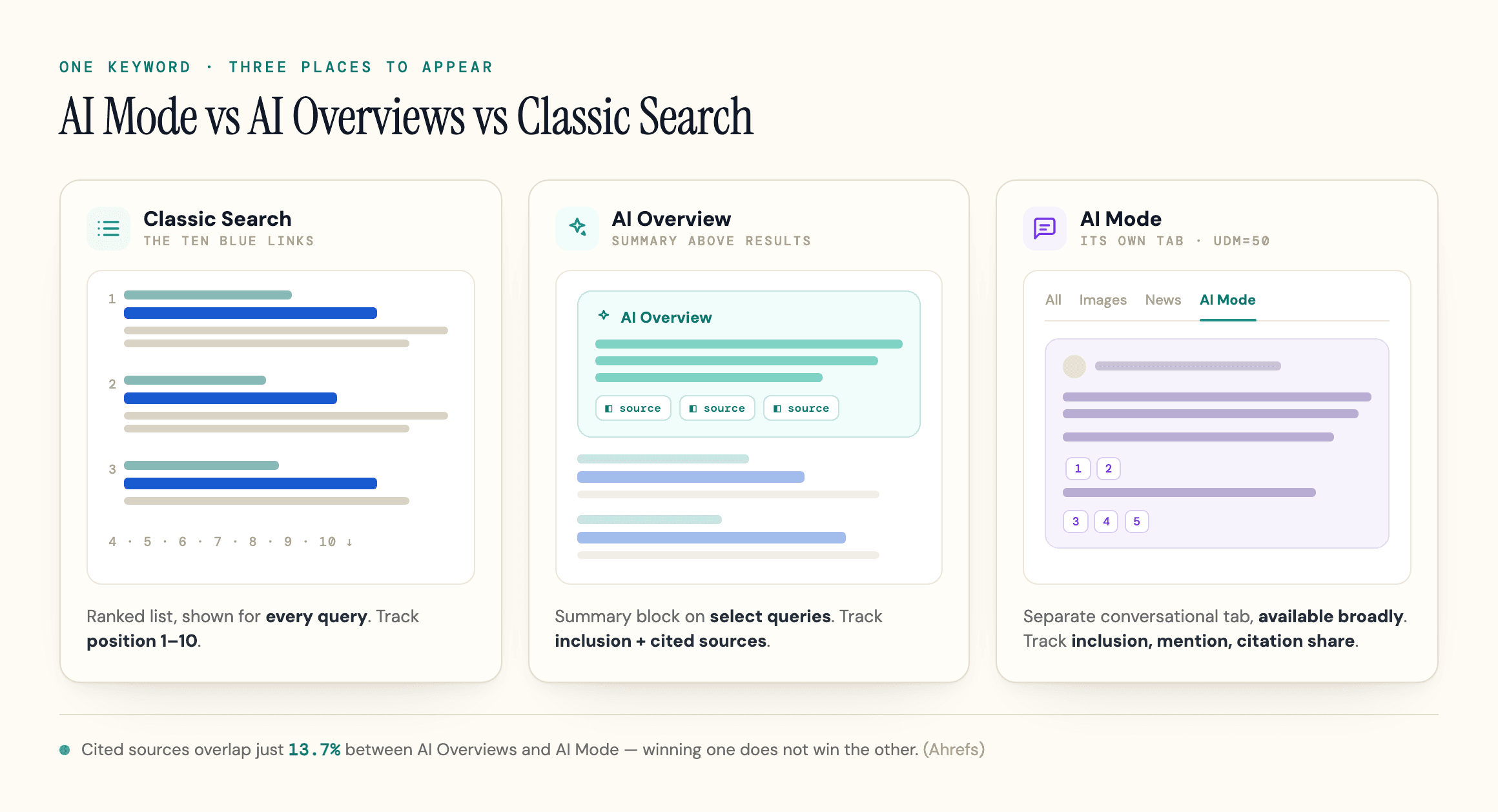
Classic search is the familiar list of links, where you either rank on page one or you do not. An AI Overview is the summary box stitched onto the top of a normal results page, and it only appears for a share of queries. AI Mode is a separate, full-page conversational experience, reached by opting into the AI Mode tab (its own udm=50 view), where a search becomes a back-and-forth and one question fans out into many. It is not a fringe surface: Google said at I/O 2026 that AI Mode had passed one billion monthly users within a year of launch.
| Surface | What it is | What you measure | How to track it |
|---|---|---|---|
| Classic search | Ranked list of ~10 links, shown for every query | Position 1 to 10, CTR by rank | Any classic rank tracker |
| AI Overview | AI summary block above the results, on select queries | Inclusion in the block, cited sources, position below | An AI Overview tracker |
| AI Mode | Separate conversational tab, available broadly | Inclusion, mention, citation share, answer share | A dedicated AI Mode tracker (this guide) |
Why treat them separately? Because winning one does not win the others. Ahrefs, comparing both surfaces across hundreds of thousands of queries, found the cited sources overlap just 13.7% of the time for the same query. A brand that owns the AI Overview can be absent from the AI Mode answer to the same starting question. AI Mode answers also run longer and fan out further, so they pull from a different mix of pages, a pattern we cover in query fan-out and in Google AI Mode SEO. That mix leans heavily on Google itself: SE Ranking's analysis of 1.3M AI Mode citations found Google's own domains are the single most-cited source at 17.42%, so the winnable ground is usually your buyer's specific question, not the head term Google already owns.
Google's own tooling reinforces the split. In June 2026 it launched a generative-AI performance report in Search Console that, as of August 31, 2026, covers all websites worldwide, but it reports impressions for AI Overviews and AI Mode counted together, with no click data and no way to isolate AI Mode. So even Google will not hand you a clean AI Mode number. That gap is exactly what a dedicated tracker exists to fill.
How AI Mode Trackers Actually Work
Knowing the mechanics tells you what you are paying for, and which vendor claims to distrust. Because there is no public API, the tools work in broadly the same way: each drives a real browser session, runs your prompts against AI Mode on a schedule, and parses what comes back.
The pipeline has a few steps:
- Execute: run each prompt in a headless browser, usually through residential proxies, with a set country, device, and logged-out state so runs are comparable
- Capture: store the full answer text, inline citations, and follow-up suggestions
- Detect and extract: use language processing to find brand mentions and pull the cited URLs
- Score: classify sentiment around each mention and aggregate inclusion, citation rate, and share of voice over time
Two things follow from this. First, the quality of a tool's proxy and parsing infrastructure decides how reliable its data is, which is why two trackers can report different numbers for the same prompt. Second, and more important, none of them see real user prompts. Every tool samples controlled questions on a schedule and infers your standing. Treat the output as a modeled estimate, not ground truth.
That matters because AI Mode is volatile. The same prompt can return different citations by time, location, and login state, and Google ships model updates mid-week that shift the answer overnight. A single check is close to meaningless. A tracker earns its price by running a fixed prompt set repeatedly and showing you the trend, not by telling you where you sat at 3pm on a Tuesday.
One buyer-beware note on the marketing. Because there is no public feed, be skeptical of any vendor that claims its data comes "direct from Google" or from a private pipeline. These tools generally scrape the same logged-out interface you could open yourself. The differences are in coverage, cadence, and how cleanly they parse the answer, not in privileged access nobody actually has.
What to Look For When Choosing
Before the tool list, here is the short checklist that separates a real AI Mode tracker from a dashboard that bolts the label on.
Is Google AI Mode in the plan you can actually afford? This is the trap. Several tools advertise a low entry price, then put AI Mode behind a higher tier or a paid add-on. Profound sells no self-serve brand plan at all now, only a free 7-day trial (ChatGPT, Gemini, Google AI Overviews) and a custom Enterprise tier. Otterly bills AI Mode as an add-on on top of its base price. Scrunch keeps AI Mode for its Enterprise tier. The list price and the AI-Mode price are often different numbers, which is why the comparison table below is anchored on the cheapest tier that actually includes it.
Does it track citations at the URL level, not just mentions? A mention tells you AI Mode said your name. A URL-level citation tells you which of your pages it linked, which is the thing you can actually replicate. Domain-only aggregates hide that.
How many engines beyond AI Mode? Most brands also want ChatGPT, Perplexity, and Gemini. Google AI Mode is one surface, and buying a single-engine tool usually means buying several. Coverage breadth is where budgets get eaten, so match it to where your buyers actually search.
Refresh cadence, and how many times each prompt runs. Daily catches fast movement during launches; weekly is fine for stable content. Anything monthly, which is where some SEO-suite add-ons land, is a blind spot in a surface that can shift within a week. Ask how many times a tool re-runs each prompt per cycle too, because a single sample of a nondeterministic answer is noise, and averaging several is the whole point.
Does it follow the conversation, not just the first question? AI Mode is multi-turn by design. Ask "best email software" and you might be cited first, but the follow-up "which has the better mobile app?" can hand the answer to a competitor. Tools that only capture the opening query miss half the story. The better ones run follow-up chains and show whether you hold the citation as the dialogue deepens.
Geo and market coverage, exports, and an API. If you sell in more than one country, AI Mode citations differ by market, and you need per-country tracking plus raw exports to do anything serious with the data.
The reachability check most tools skip. A tracker tells you that you are missing. It rarely tells you why. Often the reason is upstream: the page an AI answer should cite is blocked, slow, or renders nothing without JavaScript, so it never becomes an eligible source. Before paying for any tracker, confirm the AI crawlers can even load your pages, because a tracker cannot fix a page it can only keep reporting as absent.
The Best AI Mode Rank Trackers Compared
The table below lists the tools that genuinely track Google AI Mode, ordered by the cheapest plan that actually includes it, except geotoolbox, which we list last on purpose. We are not a neutral bystander here: geotoolbox is on this list. Every price was pulled from the vendor's own page on September 1, 2026. Several of these vendors are European and charge in euros, so those rows show the euro figure the vendor actually bills. Where a vendor gates AI Mode behind an add-on or a higher tier, the price reflects what you actually pay to get it.
| Tool | Cheapest plan with AI Mode (2026-09-01) | AI Mode in base plan? | Refresh | Best for |
|---|---|---|---|---|
| Rankscale | Essentials, €20/mo, credit-based | Yes | Hourly to monthly | Broad engine coverage on a budget |
| Otterly.ai | Lite €29 + AI Mode add-on €9 | Add-on | Daily | Budget multi-engine monitoring |
| LLM Pulse | Starter, €49/mo ($60) | Yes | Weekly (daily plans available) | Dedicated AI-search analytics |
| Nightwatch | Starter, €79/mo | Yes | Daily | Precision and local tracking |
| Omnia | Growth, €79/mo | Yes | Daily | Turning gaps into content briefs |
| Peec AI | Starter, €85/mo | Yes | Daily | Daily monitoring with hallucination flags |
| Rankability | Starter, $99/mo | Yes | Daily | Agencies wanting one visibility score |
| Semrush AI Visibility Toolkit | $99/mo per domain | Yes (own toolkit) | Daily or weekly | Teams already inside Semrush |
| SE Ranking | Core $129 + AI Search add-on $89 | Add-on | Daily | SEO and GEO in one suite |
| Ahrefs Brand Radar | From ~$129 (Lite, custom prompts); full index ~$199 | Add-on | Daily to monthly | Backlink and AI-mention combo |
| Profound | Enterprise (custom) | Enterprise only | Daily | Enterprise compliance |
| Scrunch AI | Enterprise (custom) | Enterprise only | Daily | Regulated enterprises |
| geotoolbox | Plus, $199/mo ($99 Starter has no AI Mode) | No (Plus tier) | Weekly | Reachability plus citation tracking in one scan |
A couple of tools you might expect are not in the table: Keyword.com and AccuRanker. Both advertise AI visibility, but as of September 1, 2026 their own pages name only AI Overviews, not Google AI Mode. AccuRanker's AI tracking (on its higher Expert tier) and Keyword.com's credit-based AI plans are real products, but until each one names AI Mode in plain words, we do not list it as an AI Mode tracker. When a vendor will not name the surface, assume it does not track it. A handful of other tools also track AI Mode and were left out only to keep the list readable, including Writesonic GEO, Rankshift, Waikay, and the AIclicks and KIME platforms behind two of the competing guides.
The AI Mode Trackers, One by One
Prices are as of September 1, 2026, and euro figures carry an approximate dollar conversion because those vendors do not offer US pricing.
LLM Pulse
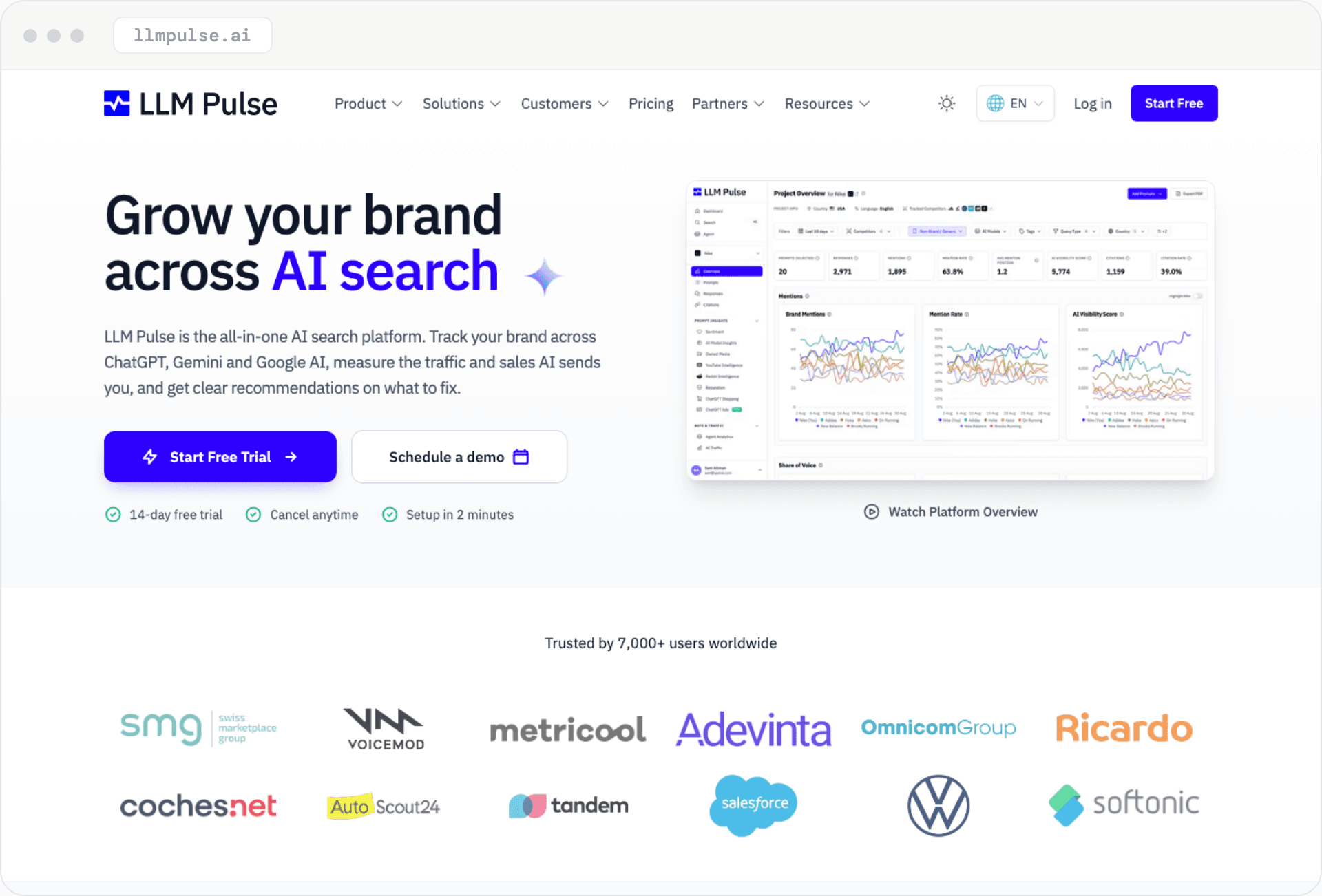
Best for: teams that want AI visibility as its own discipline rather than a tab inside an SEO platform.
A dedicated AI-search analytics platform, not an SEO suite with tracking bolted on. It covers Google AI Mode, ChatGPT, Perplexity, Gemini, and AI Overviews from one dashboard, with sentiment, share of voice, white-label reports, and unlimited seats. AI Mode is one of the engines in the €49/mo ($60) Starter plan, which tracks weekly by default, with daily-refresh plans available. Watch-for: it does no classic SERP rank tracking, so you keep a separate tool for that.
Rankscale
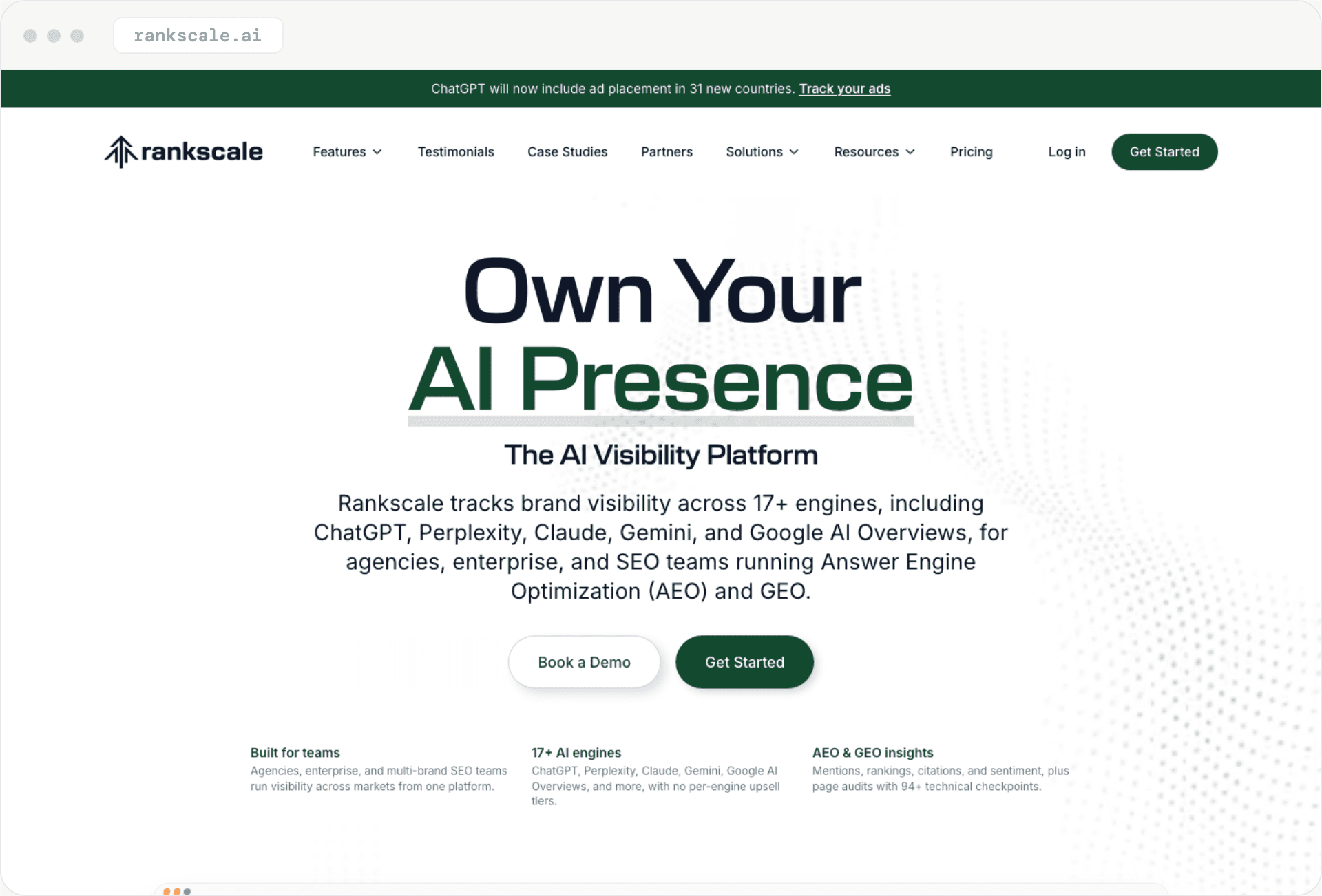
Best for: small teams that want the widest engine coverage for the least money and can live with lighter reporting.
The value pick for breadth. Rankscale tracks 17-plus engines including Google AI Mode from a credit-based Essentials plan at €20/mo, with configurable schedules from hourly to monthly. Watch-for: analytics are shallower than pricier tools and the credit model limits how much you can run at the entry price.
Otterly.ai
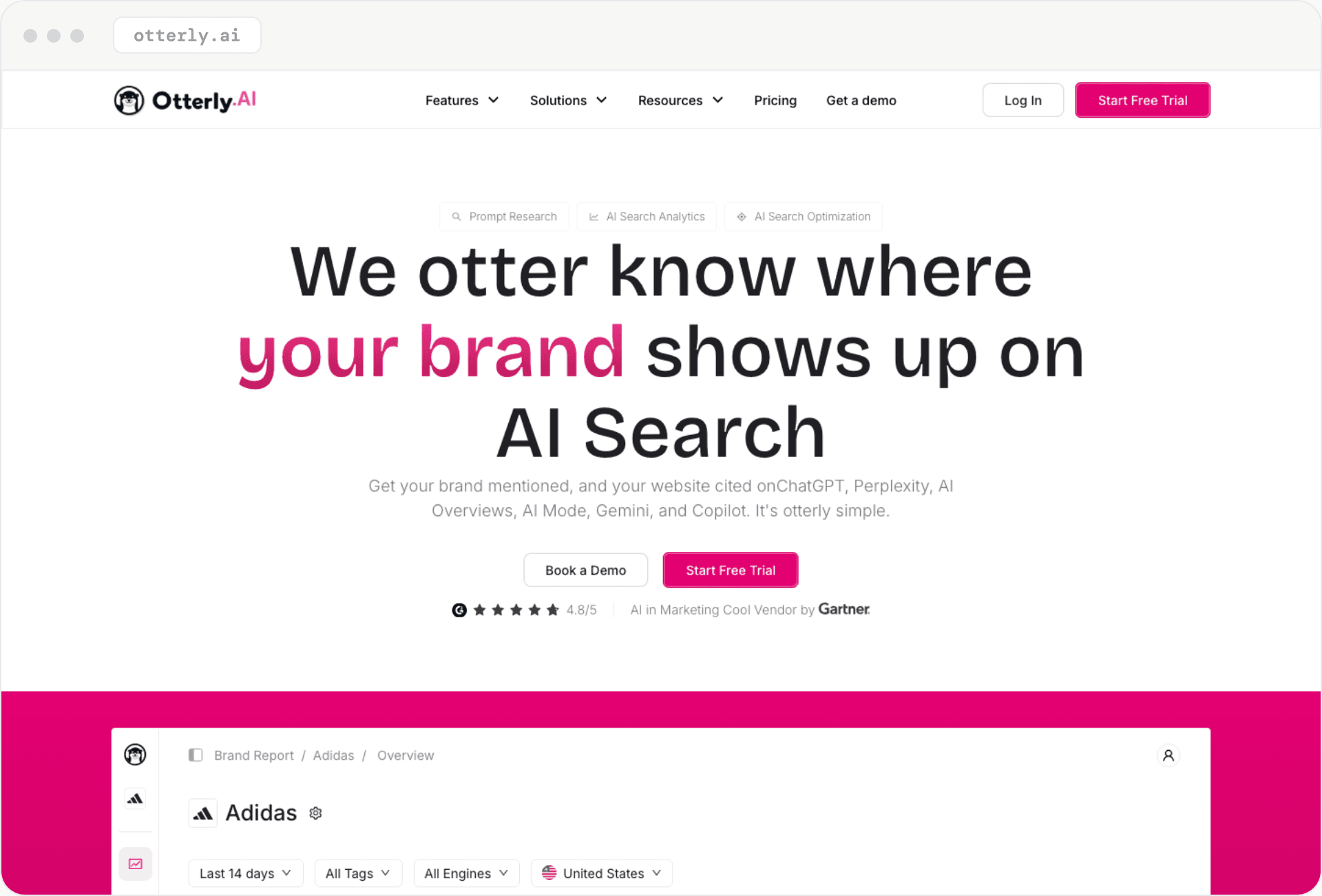
Best for: budget teams that want multi-engine coverage and will price in the AI Mode add-on.
Human-like monitoring that reads the live AI interfaces the way a real user would, across many platforms with sentiment and location tracking. The catch is the one buyers miss: Google AI Mode is a paid add-on (about €9/mo) on top of the €29 Lite plan, not part of the base price. Watch-for: the Lite plan caps you at fifteen prompts, so factor in both the add-on and a likely tier bump.
Nightwatch
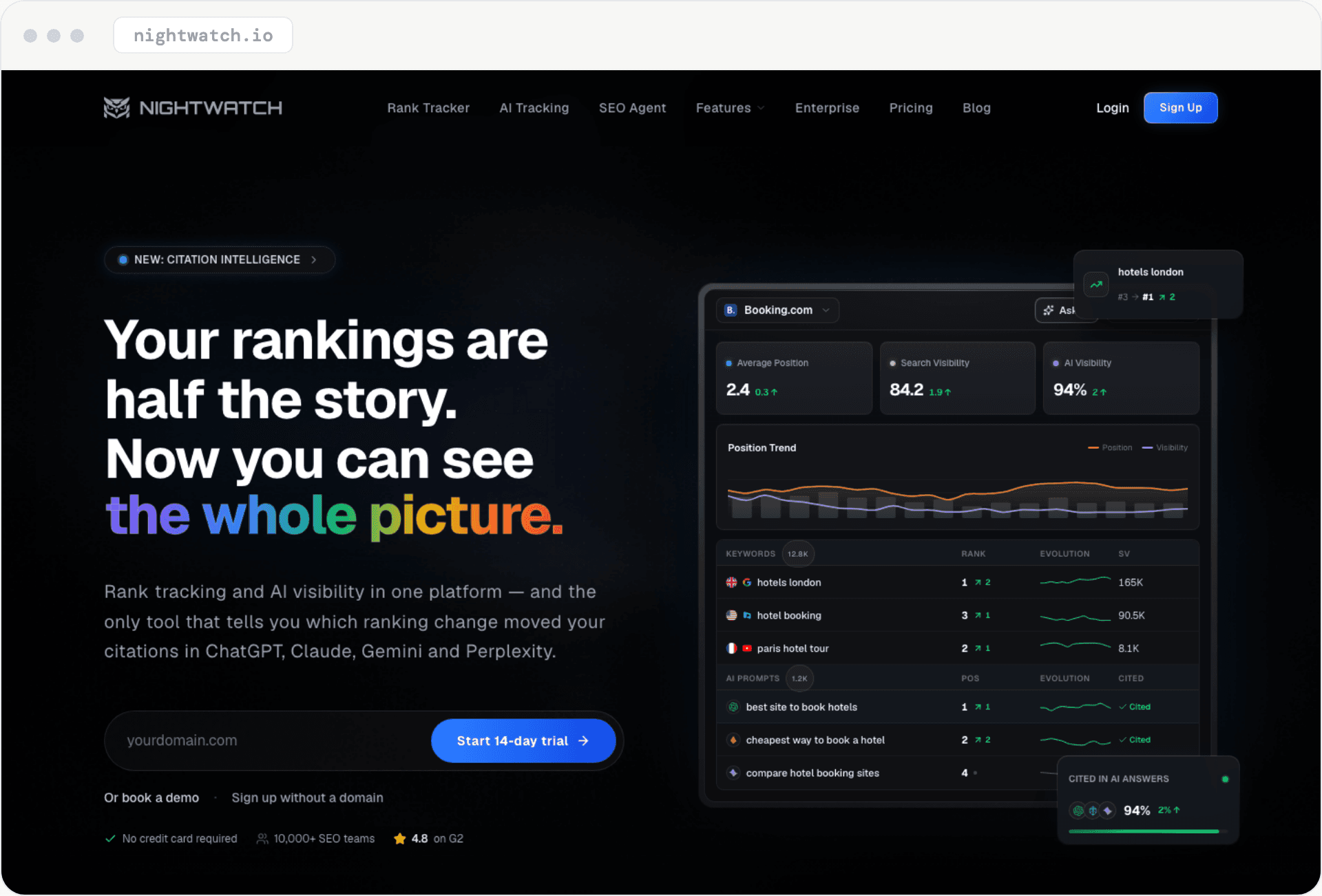
Best for: SEO teams that need granular geographic segmentation.
Precision and local tracking. Nightwatch shows how AI Mode answers change by location down to the neighborhood, which matters for local and multi-market brands, with AI Mode in the €79/mo Starter plan and daily refresh. Watch-for: fewer engines than the AI-first specialists, and no dedicated sentiment analysis.
Omnia
Best for: lean teams that want the tool to tell them what to publish next.
A monitoring tool with an execution layer. Beyond tracking inclusion and share of voice, Omnia turns citation gaps into content briefs, so it is aimed at small teams that need to act on the data, not just read it. AI Mode is in the €79/mo Growth plan with daily refresh and a fourteen-day trial. Watch-for: the content-recommendation focus is more than a team wanting plain monitoring needs.
Peec AI
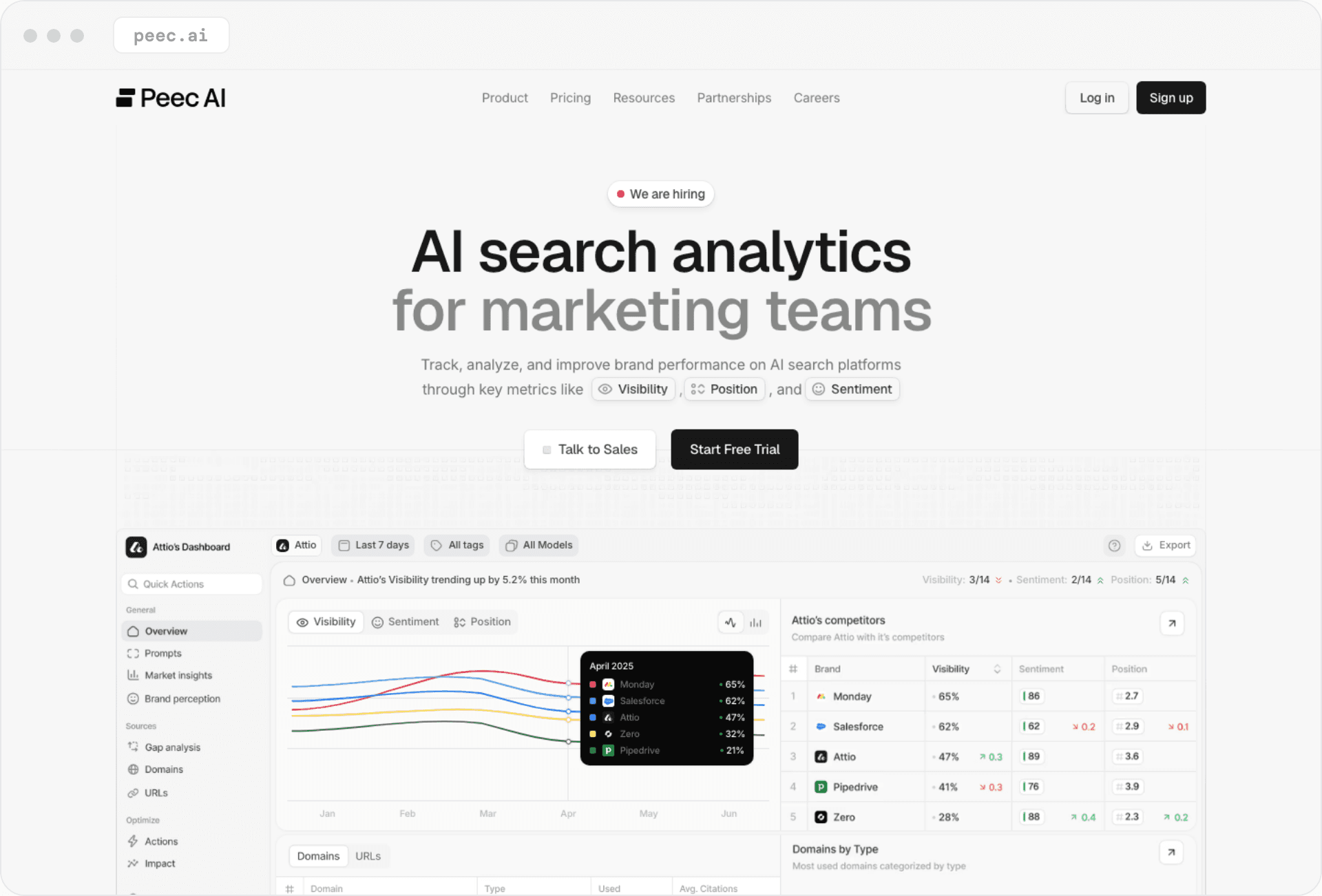
Best for: B2B and ecommerce brands that want accurate daily tracking and reputation flags.
Daily monitoring with a useful extra: hallucination detection that flags when an AI answer attributes a false claim to your brand, plus AI shopping-search tracking for ecommerce. AI Mode is in the base Starter plan at €85/mo. Watch-for: it is monitoring-only, with no content workflow, and the digital-PR features add less for pure content teams.
Rankability
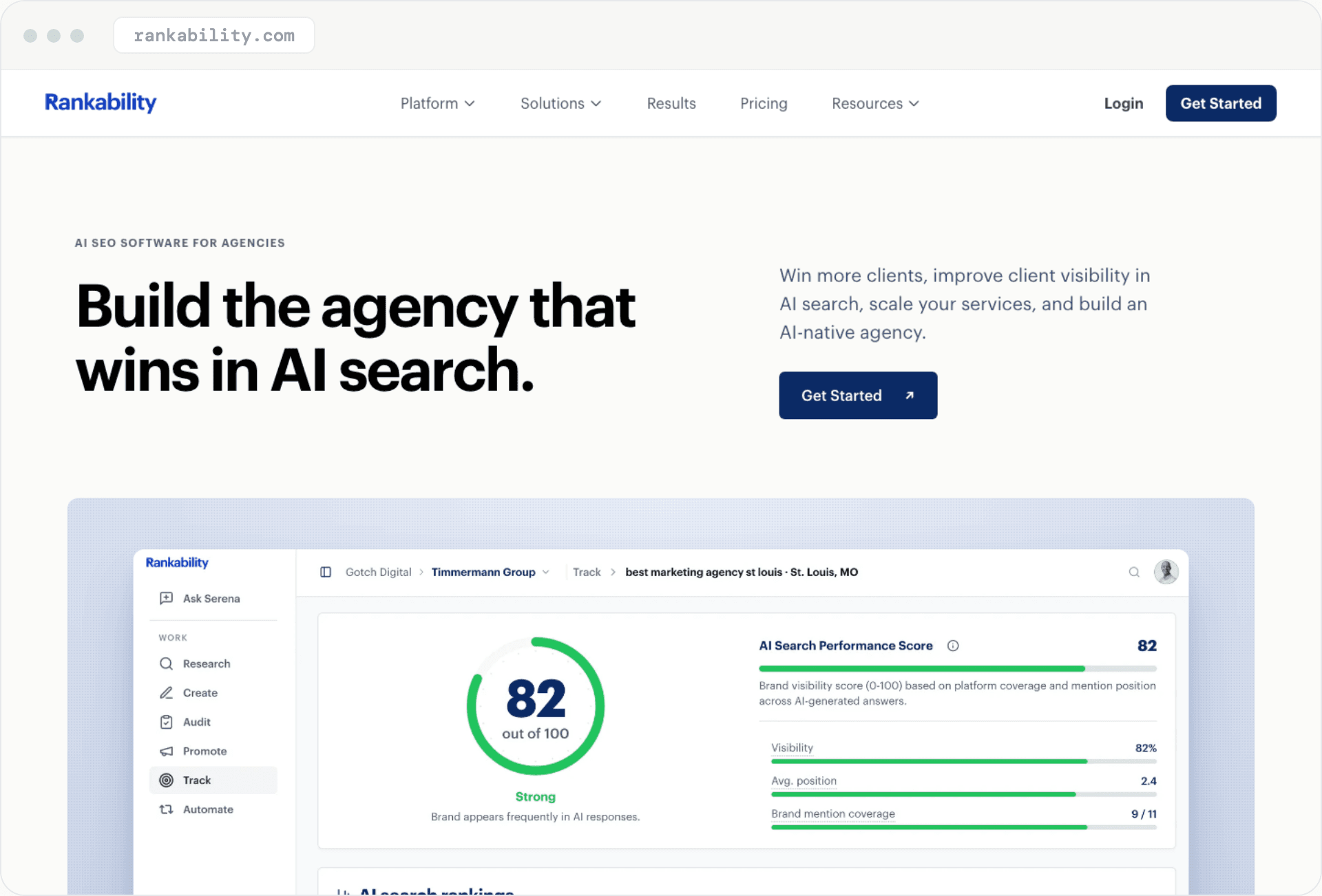
Best for: agencies that want a single shareable visibility number per client.
Built for agencies, Rankability rolls traditional rankings, AI mentions, and AI citations into a single Search Performance Index score for client dashboards. AI Mode sits in the base Starter plan at $99/mo, alongside ChatGPT and Claude, with daily refresh and citation-gap analysis. Watch-for: it is a full AI-SEO platform, so the tracker is one module of a broader toolkit you are also paying for.
Semrush AI Visibility Toolkit
Best for: teams consolidating rather than adding a separate vendor.
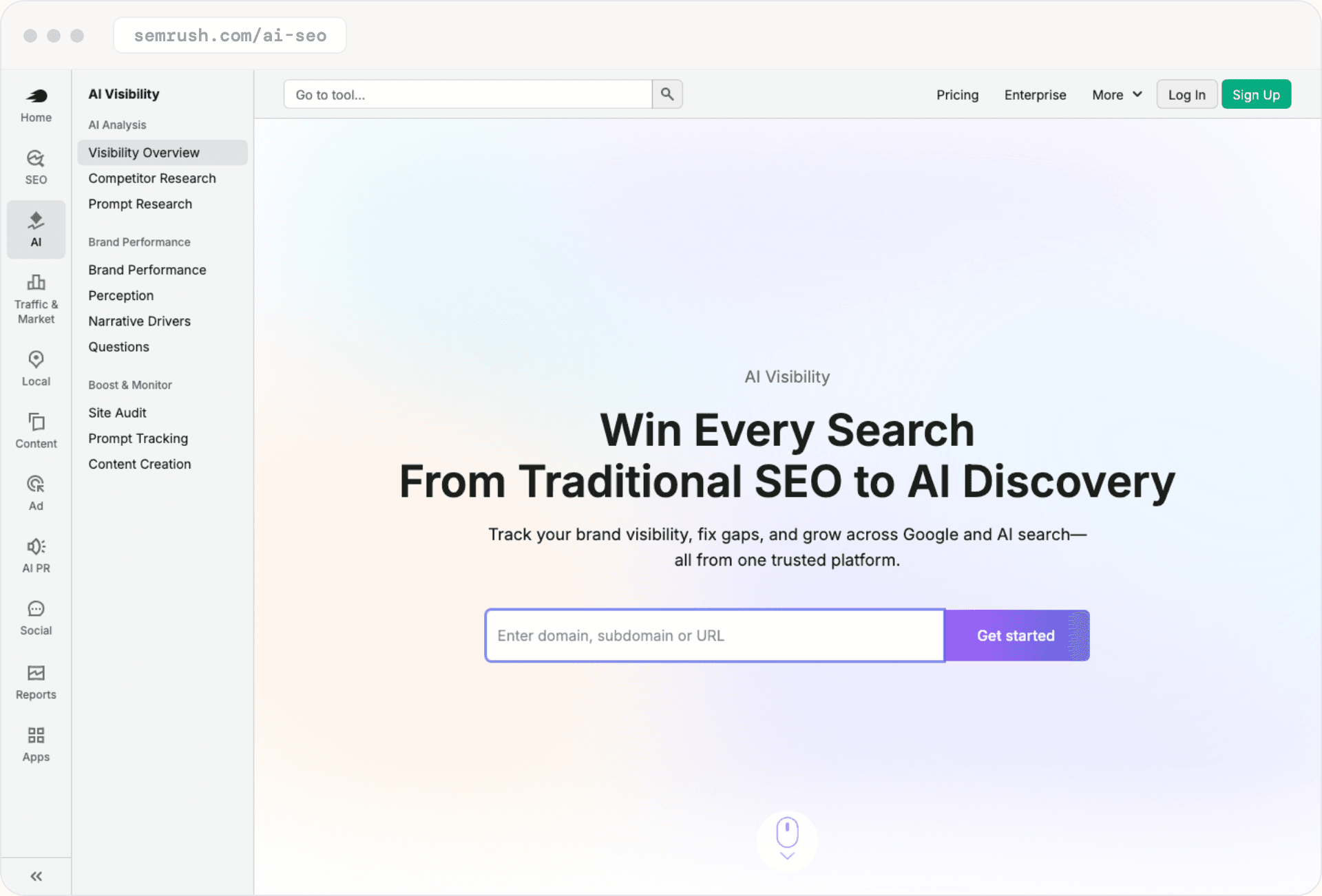
If your team already lives in Semrush, this keeps AI Mode data beside your keyword and competitor work. Worth correcting a common claim: the Toolkit does track Google AI Mode, not just AI Overviews, verified on Semrush's own documentation. It runs $99/mo per domain. Watch-for: that price covers a single domain and a limited prompt count, so agencies scale up fast, and the AI features are newer than the core suite.
SE Ranking
Best for: teams that want one login for both traditional SEO and AI visibility.
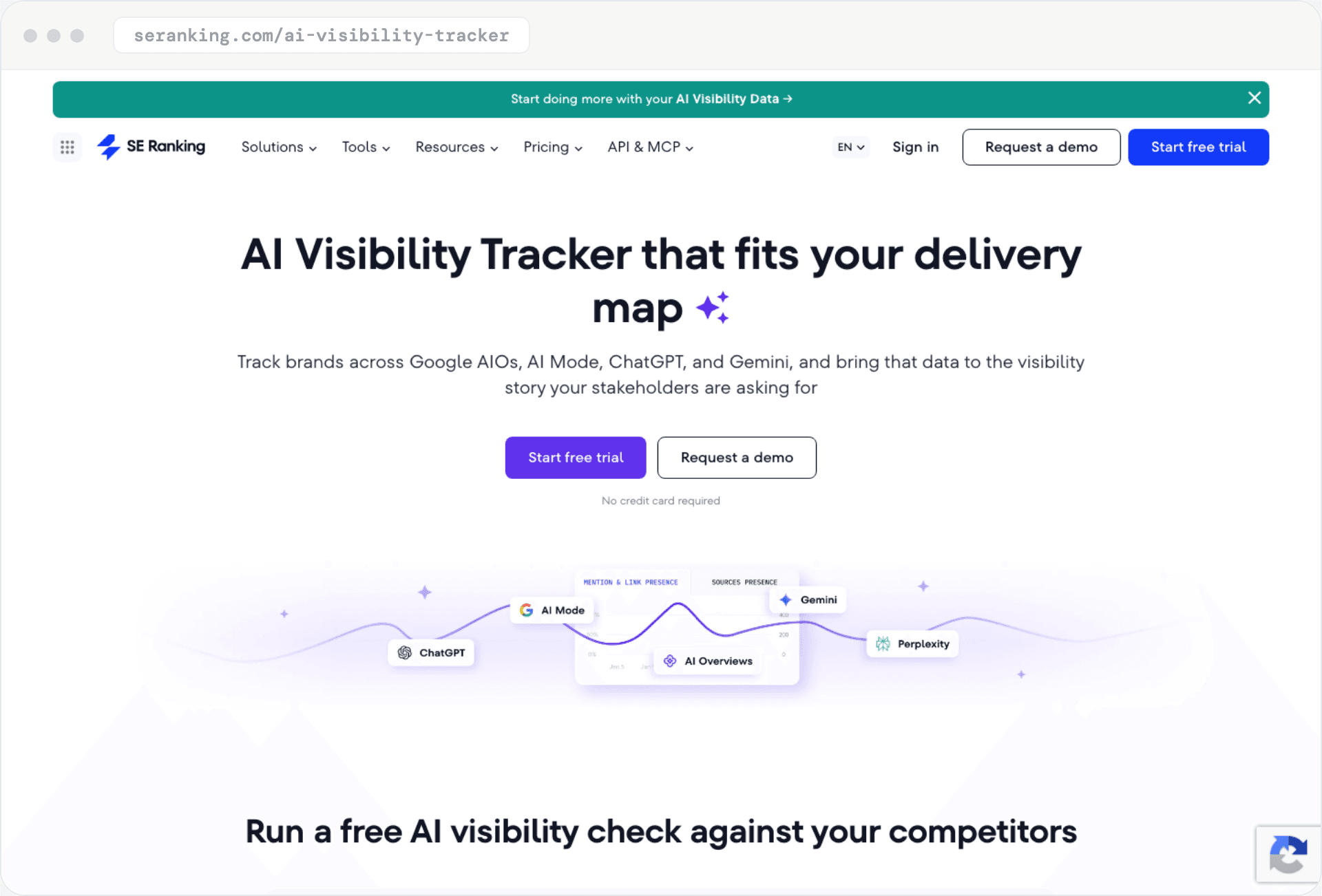
An all-in-one SEO suite where AI Mode tracking is a paid extension. You get rank tracking, audits, and backlinks in the Core plan at $129/mo, then add the AI Search module at $89/mo for AI Mode, mention, and citation tracking with cached answer snapshots. Watch-for: the AI features are an add-on cost, so budget the combined figure, and the AI tools are less mature than the core suite.
Ahrefs Brand Radar
Best for: SEO teams that want to see how backlinks correlate with AI-cited pages.
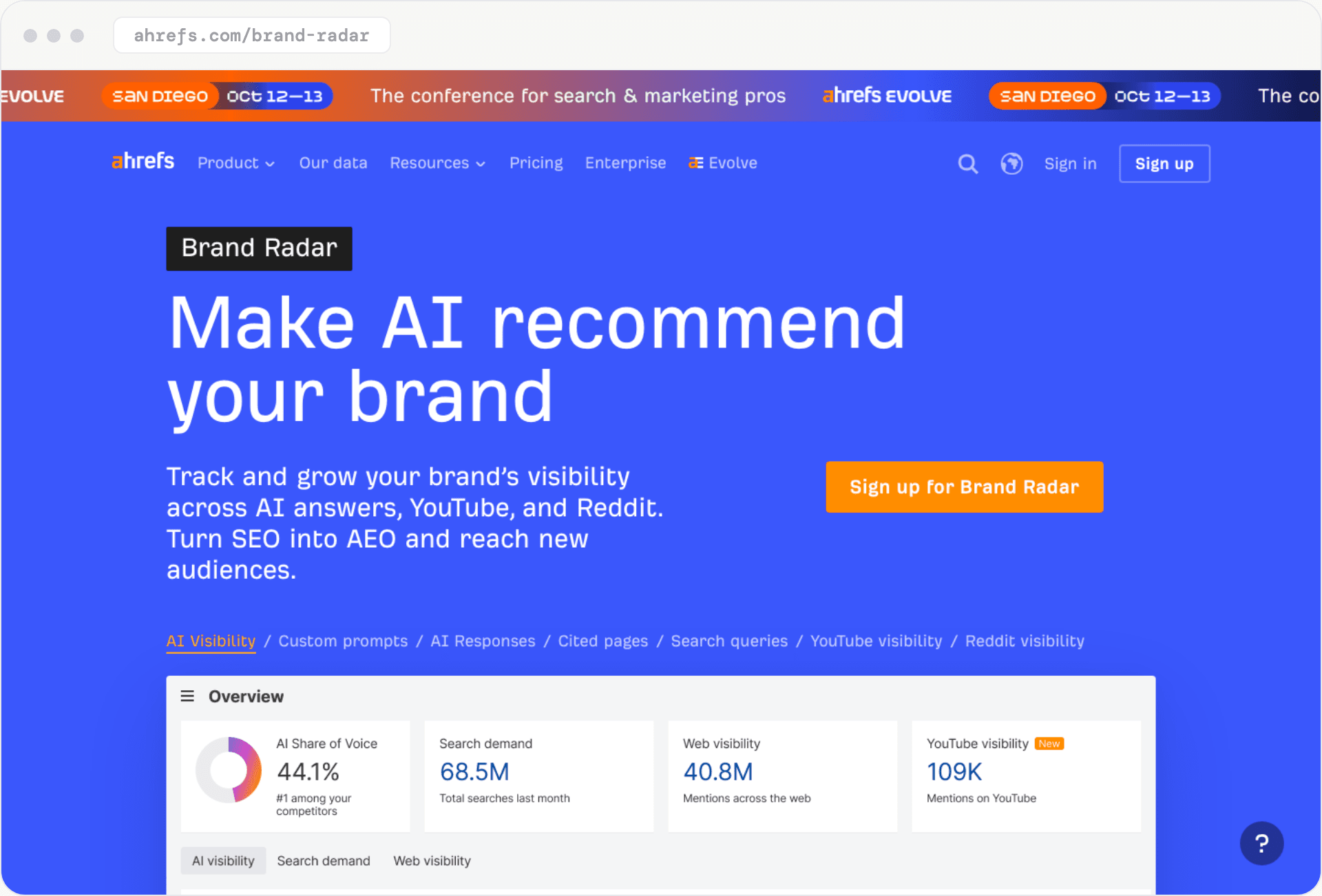
Ahrefs added AI visibility to its backlink platform, so its edge is connecting AI citations to the link and ranking data behind them. Custom AI-Mode prompt tracking comes with any paid plan (Lite from about $129 for 150 checks a month), and the full AI Mode index is a further ~$199 add-on. Watch-for: refresh runs daily to monthly depending on plan, there is no sentiment analysis, and the all-in cost climbs fast once you add the index.
Profound and Scrunch AI: The Enterprise-Gated Tier
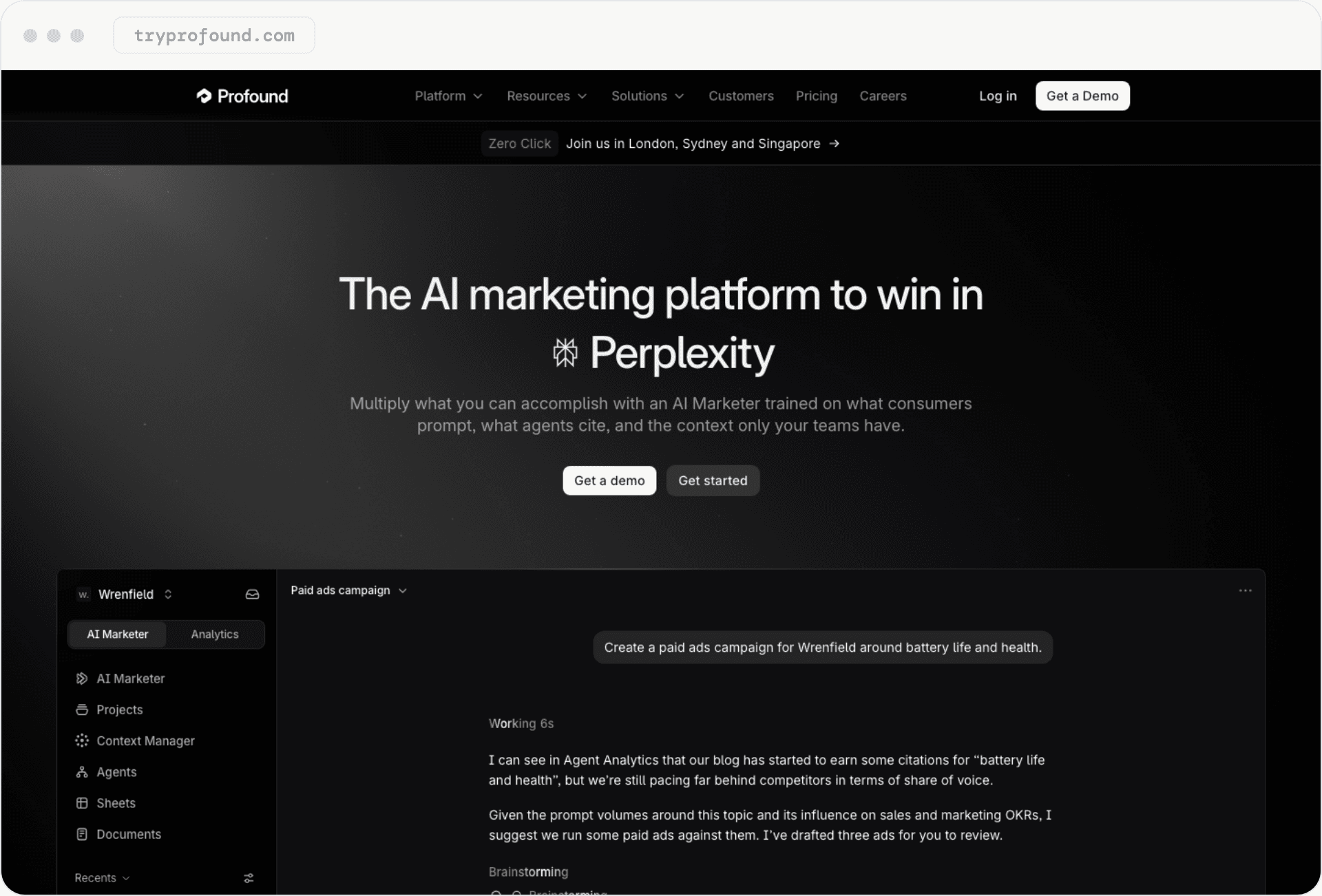
A pair of well-known names put AI Mode out of reach of their self-serve plans entirely. Profound no longer has a paid self-serve plan for brands; its free trial covers ChatGPT, Gemini and Google AI Overviews only, and Google AI Mode arrives just on a custom Enterprise contract, which covers its full nine-engine set. Scrunch AI is the same story, with AI Mode reserved for Enterprise while its lower Core plan excludes it. Neither publishes a number on the plan that finally includes AI Mode. Both are capable platforms built for enterprise scale and compliance, but if Google AI Mode is your reason for buying, know that the price is a sales call, not a published figure.
geotoolbox
Best for: teams that treat a missing citation as a bug to diagnose and fix.
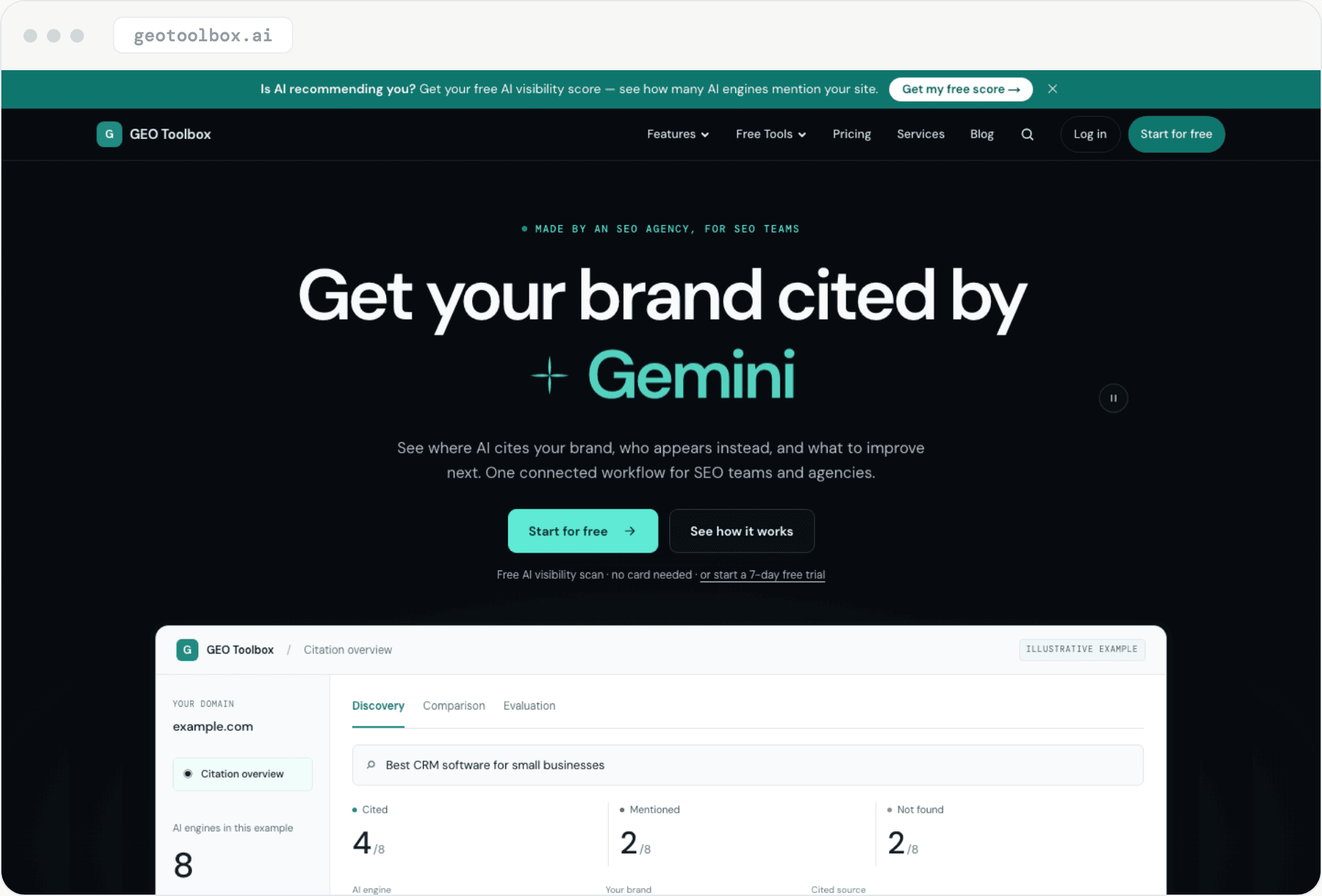
Full disclosure: this is our tool, and we hold it to the same rule as everyone else here. geotoolbox tracks eight engines, with Google AI Mode and AI Overviews as separate surfaces, and pairs the citation and share-of-voice data with an Agent Readiness scan that checks whether the page an answer should cite is even reachable, so you can see what is blocking a citation, not only that one is missing. The honest catch is the one we flag in competitors: AI Mode is not in the $99 Starter, which covers ChatGPT, Perplexity, and AI Overviews only. It starts on the Plus plan at $199/mo, where you pick five of the eight engines, with GSC and GA4 integration built in. Watch-for: AI Mode sits a tier above entry, and scans are weekly rather than daily. For the wider field of AI-visibility platforms beyond AI Mode, our best AI visibility tools roundup compares them by job.
How to Confirm a Tool Really Tracks AI Mode (Not AI Overviews)
Vendor demos show polished charts. Few prove the charts come from AI Mode rather than the AI Overview block or a generic Gemini API call. You can settle it in about thirty minutes with seven checks before you sign anything.
- Ask for a timestamped screenshot of the actual AI Mode tab. Not parsed data, not the AI Overview box. The real AI Mode interface, with the full answer and its inline citations. If a vendor cannot show it, they are probably tracking Overviews and calling it AI Mode.
- Check citations are captured at the URL level. The dashboard should show specific cited pages, for example
competitor.com/pricingas its own line, not just "competitor.com cited five times." - Confirm queries run logged-out and per-country. Configure the same prompt for two countries and verify the citations differ. Identical results across countries, or a logged-in session, means personalization is contaminating the data.
- Make them separate AI Mode from AI Overviews. A credible vendor can explain the technical difference and show distinct data for each surface. Interchangeable language is a red flag.
- Get raw answer-text export, not just metrics. You want the full captured answer with timestamps in a CSV or API, so you can audit what the tool actually saw.
- Verify it queries live, localized AI Mode. Some tools approximate AI Mode by calling a Gemini API, which is not the same product and cites a different mix of sources. Ask directly whether the data comes from the live AI Mode interface in your target markets.
- Check it handles follow-up prompts. AI Mode is a conversation, so ask whether the tool can track a follow-up question and show how the citations shift between the opening query and the next one. Single-query-only tools miss where you lose the thread.
A tool that passes all seven is doing the real job. One that stumbles on the screenshot or the AI-Mode-versus-Overviews question is selling you a relabeled Overview tracker, and you should price it accordingly.
Free and DIY: Can You Track AI Mode Without Paying?
Partly, and it is worth doing before you buy anything. The manual method costs nothing but time.
Pick the ten questions where being cited in AI Mode would matter most to your business. Open the AI Mode tab in a clean, logged-out session, ask each one, and log whether you are cited, who is cited instead, and which of your URLs appears. Re-run the set on a schedule, weekly is enough for most brands, and watch the trend rather than any single result. Pair it with two free signals: the Search Console generative-AI report, which shows AI Overview and AI Mode impressions (lumped together, no clicks), and your branded-search trend, which tends to lift when AI answers start naming you. Our walkthrough on how to measure your AI visibility covers the manual setup in more depth, and the AI visibility audit turns it into a repeatable checklist.
What free will not give you is scale or memory. Ten prompts by hand is manageable; a hundred prompts across three countries, re-run weekly with stored history and competitor share of voice, is not. Search Console will not split AI Mode from Overviews or show you a single click, and it cannot tell you which competitor took the citation you wanted. The moment you need more than a spot check, a repeatable prompt set, or a number you can put in front of a client, the manual method stops paying for itself. That is the line where a paid tracker earns its price, and the tools compared above are how you cross it.
Frequently Asked Questions
Can I track Google AI Mode for free with Search Console?
Only partly. Since June 2026, Search Console has had a generative-AI performance report, now available to all websites worldwide as of August 31, 2026, but it counts AI Overview and AI Mode impressions together, shows no clicks, and gives you no way to isolate AI Mode. For a free spot check, ask your top buyer questions in the AI Mode tab yourself and log whether you are cited. For prompt-level coverage, competitor citations, and history, you need a dedicated tool.
How much does an AI Mode rank tracker cost, and why is real coverage gated above the entry tier?
Plans that include AI Mode start around €20 a month at the budget end and run into custom enterprise pricing. The trap is that several tools advertise a low headline price, then place AI Mode behind an add-on or a higher tier: Profound and Scrunch reserve it for Enterprise, Otterly and SE Ranking charge an add-on on top of the base plan, and geotoolbox (ours) puts it a tier above its own entry plan. Always confirm which plan actually includes AI Mode before comparing prices.
Does Google AI Mode actually drive traffic?
Less than classic search, and it is harder to measure. AI Mode answers are designed to satisfy the question in place, so they generate fewer clicks than a page of links, and briefly at launch in May 2025 the links even carried a noreferrer attribute that hid the traffic from analytics until Google fixed it within days. The value today is less about direct clicks and more about being the source Google's AI trusts, which supports branded search and downstream demand. Measure presence and share of voice, and watch branded search for lift.
Which AI Mode rank tracker is best?
There is no single winner, because the right tool depends on your job. Dedicated platforms like LLM Pulse go deepest on AI visibility, suite add-ons like SE Ranking and Semrush suit teams consolidating tools, and enterprises with compliance needs pay a premium for Scrunch or Profound. Pick on whether AI Mode is in a plan you can afford, how many other engines you need, and whether you want the fix or just the flag.
Which AI Mode Rank Tracker Should You Pick?
So name your job and the pick follows. For the deepest AI-visibility analytics, LLM Pulse goes furthest. On a tight budget, Rankscale covers the most engines for the least. If you already run an SEO suite, SE Ranking or Semrush add AI Mode beside your rankings with the least friction. Regulated enterprises pay up for Scrunch or Profound. And if you want the reachability check that explains a missing citation, that is the gap we built geotoolbox to close. The rule that outranks all of them: if AI Mode is gated above the tier you can afford, that tool is not cheap, whatever its headline price says.
Whichever you choose, do the reachability check first, because the fastest way to be missing from AI Mode is a page its crawlers cannot load. You can rule that out in a minute with our free AI Crawler Checker, which tests whether the named AI agents can actually fetch and render your pages. It is the cheapest fix in this whole discipline, and no tracker can do it for you.
When you are ready to track, geotoolbox runs your prompts across eight engines, Google AI Mode among them, and pairs the result with the same reachability check, so you see where you stand and what is holding a page back. It will not hand you a clean click count, because no honest tool can yet, but it will tell you whether you are in the answer.
Sources
- Are AI Mode and AI Overviews Just Different Versions of the Same Answer? (730K Responses Studied) - Ahrefs, 2025 (AI Overview and AI Mode cited sources overlap 13.7%) -
ahrefs.com/blog/ai-overviews-vs-ai-mode - Introducing Search Generative AI performance reports in Search Console - Google Search Central, June 2026 (impressions, pages, countries, devices and dates) -
developers.google.com/search/blog/2026/06/gen-ai-performance-reports - Search at I/O 2026 - Google, May 2026 (AI Mode passed one billion monthly users) -
blog.google/products-and-platforms/products/search/search-io-2026 - Google's AI Mode traffic was untrackable - Search Engine Land, 2025 (AI Mode links carried a noreferrer attribute that hid analytics referrers, since fixed) -
searchengineland.com/googles-ai-mode-traffic-untrackable-455883 - Google links in AI Mode answers (1.3M citations analyzed) - SE Ranking, 2026 (Google's own domains most-cited at 17.42%) -
seranking.com/blog/google-links-in-ai-mode-answers - Tool pricing and plan details verified vendor-direct on September 1, 2026 from each provider's own pricing page.