
Most "best GEO tools" lists rank the author's own product first and bury the disclosure. This one groups the tools by what they actually do, tells you where the free options are, and says plainly which one is ours. If your budget is zero for now, start with our best free SEO tools guide, which includes the free way to check your AI visibility.
Generative engine optimization (GEO) tools help you see and improve how AI engines like ChatGPT, Perplexity, and Google AI Overviews cite your brand. But "GEO tool" covers five very different jobs, from prompt-level visibility tracking to checking whether AI crawlers can even reach your pages. Buying the wrong category is the easiest mistake to make, so we have grouped them by use case rather than forcing a ranked list. If Perplexity is the engine you care about most, we compare the best Perplexity rank trackers separately, and the best Claude rank trackers if it is Claude. And if the tracker category is the one you're buying, our best AI visibility tools comparison ranks those head-to-head with per-tier pricing.
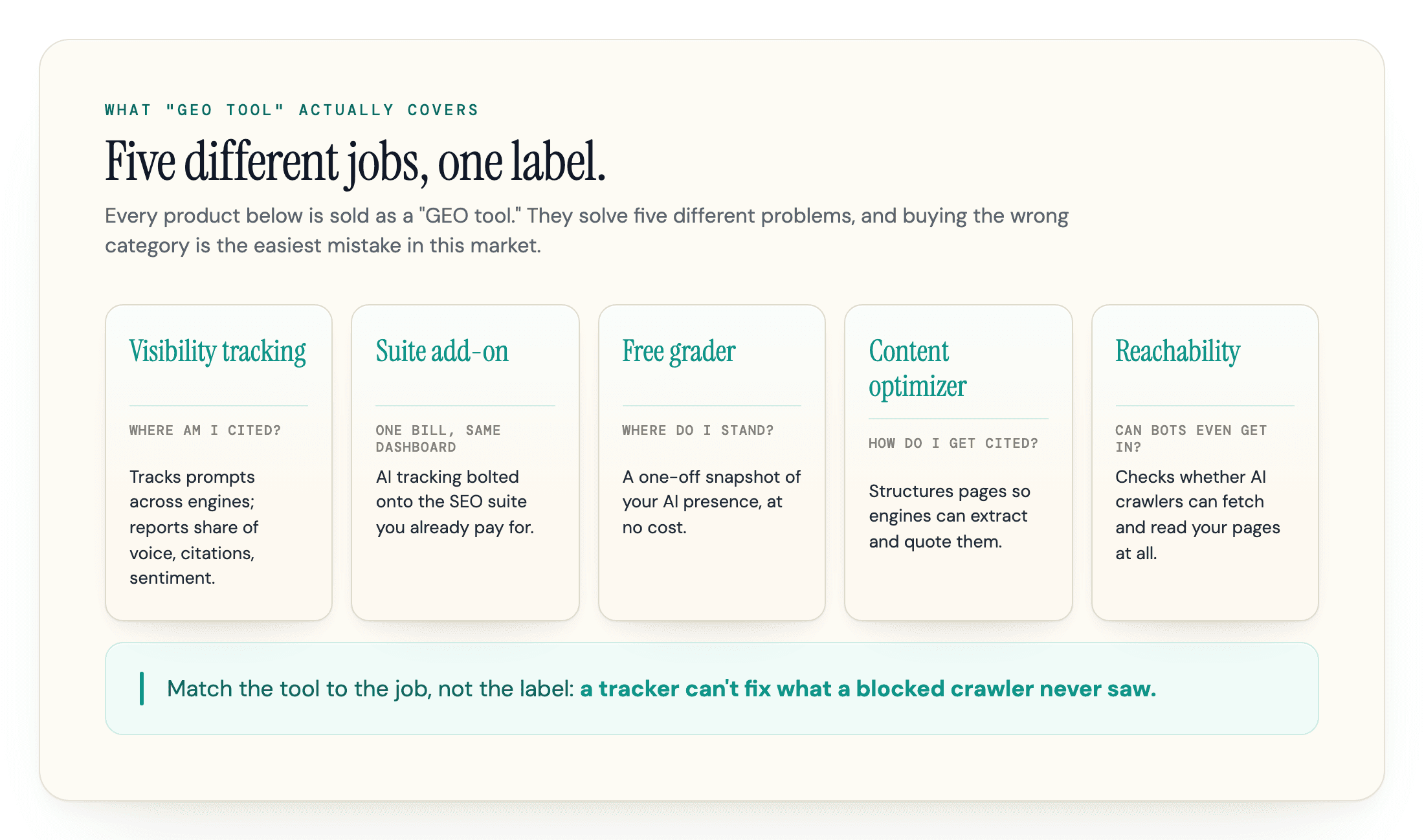
Disclosure: Geotoolbox, the site you are reading this on, makes a GEO tool. We have included it below, labeled it clearly, and placed it in the categories it actually fits, not at the top. Every price and plan here was re-verified against each vendor's live pricing page in July 2026 (Ahrefs Brand Radar re-verified August 2026). Pricing in this space changes often, so confirm current numbers on each tool's site before you buy.
How We Evaluated These Tools
We looked at each tool on the criteria buyers actually weigh, not feature-count vanity:
- Engines covered. ChatGPT, Perplexity, Google AI Overviews and AI Mode, and Gemini are the table stakes. Coverage of all the major ones matters more than depth on one.
- Pricing and free tier. Whether you can start free, self-serve at a published price, or only "book a demo."
- Scope. Tracking (where am I cited), optimization (how do I write to get cited), or reachability (can the engine even fetch my page). These are different problems.
- Methodology transparency. A visibility score with no stated method is a red flag.
- Fit. Standalone tool, add-on to an SEO suite you already pay for, or a quick free grader.
Why this matters now: AI search is no longer a fringe channel. Pew Research found that 44% of US adults had used ChatGPT per a survey published June 2026, up from 34% a year earlier and 18% in 2023. On the classic-search side, Ahrefs' re-run on December 2025 data found that AI Overviews correlate with a 58% lower click-through rate for the top organic result, up from the 34.5% it measured in April 2025. When fewer people click and more answers come from AI summaries, being cited in those summaries is how you stay visible, which is exactly what these tools measure. For the full landscape these tools operate in, see our 2026 state of AI search report.
The category is also consolidating fast. Adobe closed its Semrush acquisition this spring; Sitecore bought Scrunch AI in June. When the buyers are this big, packaging and pricing keep moving, which is why we date every number in this guide.
GEO Tools at a Glance
| Tool | Category | Free option | Paid from | Engines on entry plan | Best for |
|---|---|---|---|---|---|
| Profound | Visibility tracking | Free AEO Report | No self-serve brand tier; Enterprise custom | 3 on Trial (ChatGPT, Gemini, AI Overviews); up to 9 on Enterprise | Enterprise brand-citation analytics |
| Peec AI | Visibility tracking | Free trial | €85/mo (Starter) | Pick 3 of: ChatGPT, AI Overviews, AI Mode, Copilot, Perplexity, Gemini | Competitive benchmarking |
| Otterly.ai | Visibility tracking | Free trial | ~$29/mo | ChatGPT, AI Overviews, Perplexity, Copilot; Gemini, AI Mode, Claude as add-ons | SMB prompt tracking on a budget |
| Rankscale AI | Visibility tracking | Free Pro trial | From $20/mo (Essentials, credits extra) | ChatGPT, Gemini, Perplexity, Claude, Grok, Copilot, more | Cheapest multi-engine entry point |
| AthenaHQ | Visibility tracking | Free tier (300 credits) + 10-min audit | ~$295/mo (~$245 annual) | ChatGPT, Perplexity, AI Overviews, AI Mode, Gemini, Claude, Copilot, Grok, DeepSeek, Meta AI | Self-serve tracking without a sales call |
| Scrunch AI | Visibility tracking | 7-day trial | $250/mo entry | 4 on Core (ChatGPT, Perplexity, AIO, Copilot); 9 on Enterprise | Enterprise multi-brand tracking |
| Writesonic | Tracking + content | Free trial | $99/mo ($79 annual) | ChatGPT, Gemini, AI Overviews on all self-serve tiers | Tracking plus AI writing in one |
| Semrush AI Visibility | SEO-suite add-on | Free checker | $99/mo add-on (per domain) | ChatGPT, Google AI, Gemini, Perplexity | Existing Semrush users |
| SE Ranking / SE Visible | SEO-suite add-on | Free daily checks + trial | Add-on ~€63-79/mo; SE Visible from $99/mo | ChatGPT, Perplexity, Gemini, AI Overviews, AI Mode | SE Ranking users, or standalone via SE Visible |
| Ahrefs Brand Radar | SEO-suite add-on | Free AI visibility checker | $199/mo+ | AI Overviews, AI Mode, ChatGPT, Perplexity, Copilot, Gemini | Existing Ahrefs users |
| Mangools AI Search Grader | Free grader | Free (full model set with a free account) | Free | ChatGPT, Gemini, Mistral, Llama, DeepSeek, Claude | A quick one-off grade |
| HubSpot AEO Grader | Free grader | Free grader | ~$50/mo for ongoing | ChatGPT, Gemini, Perplexity | HubSpot users / free grade |
| Surfer SEO | Content optimizer | None stated | ~€49/mo billed yearly (AI tracking from ~€99) | ChatGPT on Standard; multi-engine from Pro | On-page content scoring |
| Frase | Content optimizer | 7-day trial | ~$49/mo ($39 annual) | Citation tracking on ChatGPT + Google AI; 5 engines on the Scale tier | Answer-first content briefs |
| Geotoolbox | Reachability + tracking | 7-day free trial | From $99/mo ($79 annual) | 3 engines on Starter (ChatGPT, Perplexity, AI Overviews); 8 engines by tier | Checking whether AI bots can reach + cite your pages |
Every price re-verified on the vendors' pricing pages in July 2026 (Ahrefs Brand Radar, Scrunch and AthenaHQ re-verified August 2026). It changes often in this category, so confirm on each tool's site.
SEO Suites with AI Add-Ons
If you already pay for an SEO suite, you may not need a separate GEO subscription. Several established platforms now bundle AI visibility as an add-on, which keeps your data in one place.
Semrush AI Visibility
Best for: existing Semrush users.
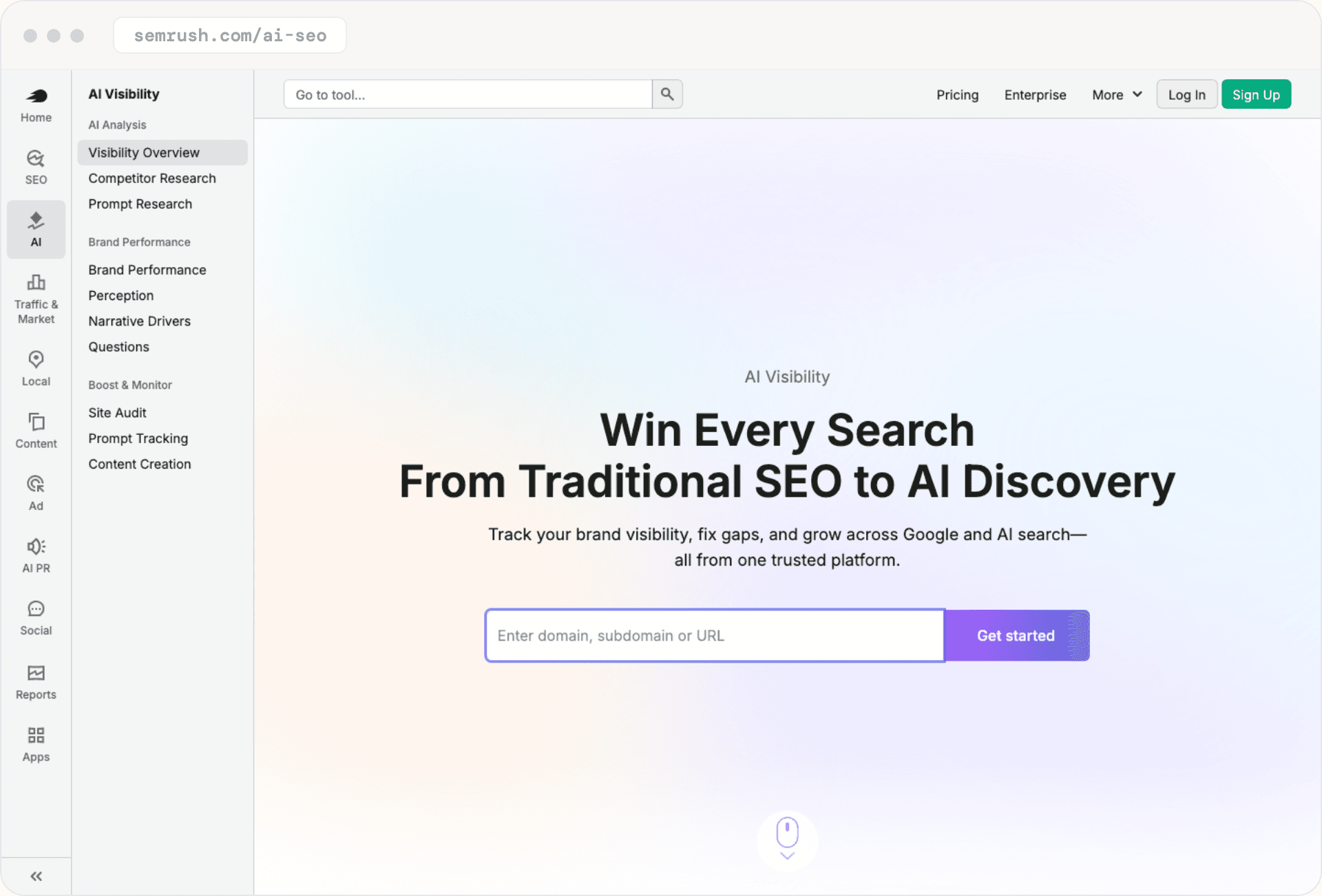
Semrush's AI Visibility Toolkit tracks AI share of voice, prompt-level rankings, and brand sentiment across ChatGPT, Google AI, Gemini, and Perplexity, with a free checker to start. Pricing is an add-on model rather than a standalone plan: $99 per month per domain covers 25 tracked prompts on either billing term, extra prompts are sold in blocks ($60 per month per 50, per Semrush's knowledge base), and the Semrush One bundles fold it in from $199 per month. Because it plugs into the wider Semrush data, you can line up AI citations against the same keywords and competitors you already track for classic search. The obvious pick if you already live in Semrush and want one bill rather than a separate tracker. One ownership note: Adobe completed its $1.9 billion acquisition of Semrush in April 2026 and launched Adobe Brand Visibility on June 17, an enterprise product built on Semrush's visibility data, so expect the packaging to keep shifting as the toolkit settles in under Adobe.
SE Ranking / SE Visible
Best for: SE Ranking users, or standalone via SE Visible.
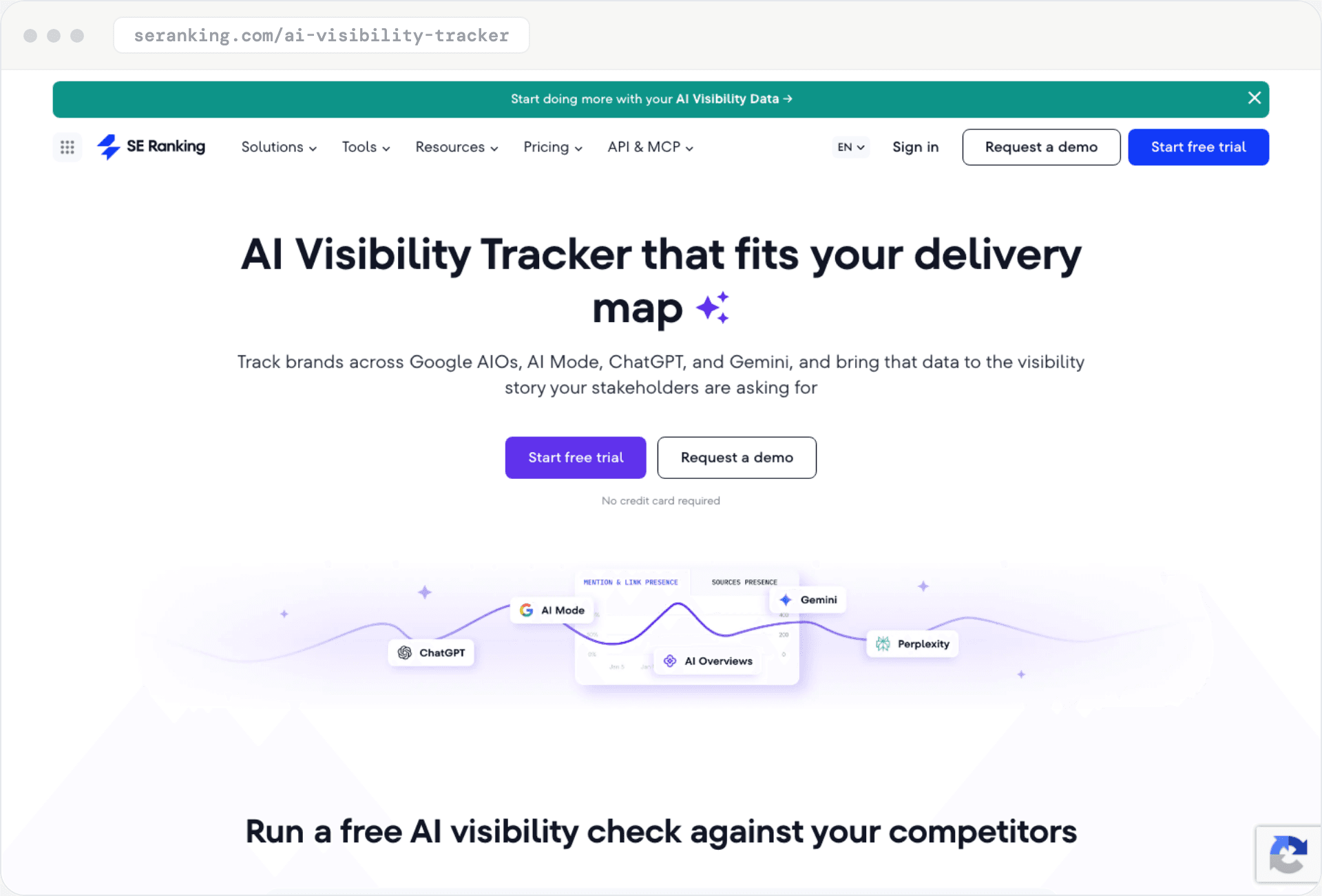
SE Ranking now sells AI visibility two ways. Inside the SEO suite, the AI Search add-on (€63.20 a month billed annually, €79 monthly, on top of a base plan) tracks brand performance for targeted prompts next to your organic positions, with free daily checks (5 per day) and a 14-day trial. And since 2025 there is SE Visible, a standalone AI-visibility platform built on the same data. Plans run $99 per month (200 prompts), $189, and $355, with a 10-day trial. It covers ChatGPT, Perplexity, Gemini, Google AI Overviews, and AI Mode, and adds a visibility score, sentiment, and competitor benchmarking. The add-on is the value route for existing SE Ranking users; SE Visible competes head-on with the dedicated trackers below.
Ahrefs Brand Radar
Best for: existing Ahrefs users.
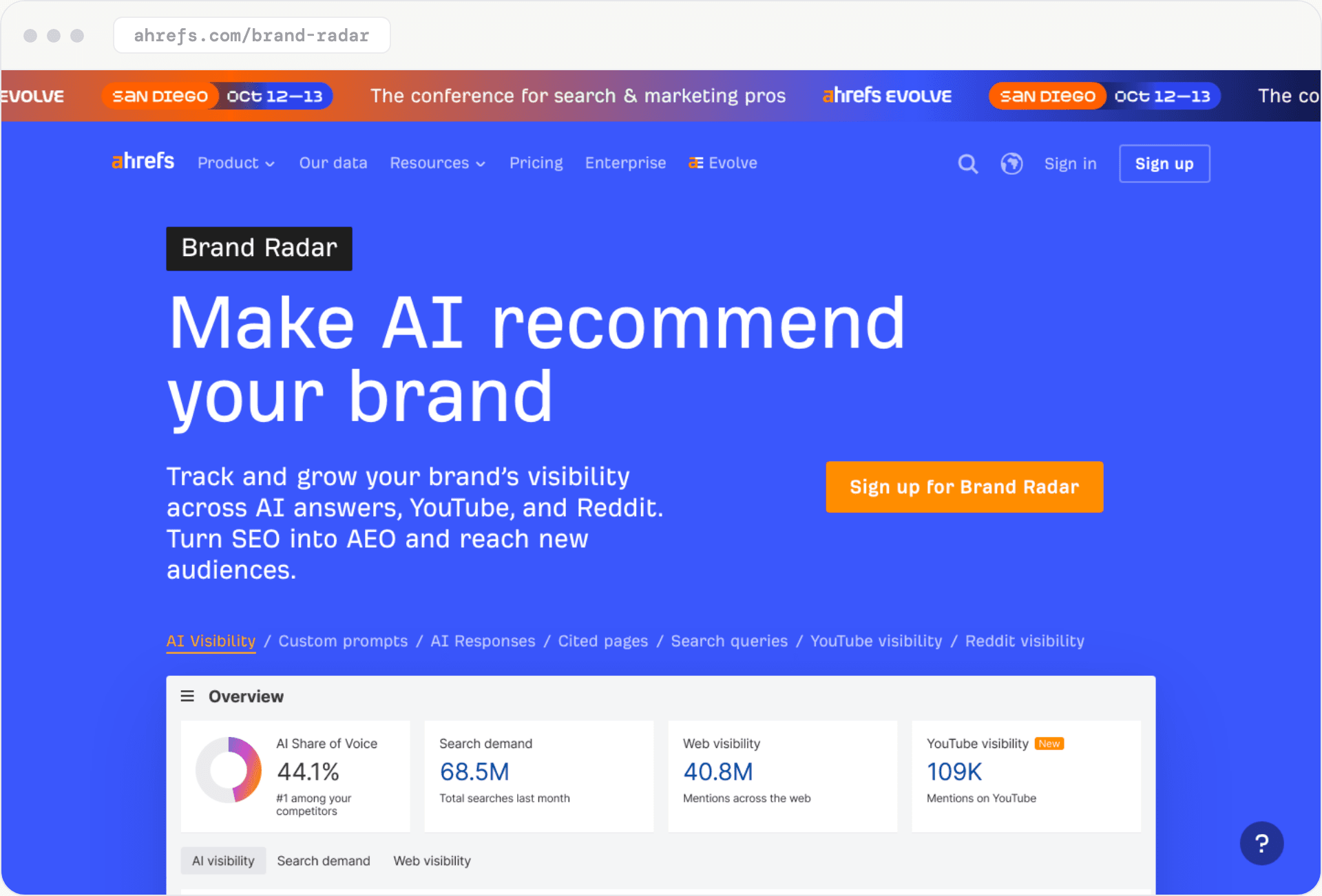
Ahrefs Brand Radar brings AI mention tracking into the Ahrefs ecosystem, reporting how often your brand and rivals surface in AI answers and which pages get cited, tied to the backlink and keyword data Ahrefs is known for. YouTube, TikTok, and Reddit tracking is bundled free while in beta, and a free AI visibility checker gives you a quick preview, but the AI tracking sits at the higher end, $199 per month per platform for selected platforms or $699 per month for all of them as of August 2026, so it makes sense mainly if you already pay for Ahrefs and want the AI layer in the same place as your link and rank data.
Free GEO Graders
If you just want a quick read on where you stand, start here. These give you a snapshot at no cost, which is the right first step before committing to a paid tracker.
Mangools AI Search Grader
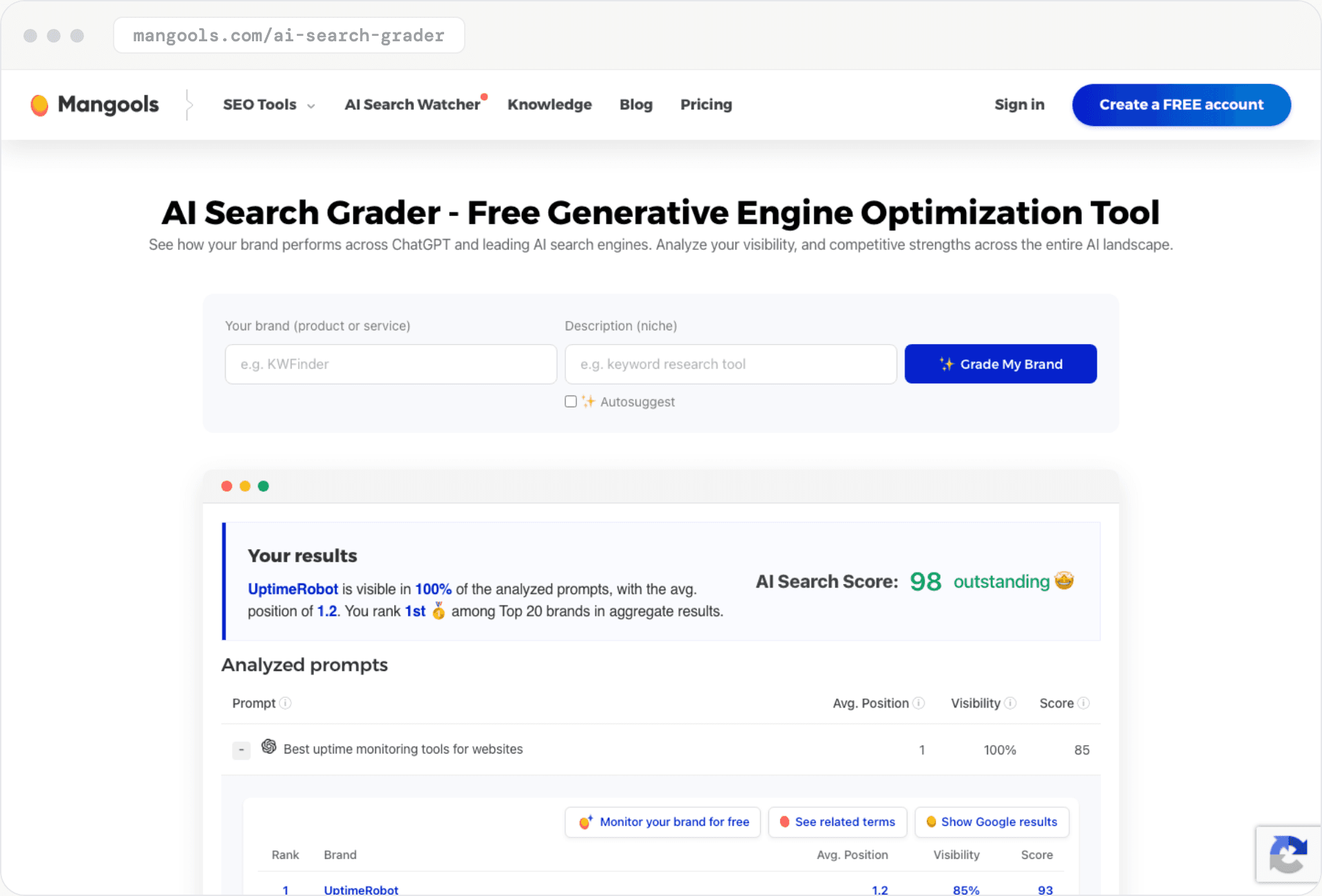
Best for: a quick one-off grade.
Mangools AI Search Grader is free to use, with a free account giving access to the full set of models, and evaluates your brand's visibility and performance across AI-powered search. A clean way to get a baseline.
HubSpot AEO Grader
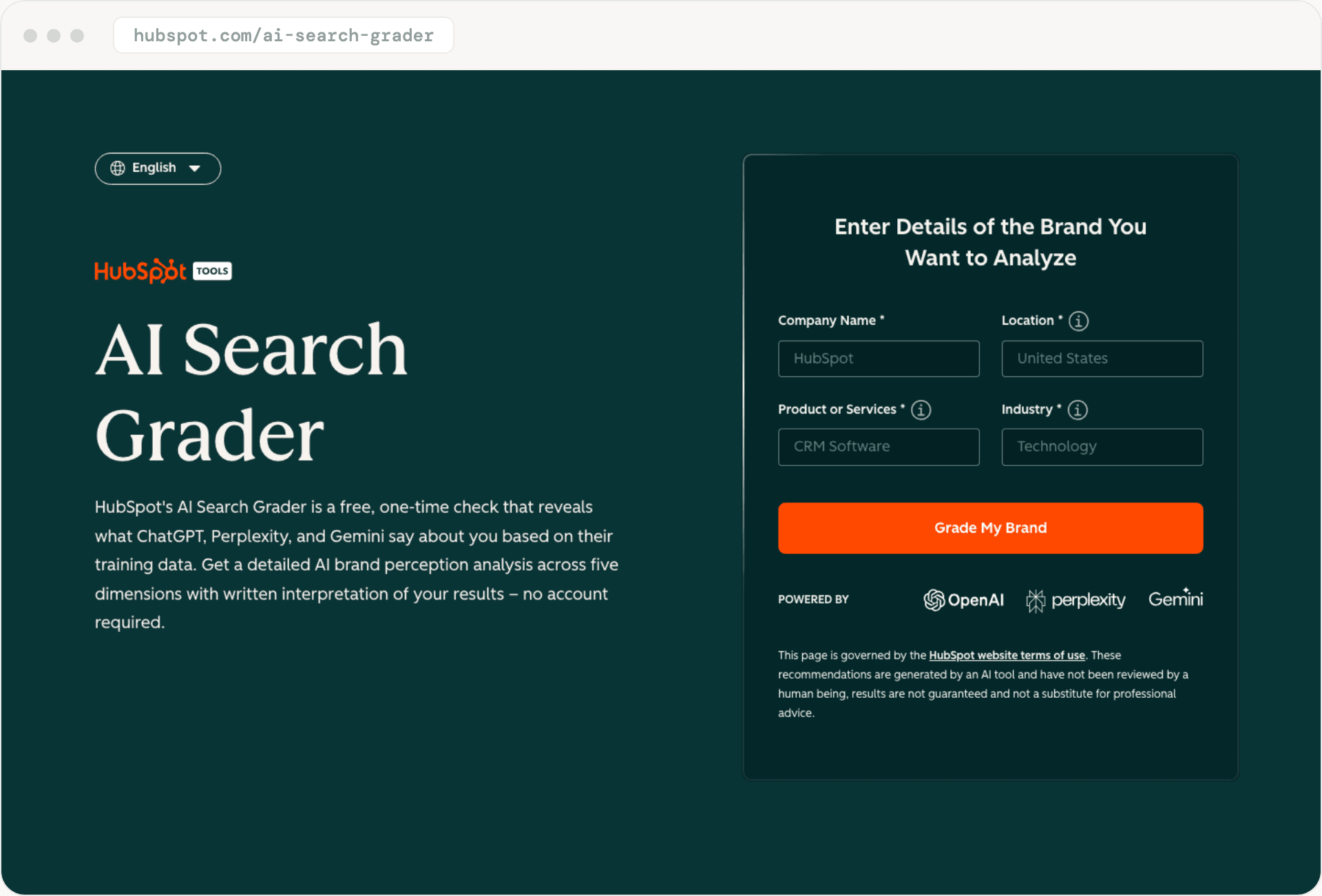
Best for: HubSpot users, or a free grade.
HubSpot's AEO Grader (HubSpot publishes the same tool as its AI Search Grader) is a free one-time grader, no account required, that scores your brand's presence across ChatGPT, Gemini, and Perplexity on a 100-point scale. Ongoing monitoring is a separate product, HubSpot AEO, at about $50 per month ($45 billed annually), no HubSpot subscription required. Convenient whether or not you already use HubSpot.
Geotoolbox
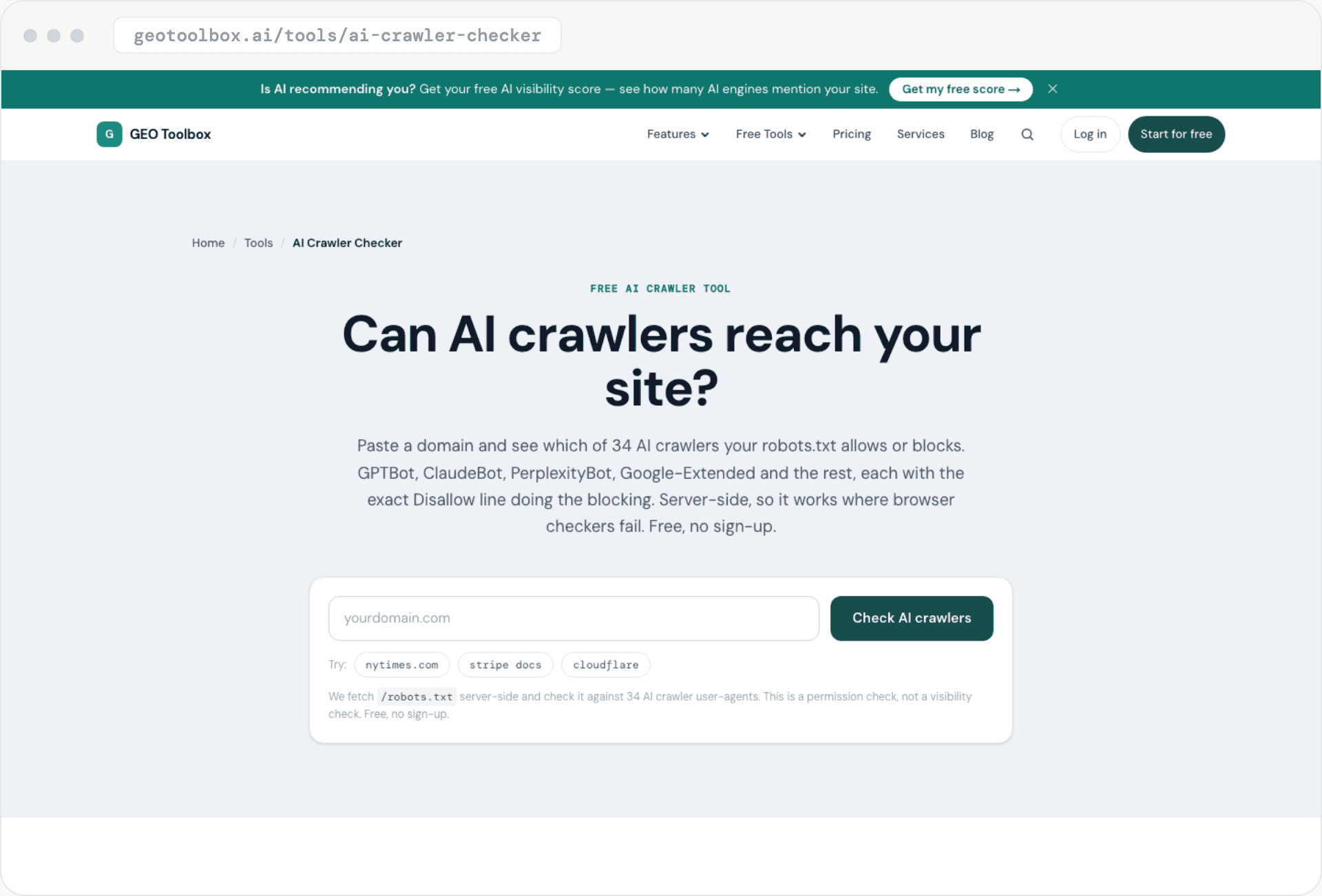
Best for: a free check of which AI crawlers your robots.txt blocks.
Geotoolbox (our tool) has a free grading layer too, but it grades something the others mostly skip: whether AI crawlers can actually reach and read your page, and how citable that page is once they do. More on that in the reachability section below. The paid tracker side is reviewed in the tracking category below, where it belongs: from $99 per month with a 7-day free trial.
Content Optimization Tools
Content optimizers such as Surfer SEO and Frase work mainly on the input side of GEO: they structure pages so they are easier to extract and cite. Both also offer AI tracking, listed in the table above. We cover the workflow tools in our AI SEO tools guide and compare the field in depth in our content optimization tools roundup.
AI Visibility Tracking Tools
These trackers, often sold as AI visibility platforms, answer one question: how often, and where, do AI engines mention or cite your brand. They track prompts across models and report share of voice, citations, and sentiment. This is the largest and most crowded category, and most are priced for teams rather than solo users.
Profound
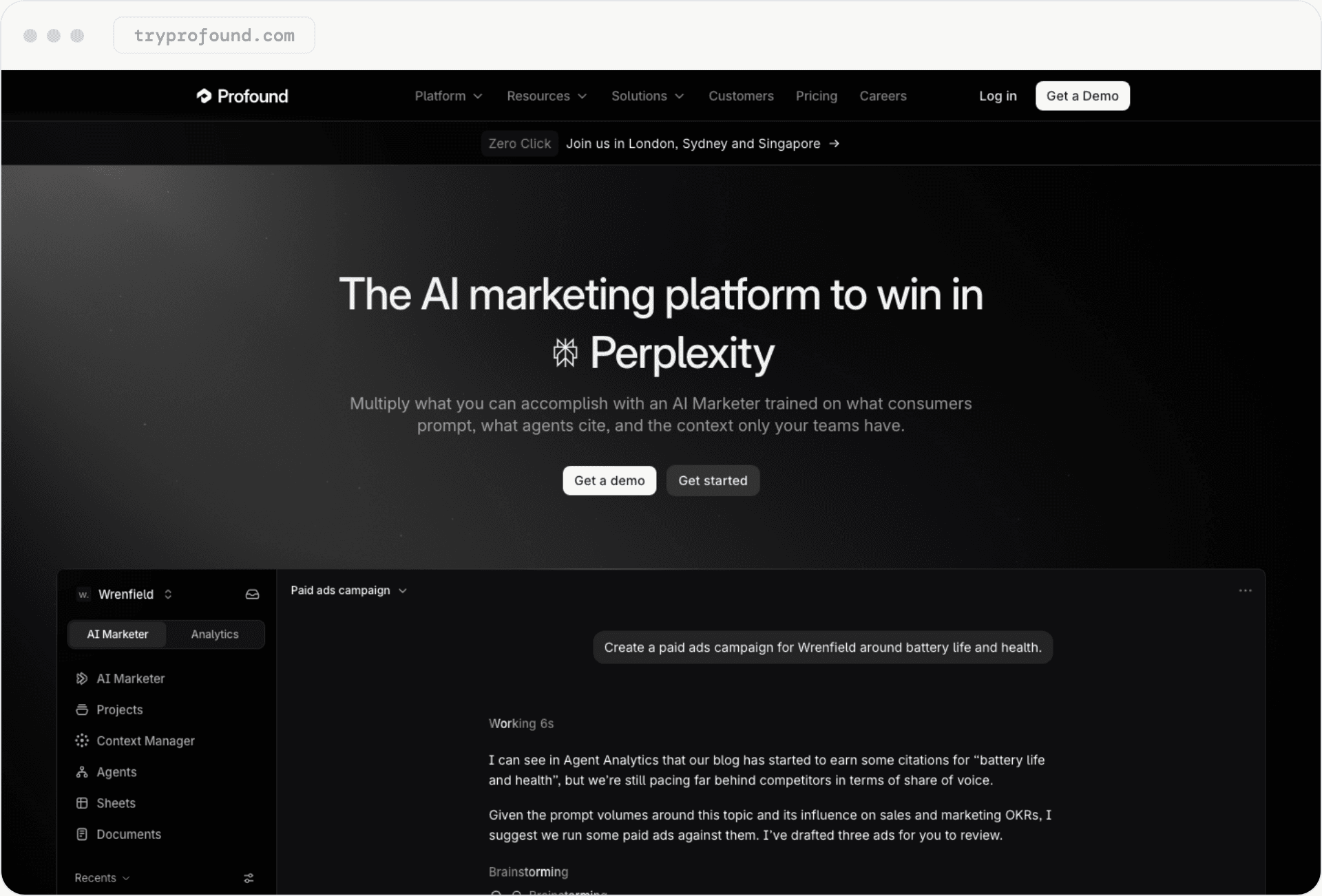
Best for: enterprise brand-citation analytics.
Profound is the enterprise option, with deep analytics on AI visibility, brand citations, and competitor comparisons. As of September 2026 it sells no self-serve tier for brands: a free Trial tracks ChatGPT, Gemini, and Google AI Overviews (50 prompts a day for 7 days), and the full set of up to 9 answer engines, including Perplexity, Copilot, DeepSeek, Claude, and Exa Search (Grok is not listed), is Enterprise-only, priced custom. Beyond prompt-level tracking, it surfaces which source pages the engines pull from and lets you run a high volume of custom prompts, which is where the enterprise pricing goes. It is built for larger teams, and the backing matches: Profound raised a $180 million Series D at a $1.8 billion valuation in September 2026, seven months after its $96 million Series C, the largest war chest in this category. The $99 Starter and $399 Growth brand tiers from mid-2026 were withdrawn; agencies buy a separate plan, Agency Growth, $99/month base plus $399/month per full client workspace (add-on). It offers a free AEO Report to start, so you can see a sample of your citation footprint before committing. If the enterprise pricing rules it out for you, we break down what Profound actually costs and compare the Profound alternatives that cover the same job at a lower tier.
What works:
- up to 9 answer engines on Enterprise
- shows the source pages engines cite
What doesn't:
- no self-serve brand tier
- the free Trial: 3 engines, 7 days
Peec AI
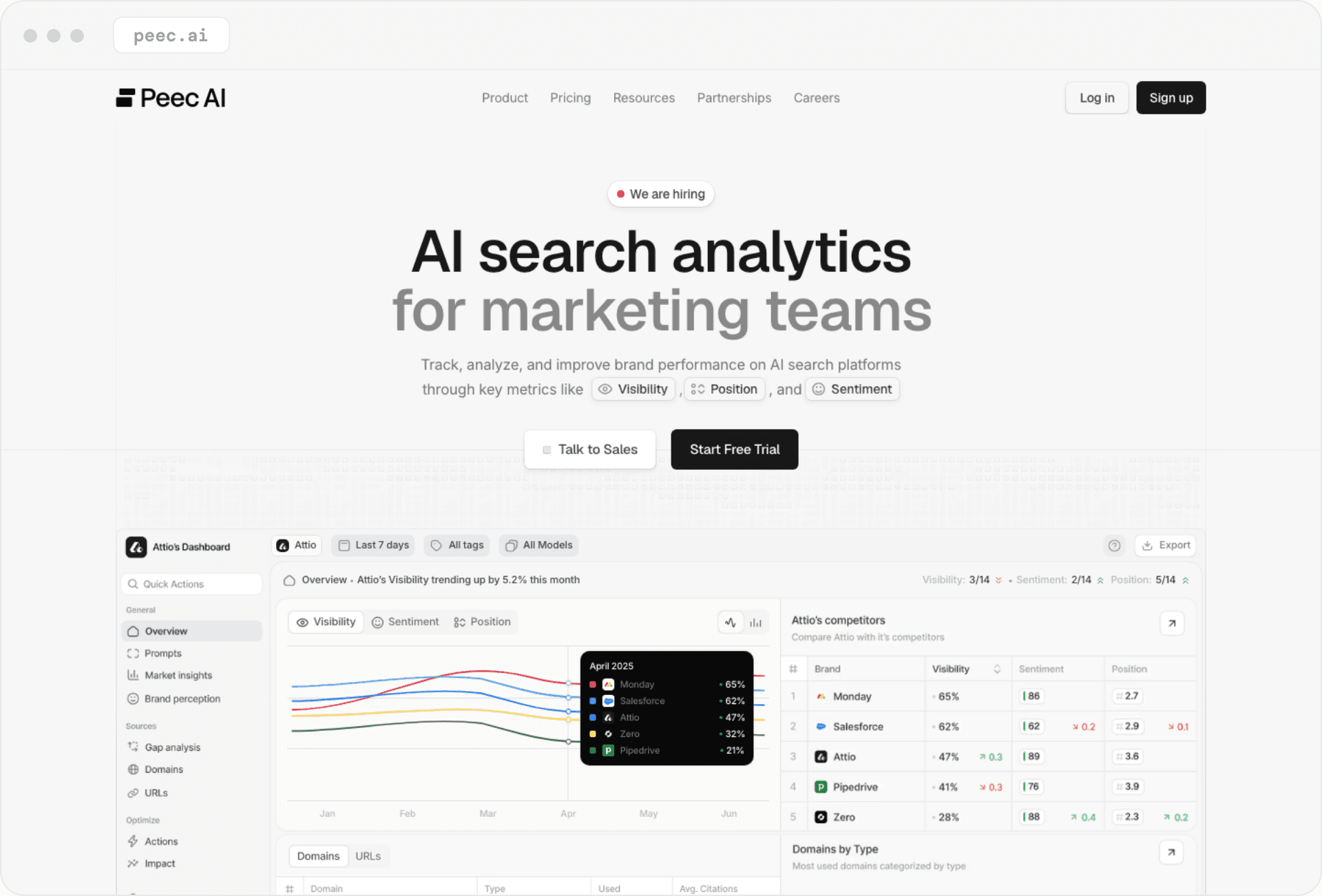
Best for: competitive benchmarking.
Peec AI leans into competitive benchmarking, tracking how your brand performs against named rivals and organizing the source content cited in responses so you can see which competitor pages keep getting pulled. Each tier includes three models of your choice from a six-engine menu (ChatGPT, Google AI Mode, AI Overviews, Microsoft Copilot, Perplexity, and Gemini), with additional models available as paid add-ons from €30 per month. The prompt allowance and tracked-competitor count scale with the plan, which is the main lever on price. It starts with a free trial, with self-serve plans from €85 per month (Starter) and enterprise via sales. A solid pick if your priority is seeing where rivals out-cite you rather than just your own standing. Our full Peec AI breakdown covers its 2026 pricing and limitations in depth, and our Peec AI alternatives guide compares the tools people move to.
What works:
- groups the competitor pages engines keep citing
- pick 3 models from a six-engine menu
What doesn't:
- extra models from €30 a month
- prompt caps scale with the plan
Otterly.ai
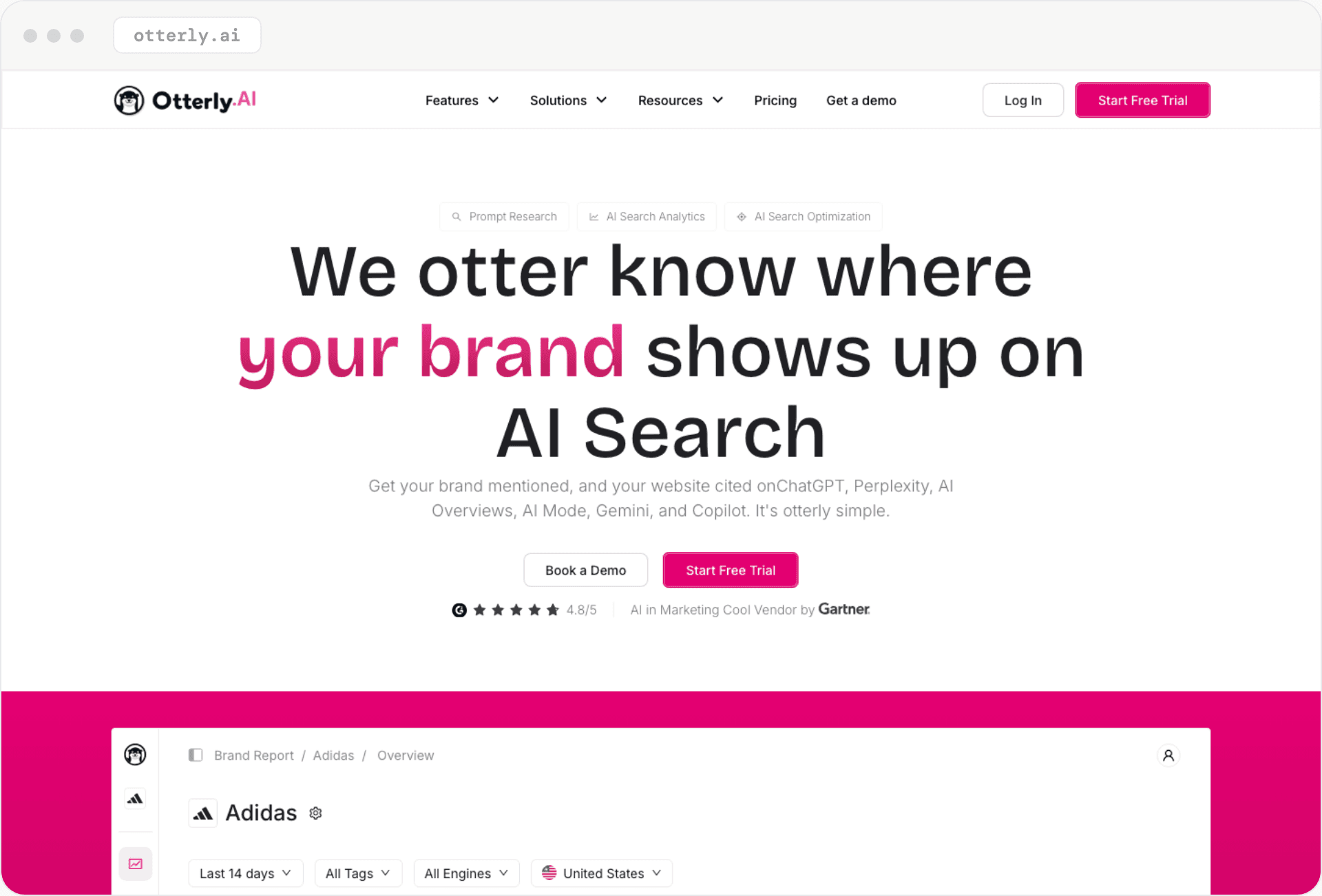
Best for: SMB prompt tracking on a budget.
Otterly.ai is one of the more affordable standalone trackers, with self-serve plans from around $29 per month and a free trial (no credit card). All plans cover ChatGPT, Google AI Overviews, Perplexity, and Microsoft Copilot; Gemini, Google AI Mode, and now Claude are paid add-ons, and the prompt allowance (15 on the entry plan) is what scales by tier. A reasonable starting point for a small team that wants prompt tracking without an enterprise contract, as long as you check the per-tier prompt cap against the keywords you actually care about.
What works:
- from around $29 a month
- four engines on every plan
What doesn't:
- Gemini, AI Mode, and Claude are paid add-ons
- 15 prompts on the entry plan
Rankscale AI
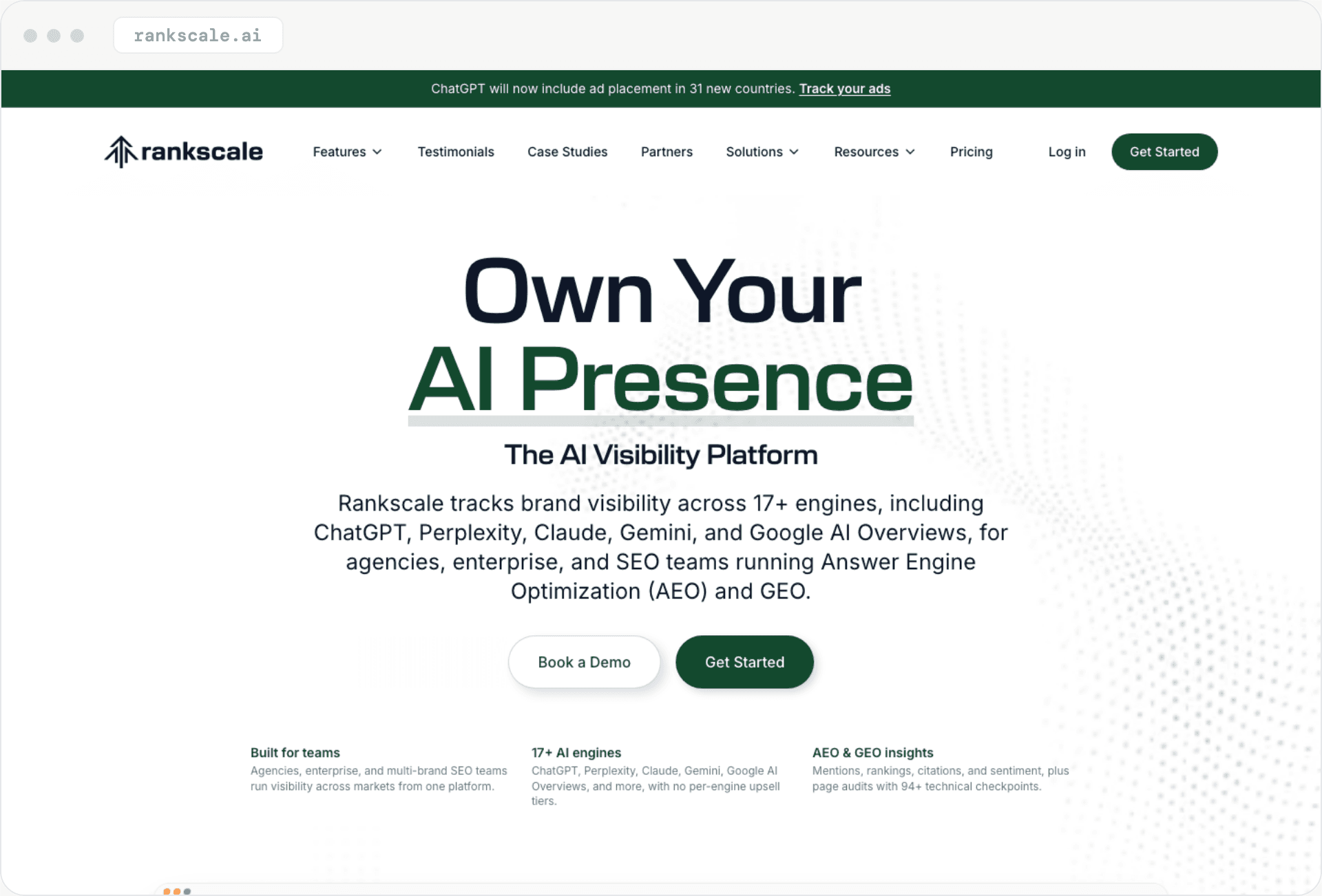
Best for: the cheapest multi-engine entry point.
Rankscale AI currently owns the cheapest multi-engine entry point in this category: its Essentials plan starts at $20 per month (Rankscale quotes in US dollars for EU visitors too, not a converted local price), and even that tier draws from a broad engine set (ChatGPT, Gemini, Perplexity, Claude, DeepSeek, Mistral, Grok, and Copilot). Usage is credit-based, roughly a quarter-credit per engine per prompt for ChatGPT, Perplexity, Gemini, and AI Mode — though DeepSeek costs a full credit and Claude runs two or more — and Essentials ships with no included credits, so you top up separately; included credits start on the $99 Pro tier. A free Pro trial lets you test the fit first. The pick if Otterly's per-engine add-on pricing does not suit you and you want many engines cheap rather than one engine deep.
What works:
- $20 a month entry with a broad engine set
- free Pro trial
What doesn't:
- Essentials includes no credits
- DeepSeek and Claude cost more credits
AthenaHQ
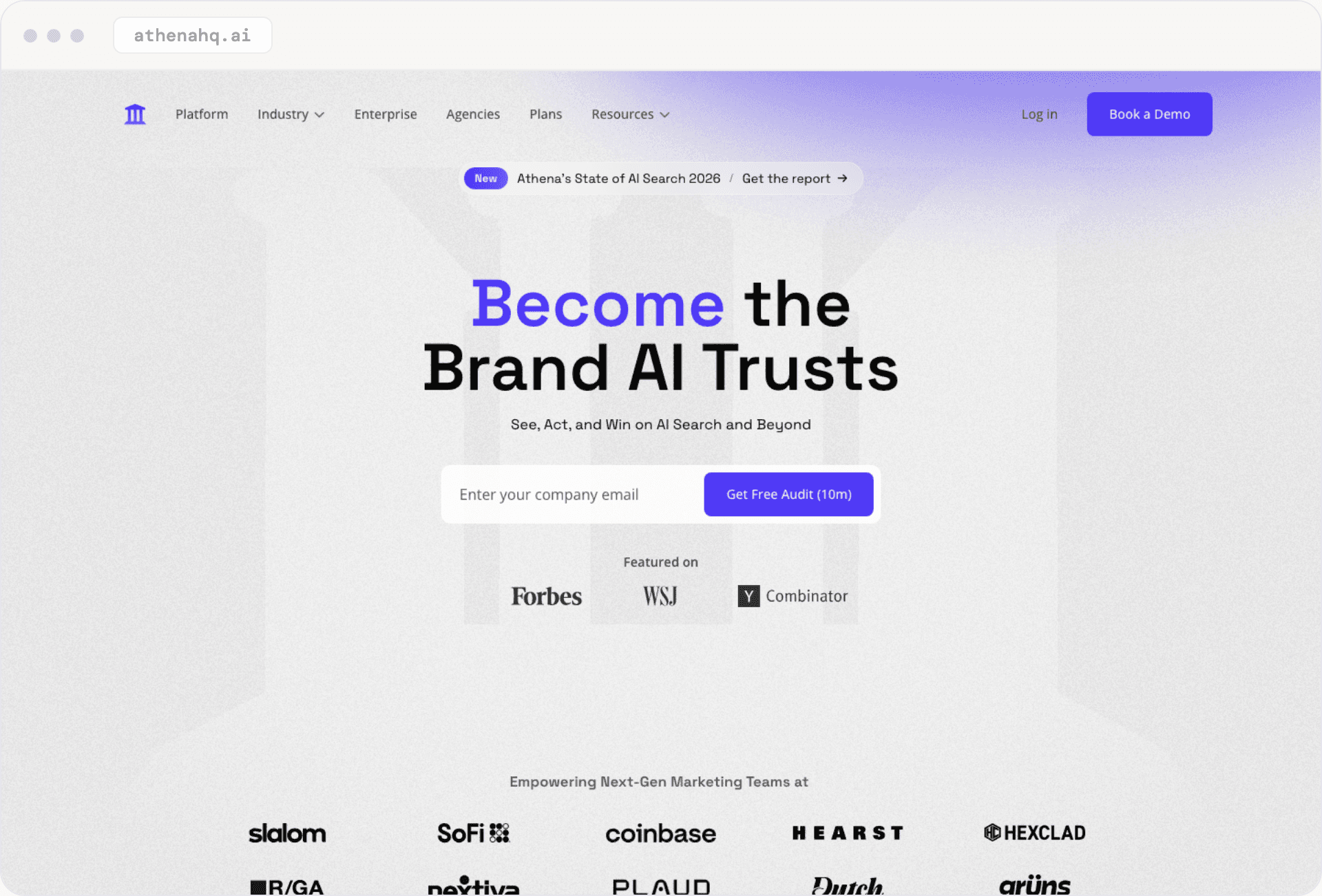
Best for: self-serve tracking without a sales call.
AthenaHQ is self-serve from roughly $295 per month, or about $245 per month billed annually, and it added a real free tier this year: alongside the 10-minute audit there is now a free Essential plan with $25 of credit (300 credits) and unlimited team members. Engine coverage runs wide: AthenaHQ's Starter plan tracks ten named models (ChatGPT, Perplexity, Google AI Overviews, AI Mode, Gemini, Claude, Copilot, Grok, DeepSeek, and Meta AI), with additional models on request, and it reports share of voice, citations, and the sources cited in responses. Good fit if you want to skip the sales call and start the same day.
What works:
- free Essential plan with 300 credits
- ten named models on Starter
What doesn't:
- paid plans from about $295 a month ($245 billed annually)
Scrunch AI
Best for: enterprise multi-brand tracking.
Scrunch AI targets enterprise and multi-brand tracking, with workspace-style separation so an agency or a multi-product company can monitor several brands side by side. It is available via a 7-day trial, with self-serve entry at $250 per month and a custom-priced Enterprise tier. One honest caveat: Scrunch repackaged repeatedly and briefly A/B-tested two lineups, but its pricing page has since settled on a four-engine $250 Core plan plus a nine-engine custom Enterprise tier. Confirm the current packaging on scrunch.com before you commit. Sitecore acquired Scrunch on June 3, 2026, for roughly $225 million per Bloomberg reporting, so expect packaging to keep moving. Worth a look if you manage visibility across several brands and need them reported separately rather than rolled into one account. Our full Scrunch AI review covers its features, pricing, and alternatives in depth.
What works:
- reports each brand separately
- 7-day trial
What doesn't:
- four engines on the $250 Core plan
- packaging still moving under Sitecore
Writesonic
Best for: tracking plus AI writing in one.
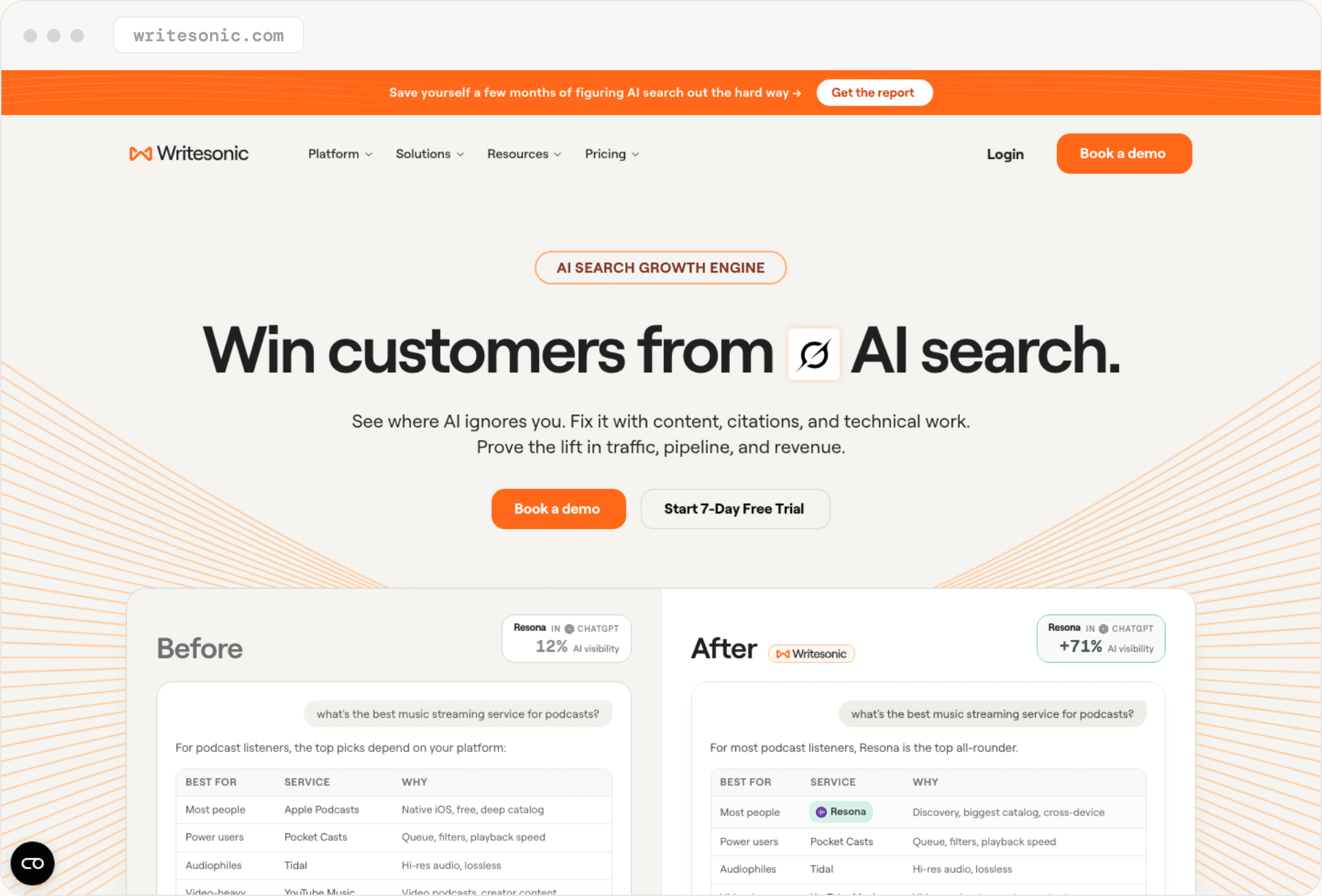
Writesonic combines AI-search tracking with AI writing, so the same tool that flags a gap can help you draft the fix. The tracking side reports share of voice and citations. Writesonic flattened its tier ladder in 2026: every self-serve plan now tracks the same three platforms (ChatGPT, Gemini, and Google AI Overviews), tiers differ by prompt and answer volume instead, and the full 10-platform set (adding Perplexity, Claude, Grok, Copilot, and more) remains enterprise-only. The writing side draws on the same prompt data to brief new content. Plans start at $99 per month, or $79 per month billed annually, as of July 2026 after a free trial, and the prompt allowance and word or generation limits scale with the tier. Best if you want tracking and content generation under one roof rather than paying for two tools, though neither half is as deep as a dedicated specialist.
What works:
- the same prompt data briefs new content
- $79 a month billed annually
What doesn't:
- three engines on every self-serve plan
- shallower than a specialist on both halves
Geotoolbox (Yes, Ours — in Its Category This Time)
Best for: checking whether AI bots can reach + cite your pages.
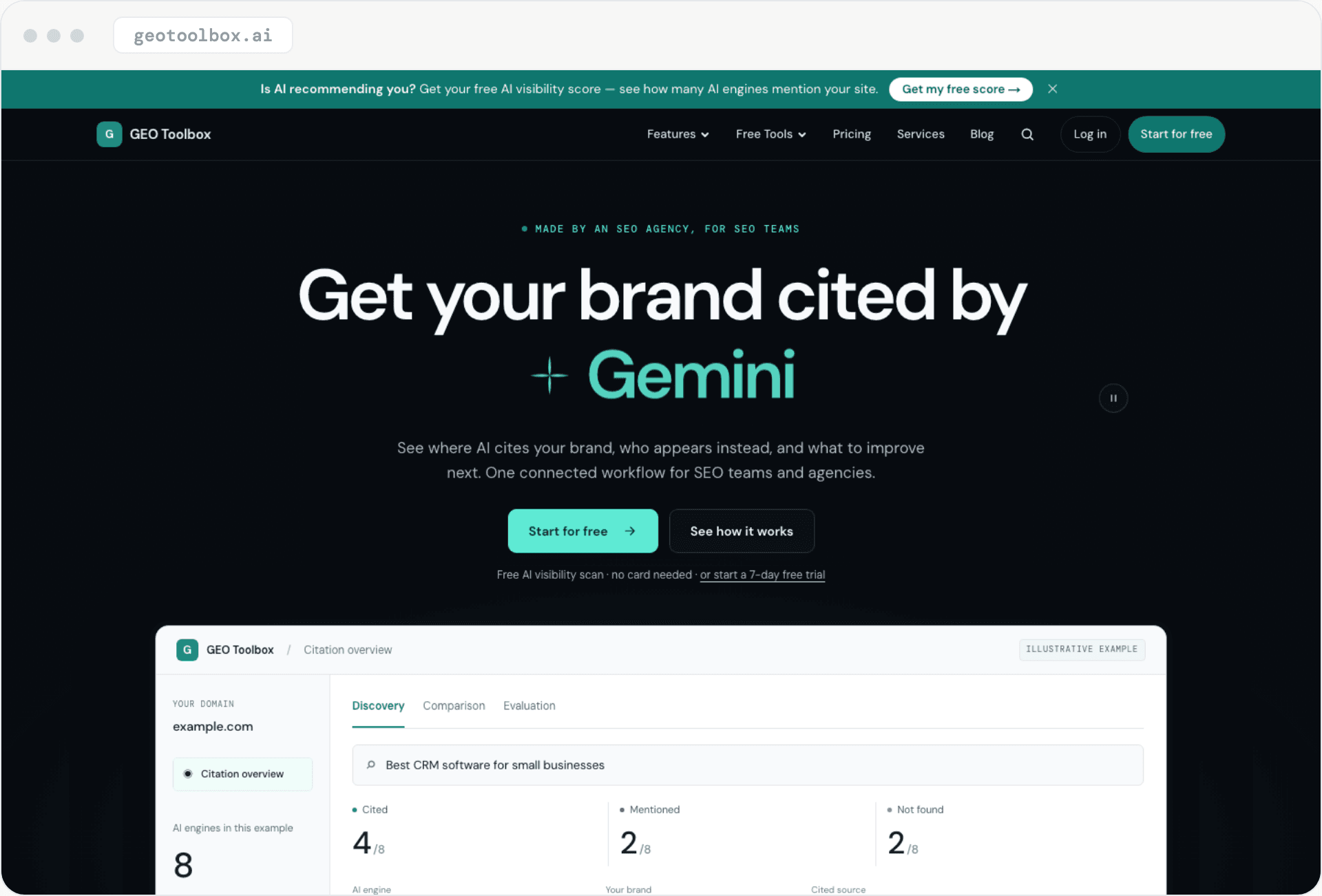
Geotoolbox belongs in this category too, not just the free-grader section where we placed it above: the paid product is a visibility tracker, and it competes with the tools above on their own terms. Plans start at $99 per month ($79 billed annually) with a 7-day free trial; the entry Starter covers ChatGPT, Perplexity, and Google AI Overviews (the same three-engine count as Profound's free brand Trial, which covers ChatGPT, Gemini, and Google AI Overviews), and the full eight-engine set (adding Gemini, Claude, AI Mode, Copilot, and Grok) arrives by the Pro tier. What separates it from most of this list is the order of operations: every plan bundles the tracking with a reachability check and a page-level Content Analyzer, so a zero in the dashboard tells you whether the problem is your content or a crawler that never reached the page. The honest limit: it does not have the real-conversation prompt-volume dataset the enterprise research platforms sell, so if that is your job, look at Profound or AthenaHQ above.
What works:
- reachability check on every plan
- 7-day free trial
What doesn't:
- three engines on Starter; all eight from Pro
- lacks the enterprise platforms' real-conversation prompt dataset
Also on the Radar
Three trackers show up across competing roundups but did not earn a full entry here: BrightEdge's Generative Parser is enterprise and demo-only with no published pricing; Goodie AI has grown into a full-stack AEO platform with a published $399-per-month Explorer plan, overlapping the enterprise trackers above without undercutting them; and Yotpo Discover is commerce-native but still in early access, demo-gated. If one of those descriptions is exactly your situation, they are worth the demo call.
The Reachability Layer Most Tools Skip
Here is the gap in the categories above. Every tracker can tell you that you are not cited. None of the trackers above lead with whether an AI engine could even fetch and read your page in the first place, which is a common and usually fixable reason a brand is missing from AI answers.
That is the layer Geotoolbox focuses on. It runs a reachability check across the major AI crawlers (GPTBot, ClaudeBot, PerplexityBot, plus the Google-Extended robots.txt token, and more), flags robots.txt and WAF (web application firewall) blocks that quietly keep bots out, checks whether your content survives without JavaScript, and grades how citable the page is once a bot arrives. The robots.txt layer is free via the AI Crawler Checker, which lists exactly which checks it runs; the full live-fetch grade is part of the paid plans, from $99 per month ($79 billed annually).
Two honest caveats. First, we also sell prompt-level visibility tracking from $99 per month ($79 billed annually), which competes directly with the trackers above, so judge that side of the product against them by the same criteria, not on our word. Second, we are not claiming the tool replaces a full enterprise tracker like Profound. The framing we stand behind: reachability is the prerequisite the tracking tools assume you have already solved, and many sites have not. If you want the background, see our guide on what generative engine optimization is and the step-by-step how to optimize for AI search playbook, where reachability is step one.
How to Choose
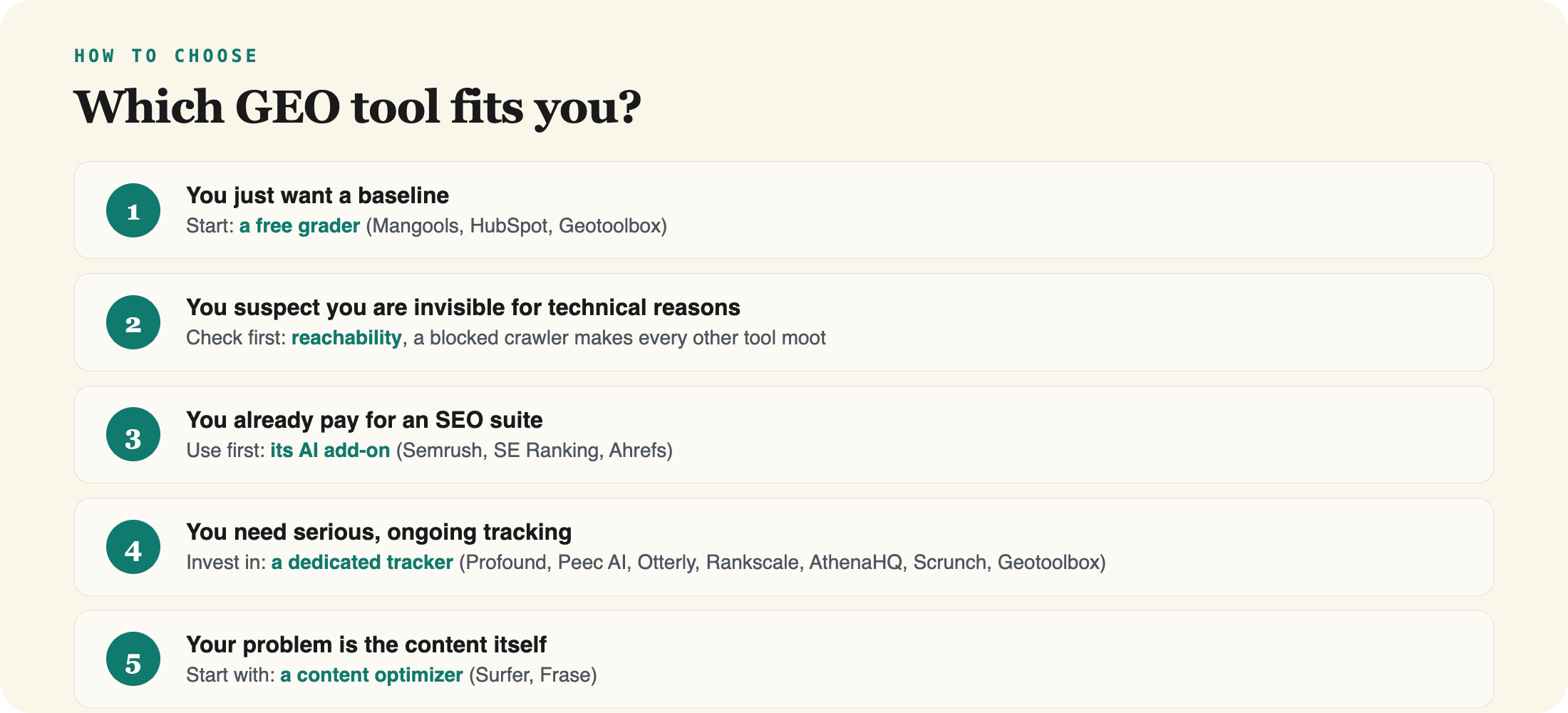
Match the tool to the job, not the hype. If you think of this as answer engine optimization, the same split holds, and we break down the best AEO tools by job the same way. Work down this list in order and stop at the first one that fits:
- You just want a baseline. Start with a free grader (Mangools, HubSpot, or Geotoolbox). Spend nothing until you know where you stand.
- You suspect you are invisible for technical reasons. Check reachability first; a blocked crawler makes every other tool moot.
- You already pay for an SEO suite. Use its AI add-on (Semrush, SE Ranking, Ahrefs) before buying a standalone tracker.
- You need serious, ongoing tracking across many prompts or brands. A dedicated tracker (Profound, Peec AI, Otterly, Rankscale, AthenaHQ, Scrunch, or our own Geotoolbox if you want the reachability layer on the same bill) earns its price.
- Your problem is the content itself. A content optimizer (Surfer, Frase) helps you write the extractable version.
What GEO Tools Can't Do for You
A tool surfaces the gap. It does not close it. These tools can tell you that you are under-cited; none of them rewrite your pages or earn your mentions for you. That work is still yours, which is the real choice behind GEO services vs software: do it in-house or hire it out.
Be skeptical of two claims in particular. First, any AI visibility score with no stated methodology, since a number you cannot interrogate is marketing, not measurement. Second, any promise of guaranteed citations, because engines retrieve and cite only a fraction of eligible pages and the set shifts constantly. A critical survey of 45 GEO studies published on arXiv in July 2026 reached the same conclusion: no optimization technique reviewed showed stable effects across all AI platforms. The honest use of these tools is to measure direction and prioritize work, not to buy an outcome.
Frequently Asked Questions
What is the best free GEO tool?
For a quick baseline, Mangools AI Search Grader and HubSpot's AEO Grader are fully free, and Geotoolbox's free tools cover the robots.txt half of reachability, and its paid tracking opens with a 7-day free trial. Start with a free grader before paying for anything.
Which AI engines should a GEO tool track?
At minimum ChatGPT, Perplexity, Google AI Overviews and AI Mode, and Gemini. Match the list against where your audience actually asks questions; a tool that goes deep on one engine your buyers never use is wasted coverage.
How much do GEO tools cost?
They range from free graders to roughly $20 to $99 per month for self-serve trackers, up to several hundred per month or demo-only enterprise pricing. Prices move fast, so confirm on each site.
Are GEO tracking tools accurate?
They sample; they do not see every AI answer. Treat the numbers as directional and prefer tools that publish their methodology over those that show a score with no explanation.
Start Free, Then Decide
You do not need to pick a paid platform today. Get a baseline from a free grader, confirm AI engines can actually reach your most important pages, and only then decide whether you need ongoing tracking and which category fits.
If you want to start with the reachability question the trackers assume away, Geotoolbox's free AI Crawler Checker shows which of 34 AI crawlers your robots.txt allows or blocks in seconds, and the Content Analyzer goes further: it probes access for the major AI crawlers (GPTBot, ClaudeBot, PerplexityBot, CCBot) and the Google-Extended directive, pinpoints where any block lives, and grades how citable the page is, in minutes. When you are ready for the ongoing tracking, the 7-day trial starts on the same account.
Sources
- GEO: Generative Engine Optimization - Aggarwal et al., KDD 2024 -
arxiv.org/abs/2311.09735 - Optimizing Visibility in Generative Engines: A Critical Survey of GEO (2023-2026) - Martinez, arXiv, July 2026 -
arxiv.org/abs/2607.14035 - AI features and your website - Google Search Central -
developers.google.com/search/docs/appearance/ai-features - Update: AI Overviews Reduce Clicks by 58% - Ahrefs, February 2026 (December 2025 data, 300,000 keywords) -
ahrefs.com/blog/ai-overviews-reduce-clicks-update - Americans and AI 2026: Chatbots, Smart Devices and Views on Impact (44% of US adults have used ChatGPT) - Pew Research Center, June 2026 -
pewresearch.org/internet/2026/06/17/americans-and-ai-2026-chatbots-smart-devices-and-views-on-impact
Each tool above links to its official site.