
Search "best Copilot rank tracker" and you get a wall of lists, each one crowning the tool its author happens to sell. Ask ChatGPT, Perplexity, and Gemini the same question and all three hand back a different set of "best" tools, with barely any overlap. That tells you two things: the demand for tracking Microsoft Copilot is real, and almost nobody writing about it is neutral. This guide groups the tools by what they actually do, says plainly which ones run Copilot live versus only claim support, explains the one distinction most guides blur, and tells you where ours fits.
Geotoolbox, the site you are reading this on, makes an AI-visibility tool that covers Copilot. We have included it below and list it last on purpose. We are not the cheapest way to track Copilot, and we say so. Pricing and Copilot coverage were checked against each vendor's own pages in September 2026. These change often, so confirm the current details on each vendor's site before you buy.
What a Copilot Rank Tracker Actually Tracks
Start with the thing most tool pages skip: Microsoft Copilot does not rank pages in a numbered list. It reads a question, grounds the answer in Bing's search index, and writes a few sentences that name and cite a handful of sources. So a "Copilot rank tracker" is not tracking a rank. It is tracking whether Copilot mentions you, cites you, and how it describes you, across a set of prompts run again and again.
That splits into a small family of things the useful tools measure, and you should know which you are buying:
- Brand mentions are when Copilot names you in the answer text, with or without a link. They shape perception.
- Citations are the linked sources Copilot attributes the answer to. They can drive referral clicks.
- Share of voice is how often you appear against named competitors across the same prompt set.
- Sentiment is how Copilot frames you when it does mention you, which matters as much as whether it does.
There is one more reason position matters here. Copilot runs one of the tightest citation budgets of any major assistant. In the citation database published by Omnia, one of the trackers compared below (so weight its numbers as a vendor's own), Copilot averages 4.36 distinct domains per answer, against 9.97 for ChatGPT, and six in ten Copilot answers cite four domains or fewer. Fewer slots means the gap between "cited" and "invisible" is narrow, so a tool that reports citation share and position, not just a raw mention count, is doing the more useful job. If a dashboard shows a single "visibility score" with no method behind it, treat that as marketing, not a metric.
The same Omnia data hides a useful pattern. Citations barely overlap between engines: only about 13% of the domains ChatGPT cites, and 18% of Perplexity's, also show up in Copilot for the same prompt. But a domain cited by both ChatGPT and Perplexity appears in Copilot roughly 39.6% of the time, close to triple the 13% rate for a domain cited by ChatGPT alone. Whatever drives that overlap, being cited across engines tends to coincide with being cited in Copilot, so a tracker that shows you where you stand on the other engines gives you a useful leading signal.
How Tracking Copilot Differs From Other Engines
Three differences change what you should expect from a tool, and the first one is good news.
Copilot's sources overlap with regular SEO. Web Copilot grounds its answers in the Bing index and the follow-up searches it runs on your behalf. Its citation layer sits closer to the classic web-ranking surface than ChatGPT, Claude, or Perplexity: it leans on pages Bing already crawls and ranks. That means the SEO work you do for Copilot is more traceable than it is elsewhere: you can correlate Bing indexing with Copilot citations instead of guessing, even though any single reading stays noisy. It also means the tracking problem is more tractable here than on the other engines we cover.
It answers from several surfaces, and they differ. Copilot lives in Bing chat, the Edge sidebar, Windows, and the Microsoft 365 apps, and the same prompt can return different answers depending on where it runs. A tracker has to standardize which surface it samples, or its numbers drift for reasons that have nothing to do with your content. Results also shift by country, because Bing leans on regional indexes, so a global average can hide a weak home market. Ask any tool which surface and which market its data comes from before you trust a trend line.
The same prompt gives different answers. Copilot is non-deterministic. Ask it twice and the cited sources can change by time, phrasing, and location. In Omnia's data, only about 41.5% of Copilot prompts keep the same top-cited domain week over week, the most volatile of the major engines it measured. One check is only directional. A tracker earns its price by running a fixed prompt set on a schedule and reporting the trend, not by telling you where you sat at 3pm on a Tuesday.
The Part Most Guides Blur: Web Copilot vs Microsoft 365 Copilot
This is the single most important thing to understand before you buy anything, and most tool pages talk around it. "Copilot" is two different products.
Web Copilot is the consumer assistant: Bing chat, copilot.microsoft.com, the Edge sidebar, and Copilot in Windows. It grounds on the public Bing index. This is the only Copilot that any third-party tracker can actually measure, because anyone can send it a prompt and read the answer.
Microsoft 365 Copilot is the work assistant embedded in Word, Excel, Outlook, and Teams. It runs inside your organization's private tenant and grounds on your own SharePoint, email, and files behind authentication, blended with web results. No outside tool can see another company's tenant answers, because the tenant is a privacy and compliance boundary by design, as Microsoft's own documentation on how M365 Copilot handles tenant data spells out.
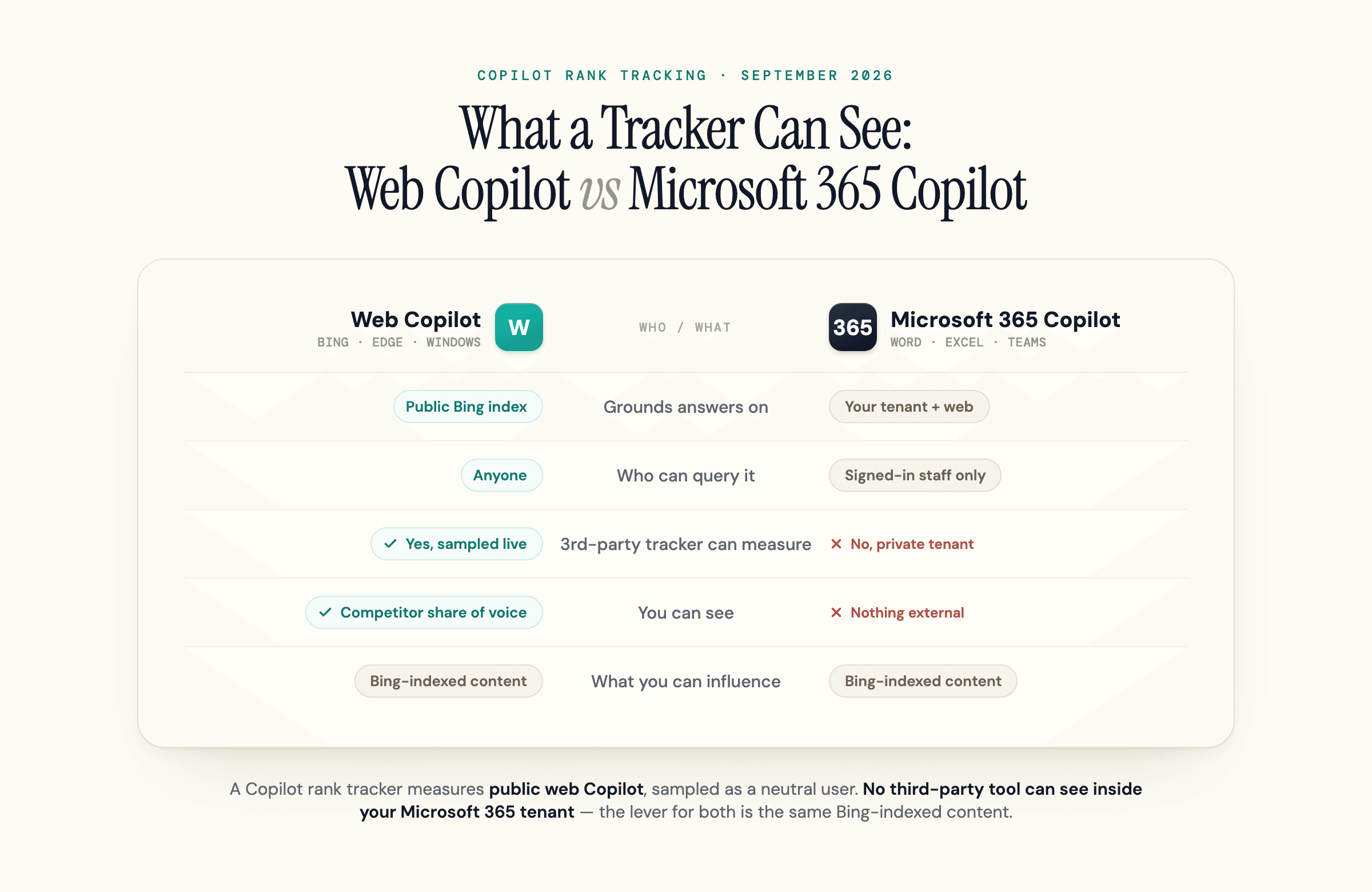
One naming note: in 2026 Microsoft renamed Microsoft 365 Copilot to simply Microsoft Copilot, and folded the Microsoft 365 app into a Microsoft Copilot app. The names converged; the boundary did not. Microsoft states there are "no changes to security, compliance, and privacy for organizations," so everything in this section still holds — you just have to read the labels more carefully than before.
Why this matters for your money: vendors love to justify a Copilot tracker by pointing at enterprise reach, and the reach is real. Microsoft reported more than 30 million paid Microsoft 365 Copilot seats in its FY26 Q4 results, announced in July 2026, up from 20 million a quarter earlier. But a tracker cannot watch how you appear inside those seats. What it measures is public web Copilot, sampled as a neutral user. That is still worth doing. Just know the boundary: M365 Copilot grounds mostly on private tenant data, so the only external lever you have is your public, Bing-indexed content, and only when Copilot's optional web-grounding step reaches past the tenant for it. Nothing a dashboard reads touches inside the tenant.
Check This First: Can Bing Even Reach and Index You?
Before you pay for any tracker, rule out the failure that no tool can fix. Web Copilot cites the pages Bing has crawled and indexed. If BingBot is blocked or your pages are not in the Bing index, there is next to nothing for a tracker to find, and the dashboard will show a flat zero that has nothing to do with your content.
Three quick checks settle it:
- Confirm your robots.txt does not disallow
bingbot, and that no firewall or bot filter is quietly dropping it. This is the most common self-inflicted AI-crawler block we see. - Verify the pages you care about are actually in Bing (a
site:check, or URL inspection in Bing Webmaster Tools). - Use IndexNow to push new and changed URLs to Bing so Copilot grounds on the current version instead of a stale one.
If Copilot is not citing you, this is where to look before a tracker, not after. You can run a free reachability check with our AI crawler checker to see whether the major AI and search crawlers, BingBot included, can actually fetch your pages.
The Best Copilot Rank Trackers, Compared
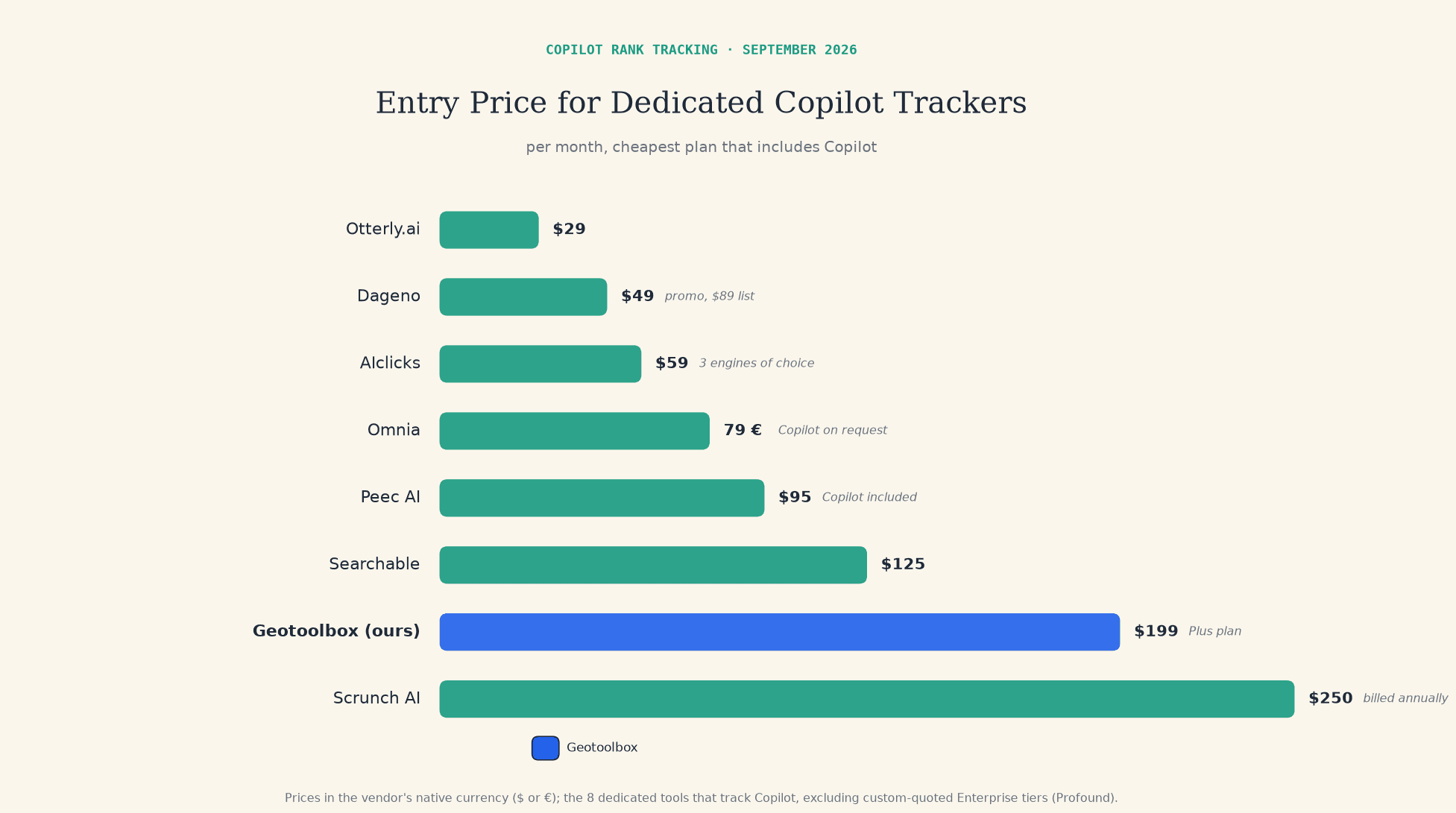
The tools that track Copilot sort into a few groups: dedicated AI-visibility platforms, SEO suites that bolted on an AI add-on, and free or pay-as-you-go options. The table below is a starting map, not a ranking. Prices point to the cheapest plan that includes Copilot where a vendor's tiers make it clear; where they do not, the cell says to confirm. All checked in September 2026 (see the note above before you buy).
| Tool | Type | From (with Copilot) | Best for |
|---|---|---|---|
| Bing Webmaster Tools | Free, first-party | Free | Your own domain's Copilot citations |
| Orchly | Free checker | Free (one-off) | A quick baseline before you commit |
| Semrush AI Visibility Toolkit | SEO suite add-on | Copilot not covered ($99/mo tracks 4 other engines) | Teams already on Semrush |
| Ahrefs Brand Radar | SEO suite add-on | $699/mo (all platforms) | Teams already on Ahrefs |
| SE Ranking / SE Visible | SEO suite add-on | Copilot not covered ($89/mo AI Search add-on) | Existing SE Ranking users — but not for Copilot |
| Keyword.com | SEO suite add-on | ~$24.50/mo (credits) | Agencies with variable tracking needs |
| Otterly.ai | Dedicated | $29/mo | Solo and small teams on a budget |
| Peec AI | Dedicated | $95/mo | Clean multi-model reporting |
| AIclicks | Dedicated | $59/mo, 3 engines of choice (confirm Copilot) | Citation-level detail plus recommendations |
| Dageno | Dedicated | $49/mo (promo, $89 list) | Cross-platform monitoring plus execution |
| Searchable | Dedicated | $125/mo | Full-stack tracking with GA4 and CRM |
| Scrunch AI | Dedicated | $250/mo | Enterprise plus crawl diagnostics |
| Profound | Dedicated | Enterprise tier (confirm) | Enterprise and regulated industries |
| Omnia | Dedicated | EUR 79/mo (Copilot on request) | Citation intelligence and execution |
| Geotoolbox (ours) | Dedicated | $199/mo (Plus) | Reachability plus citation tracking |
Dedicated AI-Visibility Trackers
These were built for AI answers, and most cover Copilot alongside ChatGPT, Gemini, and Perplexity. Otterly.ai is the cheapest real entry point at $29/mo and the right first tool for a solo marketer, though its low tier is prompt-limited. Peec AI ($95/mo) is liked for clean, readable multi-model dashboards, and AIclicks leans into citation-level detail, though its $59 Starter lets you pick three engines from its roster, and AIclicks markets Copilot tracking from that tier; the roster-per-tier detail is not spelled out publicly, so confirm Copilot is selectable on the plan you buy. Dageno (from $49/mo on its current promotion, $89 list, all nine engines on every plan) and Searchable ($125/mo, with Copilot in every plan) push past monitoring into execution and attribution, with Searchable wiring visibility to GA4 and CRM data. At the top, Scrunch AI ($250/mo billed annually, more month to month) adds bot-crawl diagnostics and Profound targets enterprise and regulated teams that need audit trails. Profound no longer sells a self-serve brand tier at all: there is a free trial (50 prompts run daily for 7 days, covering ChatGPT, Gemini and Google AI Overviews) and then custom Enterprise pricing, and Microsoft Copilot appears only on Enterprise. Agencies get a separate self-serve plan, Agency Growth, $99/month base plus $399/month per full client workspace (add-on), and its client workspaces do not list Copilot. Omnia (from EUR 79/mo, with Copilot enabled on request rather than shipped in the plan) leans on citation intelligence and an execution layer, and samples through real browser sessions; it also publishes the citation research we cite in this guide, which is worth knowing when you read its data. AthenaHQ and Hall AI round out the enterprise end. The watch-for across this group is prompt caps: the sticker price often buys a small prompt allowance, and Copilot's volatility means you want enough prompts to sample properly.
SEO Suites With an AI Add-On
If you already pay for an SEO platform, check its AI module before buying a second tool. Semrush's AI Visibility Toolkit costs $99/mo per domain but tracks ChatGPT, Google AI, Gemini and Perplexity, not Copilot. If Copilot is the engine you need, this add-on will not give it to you. Ahrefs Brand Radar covers Copilot on its all-platforms plan at $699/mo, steep unless you are already deep in Ahrefs. Keyword.com runs a credit model that starts around $24.50/mo and flexes for agencies. The one to scrutinize is SE Ranking / SE Visible: one guide awarded it strong Copilot coverage, but SE Ranking's own product page settles it (more on that next) — Copilot is not one of the engines it tracks. The trap in this group is that "AI search tracking" in a suite is often broad and shallow, so confirm it genuinely isolates Copilot rather than lumping every engine into one score.
Free and Pay-As-You-Go
You do not have to start with a subscription. Bing Webmaster Tools now includes a free AI Performance report (more below) that is the authoritative view of your own domain's Copilot citations. Orchly offers a free one-off Copilot visibility check, useful for a baseline, and pay-per-check tools like AI Rank Checker fit consultants running occasional audits rather than continuous monitoring. None of these give you competitor share of voice, which is the main reason to graduate to a paid tool.
Which Tools Actually Run Copilot Live (and Which Just Say They Do)
"Supports AI search" is not the same as "tracks Copilot," and the difference is where buyers get burned. Three things separate real coverage from a checkbox.
Live browser sessions versus API calls. Some tools run prompts through a real browser session to capture what a person actually sees; others hit an API that can return different output. Vendors that use browser sessions, Omnia and Profound among them, argue that approach reflects reality more faithfully on a volatile engine like Copilot. They have an interest in the claim, and neither approach is automatically wrong, but you should know which one you are paying for.
Claimed versus verified. The clearest example is SE Ranking and its SE Visible module, where one guide awarded it strong Copilot coverage. SE Ranking's own product page settles it: the engines it lists are AI Overviews, AI Mode, ChatGPT, Gemini and Perplexity. Copilot is not among them. When two roundups disagree, the vendor's own engine list is one fetch away and outranks both — verify native Copilot on the exact plan you intend to buy, inside a trial, before you pay, rather than trusting any single roundup.
"Coming soon" is not coverage. Several suites list Copilot on a roadmap. Treat a roadmap as a zero until the data shows up in your dashboard.
Where Geotoolbox Fits (and Where It Doesn't)
We build a multi-engine AI-visibility tool that tracks Copilot (its Bing web surface) alongside seven other engines, so we will place ourselves the same way we placed everyone else. Our $99 Starter covers three engines and Copilot is not one of them; Copilot starts on our Plus plan at $199/mo, which lets you pick five of the eight. Our strength is the pairing that this article keeps coming back to: reachability plus citation tracking. We check whether BingBot and the other AI crawlers can actually reach your pages, then track your mentions and citations across Copilot and the other engines, so the "why am I invisible" question has an upstream answer, not just a number. Our AI visibility tracker is where that lives.
Where we are not the answer: if you only need the cheapest paid way to sample Copilot, Otterly starts at $29 against our $199 (and the free Bing Webmaster Tools report is cheaper still). If you need SOC 2 paperwork and enterprise stakeholder dashboards, Profound is built for that and we are not. And like every tool here, we measure public web Copilot, not your M365 tenant. Pick us when reachability and citation quality are the problem you actually have.
Is There a Free Way to Track Copilot?
Partly, yes, and you should use it before paying for anything. Microsoft launched a free AI Performance report in Bing Webmaster Tools in February 2026. It shows total citations, average cited pages, and the grounding queries Copilot generates to retrieve content, for pages across Microsoft Copilot and Bing's AI answers. It is first-party and authoritative, with one limit: it shows your domain only, so there is no competitor share of voice. Microsoft expanded the report in June 2026 with Intents, Topics, Citation Share, and Compare, all in preview. Citation Share shows how much of the citation space you hold on a given grounding query, but Microsoft is explicit that it "does not expose competitor domains" — so the own-domain-only limit still stands.
Beyond that, Orchly runs a free one-off check, and you can always spot-check by hand: write down 15 to 25 real buyer questions, run them in Copilot on a schedule, and log the surface, date, whether you appeared, your position, the cited URLs, and which competitors showed up. Manual works for a tiny prompt set. It stops working the moment you need trends, volume, or a repeatable sample, which is the whole reason paid trackers exist.
What to Look for in a Copilot Rank Tracker
Once you are past the reachability check and know web-Copilot is what you are measuring, a good tool clears a short bar:
- Native Copilot, not just "AI search." Confirm Copilot is a real, separate engine in the product, with its own numbers.
- A stated surface. It should tell you whether it samples Bing chat, Edge, or the Copilot app, and keep it consistent.
- Scheduled, repeated sampling. Copilot's volatility makes any single run only directional. You want a fixed prompt set run on a cadence, with trend history.
- Citation and source transparency. Not just "you were mentioned," but which pages were cited and where you sat among them.
- Competitor share of voice. The point of paying is seeing who wins when you lose.
- An honest method. Be wary of a single black-box "visibility score" with no explanation of how it is computed.
One attribution caveat to plan around: Copilot referral traffic often arrives stripped of its referrer, so it lands in GA4 as direct or unassigned. A tracker's citation data, rather than your analytics, is usually the more reliable signal that Copilot is sending you anything.
When You Don't Need a Copilot Rank Tracker
A Copilot-specific tool is not always the right buy. Copilot's standalone consumer reach is small next to the leaders: First Page Sage puts its share of the generative-AI chatbot market at about 1.3% (checked September 2026), a sliver of a market ChatGPT still leads by a wide margin. Copilot's weight is in the enterprise, through Microsoft 365, not in consumer chat. If your GA4 and Bing data show little Bing or Copilot referral, and your audience is not concentrated in Microsoft-heavy enterprises, a broad multi-engine tracker will serve you better than a Copilot specialist. Track the engine your buyers actually use: if that is Grok or Perplexity, our guides to the best Grok rank trackers, Perplexity rank trackers, and AI Mode rank trackers cover those the same way this one covers Copilot.
The Verdict
There is no single best Copilot rank tracker, only the right one for your situation. On a budget, start with Otterly. Already paying for Semrush or Ahrefs, turn on their add-on before buying anything new. In a regulated enterprise, Profound is built for you. If the problem is getting reachable and then cited in the first place, that is where we focus. And whoever you pick, run the free Bing Webmaster Tools report first, because it is authoritative for your own domain and costs nothing.
If your pages are not showing up in Copilot and you want to know whether the cause is reachability or content before you commit to a subscription, our AI visibility tracker pairs the crawler check with Copilot citation tracking so you are diagnosing the real problem instead of watching a number you cannot explain.
Frequently Asked Questions
Does Microsoft Copilot have a rank you can track?
Not in the blue-link sense. Copilot writes a synthesized answer and cites a few sources rather than listing ranked pages. What you track is whether it mentions you, whether it cites your domain and in what position, your share of voice against competitors, and the sentiment of how it describes you, sampled across a fixed prompt set over time.
Is tracking Copilot different from Bing SEO?
They are linked but not the same. Copilot grounds its answers in the Bing index, so strong Bing SEO (indexing, IndexNow, clean structure) is the pipeline that gets you eligible to be cited. Tracking then measures whether that eligibility turns into actual mentions and citations inside Copilot answers, which Bing rank alone does not tell you. If you also want to watch your blue-link positions in Bing next to Google, our Bing rank tracker comparison checks which trackers document Bing tracking.
How often should I check Copilot?
Weekly is the floor, because Copilot is the most volatile major engine and single checks mislead. Run a fixed prompt set on a schedule and read the trend, not any one snapshot. Daily is worth it only if your category moves fast or you are actively remediating a visibility drop.
Sources
- Microsoft FY26 Q4 results, Microsoft 365 Copilot reaches over 30 million paid seats - Microsoft Investor Relations, July 2026 -
microsoft.com/en-us/investor/earnings/fy-2026-q4/press-release-webcast - Introducing AI Performance in Bing Webmaster Tools (Public Preview) - Bing Blogs (Microsoft), February 2026 -
blogs.bing.com/webmaster/February-2026/Introducing-AI-Performance-in-Bing-Webmaster-Tools-Public-Preview - Top Generative AI Chatbots by Market Share - First Page Sage, 2026 -
firstpagesage.com/reports/top-generative-ai-chatbots/ - Microsoft 365 Copilot data, privacy, and security - Microsoft Learn -
learn.microsoft.com/en-us/microsoft-365/copilot/microsoft-365-copilot-privacy - Copilot citation-budget benchmarks (domains per answer, week-over-week volatility) - Omnia citation database -
useomnia.com/blog/rank-tracking-tool-copilot