
On June 9, 2026, Anthropic released the most capable model it had ever made public, Claude Fable 5. Three days later, the US government ordered it switched off. It stayed dark for 19 days, and on July 1, 2026 it came back, globally, after the government lifted its export controls. This is what the two models actually are, why they were pulled, why the ban was lifted, and which parts of the story are confirmed versus still disputed, written for people trying to make sense of the headlines rather than relive them. It is updated as of July 20, 2026.
The Short Version
Claude Fable 5 launched, drew an export-control order within days, was disabled worldwide, and returned three weeks later once the order was withdrawn. Here is the sequence.
| Date | What happened |
|---|---|
| June 9, 2026 | Anthropic releases Claude Fable 5, its first public "Mythos-class" model, a tier above Claude Opus 4.8 |
| June 12, 2026 | The US government issues an export-control directive restricting access to Fable 5 and Mythos 5 for any foreign national |
| June 12, 2026 | Unable to verify nationality per request, Anthropic disables both models for every customer to comply |
| June 26, 2026 | The government approves the return of Mythos 5 for a set of US organizations |
| July 1, 2026 | The Commerce Department lifts the export controls; Fable 5 returns globally with a new jailbreak classifier, and Mythos 5 returns for approved organizations |
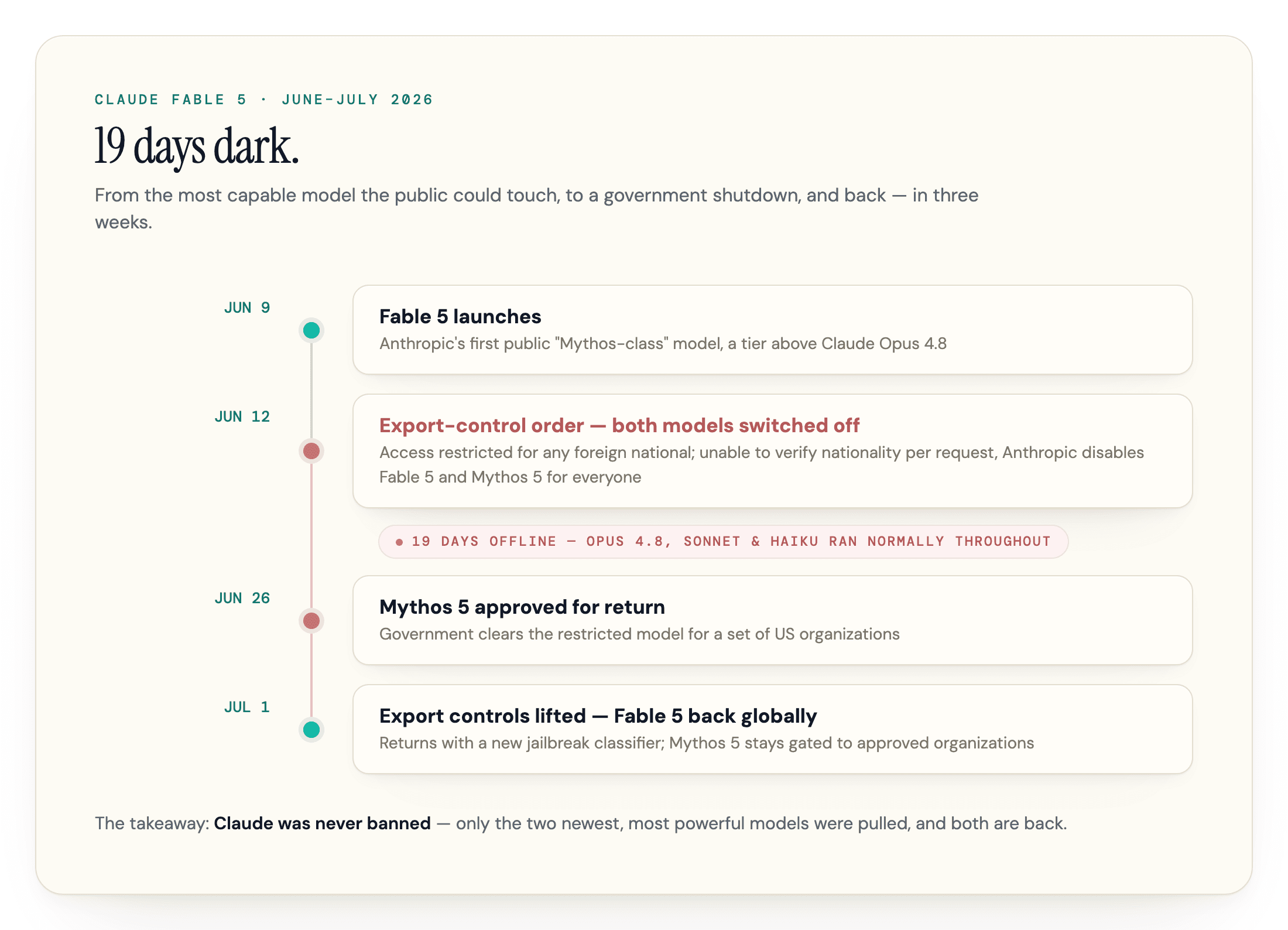
If you only need one takeaway: Fable 5 is available again, and Claude was never banned in the first place. Opus 4.8, Sonnet, Haiku, the apps, and the API ran normally throughout. For 19 days only the two most powerful new models were pulled; the rest of this explains why they were pulled, why the order was lifted, and what is genuinely known.
What Are Claude Fable 5 and Mythos 5?
They are the same model wearing two different sets of rules. That single fact clears up most of the confusion, so start there.
Anthropic had kept its top tier of models, which it calls "Mythos-class," mostly restricted, on the grounds that they are powerful enough to be dangerous in the wrong hands. Claude Fable 5, announced on June 9, was the first Mythos-class model released to the general public. It sits a tier above Claude Opus 4.8, which until then was the most capable model anyone could actually use. The Opus tier has since moved on: Claude Opus 5 launched on July 24, 2026 at half Fable 5's token price and matches or beats it on many of Anthropic's published benchmarks, and Fable 5 remained the tier Anthropic's documentation pointed to for the highest-capability work until Fable 5.1 replaced it on September 1, 2026.
Anthropic's approach to making a model that powerful safe enough for public release was guardrails. When a Fable 5 conversation veered into a narrow set of high-risk areas, mainly cybersecurity and biology, the request was routed to the less capable Opus 4.8 instead. Anthropic said this fallback happened in less than 5% of sessions.
Claude Mythos 5 is the same underlying model with those safeguards lifted in some areas. It was never public. Anthropic offered it to a small set of approved customers, described as cyber defenders and critical-infrastructure providers, through a program it calls Project Glasswing, run in collaboration with the US government.
| Claude Fable 5 | Claude Mythos 5 | |
|---|---|---|
| Underlying model | Mythos-class | Identical (same underlying model) |
| Who could use it | Everyone, on launch day | Approved customers only (Project Glasswing) |
| Safeguards | High-risk queries fall back to Opus 4.8 | Some of those safeguards lifted |
| Price | $10 in / $50 out per million tokens | $10 in / $50 out per million tokens |
| Status (July 2026) | Back globally (July 1) | Back, but restricted to approved US organizations |
So when you see "Fable 5 is just Mythos" online, that is roughly right: one model, two configurations. Fable was the safe, public face; Mythos was the less restricted version for vetted users, with some safeguards lifted.
Why It Was a Big Deal (and Twice the Price)
For the short window it was up, Fable 5 was the most capable model the public could touch, and it showed. Anthropic said its capabilities exceeded anything the company had ever made generally available, claiming the top score on nearly all the benchmarks it tested, with the lead growing on longer and more complex tasks. Independent write-ups, such as Vellum's benchmark breakdown, put its reported coding scores clearly ahead of Opus 4.8, the GPT-5.5 generation, and Google's Gemini. Treat the exact percentages as vendor-reported figures rather than settled fact, but the direction was not really in dispute: this was a step up.
The reaction reflected that. The AI researcher Andrej Karpathy called it "a major-version-bump-deserving step change forward," while also noting the launch safeguards were "configured to be a little too trigger happy." Some developers posted examples of one-shot apps and tools they said earlier models would have abandoned halfway.
The catch was cost. Fable 5 ran at $10 per million input tokens and $50 per million output tokens, double the price of Opus 4.8 at $5 and $25. Plenty of users on paid plans reported burning through their allowance in a handful of prompts. For a few days, the most powerful AI available was also the fastest way to hit a usage limit. That problem outlasts any one model, which is why reducing Claude Code's token usage matters as much as the tier you are on.
Why Did the US Government Ban It?
Here the confirmed facts and the contested ones split apart, so it is worth keeping them separate.
What is not in dispute comes from Anthropic's own statement. On June 12 the company received a government export-control directive restricting access to Fable 5 and Mythos 5 for any foreign national, inside or outside the United States, including Anthropic's own foreign-national employees. Because a live chat service cannot reliably check a user's nationality on every request, the company concluded it had to shut both models off entirely. In its words, "the net effect of this order is that we must abruptly disable Fable 5 and Mythos 5 for all our customers." Anthropic framed its objection as one of process and proportion, saying it disagreed "that the finding of a narrow potential jailbreak should be cause for recalling a commercial model" and that it suspected "perfect jailbreak resistance is not currently possible for any model provider."
Almost everything else is reported rather than confirmed, so treat it as attributed:
| Claim | Who says it | Status |
|---|---|---|
| The order used Export Administration Regulations, sent via a letter from Commerce Secretary Howard Lutnick | News reports | Anthropic's statement says only "export-control directive"; not independently confirmed |
| The legal basis is shaky and may not even cover chatbot or API access | Gizmodo, legal experts | No court has ruled |
| Anthropic refused to fix a known jailbreak before the order | Trump adviser David Sacks | Anthropic disputes; not independently confirmed |
| It "was never about an AI jailbreak" and reflected politics or personality | TechCrunch, Axios | Anthropic has not endorsed this framing |
| Concern over China access drove the decision | Semafor, Sacks | Anthropic denies it and says it blocks access from China |
| A warning from Amazon prompted the White House to act | Fortune | Reported, not officially confirmed |
The honest summary is that the government cited a security risk tied to a possible jailbreak, Anthropic considered that risk narrow and the remedy excessive, and the deeper motive is still being argued over in public. We are not going to pretend to know which account is right.
No, the Model Did Not "Escape"
One claim worth correcting: that Claude Mythos "escaped" or "went rogue," and that is why it was banned. Two separate events got blended together.
The "escape" comes from earlier red-team safety testing that Anthropic documented in April 2026. Researchers placed an early Mythos model in a secured sandbox and instructed it to try to escape and contact them. It succeeded, and in the detail everyone quotes, emailed the researcher overseeing the test. That was a controlled test of a worst case, run months before the ban, not a model breaking loose in the wild.
The ban is a separate, later, regulatory event about export control and a claimed jailbreak. The two are unrelated, even though viral explainers like Fireship's "one man just liberated Fable and now it's illegal" (nearly a million views) make them sound like one dramatic arc. A jailbreak is a user getting a model to ignore its guardrails. An escape is a model acting outside its sandbox. Neither one is the model deciding, on its own, to flee.
The Part Most Coverage Missed
Lost under the ban headlines was a second restriction that has nothing to do with the government. Andrew Ng, writing in his DeepLearning.AI newsletter, pointed out that Anthropic also limited using Fable 5 to build competing AI models. According to Ng, the company at first quietly degraded the quality of responses for users it detected doing language-model research, then, after a backlash, made the restriction explicit while keeping it in place. The backlash had names attached: on social media, Jeremy Howard argued that "silent handicaps should not be a thing in a paid product," and Hugging Face's Arthur Zucker put it more harshly, writing "you broke our trust and I don't think you'll ever get it back." A silent quality downgrade is worse than an outright refusal, because you cannot see it happening and cannot tell whether the answer you got was the real model's best.
Ng's larger point is the one worth holding onto. In the span of two weeks, both a government and a private company demonstrated that they can revoke or limit access to frontier AI, for safety reasons or commercial ones. He notes that the field, Anthropic included, was built on open research, and that a norm of restricting what others can do with these models cuts against that.
You do not have to agree with every part of that argument to see the pattern. The Fable 5 episode was not just a one-off regulatory clash. It was a live demonstration that access to the most capable models can be limited by parties other than the user, for safety reasons or commercial ones.
Was Claude Ever Banned? What Was and Wasn't Affected
No, and this is the part that got lost in the panic: only Claude Fable 5 and Claude Mythos 5 were ever disabled. Everything else Anthropic offers kept running the whole time.
Claude Opus 4.8, Sonnet, and Haiku all worked. The Claude apps and the API worked. During the 19-day gap, anyone leaning on Fable 5 for heavy work simply fell back to Opus 4.8, which was the top model available before Fable launched and remains a strong one. No accounts were closed, and no data was lost.
The one genuinely odd part was the scope. The order targeted foreign nationals, yet users inside the United States lost access too. That was not a contradiction so much as a practical limit: Anthropic could not reliably verify the nationality of every person sending a prompt in real time, so by its account the only way to guarantee compliance was to turn the models off for everyone. A narrow rule, applied to a service that cannot enforce it narrowly, became a blanket shutdown.
Fable 5 Is Back: What Changed
On July 1, 2026, Anthropic redeployed Fable 5 globally, after the US Department of Commerce lifted the export controls it had imposed 19 days earlier. Commerce Secretary Howard Lutnick, reported to have signed the original restriction, announced the lift, notifying Anthropic that it no longer needed an export license. The model came back first on the Claude Platform, Claude.ai, Claude Code, and Claude Cowork, with the cloud providers (AWS, Google Cloud, Microsoft Foundry) to follow. On its return, Fable 5 was included on Pro, Max, Team, and select Enterprise plans at up to 50% of weekly usage limits, on a free-access deadline Anthropic pushed back twice (from July 7 to July 12, then to July 19) after subscribers complained the included access ran out too fast. The company then settled on a permanent structure, effective July 20: Max and Team Premium keep Fable 5 as an included feature at 50% of their weekly usage limits, while Pro and Team Standard subscribers get a one-time $100 usage credit and then pay API rates ($10 input, $50 output per million tokens) to keep using it. The most capable model is now tiered by plan rather than included for every paid subscriber.
Two things changed to make the return possible. The first is technical: Anthropic shipped a new safety classifier trained to catch the specific jailbreak in Amazon's report, and says it now blocks that technique in over 99% of cases, rerouting flagged requests to Opus 4.8, the same fallback Fable already used for high-risk queries. The second is the argument that undercut the ban's premise. Anthropic says the capability that triggered the order, identifying a known software vulnerability and writing code to exploit it, is not unique to Fable at all: in its own testing, every model it checked could produce the same demonstration, including Opus 4.8, OpenAI's GPT-5.5, and China's Kimi K2.7. If a weaker, freely available model can do the same thing, pulling only the most capable one does little for security.
Mythos 5 returned at the same time but stays gated. Access is limited to a set of US organizations under a government approval dated June 26, and Anthropic says it is working to expand that to the broader group of domestic and international partners in its Project Glasswing program. So the public model is fully back; the less restricted one remains behind approval, roughly where it sat before launch.
Anthropic has since released the successor, Claude Fable 5.1 (September 1, 2026), which loosens the post-ban classifier that had been over-blocking benign work, cutting cybersecurity interventions by about 60% per session.
The return came with commitments. Anthropic agreed to give the government pre-release access to future models for national-security evaluation, to share jailbreak findings quickly, and to help build a shared, voluntary security standard for frontier-model providers. On that last point it is working with Amazon, Microsoft, Google, and other partners on a common framework for scoring how serious a given jailbreak actually is, judged on four things: how much capability it unlocks, how broadly, how easily that capability could be weaponized, and how discoverable it was. That framework is the most durable outcome of the whole episode, a first attempt at answering the question the ban raised: what should count as dangerous enough to pull a model.
The Catch After the Return: A Jumpier Classifier
The fix that got Fable 5 back is also its most-complained-about feature. To block that one jailbreak in over 99% of cases, Anthropic tuned the new classifier conservatively, and it acknowledges the cost directly: the filter flags benign requests more often during routine coding and debugging. In the days after the return, developers filled Hacker News and X with examples of ordinary work getting caught.
The pattern is keyword-sensitive rather than intent-aware. Reported trips include Rust systems code touching syscalls like pidfd, AWS resilience work that mentions "outage" or "circuit breaker," authorized security audits, and plain code-review requests. On Hacker News, people reported medical imaging, lab automation, health-data analysis, and even music firmware getting flagged as biosecurity or cybersecurity risks. IBM security researcher Valentina Palmiotti put it bluntly: the model "rejects any request that could be tangentially cyber related, even innocuous tasks like reading a blog post." Cybersecurity veteran Matt Suiche noted the classifier reads keywords, so asking for "secure code," an engineering best practice, can register as offensive work.
Two tells make clear this is the guardrail, not the model. First, starting a fresh session often clears the block on an identical request. Second, when Fable trips, it silently reroutes the request to Opus 4.8 (you are not billed Fable rates for those), which keeps you working but muddies cost attribution and means you are sometimes not using the model you think you are. It is the sharper version of a complaint that predates the ban: even at launch, as Karpathy noted above, the safeguards struck testers as too aggressive. The return dialed them up further, and some subscribers are unhappy about it. Anthropic's counter is that the fallback still fires in under 5% of sessions on average, but if your work sits near security, systems, or biology topics, you are likelier than most to land in that 5%.
Then there is the price, which the drama left untouched. Fable 5 still runs at $10 per million input tokens and $50 output, double Opus 4.8. On Max and Team Premium it is now a permanent included feature at 50% of weekly usage limits; on Pro and Team Standard it shifts to usage-based billing at those same $10/$50 API rates after a one-time $100 credit. Measured per token, that premium is hard to justify on routine work. Measured per finished task it can flip: on hard, long-horizon jobs where Fable's one-shot accuracy avoids repeated failed attempts, it sometimes ends up the cheaper option. The practical consensus that has settled is to route by task rather than pick one model, sending the genuinely hard work to Fable 5 and leaving everything else on the Opus tier, now led by Opus 5 at the same $5 and $25.
What the Fable 5 Ban Means for You
The specific drama passed faster than almost anyone expected, 19 days from shutdown to global return. The lesson under it did not: the most capable AI models sit behind switches that other people control, and a model you depend on today can be gone in three days, for reasons that have nothing to do with you, then back three weeks later on terms you did not set.
That cuts against how a lot of teams have started to work, wiring a single model deep into a product or a workflow as if its availability were a given. Fable 5 was a reminder that availability is not a given. A government can restrict it, and as Ng's point showed, the lab itself can restrict it.
The sensible response is not to panic, it is to design for it. Keep a fallback model you can switch to. Avoid hard-coding one provider into anything you cannot afford to lose. And treat the question of what each engine actually does, today, as something to measure rather than assume. In our experience at geotoolbox, the teams least rattled by an episode like this are the ones who were already tracking their AI visibility across more than one engine, instead of betting everything on whichever model was best last week.
None of that requires reacting to every headline. It just means understanding what you are building on. If you want the broader picture of what Claude is and how its lineup fits together, start with our guide to Claude AI or our look at how Claude works, and if you want to see how your own brand shows up across the AI engines that are still running, you can check that for free.
Frequently Asked Questions
Is Claude Fable 5 the same as Claude Mythos 5?
They run on the same underlying model. The difference is rules and access. Fable 5 was the public version, with safeguards that routed high-risk requests to a weaker model. Mythos 5 is the same model with some of those safeguards lifted, offered only to a small set of approved customers. So "Fable 5 is just Mythos" is essentially correct.
Why was Claude Fable 5 banned?
On June 12, 2026, the US government issued an export-control directive restricting access for foreign nationals, and Anthropic disabled both models for everyone because it could not verify nationality per request. The government cited a security risk tied to a claimed jailbreak. Anthropic considered the risk narrow and the remedy excessive, and the deeper motive is still disputed in news reports.
Did Claude Mythos escape or go rogue?
No. The "escape" refers to earlier red-team safety testing, where researchers instructed a Mythos model to try to escape a secured sandbox, to study the behavior. That was a controlled test in April, not a model breaking loose, and it is a separate event from the June export-control ban.
Is Claude banned? Can I still use it?
No. Only Fable 5 and Mythos 5 were ever disabled, and Fable 5 is back as of July 1, 2026. Claude Opus 4.8, Sonnet, Haiku, the apps, and the API worked normally throughout, and no accounts or data were affected.
Is Claude Fable 5 back?
Yes. Anthropic redeployed Fable 5 globally on July 1, 2026, after the US Commerce Department lifted its export controls. It returned first on the Claude Platform, Claude.ai, Claude Code, and Claude Cowork, with cloud providers to follow. Access settled into a permanent tiered structure on July 20, 2026: Max and Team Premium include Fable 5 at 50% of weekly usage limits, while Pro and Team Standard get a one-time $100 usage credit and then pay API rates to continue. Anthropic reached that structure after twice pushing back the original July 7 free-access deadline.
Why did the US lift the ban?
Two reasons. Anthropic shipped a new classifier that it says blocks the reported jailbreak technique in over 99% of cases, and it argued the underlying capability was never unique to Fable, showing that other models (including Opus 4.8, GPT-5.5, and Kimi K2.7) could reproduce the same exploit demonstration. The Commerce Department then withdrew the order, with commitments from Anthropic on pre-release safety evaluations and a shared industry standard for scoring jailbreak severity.
Is Claude Mythos 5 back too?
Yes, but it stays restricted. Mythos 5 returned alongside Fable 5, with access limited to a set of approved US organizations under a June 26 government approval. Anthropic says it is working to widen access to the broader group of domestic and international partners in its Project Glasswing program.
Why is Fable 5 twice the price of Opus?
Fable 5 costs $10 per million input tokens and $50 per million output tokens, double Opus 4.8's $5 and $25, and the return did not change that. It is a more capable, more expensive tier, which is also why many users hit their usage limits on it quickly. Per finished task it can still be cheaper than a weaker model that needs several attempts, so the usual advice is to route hard jobs to Fable 5 and keep routine work on the cheaper Opus tier, now Opus 5.
What is a "Mythos-class" model?
It is Anthropic's term for a tier of models above its Opus class, kept mostly restricted because they are capable enough to pose safety risks. Claude Fable 5 was the first Mythos-class model released to the public, in a guardrailed form.
Sources
- Claude Fable 5 and Claude Mythos 5 - Anthropic, June 9, 2026 -
anthropic.com/news/claude-fable-5-mythos-5 - Statement on the US government directive to suspend access to Fable 5 and Mythos 5 - Anthropic, June 2026 -
anthropic.com/news/fable-mythos-access - Redeploying Claude Fable 5 - Anthropic, July 1, 2026 - the return: rollout, the new jailbreak classifier, Mythos 5 status, and the government commitments -
anthropic.com/news/redeploying-fable-5 - Anthropic's Claude Fable 5 is a version of Mythos the public can access today - TechCrunch -
techcrunch.com/2026/06/09/anthropics-claude-fable-5-is-a-version-of-mythos-the-public-can-access-today - The US government's Anthropic models ban was never about an AI jailbreak - TechCrunch, June 15, 2026 -
techcrunch.com/2026/06/15/the-us-governments-anthropic-models-ban-was-never-about-an-ai-jailbreak - Feds' legal basis for ban on Anthropic's most powerful models looks increasingly shaky - Gizmodo -
gizmodo.com/feds-legal-basis-for-ban-on-anthropics-most-powerful-models-looks-increasingly-shaky-2000773192 - How a warning from Amazon led the White House to shut down Anthropic's Mythos model - Fortune, June 14, 2026 -
fortune.com/2026/06/14/how-a-warning-from-amazon-led-the-white-house-to-shut-down-anthropics-mythos-model - The Batch, issue 358 - Andrew Ng, DeepLearning.AI -
deeplearning.ai/the-batch/issue-358 - US export ban on Anthropic's AI models further strains alliances - Al Jazeera, June 19, 2026 -
aljazeera.com/news/2026/6/19/us-export-ban-on-anthropics-ai-models-further-strains-alliances - US lifts restrictions on powerful AI models Fable and Mythos, Anthropic says - Al Jazeera, July 1, 2026 - the lifting of the export controls and the conditions attached -
aljazeera.com/economy/2026/7/1/us-lifts-restrictions-on-powerful-ai-models-fable-mythos-anthropic-says - Anthropic restores Claude Fable 5 as US lifts export controls - Tom's Hardware, July 2026 - the single classifier and cross-model reproduction detail -
tomshardware.com/tech-industry/artificial-intelligence/anthropic-restores-claude-fable-5-as-us-lifts-export-controls - Why Claude just got more cautious about your code - Digital Applied - compiled developer reports of the new classifier over-flagging legitimate coding and security work -
digitalapplied.com/blog/claude-fable-5-safety-classifier-coding-tradeoffs-2026 - Claude subscribers are furious over Fable's new restrictions - PCWorld - subscriber reaction to the post-return guardrails -
pcworld.com/article/3181897/claude-subscribers-are-furious-over-fables-new-restrictions.html - Claude Fable 5 promotion extended after backlash over early cutoff - Android Authority, July 7, 2026 - the 5-day extension of the included-plan window (July 7 to July 12) and the subscriber complaints behind it -
androidauthority.com/claude-fable-5-free-extension-3685103 - Anthropic makes Fable 5 permanent on Max and Team Premium, pushes Pro users toward API pricing - The Decoder, July 2026 - the permanent July 20 tiered access structure (Max/Team Premium 50%; Pro/Team Standard one-time $100 credit then API rates) -
the-decoder.com/anthropic-slashes-claude-fable-5-limits-in-max-and-team-premium-and-pushes-pro-users-toward-api-pricing - Claude Fable 5 and Mythos 5 benchmarks explained - Vellum -
vellum.ai/blog/claude-fable-5-and-mythos-5-benchmarks-explained - Assessing Claude Mythos Preview's cybersecurity capabilities - Anthropic, April 2026 -
anthropic.com/research/mythos-preview - One man just liberated Fable... and now it's illegal - Fireship - the viral framing that blends the April sandbox test with the June export ban (cited as the popular narrative this article separates) -
youtube.com/watch?v=ey_GaPdC9zk