
Claude vs ChatGPT is usually framed as a contest with a winner. It is not one. As of September 2026 two of the leading general-purpose AI assistants are close enough that the honest answer is "it depends on the task," and for anyone who publishes or markets, there is a third question almost nobody asks: which one should cite your brand. This is the comparison done honestly: how each one is actually built, how each searches and cites the web, and who wins which job. It is written for people who publish content rather than build models. New to Claude? Start with what Claude AI is.
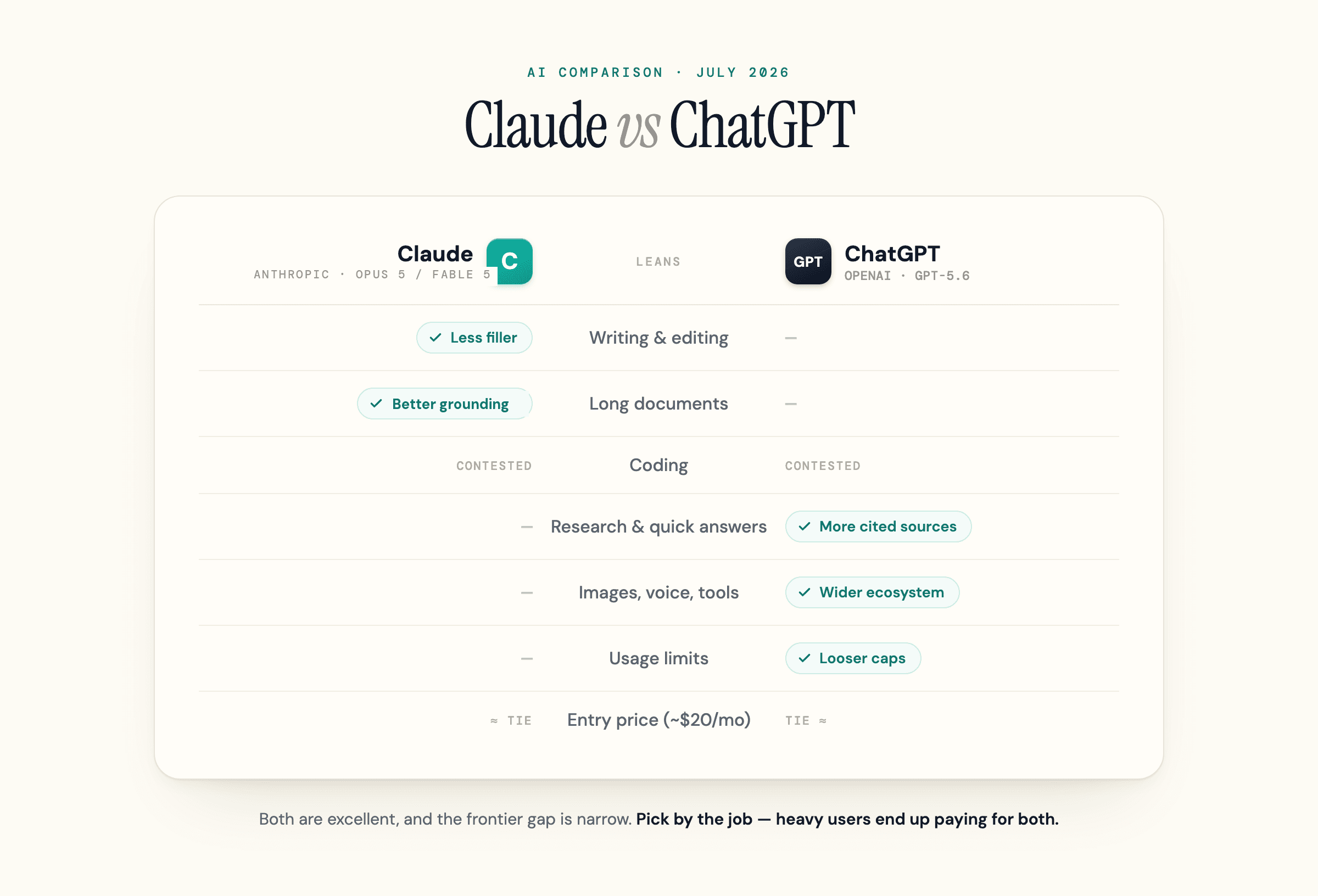
Claude vs ChatGPT at a Glance
Here is the honest version of the comparison before the detail. Both are excellent. The real differences sit at the edges, and which edge matters depends entirely on what you do all day. Model versions move monthly, so check the update date at the top of this page before you act on anything below.
| Claude | ChatGPT | |
|---|---|---|
| Maker | Anthropic | OpenAI |
| Top models (October 2026) | Opus 5.5, Sonnet 5.5, Haiku 5.5, and the higher-tier Fable 5.1 (Haiku 4.5, Sonnet 5, Opus 5, Fable 5 and Opus 4.8 now prior/legacy) | GPT-6 Astra, OpenAI's frontier model since September 3, 2026, above GPT-6 Sol and Luna (September 22, 2026, in ChatGPT Work, Codex and the API), which succeed the GPT-5.6 generation |
| Leans best at | Long-document work, writing, agentic coding | Breadth: images, voice, custom GPTs, broad tool use |
| Entry price | Pro around $20/month | Plus around $20/month (Go around $8; Free and Go may show ads, paid tiers above Go do not) |
| Context window | Up to 1M tokens on Opus 5.5, Sonnet 5.5, Haiku 5.5, and Fable 5.1 | 1,050,000 on the GPT-6 Astra and GPT-5.6 APIs, published by OpenAI; the consumer app exposes far less, by plan |
| Web search and citations | Web search built in; fewer, more authoritative citations; strong at grounding a document you give it | Live web search; more inline web citations per answer |
| Standout feature | Claude Code; the careful, low-fluff character | Image generation, Advanced Voice, custom GPTs, the wider ecosystem |
| Free tier | Yes (a Sonnet-class model) | Yes (with usage limits) |
Both are large language models built on the same basic idea, so a feature checklist only gets you so far. The differences that actually predict which one you will prefer come from how each was trained and how each handles the open web, which is where most comparisons stop and this one keeps going.
Is Claude Better Than ChatGPT?
No, and neither is the other one. "Better" is the wrong question, because the answer flips by task and sometimes by the specific job in front of you. The honest version is a split: Claude tends to win on writing and long-document work, ChatGPT wins on built-in image generation and a more mature voice and tool ecosystem, and coding is genuinely contested. Most people who use either one heavily end up paying for both.
That sounds like a dodge, so here is the specific shape of it. If your day is drafting, editing, and reasoning over long documents, Claude usually feels sharper and less padded. If your day involves generating images, talking to the model by voice, building a custom assistant, or reaching for whatever tool a task needs, ChatGPT's ecosystem is hard to beat. For code, the benchmarks and professional adoption point at Claude, but plenty of developers get better real-world results from ChatGPT, which is a contradiction worth taking seriously rather than explaining away.
There is one practical catch that the "just pick the smarter model" advice ignores: usage limits. Anthropic publishes an explicit structure, a five-hour rolling window plus a weekly cap, both visible as progress bars in Settings > Usage, while OpenAI says only that Plus "may include usage limits such as message caps, especially during high demand," which "may vary based on system conditions." Claude tells you where the wall is and ChatGPT does not, and heavy users of either report hitting one. Anthropic raised those five-hour limits on Pro, Max, Team and seat-based Enterprise plans on September 22, 2026, alongside Opus 5.5. Which plan actually stops you first depends on your workload rather than on any published number; we break the Claude side down in our guide to Claude's costs. That, more than any benchmark, is why "use both" keeps winning as the real-world answer.
So the useful question is not which one is better. It is better at what, for whom, and measured how, which is exactly what the rest of this comparison gets specific about.
How Claude and ChatGPT Actually Work (and Why You Feel the Difference)
Under the hood, both run the same kind of engine, and then take a sharp turn that explains most of how they behave. Each is a transformer that predicts the next token, trained on a large slice of the internet. The character you talk to comes from a second stage, alignment, and from the product wrapped around the model. That second stage is where Claude and ChatGPT diverge, and it is the part almost every comparison skips.
ChatGPT's assistant behavior was shaped largely through reinforcement learning from human feedback, where people rate answers and the model learns to produce more of what they reward. Claude uses that too, but adds Constitutional AI. It works in two parts: the model first critiques and revises its own answers against a written set of principles, then the reinforcement-learning step is driven by preferences another AI generates against those same principles, rather than by human ratings (Anthropic calls this reinforcement learning from AI feedback). In Anthropic's words, "the only human oversight is provided through a list of rules or principles." Different training recipe, different defaults.
You feel that difference in small ways. Claude is more likely to ask a clarifying question, push back, or refuse on the edges, and it tends to write with less filler. ChatGPT is broader and more eager to just produce something, with a deeper bench of built-in tools. These are tendencies, not laws, and both companies tune them constantly. We cannot inspect either model's internals from outside, so treat any claim about why it behaves a certain way as an informed read, not a readout. The deeper mechanism lives in our companion pieces on how ChatGPT actually works and how Claude works under the hood.
One distinction matters more than any of this for getting the comparison right.
| The model | The product | |
|---|---|---|
| What it is | A trained network that turns text into more text | The app around it: tools, memory, web search, image generation, safety filters, UI |
| Claude | Opus 5.5 / Sonnet 5.5 / Fable 5.1, shaped by Constitutional AI | claude.ai and Claude Code: web search, file handling, artifacts, agentic coding |
| ChatGPT | GPT-6 Astra, above GPT-6 Sol and Luna, shaped by RLHF | The ChatGPT app: image generation, voice, custom GPTs, browsing, broad tools |
When people say "ChatGPT can generate images" or "Claude writes code," they are usually describing the product, not the raw model. Keeping the two apart is the difference between a comparison that holds up and one that ages badly the next time either company ships a feature. A capability gap today is often a product decision, not a permanent limit of the underlying model.
How Each One Searches the Web and Cites Its Sources
This is the part that decides whether either tool gets your business right, and almost no comparison covers it. A model only knows the world up to its training cutoff. That is June 2026 for Claude Opus 5.5, the current Opus since September 22, 2026, per Anthropic's own models table, and around May 2026 for the prior Claude Opus 5 (Opus 4.8, now legacy, and Sonnet 5 both stop around January 2026) and around December 2025 for the prior GPT-5.5 generation. GPT-5.6, which superseded it on July 9, 2026, publishes a cutoff of February 16, 2026, shared across Sol, Terra and Luna. That gap has since narrowed but not closed. GPT-6 Astra, OpenAI's frontier model since September 3, 2026, publishes a cutoff of April 30, 2026: about two months behind Opus 5.5 and Fable 5.1, both of which Anthropic's models table gives a reliable knowledge cutoff of June 2026, and about a month behind the prior Opus 5. Anything newer, including most recent facts about your company, reaches the model only at query time, whether through live web search, the context you paste in, files you upload, or connected sources. How each one fetches and cites the web differs in ways that matter.
ChatGPT's web behavior runs on three separate bots, and OpenAI documents exactly what each one does. GPTBot collects training data. OAI-SearchBot surfaces pages in ChatGPT's search results. ChatGPT-User fetches a page live when you ask a question that needs it. They are independent switches, which is why blocking one does not block the others. In our testing, ChatGPT tends to pull from more sources and show more inline citations per answer, with clickable links you can check. The mechanics, and where it gets attribution wrong, are in our piece on how ChatGPT cites sources.
Claude's web search is newer and more conservative. It pulls fewer sources, leans toward authoritative and technical ones, and is unusually strong when you paste a long document into its context window and ask it to reason over that instead of the open web. One informal pattern people report: on the same research question, ChatGPT may cite roughly twice as many sources as Claude. Treat that as a directional observation, not a fixed rule, since both change with every release.
Now the part both share, and the one to take seriously. When web search is off, each model answers from frozen training memory, and either one can produce a confident, authentic-looking citation that does not exist. This is not lying. It is a known failure mode where the model recognizes the shape of a source and fills in plausible details, which is why both tools invent journal articles and URLs that were never real. We cover the mechanism in AI hallucinations. Turning on web search reduces it sharply, but does not make it zero, so the citation a model hands you is a lead to verify, never a guarantee.
Claude vs ChatGPT for Writing, Coding, and Research
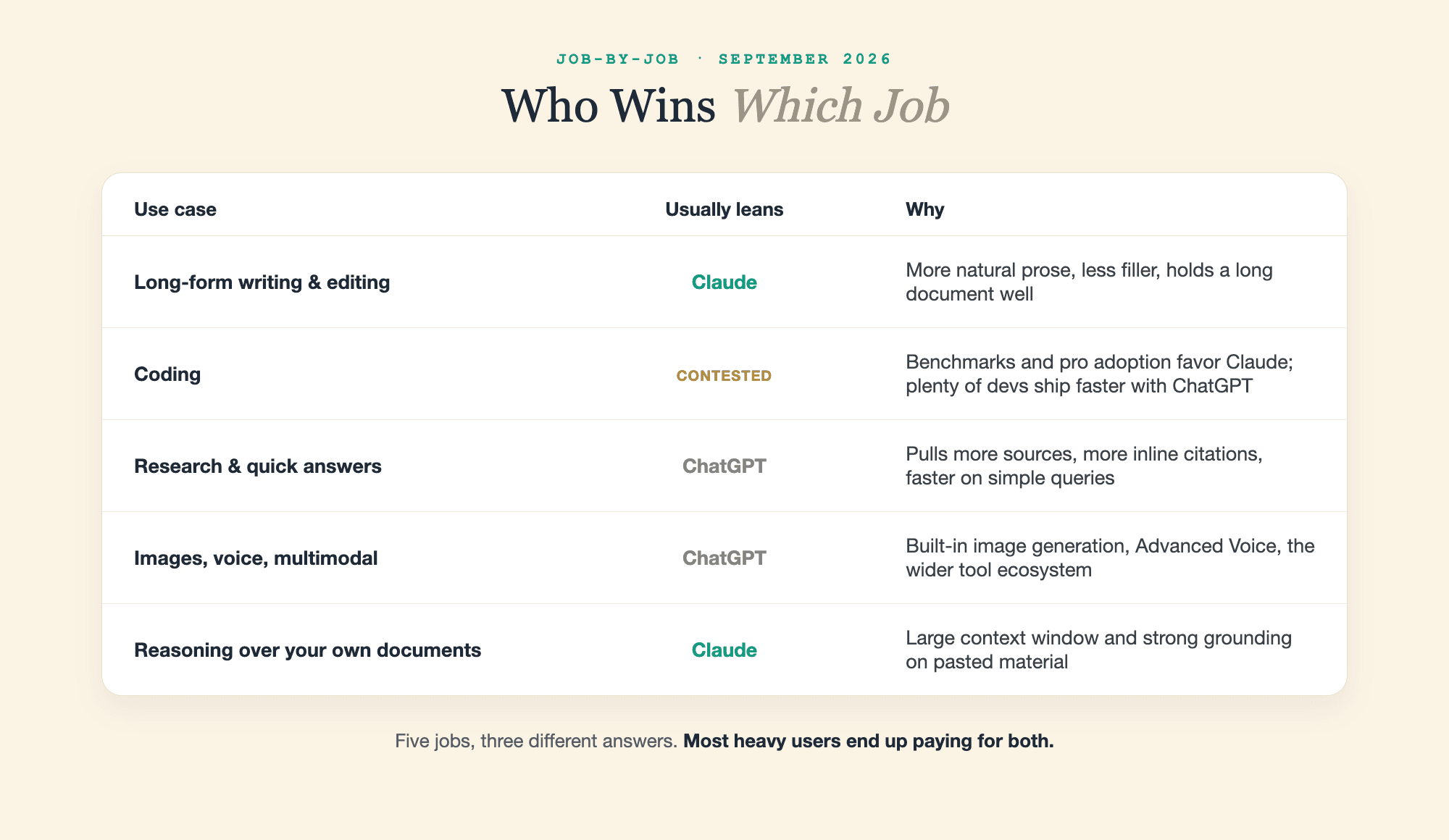
Sorted by job, the picture gets clearer than any overall winner. Here is where each one tends to land, with the caveat that matters for each.
| Use case | Usually leans | Why | The caveat |
|---|---|---|---|
| Long-form writing and editing | Claude | More natural prose, less filler, holds a long document in working memory well | Can be agreeable to a fault, nodding along instead of pushing back |
| Coding | Contested | Benchmarks and pro adoption favor Claude; Claude Code is a full agent | A benchmark lead is not an implementation lead; some devs ship faster with ChatGPT |
| Research and quick answers | ChatGPT | Pulls more sources, more inline citations, faster on simple queries | More sources is not more accuracy; the model can cite many and still be wrong |
| Images, voice, multimodal | ChatGPT | Built-in image generation, Advanced Voice, the wider tool ecosystem | Claude focuses on text and code by design, not a bug |
| Reasoning over your own documents | Claude | Large context window and strong grounding on pasted material | Advertised context is not the same as reliable recall across all of it |
On writing, Claude's edge is real but comes with a tell: it leans agreeable. Ask it to critique your draft and it will often soften the verdict, so you have to explicitly tell it to be harsh. ChatGPT can drift the other way, confidently producing polished filler. Neither replaces an editor.
On coding, the data favors Claude. Menlo Ventures' 2025 State of Generative AI in the Enterprise put Anthropic at an estimated 54% of the enterprise coding market against OpenAI's 21%, based on a November 2025 survey of 495 U.S. enterprise decision-makers plus modeled spend, not a direct census, and the sample is U.S. enterprises only. Menlo is also an Anthropic investor, so read it as a directional signal. It measures adoption, not a head-to-head test: on the coding benchmarks themselves the gap is narrow on some evals and wider on others, and depends heavily on the test setup, so the difference developers feel is often about tooling and workflow more than raw model skill. Coding "better" depends on your language, your codebase, and how you prompt, and plenty of developers genuinely prefer ChatGPT. Benchmark leadership and the build that actually compiles on your machine are different claims.
On research, ChatGPT's broader sourcing is handy, but the same caution from a comparison of ChatGPT vs Perplexity applies here: a research-style answer is only as good as the sources it grounded on, and a confident summary can rest on weak ones. Read the links, do not trust the summary.
What the Benchmarks Actually Say (Read Them Skeptically)
Benchmarks are the most quoted and least understood part of any comparison. They are useful for spotting which models are roughly in the frontier tier and nearly useless for picking a daily driver. Here is the honest state of the major ones as of September 2026.
| Benchmark | What it measures | Reported leader (September 2026) | Read it with |
|---|---|---|---|
| SWE-bench Verified | Resolving real GitHub issues (coding) | Claude leads, but the public board has not been updated since February 2026 and lists no 2026 flagship: top score 79.2% (Claude 4.5 Opus), with Gemini 3 Flash and MiniMax M2.5 within a point in the default view | Scores depend heavily on the test harness, and both labs have stopped reporting this variant for their newest models; Anthropic now publishes SWE-bench Pro and Multilingual instead |
| GPQA Diamond | Graduate-level science questions (reasoning) | GPT-6 Astra leads at 96.0%, with Gemini 3.8 Flash at 95.3% and Claude Fable 5.1 at 93.7%, but these are OpenAI's own runs; Anthropic publishes no GPQA score for its flagship | Scores sit near the ceiling, so tiny gaps look bigger than they are |
| Arena | Human head-to-head preference votes | Anthropic models hold the entire top four in text and are statistically tied for first (2 September 2026 snapshot); OpenAI's best entry, GPT-5.6 Sol, ranks 17th | This measures what people prefer, not what is correct |
| OSWorld | Computer-use and agentic tasks | Claude Opus 5 leads the official OSWorld 2.0 board (70.2% partial vs GPT-5.6 Sol's 64.1%); OpenAI's own Astra table puts GPT-6 Astra ahead at 72.6%, but the two vendors' figures are not directly comparable and both say so | A young, noisy benchmark that moves a lot release to release |
Four things keep benchmark numbers from meaning what they look like. First, most headline coding scores are self-reported by the labs, and the same model can swing five to ten points depending on the scaffolding around it. Second, the older general-knowledge tests like MMLU are effectively saturated, with everyone scoring in the high 80s and 90s, so they no longer separate the top models. Third, the leads flip almost monthly as each lab ships, so any single number is a snapshot, not a standing. Fourth, Arena rewards the answers people prefer, which tracks quality but also rewards confident, agreeable, well-formatted responses that are not always right.
The practical takeaway is dull but true: by September 2026 the frontier models from both labs are close enough that benchmark gaps rarely decide a real workflow. The benchmark that counts is your own workflow, measured on both.
Privacy, Drift, and the Other Catches
Two things the feature tables leave out matter more than most of the specs.
Privacy. As of September 2026, both makers train on consumer chats by default and let you opt out, while their business and enterprise tiers, plus the API, are contractually excluded from training by default. Anthropic changed Claude's consumer default in autumn 2025, announced on August 28, 2025, with the new consumer terms taking effect on October 8, 2025, so whatever you remember about Claude not training on your data may be out of date. There is no European exception to that default: the EEA version of Anthropic's consumer terms and OpenAI's separate Europe privacy policy apply the same rule to users in Germany, France, and the rest of the EU. What Europe adds is a second way out: because OpenAI bases model training on legitimate interests, users there can object under Article 21 of the GDPR as well as using the in-product setting. If your work is sensitive, use a business tier or check the data settings on whichever one you run.
Drift. Both models change under you. New versions ship constantly, old ones get retired, and people regularly report a model feeling worse after an update, sometimes real, sometimes perception. Claude's habit of agreeing with you is the quirk to watch on its side; ChatGPT's is sounding equally confident whether or not it should be. Re-test your own workflow after any major update rather than trusting last quarter's verdict.
Which One Should Your Brand Appear In?
If you publish or market anything, the question that pays is not which tool you use. It is which one names your brand when your customer asks. Both ChatGPT and Claude are answer engines now. People ask them which product to buy, which agency to hire, which tool is best, and the model's answer either includes you or it does not. In that moment the citation is the impression, and you never see the ones you lose.
This is not a fringe behavior, and the clearest measured case so far is Google's own search. A 2025 Pew Research Center study found that when an AI summary appeared in Google results, users clicked a traditional result link in just 8% of visits, against 15% when there was no summary, roughly half. That study measures Google AI Overviews, not ChatGPT or Claude, but it captures the same shift: as more answers get consumed without a click, being inside the answer matters more than ranking below it.
The catch is that the two engines reach for different sources, so showing up in one does not mean showing up in the other, and Gemini adds a third pool again, which we cover in Claude vs Gemini, while Grok vs Claude and Grok vs ChatGPT map Grok's very different, X-driven source pool. Both sit on the same underlying machinery of how AI search works, but they weight it differently, which splits into two concrete jobs.
To earn ChatGPT citations, make your facts easy for a machine to lift: clean static HTML it can crawl, question-shaped headings, structured data, and claims backed by sources it already trusts like Wikipedia. The fuller playbook is in showing up in ChatGPT. To earn Claude's, write the way it tends to favor: plain, well-organized prose that states the answer directly and cites authoritative or technical sources, not keyword-padded pages. That is why getting cited in Claude is its own job, and why a page tuned only for classic Google rankings can be invisible in both.
You cannot control which model a customer opens, and the field is widening past these two to open-weight challengers like Kimi and DeepSeek; you also cannot control the dice on any single answer, since the same question can cite you one time and skip you the next. What you can do is make your page the clearest, most authoritative source on the question, then measure how often each engine actually cites you and fix the gaps. In our experience auditing brands across these engines, the most common and most fixable problem is simply not knowing the score: companies are absent from AI answers about their own category and have no idea, because they are still watching blue-link rankings. You cannot improve a number you are not measuring, which is the whole case for tracking your AI share of voice per engine rather than guessing.
How We Use Them, and Why the Loop Beats the Model
A note on where this comes from. We run an SEO agency, build a GEO tool, and do security research, and most of that work happens in Claude through Claude Code, with OpenAI's models running a second pass through Codex. So this is not a spec-sheet comparison. It is how we use both every day.
The thing we learned the hard way is that the model matters less than the loop around it. A model reviewing its own work is notoriously bad at catching its own mistakes. It rereads its error and confidently approves it, because the same blind spot that produced the mistake is doing the checking. The fix is not a smarter model. It is a second, adversarial pass, ideally from a different model family, because a different model fails in different places and sees what the first one cannot.
So we never ship a first draft. Whether it is an article, a line of production code, or a security finding, it goes through several harsh, independent reviews before it counts. This article is an example: one model wrote it, then six independent reviewers and a separate cross-model pass tore into it and caught real problems the draft was blind to, including a training mechanism explained only halfway and a missing section on data privacy. We use Claude and ChatGPT against each other on purpose.
The takeaway for your own work is simple. Pick whichever model fits the task, then stop trusting any single answer it hands you. Build the loop. It is the same reason we measure AI visibility by sampling many times instead of trusting one check: one pass, from one model, on one run, is never the whole picture.
So, Claude or ChatGPT? How to Decide
Pick by task, not by leaderboard. Reach for Claude when you are writing, editing, or reasoning over long documents, and when you want a careful, low-fluff style, though you have to ask it directly for hard critique, since it leans agreeable by default. Reach for ChatGPT when you need images, voice, a custom assistant, or whatever tool the job calls for. Both have free tiers, so the cheapest way to settle the debate for your own work is to put the same real task through each and stop looking for a universal winner that does not exist.
For a business, the calculus is different, and it has nothing to do with which model is smarter: your customers use both, so the question that actually moves revenue is not which one you prefer, but which one cites you when someone asks about your category, and how that compares to your competitors.
That is the gap geotoolbox closes. We track what ChatGPT, Claude, and the other engines actually say and cite about your brand, per engine and over time, so you can see where you show up, where a competitor owns the answer, and what to fix. You can start with a free AI readiness check to see whether these engines can even read your site, then watch your presence across them in the domain overview. The models will keep trading the lead. Whether they mention you is the part you can work on.
Frequently Asked Questions
Is Claude better than ChatGPT?
It depends on the task, and that is the honest answer rather than a dodge. As of September 2026, Claude tends to win on long-form writing, document analysis, and coding benchmarks, while ChatGPT wins on breadth: image generation, voice, custom assistants, and a wider tool ecosystem. For most people there is no single winner, which is why heavy users often pay for both and switch by task.
Is Claude or ChatGPT cheaper?
At the entry level they are close, both around $20 a month for the main paid plan, with ChatGPT offering a cheaper Go tier at around $8 that, like its free tier, may show ads. The bigger practical difference is usage limits: Anthropic publishes a five-hour window plus a weekly cap on Claude's paid tiers, while OpenAI's Plus help page says only that Plus may include usage limits such as message caps, and heavy users of either can hit the wall. Anthropic raised its five-hour limits on September 22, 2026, and which plan stops you first depends on your workload. On the API, per-token prices vary by model and change often, so check each provider's current pricing before budgeting.
Should I switch from ChatGPT to Claude?
Usually the better move is to add, not switch. They are good at different things, and both have free tiers, so you lose nothing by keeping ChatGPT for images, voice, and breadth while using Claude for writing and long documents. Switch fully only if your work sits almost entirely in one model's strengths and the other's usage limits or feature gaps actively get in your way.
Does it matter which one my brand shows up in?
Yes, because your customers use both, and the two engines cite different sources, so being mentioned in one does not mean being mentioned in the other. As people get more answers without clicking, presence inside the answer becomes the visibility that ranking used to provide. The practical step is to measure how often each engine cites you, per engine and over time, and fix the gaps rather than guess.
Sources
- Anthropic - Constitutional AI: Harmlessness from AI Feedback -
anthropic.com/research/constitutional-ai-harmlessness-from-ai-feedback - OpenAI - Overview of OpenAI Crawlers (GPTBot, OAI-SearchBot, ChatGPT-User) -
developers.openai.com/api/docs/bots - Anthropic - Claude models overview (current models, context windows, pricing) -
platform.claude.com/docs/en/models/overview - SWE-bench - software engineering benchmark -
swebench.com - Arena - human-preference LLM leaderboard -
arena.ai/leaderboard - Menlo Ventures - 2025: The State of Generative AI in the Enterprise -
menlovc.com/perspective/2025-the-state-of-generative-ai-in-the-enterprise - Pew Research Center - Google users are less likely to click links when an AI summary appears -
pewresearch.org/short-reads/2025/07/22/google-users-are-less-likely-to-click-on-links-when-an-ai-summary-appears-in-the-results - Claude Opus 5.5 - Anthropic, September 22, 2026 -
anthropic.com/news/claude-opus-5-5 - Introducing GPT-6 Sol and Luna - OpenAI, September 22, 2026 -
openai.com/index/introducing-gpt-6-sol-and-luna