
If you are shopping for a Peec AI alternative, you have probably already decided Peec is a decent tool, which makes this different from most "alternatives" searches. People rarely leave Peec because it is bad. They leave because they hit one specific wall it was not built to knock down: the three-model cap, the euro billing, or the fact that it reports a problem without helping you fix it.
So this guide is organized by the wall, not by a self-serving ranking. Find the row that matches the reason you started looking, and skip the rest. The prices here were checked in August 2026, but this category rewrites its tiers monthly, so confirm the current number on each vendor's page before you buy.
Why People Look for Peec AI Alternatives
Peec AI is well-liked, so most people do not leave it over price or a bad experience. They leave when they hit one specific wall the tool was not built to knock down, and the wall is different for each team. Sort the reasons and the same handful keeps coming up.
The loudest one is that Peec watches but does not fix. It tells you where you are invisible and who is cited instead, then hands the work back to you. Practitioners weighing Peec alternatives in community discussion describe the setup friction plainly: they would rather not hand-enter every prompt to be tracked and wish the tool would just tell them where they already appear. A recurring ask is a searchable index of LLM prompts, the way a traditional SEO tool lets you research competitors, and some call the underlying data thin.
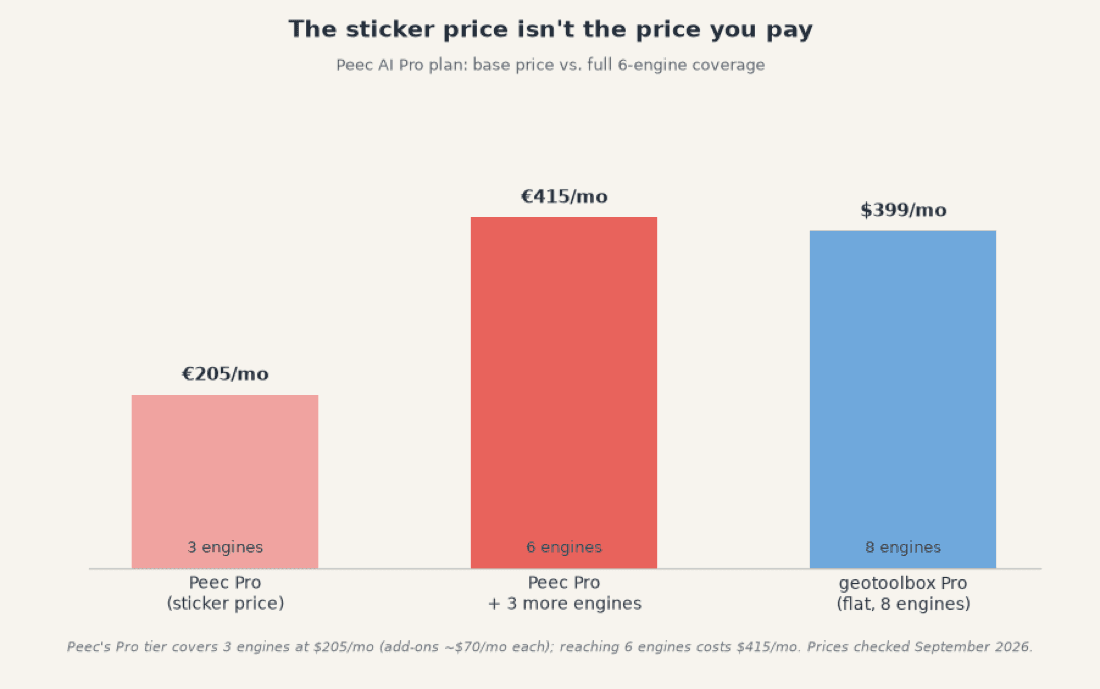
The second wall is coverage. Every self-serve Peec plan tracks three AI models, and a fourth or fifth is a paid add-on that climbs with your tier. Teams that want to watch ChatGPT, Gemini, Copilot, and Perplexity at once find the €205 Pro plan is not the real number once the add-ons stack.
The rest cluster fast: no retroactive data, so a new account starts from zero and short history windows leave little to trend against; prompt suggestions that lean synthetic rather than drawn from real search demand; euro-denominated billing that adds friction for US buyers; and thin support for agencies running many brands in parallel. None of these makes Peec a bad tool. They make it a monitoring tool with limits, and the right alternative depends on which limit you hit.
What Peec AI Does Well, So You Know What You're Replacing
Before you switch, know what you are giving up, because Peec earns its following. The interface is clean, setup takes minutes, and a non-technical marketer can stand up a useful dashboard the same afternoon. Its citation analysis is genuinely good: it shows the exact sources an engine pulled and sorts them by type, which is the raw material for a content plan. Competitor benchmarking, sentiment scoring, and multi-country tracking are all solid, and every plan includes unlimited user seats, so you are not billed per head.
Peec also closed one gap in 2026 that its rivals still ignore, adding a Crawlability audit, included on every plan, plus server-log crawl insights to its Agent Analytics module. Read all of this as real strength, tempered by one caveat: Peec only launched in 2025, so its public review base is small. That is early signal, not a long track record. A fuller picture lives in our Peec AI review.
The Best Peec AI Alternatives, by the Job You're Hiring For
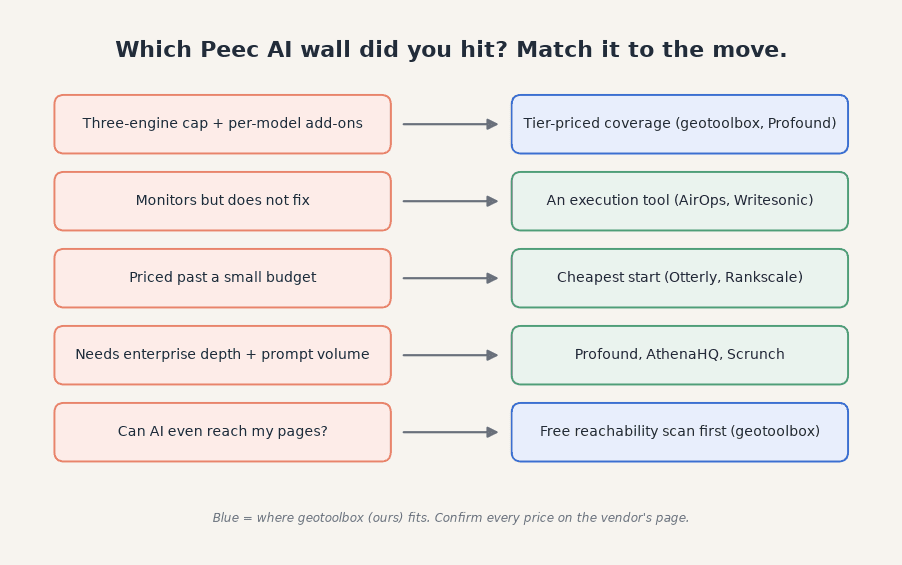
There is no single drop-in replacement for Peec, because the category splits the work across tools that each do one part well. So skip the ranked list and match the tool to the wall you hit. The short version, if you want one: most teams leaving Peec move either to deeper research data (Profound) or to broader engine coverage (geotoolbox, ours), but the right pick depends on the wall. One disclosure up front, since it recurs below: we build geotoolbox, a competing AI-visibility tool, so read our own entries with that in mind.
If You Want Action, Not Just a Dashboard
The most common complaint about Peec is that it reports the problem and stops. A separate class of tools is built around the gap.
AirOps turns visibility findings into actual content production at scale, aimed at teams that want the output, not another report. Scrunch AI, now part of Sitecore, pairs monitoring with brand-narrative and content workflows for larger organizations. Writesonic bolts AI-visibility tracking onto a content generator, so the same tool that finds the gap can draft the page that fills it. Even Profound moved into this lane with Profound Agents. Take each tool's "action" pitch with a grain of salt until you test it, but the category is real: if your problem is "I have the data and still don't know what to ship," a better tracker will not solve it.
If You Already Pay for an SEO Suite
If you already run an SEO platform, the cheapest alternative might be a module you can already access. The Semrush AI Toolkit and Ahrefs' Brand Radar each surface AI mentions and citations next to your existing keyword and backlink data, and SE Ranking layers an AI-visibility tracker onto its suite. None matches a dedicated platform's depth on prompt-volume intelligence, but consolidating AI metrics into a dashboard your team already opens daily has real value, and you avoid paying twice for overlapping data. For the wider field of standalone options, our rundown of GEO tools compares them by capability and price.
If You Want the Cheapest Serious Start
If price is the wall, start small and upgrade only when you hit a real limit. Otterly.ai is the simplest serious entry point, monitoring mentions and links across the major engines with a clean, low-friction setup, and the usual knock is the flip side of that simplicity: power users find it thin. Rankscale and LLMrefs round out the budget tier as spot-check tools rather than research platforms. Any of these lets you validate whether AI search matters for your brand before committing to a bigger subscription.
If You Need Enterprise Depth and Real Prompt-Volume Data
Some teams leave Peec for the opposite reason: they need more, with the procurement paperwork to match. This is the job where Peec's core is weakest, because its prompt suggestions are modeled rather than drawn from a pool of real conversations.
Profound leads this tier, with proprietary prompt-volume data built from a large pool of real conversations, which tells you a prompt is worth optimizing for rather than guessing from search volume. That real-conversation dataset is Profound's specific edge among the tools here: AthenaHQ, frequently named as the closest in depth for large organizations, does not publicly claim the same, and Scrunch AI, with Sitecore behind it, competes on governance and workflows. The thing to confirm here is not features but compliance: check for SOC 2 and data-residency terms in writing, because many cheaper tools are simply silent on certifications, and that silence is a procurement blocker in finance or healthcare.
If You Want Flat, Broad Engine Coverage Without Add-Ons
This is the most common reason to leave Peec, and the one where the alternatives differ most. Peec's three-model cap means real multi-engine coverage arrives as a stack of per-model add-ons, and the models most teams eventually want, Claude and GPT-5 Search among them, sit behind the Enterprise tier.
Profound is the heavyweight in this row, covering the major engines with daily refreshes, though as of September 2026 it sells no self-serve tier for brands: it offers a free Trial (3 engines, 50 prompts a day for 7 days) and then custom Enterprise (up to 9 engines); its research depth lives on the Enterprise tier. Rankscale rounds it out as a lighter, credit-based option with broad engine coverage for spot-checks rather than deep research.
geotoolbox, which we make, is built the opposite way: engine coverage expands with the tier rather than through add-ons. The $99 Starter ($79 billed annually, 7-day free trial) tracks three engines, the $199 Plus tracks five of eight, and the $399 Pro covers all eight: ChatGPT, Perplexity, Google AI Overviews, Google AI Mode, Gemini, Copilot, Claude, and Grok. There is no per-model surcharge, so the price you see is the price for that tier's coverage. The caveat, since it is ours: our prompt-volume intelligence does not match a dedicated research platform's real-conversation dataset, and Peec's unlimited seats on every plan is a real edge if a whole team logs in. Weigh both on the same terms.
The Job Peec, and Most Trackers, Skip: Can AI Even Reach Your Pages?
Every tool above answers some version of "what do the engines say about me." Almost none answers the question underneath it: can the engines read your site at all. That is a different job, and it decides whether the other tools ever return a number above zero.
The reason it matters is blunt. You can rank first on Google and still be invisible to ChatGPT, Claude, Gemini, and Perplexity, because a firewall rule or a JavaScript-only render is quietly turning their crawlers away. A share-of-voice tracker will faithfully report that zero as if it were a content problem, when the real cause is that the bot never fetched the page. A handful of tools now offer some version of this check, Peec's own Crawlability checker among them, so the point is to run it however you like, not to run it through us. It is still the exception rather than a standard feature among the trackers most teams compare.
geotoolbox's free Agent Readiness scan does that check with no account: it fetches and renders your pages the way the AI crawlers do, then flags the blocks that cause silent zeros. It sits alongside a free AI crawler checker that tests your robots.txt against 34 AI bots, an llms.txt checker, a robots.txt tester, and a query fan-out tool. That breadth is the real difference from a single-purpose tracker: you can rule out the mechanical cause for free before you pay anyone to measure the symptom. Confirm your pages are reachable, then pick a tracker for the job you actually have, using the same reachability-first order we apply to every audit.
A Pricing Reality Check
A couple of cautions before the table. First, tools in this category rewrite their tiers constantly, so treat every figure as a starting point reported in August 2026, not a quote, and confirm the current number on the vendor's own page before you commit. Second, the figures disagree across sources more than you would expect, and the disagreement is worst for Peec itself.
A lot of the "Peec alternatives" listicles you will find are quietly out of date. Several still quote Peec's old €89 Starter and €199 Pro tiers, a 100-prompt Pro cap, and claim Gemini and Google AI Mode are Enterprise-only. All three are wrong as of August 2026: Peec's pricing page lists Starter at €85 a month (€70 billed annually), Pro at €205, and Advanced at €425 (the page prices in euros and can show a dollar figure to non-euro visitors, so confirm your currency), the Pro plan now includes 150 prompts, and Gemini and AI Mode are selectable on the standard self-serve tiers. What is true, and what the headline price hides, is the three-model cap: every self-serve plan tracks three AI models, and each extra engine is a paid add-on that runs roughly €30 to €140 a month depending on tier. So broad coverage on the €205 Pro plan can add a few hundred euros, which is the most common surprise in Peec's own user reviews.
| Tool | Best job | Reported entry price (August 2026) | Note |
|---|---|---|---|
| Peec AI | Affordable monitoring | €85/mo (€70 annual) | 3 models per plan; extra engines ~€30-140/mo each; unlimited seats |
| Otterly.ai | Cheapest start | ~€29/mo | EU-based; simple by design; free trial |
| Rankscale | Budget spot-checks | ~€20/mo | EU-based; credit-based; broad engine coverage |
| LLMrefs | Budget tracker | ~$79/mo | 7-day trial, not a free-forever plan |
| Profound | Enterprise research + prompt volume | No self-serve brand tier; free Trial / Enterprise (custom) | Real prompt-volume data; enterprise reported into the thousands |
| AthenaHQ | Enterprise depth | ~$295/mo annual ($300 monthly) | Free Essential tier; closest big-org alternative |
| Scrunch AI | Enterprise + action | From $250/mo | Sitecore-owned (acquired June 2026); monitoring plus workflows |
| Writesonic (GEO) | Action + content | ~$79/mo annual (~$99 monthly) | Tracking plus content generation in one tool |
| AirOps | Content execution at scale | Quote-based | Turns visibility findings into content, not reports |
| Semrush AI Toolkit | Semrush users | ~$99/mo per domain | Add-on to the Semrush suite you may already pay for |
| Ahrefs Brand Radar | Ahrefs users | From $199/mo (AI Visibility Index) | Custom-prompt tracking is bundled into every Ahrefs plan from Lite ($129/mo) up, not the $29 Starter; ~$699 for all models |
| SE Ranking (AI add-on) | SEO-suite users | Add-on ~€79/mo | SE Visible standalone from $99/mo (the $189 plan is now the mid tier) |
| HubSpot AI Search Grader | Free one-off check | Free | A free grader, not ongoing tracking |
| geotoolbox (ours) | Coverage + reachability | From $99/mo ($79 annual), 7-day trial | Engines by tier up to all 8; no per-model add-ons; free crawler tools; lighter prompt-volume data than Profound |
The framing worth borrowing: judge cost per prompt and per engine, not the sticker price. A plan that looks cheap but tracks three engines and fifty prompts can cost more per question answered than a pricier plan with broad coverage baked in. Do the division, including any add-ons, before you decide.
How to Choose: Match the Alternative to the Wall You Hit
You do not need a single winner. Name the wall that pushed you off Peec, and the move is usually obvious.
Hit the coverage wall? If the three-model cap and add-ons are the problem, move to Profound if budget is no object and you want the deepest data; otherwise move to a tool that prices coverage by tier rather than per engine (geotoolbox, disclosure: ours).
Hit the action wall? If you have the data and still do not know what to ship, a tracker upgrade will not help. Move to an execution tool, AirOps or Writesonic, or a platform with a built-in action layer.
Hit the price wall? Drop to Otterly.ai or Rankscale for a clean monthly reading, or lean on the free tools first: HubSpot's grader for a one-off check and our free reachability scan before you pay anyone.
Already in an SEO suite? Turn on the AI add-on you already own, Semrush AI Toolkit, Ahrefs Brand Radar, or SE Ranking, before buying anything new. Add a dedicated tracker only when the add-on's depth runs out.
Run an agency or enterprise? This is where a small stack is honest rather than wasteful: a research-grade platform like Profound or AthenaHQ for prompt-volume intelligence, an action tool if you ship content at volume, and a reachability layer so a client's blocked crawler does not quietly tank a campaign you are paid to run. If the real question is whether to run this in-house at all, weigh agency versus software first.
Whatever you pick, confirm reachability before you pay to measure anything, and read the trend over weeks rather than any one day's score, because the engines are non-deterministic and a single snapshot wobbles on its own.
Frequently Asked Questions
What is the cheapest Peec AI alternative?
Otterly.ai is usually the cheapest serious starting point, at about €29 a month with a free trial, and Rankscale is comparable from around €20 a month on a credit-based model. Both are European tools, so US buyers see the equivalent in dollars. If you only need a one-off check rather than ongoing tracking, HubSpot's free AI Search Grader and geotoolbox's free reachability scan cost nothing at all. Peec itself starts at €85 a month (€70 billed annually), so the budget tools undercut it while trading away depth.
Is there a free Peec AI alternative?
For ongoing tracking, not really: the tools that call themselves free usually mean a time-limited trial, not a permanent free plan. What is genuinely free are the one-off diagnostics, HubSpot's AI Search Grader for a snapshot and geotoolbox's crawler and reachability checks with no account, plus the manual route of running your own prompts through ChatGPT, Perplexity, and Google's AI Overviews and logging who gets named. None of those replaces Peec's continuous monitoring, but they tell you whether the problem is worth paying to solve.
Peec AI vs Profound: which is better?
They serve different buyers. Peec is the affordable, simpler monitor with a clean interface and unlimited seats, most often chosen by small and mid-size teams. Profound goes deeper on enterprise research and has proprietary prompt-volume data drawn from real conversations that Peec lacks, though its serious depth sits on higher tiers. If you do not have an analyst dedicated to the data, Peec's clarity usually wins; if you need to know which prompts actually get asked, Profound's dataset is the reason to pay more.
What is the best Peec AI alternative for agencies?
It depends on whether your gap is coverage or portfolio management. For running many brands with broad engine coverage, look at a tier-priced platform rather than one that meters engines as add-ons. For deep client reporting, Profound or AthenaHQ carry the research depth, and Scrunch AI (now Sitecore-owned) targets the same enterprise buyer. Whichever you choose, confirm white-label reporting and multi-brand support in a trial, since these are the exact features teams say Peec makes them work around.
Run the Cheaper Check First
Whichever alternative you lean toward, rule out the one failure no tracker will warn you about first: a page the AI engines cannot fetch, which reads as the exact same zero as weak content. geotoolbox's free Agent Readiness scan checks whether the major AI crawlers can reach and render your pages, with no account. Fix anything it flags, then choose a tracker for the job you actually have. If you want tracking and reachability from one tool, a 7-day geotoolbox trial lets you judge it in a week.
Sources
- Pricing for Peec AI - Peec AI, 2026 (current brand pricing, three-model cap, per-model add-on costs, prompt limits, free trial) -
peec.ai/pricing - Peec AI Changelog - Peec AI, 2026 (Agent Analytics: Crawlability audit included on every plan, plus server-log Crawl Insights) -
peec.ai/changelog - best peec.ai alternatives? - Reddit r/GEO_optimization, 2026 (practitioner complaints: manual prompt entry, thin/brittle data, no searchable index, 30-day range) -
reddit.com/r/GEO_optimization/comments/1p1lwxm/best_peecai_alternatives - Peec AI more than doubled annualized revenue to ~$10M - TechCrunch, May 2026 (Peec scale, unlimited seats context, Berlin/NY, CEO) -
techcrunch.com/2026/05/23/peec-one-of-berlins-rising-startups-more-than-doubled-annualized-revenue-in-months-to-10m-sources-say - As AI Threatens Search, Profound Raises $96 Million - Fortune, February 2026 (Profound as best-funded enterprise leader with prompt-volume data) -
fortune.com/2026/02/24/exclusive-as-ai-threatens-search-profound-raises-96-million-to-help-brands-stay-visible - Sitecore Acquires Scrunch (announcement; no deal amount disclosed) - Sitecore Newsroom, June 3, 2026 -
sitecore.com/company/newsroom/press-releases/2026/06/sitecore-acquires-scrunch-to-help-brands-influence-discovery--and-buying-decisions - Sitecore Snaps Up GEO Startup Scrunch for a Reported $225M - Adweek, June 2026 (deal amount reported by Bloomberg; Sitecore has not published a figure) -
adweek.com/media/sitecore-snaps-up-geo-startup-scrunch-for-225m/