
Peec AI is one of the fastest-growing tools in the AI-visibility category, and most of what is written about it is already out of date. The funding figures, the pricing, even the list of AI engines it tracks have all moved since the popular reviews were published. This explainer is current as of August 2026, honest about what Peec AI does well, where it stops, and how it actually stacks up after a year of fast shipping.
One disclosure up front: we build geotoolbox, a competing AI-visibility tool. So we will cite real numbers, link the vendor's own pages, and describe where geotoolbox fits plainly rather than crown it. Read the criticisms with that in mind, and confirm any pricing on peec.ai before you buy.
A quick note on the name, since people search for it: it is Peec AI, the AI search analytics platform at peec.ai. The company has not published a meaning behind the word, and no public source shows it to be an acronym, so "what does peec mean" has a short answer: it is a brand name, not a term.
What Is Peec AI?
Peec AI is an AI search analytics platform. It tracks how your brand shows up when people ask AI assistants questions, then tells you where you are missing, who is getting cited instead, and how that changes over time. The company describes it as "AI search analytics for marketing teams," which is a concrete job dressed in plain language: measuring brand visibility inside the answers, not just the blue links.
It sits in the category usually called generative engine optimization, or GEO, sometimes answer engine optimization. The premise is that AI assistants now intercept questions that used to start on Google, so a brand can rank well in classic search and still be absent from the answer a buyer actually reads. Peec watches that gap across the major engines: ChatGPT, Perplexity, Google's AI Overviews and AI Mode, Microsoft Copilot, and Gemini, with more models available on higher tiers.
The output is a dashboard built around four numbers: how often you appear (visibility), where you rank against rivals, how positively you are described (sentiment), and which sources the engines cite to build their answers. Teams use it to benchmark share of voice and find the prompts where they are losing ground.
Who's Behind Peec AI? Founders, Funding, and Growth
Peec AI is a Berlin company, founded in early 2025 by Marius Meiners, Daniel Drabo, and Tobias Siwonia out of the Antler startup program. Marius Meiners is the chief executive, and one detail that says something about the company's competitive streak: TechCrunch notes he is a former esports athlete who once ranked among the top 100 League of Legends players in the world.
The growth has been unusually fast for a category that barely existed two years ago. Peec raised a €7 million seed led by 20VC in 2025, then a $21 million Series A led by Singular in November 2025, with Antler, Combination VC, identity.vc, and S20 joining. That brought total funding to around $29 million, and the Series A was raised at a valuation above $100 million. At the raise, Peec reported just over $4 million in annual recurring revenue and 1,300-plus brands and agencies onboarded since February 2025.
By May 2026 the company said it had more than doubled its revenue to about $10 million ARR in roughly six months, around 16 months after launch, with 2,500-plus customers and a new New York office. None of that tells you whether the product fits your team, but it explains the pace, and why older reviews mislead on the specifics below.
What Peec AI Does: Core Features
Strip away the positioning and Peec runs one loop: fire a set of prompts at the AI engines on a daily schedule, record how your brand and your competitors show up, and surface where you are losing. It does the watching cleanly, and most of the debate, which comes later, is about how much of the fixing it does for you.
The core of the product is brand tracking across engines: visibility share, ranking position, and sentiment for the prompts you choose. Around that sit citation analysis, which shows the exact sources an engine pulled and sorts them into types like editorial, corporate, and user-generated content such as Reddit, plus competitor benchmarking for share of voice against named rivals. Peec also suggests prompts automatically from your website content, and supports multi-country and multi-language tracking. A practical plus: every plan includes unlimited user seats, so you are not paying per head.
Reporting runs through CSV exports, a Looker Studio connector, an API on higher tiers, and a Model Context Protocol (MCP) integration that pipes visibility data into tools like Claude and n8n. The newest addition is AI Shopping Analytics, launched in June 2026, which tracks product-level visibility: which SKUs an assistant recommends, at what price, and where it sends the buyer. On data collection, reviewers report that Peec reads results from the AI tools' interfaces rather than relying only on official APIs, which is worth confirming with Peec directly if the collection method matters for your procurement.
| Feature | What it tells you | Caveat |
|---|---|---|
| Visibility & position | How often you appear and where you rank for chosen prompts | Tracks from setup forward; no retroactive history |
| Sentiment | How positively the engines describe you, on a 0-100 scale | A score, not the underlying quotes driving it |
| Sources & citations | Which pages the engines cite, grouped by source type | Strong for diagnosis; you act on it elsewhere |
| Competitor benchmarking | Your share of voice against named rivals | Useful, but limited by your prompt allowance |
| Suggested prompts | Auto-generated prompt ideas from your site | Good starting point; the valuable ones need manual curation |
| AI Shopping Analytics | Product-level visibility, price, and placement in AI answers | New (June 2026); most relevant to ecommerce |
| Integrations | CSV, Looker Studio, API, and MCP into Claude/n8n | API and some integrations sit on higher tiers |
Peec AI Pricing in 2026
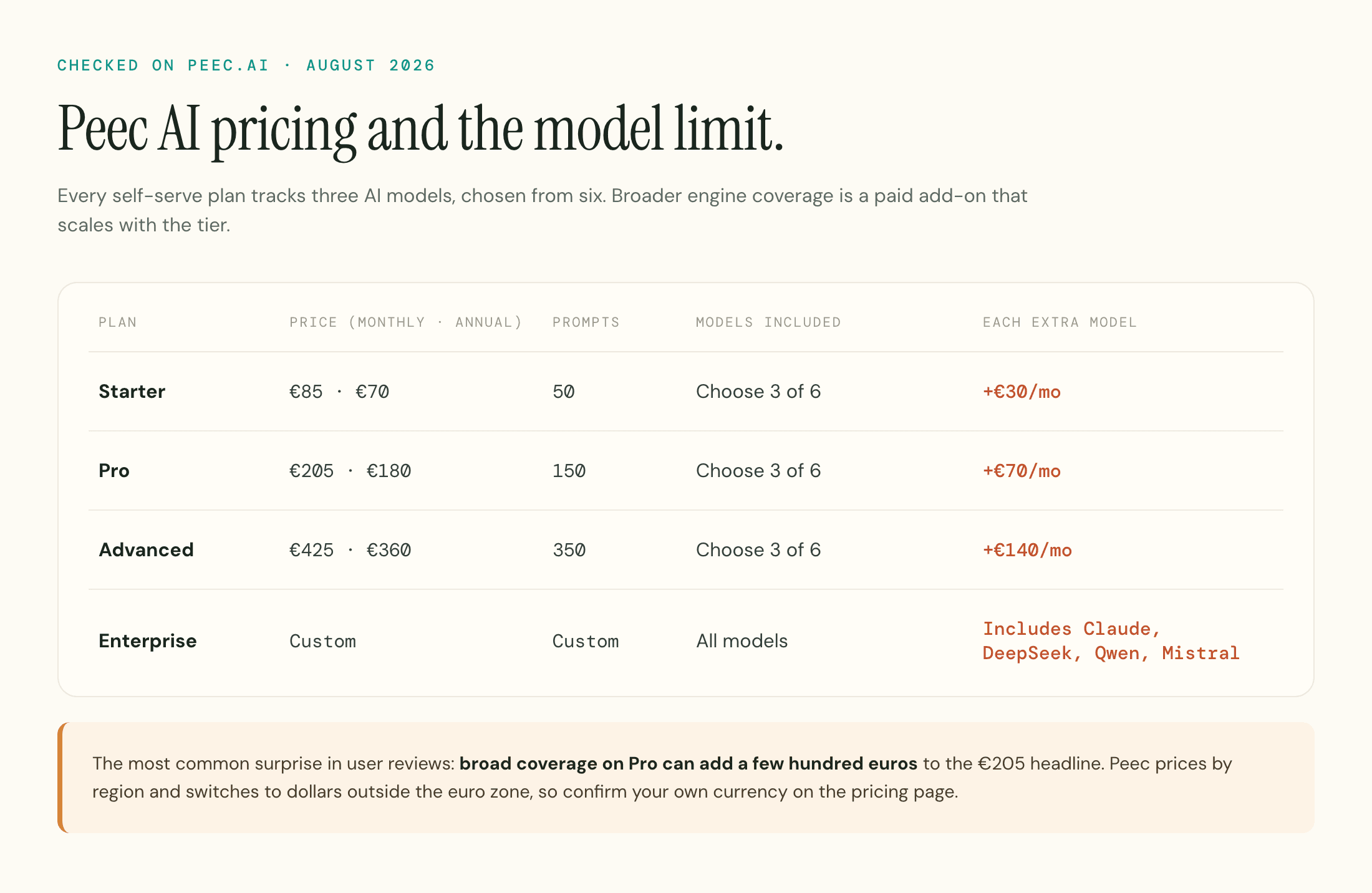
Peec's pricing page lists three self-serve brand plans plus a custom Enterprise tier, priced regionally. Month to month, the brand plans are €85 for Starter, €205 for Pro, and €425 for Advanced; billed annually those drop to €70, €180, and €360 a month (the page's own "Save" badges are €180, €300, and €780 a year). The page is priced regionally and switches to dollars outside the euro zone, so a US visitor sees a different currency and, on some line items, a different number. Each comes with a 7-day free trial and no credit card. Older reviews quoting an €89 starter or a €199 pro are reading 2025 pricing.
| Plan | Price (€/mo, monthly · annual) | Prompts | Includes |
|---|---|---|---|
| Starter | €85 · €70 | 50 | Choose 3 models, 1 project, unlimited users, daily tracking |
| Pro | €205 · €180 | 150 | Choose 3 models, 2 projects, unlimited users, daily tracking |
| Advanced | €425 · €360 | 350 | Choose 3 models, 5 projects, multi-country, Looker Studio |
| Enterprise | Custom | Custom | All models, unlimited projects, API access, SSO, dedicated support |
The detail that matters most is the model limit. Every self-serve plan lets you track only three models, chosen from ChatGPT, Google AI Mode, AI Overviews, Microsoft Copilot, Perplexity, and Gemini. Tracking a fourth or fifth engine is a paid add-on that scales with your plan: €30 a month per extra model on Starter, €70 on Pro, and €140 on Advanced. Models like Claude, DeepSeek, Qwen, GPT-5 Search, and Mistral are reserved for Enterprise, which can track up to 11 models. So broad coverage on the Pro plan can add a few hundred euros to the €205 headline, which is the most common surprise in user reviews.
Agencies get a separate, credit-based track. Essential is €205 a month for 10,000 credits, which Peec frames as roughly 111 daily prompts, then Growth at €425 for 25,000 credits, Scale at €675 for 65,000 credits, and a custom Comprehensive tier. Pricing in this category moves fast, so confirm the current figure on peec.ai before you commit, the same way you would when comparing what any AI visibility tool costs.
Peec AI Strengths and Limitations
The fairest read on Peec is that it is very good at one half of the problem. The interface is clean, setup takes a few minutes, and reviewers praise how quickly a non-technical marketer can stand up a useful dashboard. The multi-engine coverage, the competitor benchmarking, the source-level citation detail, and the unlimited seats are real advantages, and support gets named often as responsive. As a Berlin company it may also be an easier fit for some EU buyers, though you should confirm hosting, subprocessors, and data residency in its own documentation. Temper that praise, though: Peec only launched in 2025, so its public review base is still small. Read the enthusiasm as early signal, not a long track record.
The weaknesses cluster around one theme, and it is the most common complaint across nearly every independent review: Peec tells you what is happening but does little to fix it. There is no audit that hands you the specific changes to make, no content generation, and no way to push fixes to your site. Insights become a backlog your team works through by hand.
Three more limits recur. ROI attribution is thin, with no native way to tie an AI mention to a click, lead, or sale, though you can rig a rough visibility-to-revenue view through its API and MCP integration. There is no retroactive data, so a new account cannot reconstruct where a brand stood before tracking began. And full engine coverage costs extra, as the pricing section shows.
A final caveat applies to the whole category, not just Peec. Large language models are non-deterministic, so the same prompt can return different answers minutes apart. A single daily snapshot can wobble for reasons that have nothing to do with your marketing, which is why the sound way to measure AI visibility is to read the trend over weeks, not any one day's score.
In our experience building geotoolbox, the problem underneath all of this is that a visibility score tells you the symptom, not the cause. When a brand reads near zero, one cause worth ruling out is reachability: a blocked crawler or a JavaScript-only page can suppress the score even when the content is strong, and a share-of-voice number alone cannot separate that from genuinely weak content.
Where Peec AI Fits, and Why Reachability Comes First
Peec answers a sharp question well: are you showing up in AI answers, and how do you compare to rivals? For a marketing team that already produces content and wants evidence of whether AI search is working, that is genuinely useful. It works best once you have confirmed an earlier step: that the pages you want cited can actually be fetched and read by the AI crawlers.
Many sites fail that step without knowing it. They block AI crawlers in robots.txt by accident, serve content that only renders in JavaScript the bots do not execute, or sit behind bot protection that turns those crawlers away. When that happens, a visibility score can read low for a reason that has nothing to do with your content.
To its credit, this is a gap Peec closed in 2026. Its Agent Analytics module added a free Crawlability checker that tests a domain's robots.txt against more than 40 AI bots, plus Crawl Insights, which reads your server logs to show which AI crawlers actually hit which pages. So reachability is no longer something Peec ignores, and that is worth knowing if you are weighing tools on this feature.
The broader point still holds: visibility and reachability are different layers, and reachability is worth confirming first, because no tracker can lift a score for a page an engine never sees. You can run that check inside Peec, or with a standalone free tool such as our AI crawler checker, which flags the AI crawlers your site blocks in about two minutes with no account. Once reachability is clean, the work that moves a score is the same whichever tracker you use: read which source types get cited for your prompts, make your key pages reachable and well-structured (whether an llms.txt file helps is its own debate), and target the questions where a competitor is named instead of you.
Peec AI Alternatives and Competitors
There is no single drop-in replacement for Peec, because the right alternative depends on whether your problem is price, engine coverage, or enterprise depth. The category is crowded, so the practical way to choose is by the job you are trying to get done, not by a ranking. Our dedicated Peec AI alternatives guide sorts the field by the exact wall you hit.
Peec AI vs Profound
Profound is the alternative Peec gets measured against most. It is the best-funded player in the category, with daily data refreshes and proprietary prompt-volume data that Peec lacks, and its Starter plan is $99 a month against Peec's €85, or €70 a month if you pay Peec annually. The trade-off is depth versus simplicity: Profound goes deeper on research and prompt-volume data at a higher entry price, while Peec trades some of that depth for a cleaner interface and unlimited seats. Our Profound alternatives guide compares them in more detail.
Beyond that head-to-head, Scrunch AI is the enterprise-leaning option, now owned by Sitecore, priced from $250 a month. Otterly.ai is the cheapest serious start, from about $29 a month. AthenaHQ is the closest enterprise-depth alternative, around $295 a month. For the wider field, our rundown of the best GEO tools compares the standalone platforms.
geotoolbox, which we make, is also in this space, and the practical difference from Peec is how you pay for coverage: plans run from $99 a month ($79 billed annually) with a 7-day free trial, engine coverage expands with the tier up to all eight rather than through per-model add-ons (Peec's run €30 to €140 each per month), and every plan pairs the tracking with the reachability check — whether AI crawlers can fetch your pages — that this article keeps flagging as the first thing to rule out. A free crawler check covers that layer with no account. The honest caveat, since it is ours: our prompt intelligence does not match a dedicated research platform's dataset, and Peec's unlimited seats on every plan is a real edge for larger teams — weigh both on the same terms.
| Tool | Best for | Entry price (mid-2026) | Honest note |
|---|---|---|---|
| Peec AI | Affordable team depth | €85/mo (€70 annual) | Clean UI, unlimited seats; monitoring-focused, add-ons for more engines |
| Scrunch AI | Enterprise/agency monitoring | $250/mo | Sitecore-owned; strong diagnosis, thin execution |
| Profound | Research + workflows | ~$99/mo | Daily data and prompt volume; price climbs at the top |
| Otterly.ai | Cheapest serious start | ~$29/mo | Simple by design; thin for power users |
| AthenaHQ | Enterprise depth | ~$295/mo | Closest big-org alternative |
| geotoolbox | Reachability + tracking | From $99/mo ($79 annual), 7-day free trial | Engines expand by tier (no per-model add-ons), reachability check on every plan (disclosure: ours) |
Frequently Asked Questions
What does Peec AI do?
Peec AI is an AI search analytics platform that tracks how your brand appears in AI assistant answers across ChatGPT, Perplexity, Google AI Overviews and AI Mode, Microsoft Copilot, and Gemini. It measures visibility, ranking position, sentiment, and which sources the engines cite, and it benchmarks all of that against your competitors so you can see where you are winning or missing.
How much does Peec AI cost?
As of August 2026, Peec's brand plans are €85 a month for Starter, €205 for Pro, and €425 for Advanced month to month, dropping to €70, €180, and €360 on annual billing, plus a custom Enterprise tier, with a 7-day free trial and no credit card. Each self-serve plan covers only three AI models; tracking more is a paid add-on from €30 to €140 per model per month, so full coverage costs more than the headline price. Agencies have a separate credit-based track starting at €205 a month.
Who is the CEO of Peec AI?
Marius Meiners is the co-founder and chief executive. He started the Berlin company in early 2025 with Daniel Drabo and Tobias Siwonia, and TechCrunch notes he is a former esports athlete who once ranked among the top 100 League of Legends players globally.
What does "peec" mean?
Peec is a brand name, not an acronym. The company has not published a meaning behind the word, so if you are searching for a definition, there is no hidden one to find. It refers to Peec AI, the AI search analytics platform at peec.ai.
Is Peec AI worth it?
It is worth it for established marketing teams and agencies that already produce content and have someone to act on the data, since its value is a clean diagnosis rather than a fix. It is harder to justify for brand-new sites with little content or solo marketers tracking a few prompts, who can replicate basic monitoring by hand, and it does not tie AI mentions to revenue.
What are the best Peec AI alternatives?
The common alternatives are Scrunch AI for enterprise monitoring, Profound for research depth and prompt-volume data, Otterly.ai for a cheap start, AthenaHQ for large organizations, and geotoolbox (disclosure: ours) for tracking with a built-in reachability check from $99 a month. Whichever you weigh, confirm AI crawlers can reach your site first, a check you can run free in Peec's own Crawlability tool or with ours at geotoolbox.
The Bottom Line
Peec AI is a well-built, fast-growing AI search analytics tool that does the watching half of the job well. For an established marketing team with content to defend and someone to act on the data, it is a clean, fairly priced way to see where you stand across the major AI engines. The caveats to weigh are that it monitors rather than fixes and that full engine coverage costs more than the headline price.
Whichever tracker you choose, settle reachability first, because an engine cannot cite a page it cannot fetch, and a blocked crawler quietly caps any visibility score. Peec now checks this with its own Crawlability tool, and you can also run a free standalone check with our AI crawler checker in about two minutes. Confirm the engines can reach you, fix what is broken, then let a tracker — Peec, or geotoolbox's 7-day trial if you want reachability and tracking in a single subscription — measure where you stand.
Sources
- We Raised $21M Series A - Peec AI, November 2025 (Series A amount, lead investor Singular, $29M total, $4M ARR, 1,300+ customers, founders) -
peec.ai/blog/we-raised-21m-series-a-to-help-brands-win-in-ai-search - Peec AI more than doubled annualized revenue to $10M - TechCrunch, May 2026 ($10M ARR, $100M+ valuation, CEO Marius Meiners esports background, Berlin/NY) -
techcrunch.com/2026/05/23/peec-one-of-berlins-rising-startups-more-than-doubled-annualized-revenue-in-months-to-10m-sources-say - Berlin's Peec AI doubled revenue to $10M ARR - The Next Web, May 2026 (ARR corroboration, Series A, valuation) -
thenextweb.com/news/peec-ai-berlin-10-million-arr-geo-ai-search - Peec AI launches AI Shopping Analytics - GlobeNewswire, June 2026 (AI Shopping Analytics, 2,500+ customers, founders, funding) -
globenewswire.com/news-release/2026/06/17/3313204/0/en/peec-ai-launches-ai-shopping-analytics-as-product-recommendations-move-inside-chatgpt.html - Pricing for Peec AI - Peec AI, 2026 (current brand and agency pricing, prompts, models, add-on costs, free trial) -
peec.ai/pricing - Peec AI Changelog - Peec AI, 2026 (Agent Analytics: Crawlability checker and Crawl Insights server-log AI-crawler tracking) -
peec.ai/changelog