
AI search is changing how buyers find you, and you have two ways to keep up. You can hire a generative engine optimization (GEO) agency to do the work for you, or run GEO with software in-house. Most guides only sell one side of that choice. This one does not: what each actually does, what each really costs, when each wins, and the hybrid setup most brands settle on.
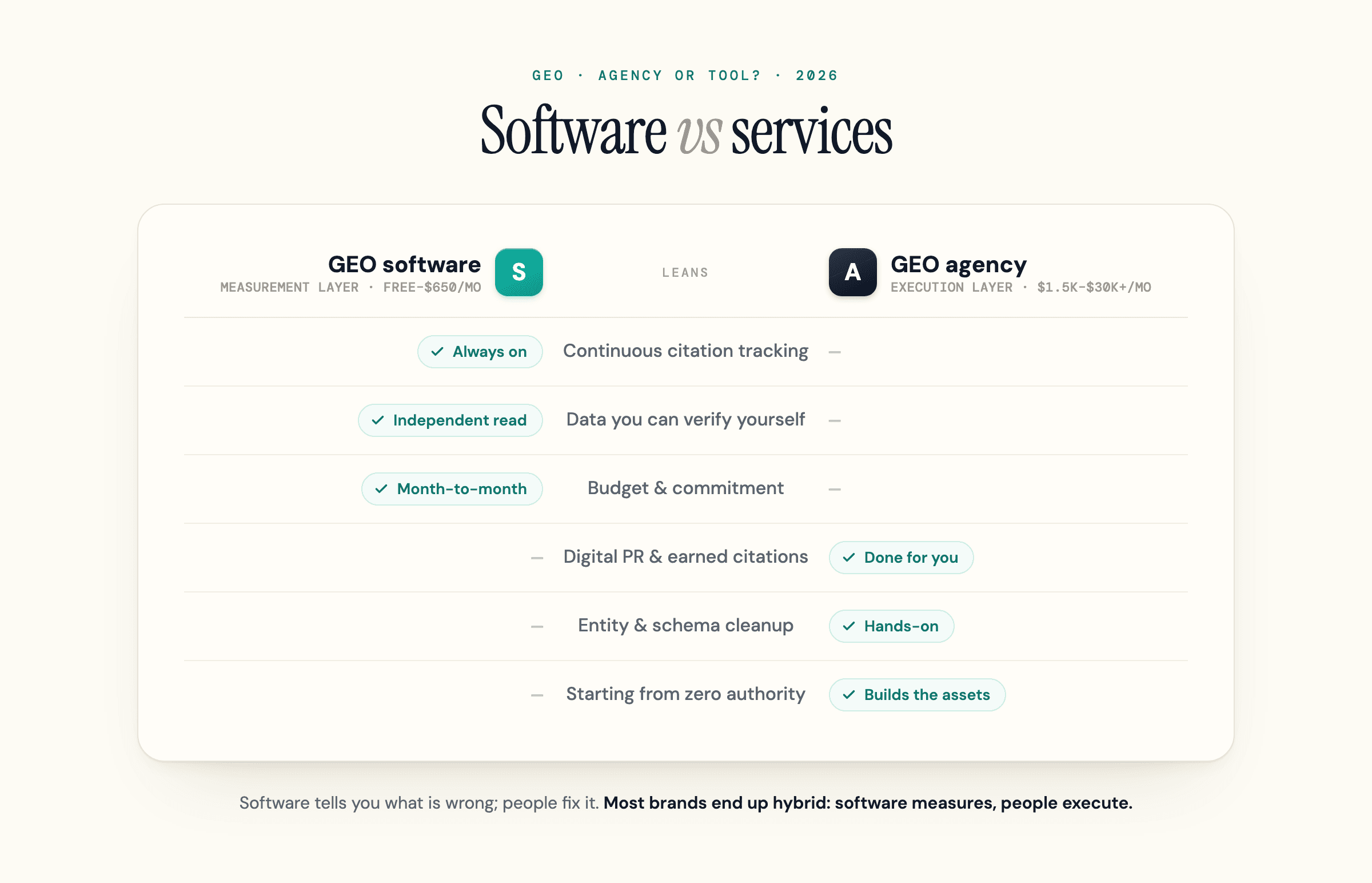
GEO Services vs Software: The Short Answer
Here is the cleanest way to think about it. Generative engine optimization (GEO) software is your measurement layer. It shows where your brand stands inside AI answers, tracks your citations across engines, and flags the gaps. GEO services, meaning a specialist agency or consultant, are your execution layer. They create the content, earn the citations, and fix the technical foundation that makes AI engines trust you.
Most brands end up needing both. The real question is rarely "agency or tool" forever. It is which one you start with, and when you add the other.
The stakes are not subtle. Buyers increasingly get their answer straight from an AI engine instead of clicking a link, and the field is new enough that there is still no agreed definition for it.
If the term itself is still fuzzy, start with what generative engine optimization actually is.
| GEO software | GEO agency / services | Hybrid | |
|---|---|---|---|
| What it is | A tool you run in-house | Done-for-you specialists | Software plus in-house or agency execution |
| Best for | Teams with content skill who need data | Brands needing hands-on execution | Most mid-market brands |
| Typical cost | Free to about $650+/mo at the enterprise end | About $1,500 to $30,000+/mo retainer | Tool cost plus execution cost |
| Mainly does | Measures and tells you what to fix | Does the fixing for you | Measures, then executes |
| Will not do | Earn citations or run PR for you | Give you independent daily data | n/a |
One line to remember: software tells you what is wrong, and people fix it. Everything below is about which half you need more.
What GEO Services (the Agency Model) Actually Include
A GEO agency sells done-for-you visibility inside AI answers. Strip away the branding and the work is fairly consistent from one provider to the next:
- An AI readiness audit: where you show up across ChatGPT, Perplexity, Gemini, Google AI Overviews, Claude, and Copilot, and where you do not.
- Entity optimization: cleaning up how your brand is represented in the places models trust, like Wikipedia, Wikidata, and the knowledge graph.
- Structured data and schema, so engines can parse what you do.
- Digital PR and citations: earning mentions in the sources AI engines pull from.
- Answer-first content built to be quoted, not just ranked.
- Reporting on citation share and sentiment, not keyword positions.
The order is consistent too. Most agencies run a version of the same loop: audit, map your entities and topics, optimize the pages, run digital PR, then measure and repeat.
The genuinely valuable part, the part you are actually paying for, is the execution software cannot do for you. Earning a citation in a high-trust publication, rewriting a thin page into something quotable, fixing a wrong entity in the knowledge graph: that is human work. It is also why the acronyms matter less than they seem. If you are still untangling them, GEO vs AEO vs SEO sorts it out.
Here is the honest framing of the agency side. Per Google's own documentation, the fundamentals have not changed: "optimizing for generative AI search is optimizing for the search experience, and thus still SEO." A good GEO agency is doing strong, AI-aware SEO and digital PR. It is not casting a spell, and you should be wary of anyone who implies otherwise.
What GEO Software Does (and the One Thing It Usually Does Not)
GEO software is the opposite trade-off: cheap, fast, and always on, but it mostly watches rather than acts.
A good tool runs a prompt across the major AI engines and returns a visibility score. GEO Toolbox, for example, scores you 0 to 100 across eight engines (ChatGPT, Perplexity, Gemini, Google AI Overviews, Google AI Mode, Claude, Copilot, and Grok), then tracks your citations, your share of voice, and where competitors are getting picked over you. The better tools also grade individual pages; GEO Toolbox's Content Analyzer grades a URL's citability and AI readability. If you want to compare options, our rundown of the best GEO software covers the field.
Disclosure: GEO Toolbox, the product behind this blog, is one of the tools this guide describes. We are also an SEO agency team ourselves, so we have skin on both sides of this comparison, and we are upfront about what software, ours included, can and cannot do for you.
Why measure continuously instead of once? Because AI answers are unstable. The original GEO research showed that targeted changes can lift a source's visibility in generative answers by up to 40%. Separately, citations swing from month to month as models update. You cannot manage what you checked one time and never looked at again, which is the whole case for being able to track your AI visibility over time.
Now the most important sentence in this guide. Most GEO software flags and suggests. It does not execute. It will tell you that you are absent from Perplexity, that your schema is missing, or that a competitor owns a topic. It will not write the digital PR, earn the citation, or publish the page for you. Earning those links and mentions runs on a separate stack of link building platforms and outreach tools.
A 2026 Semrush survey of 481 marketers put the gap in sharp relief: only 8% were actively running digital PR, even as most wanted better AI visibility. A dashboard that says "you are invisible" only pays off if someone acts on it.
The Real Cost Comparison (What Nobody Publishes)
Every tool roundup lists software prices. No agency publishes its retainer. So buyers compare a $99 tool against an invisible number and freeze. Here are both sides in one place.
| Path | Typical monthly cost | What you get | The hidden cost | Best fit |
|---|---|---|---|---|
| Software only (DIY) | Free to about $650 | Measurement, scoring, alerts | Your team's time to act on it | You have in-house content skill |
| Software plus in-house time | Tool plus a slice of a marketer's salary | Measurement plus execution you control | The "effort tax," real hours | You want control and have bandwidth |
| GEO agency retainer | About $1,500 to $5,000 (small business), $3,000 to $15,000 (mid-market), $10,000 to $30,000+ (enterprise) | Done-for-you strategy and execution | Less daily visibility into the work | You need execution, not another dashboard |
Entry-level GEO tools start near free and run to a few hundred dollars a month, while Profound's pricing anchors the premium end of the category; GEO Toolbox runs from $99 a month ($79 billed annually) with a 7-day free trial. Big money has also moved into the software side: Adobe completed its $1.9 billion acquisition of Semrush in April 2026, and Profound raised a $180 million Series D at a $1.8 billion valuation in September 2026, less than seven months after its $96 million Series C, so the measurement layer is no longer a startup curiosity. The agency retainer ranges above are reported across 2026 agency pricing guides rather than published rate cards, so treat them as orientation.
The number most people miss sits in the middle row. Software is cheap, but someone still has to act on what it finds. If a marketer spends one day a week on GEO, that time is the real cost of the "DIY" path, and it is where the honest break-even against an agency actually lives. Cheap software with no one to run it is not a strategy. It is a subscription.
When Hiring a GEO Agency Makes Sense
Start with the cases where outsourcing is clearly the right call, and once you have decided to hire, our ranked guide to the best AI SEO agencies sorts the credible ones by job. Hire a GEO agency when:
- You have no in-house content or SEO capacity. A tool hands work to a team you do not have.
- You need execution, not data: digital PR, citation building, schema and entity cleanup, hallucination correction.
- You are starting from near-zero authority. With no content and no mentions yet, another dashboard confirming you are invisible does not help. An agency that can build the assets does.
- Your brand is regulated or high-stakes, where an AI engine describing you wrong is expensive. The same Semrush study found 30% of marketers say AI describes their brand inaccurately.
- You are in a competitive niche and need to move faster than an in-house ramp allows.
How to Spot a Legit GEO Agency
The catch is trust. GEO is new enough that plenty of "GEO agencies" are repackaged SEO retainers with a fresh label. Before you sign, run a short check:
- Ask for citation-share and sentiment reporting, not keyword rankings.
- Ask them to show real AI-answer screenshots, with the engines named.
- Confirm they actually do digital PR and entity work, not just "we will add some schema."
- Walk away from anyone guaranteeing a number-one spot in ChatGPT. No one can promise that.
A legitimate provider is doing AI-aware SEO and PR that you could, in principle, verify yourself with a measurement tool. Which is exactly why so many brands keep one even after they hire the work out.
When Software Is Enough (or the Smarter Default)
Now the other side. For a large share of brands, software alone, or software plus a few hours of in-house effort, is the right starting point. Sometimes it is the whole answer.
Choose software when:
- You already have content and marketing capability in-house. You do not need a team, you need direction.
- You have assets but no data. If you have published real content and just need to know how AI engines read it, a tool wins.
- Budget is tight. A few hundred dollars a month against a few thousand is not a close call when you are testing the water.
- You want to measure first. You cannot brief an agency well, or judge one, without a baseline.
This is also the lowest-risk way to begin. Run a free GEO scan across ChatGPT, Perplexity, and Google AI Overviews, see your score and your gaps, and within minutes you will know whether this is a fix-a-few-pages problem or a hire-help problem. From there, our step-by-step playbook for AI search and our guide to running an AI visibility audit cover the work a capable in-house team can do without an agency.
Measure-first almost always changes the brief. In our experience, brands that scan before they spend ask agencies for sharper work, or confirm they need help faster than they thought.
The Hybrid Model, and How to Choose
Most mid-market brands do not pick a side. They run a hybrid: software measures, people execute.
The logic is simple. Software gives you a continuous, independent read on your AI visibility. In-house staff or an agency does the content, PR, and technical work. The tool keeps the execution honest, because you see your own citation share instead of trusting whoever you pay to grade their own homework.
Four Questions to Decide
So how do you choose? Answer four questions:
- Do you have in-house content and SEO skill? No leans agency. Yes leans software.
- Do you already have content and authority? Little leans agency, because the assets need building. Plenty leans software, because you mainly need data.
- What is the budget? Hundreds a month leans software. Thousands leans agency or hybrid.
- How high are the stakes? Regulated or fiercely competitive leans agency or hybrid.
Map your answers against the grid:
| Your situation | Start with | Why | Where a tool fits |
|---|---|---|---|
| No team, no content yet | Agency | You need assets built, not just measured | Add software later to verify the work |
| Have a team and content | Software | You need data and direction, not hands | The tool is your whole stack for now |
| Mid-market, growing | Hybrid | Measure in-house, execute with help | The tool is your accountability layer |
| Enterprise or regulated | Both | The stakes justify execution plus monitoring | The tool runs continuously alongside |
Whichever row fits, the first move is identical: get a baseline.
Frequently Asked Questions
Is Generative Engine Optimization Worth Paying for, or Is It a Scam?
The cleaner question is when it is NOT worth paying: if your buyers' queries still return plain link lists, or if your site fails basic reachability, paid GEO work of either kind is premature. Pay once AI answers visibly cover your category and the foundations are fixed.
How Much Does GEO Cost, Agency or Software?
The number that decides most budgets is not the sticker price but contract shape: software is month-to-month and cancelable, while agency retainers typically want a three-to-six-month minimum because digital PR compounds slowly. Price the commitment length, not just the monthly line.
Do GEO Tools Actually Improve My AI Visibility, or Just Track It?
Mostly track, with two exceptions worth knowing: schema generators and content-brief tools produce assets you can ship directly. Everything else (citations, digital PR, entity cleanup) still needs hands, yours or an agency's.
Can I Do GEO Myself Without an Agency?
Yes, if you have content and SEO capability in-house plus a tool to measure with. With 68% of US Google searches ending without a click in the first four months of 2026, up from the 60.45% SparkToro reported for 2024, the work (quotable content, schema, entity cleanup) is the same SEO craft most teams already have, aimed at AI answers.
Start with a Baseline, Not a Bill
You cannot choose between a GEO agency and GEO software from a blog post. You choose from a baseline. Once you can see where AI engines actually place your brand, and where they do not, the right path usually picks itself. A few fixable gaps point to software. A missing foundation points to help. Most brands land somewhere in between.
So start by measuring. Run a free GEO scan across ChatGPT, Perplexity, and Google AI Overviews (paid plans, from $99 a month with a 7-day trial, track over time, and higher tiers extend to Gemini, Claude, Copilot, and Grok), see your 0 to 100 visibility score and what is missing, then decide whether to build in-house, hire out, or run both. GEO Toolbox is built by an SEO agency team to be that measurement layer, and if the scan says yours is a hire-help problem, our own founder-led GEO service starts with a fixed-price audit rather than a retainer, for exactly the reasons this guide gives.
Sources
- Optimizing your website for generative AI features on Google Search - Google Search Central -
developers.google.com/search/docs/fundamentals/ai-optimization-guide - GEO: Generative Engine Optimization - Aggarwal et al., KDD 2024 -
arxiv.org/abs/2311.09735 - Generative engine optimization - Wikipedia -
en.wikipedia.org/wiki/Generative_engine_optimization - In 2026, Less than One Third of Google Searches Still Send a Click - SparkToro / Similarweb panel data -
sparktoro.com/blog/in-2026-less-than-one-third-of-google-searches-still-send-a-click - Adobe Completes Semrush Acquisition - Adobe -
news.adobe.com/news/2026/04/adobe-completes-semrush-acquisition - Profound Raises $180M Series D at $1.8B Valuation - GlobeNewswire, September 15, 2026 -
globenewswire.com/news-release/2026/09/15/3362180/0/en/profound-raises-180m-series-d-at-1-8b-valuation-to-build-the-ai-platform-for-marketing-teams.html - The Operational Gap: AI + SEO study - Semrush -
semrush.com/blog/the-operational-gap-ai-seo-study