
Scrunch AI is one of the more talked-about tools in the AI-visibility space, and as of June 2026 it is also a Sitecore company, a fact most reviews still online have not caught up to. This one is current on that, honest about where Scrunch is strong and where it falls short, and clear about when a cheaper alternative does the same job.
One disclosure up front: we build geotoolbox, a competing AI-visibility tool. So we will show our work, name real alternatives, and list our own tool plainly rather than crown it. Read the criticisms with that in mind, and verify the numbers against the vendor's own page before you buy anything.
A quick note on the name, because the search results are messy: this is Scrunch AI, the generative engine optimization platform at scrunch.com. It is not the older Scrunch influencer-marketing platform, and it has nothing to do with hair scrunching or scrunchies.
What Is Scrunch AI?
Scrunch AI is an AI search visibility platform. It tracks how your brand shows up when people ask AI assistants questions, and it tells you where you are missing, who is getting cited instead, and what to fix. The company calls itself "The AI Customer Experience Platform," which is marketing for a fairly concrete job: making sure the answer engines see your brand the way you want them to.
It sits in the category usually labeled generative engine optimization, or GEO, sometimes answer engine optimization. The premise is that AI assistants now intercept questions that used to start on Google, so a brand can rank perfectly in classic search and still be absent from the answer a buyer actually reads. Scrunch monitors that gap, and as of August 2026 the self-serve Core plan covers four engines (ChatGPT, Perplexity, Google AI Overviews, and Microsoft Copilot); the custom Enterprise tier adds five more (Claude, Gemini, Meta AI, Google AI Mode, and Grok) for nine, with prompt volume and seats as the tier levers.
The company is based in Salt Lake City and was founded in 2023, with Chris Andrew as chief executive. The detail most current reviews miss is who owns it now. In June 2026, Sitecore, the enterprise content and digital-experience software vendor, acquired Scrunch. So the tool you are evaluating is no longer an independent startup; it is the AI-search layer of a much larger martech stack. That shapes a lot of what follows, from roadmap to packaging to who it ultimately serves, so it is worth understanding first.
Who Owns Scrunch AI? Funding, Growth, and the Sitecore Acquisition
Scrunch grew fast for a tool in a category that barely existed two years ago. It launched out of beta in March 2025, and by mid-2025 it had raised a $15 million Series A led by Decibel, with Mayfield, Homebrew, and a roster of operator angels including TJ Parker of PillPack, Bryant Chou of Webflow, and Clara Shih of Meta AI. That round followed an earlier $4 million seed and brought disclosed funding to about $19 million at the time; Scrunch's own site now cites roughly $26 million in total backing. By its own count the platform reached more than 500 brands, naming customers like Lenovo, Skims, Crunchbase, Penn State, and Runpod.
Then the exit came quickly. On June 3, 2026, Sitecore announced it had acquired Scrunch, for a reported $225 million, per Bloomberg; Sitecore did not officially disclose terms. Sitecore is a long-established digital-experience platform, the kind of content-management and personalization software large enterprises already run. Its chief executive, Eric Stine, framed the deal around acting on AI-search data inside an existing stack, and Scrunch CEO Chris Andrew described it as helping companies "meet buyers where they are, moving beyond traditional SEO."
For a 2026 buyer, the acquisition is the single most important fact in this review. It signals the AI-visibility category is consolidating into bigger martech suites rather than staying a field of standalone startups. Practically, it raises a question older reviews never had to ask: will Scrunch keep selling as a self-serve product at its current price, or get folded into enterprise Sitecore deals over time? That is unsettled, and the product still runs under the Scrunch name. But if you are signing up today, you are buying into a Sitecore-owned tool, not a scrappy independent one, so weigh roadmap continuity accordingly.
What Scrunch AI Does: Core Features
Strip away the positioning and Scrunch is built around one loop: watch how AI engines answer questions in your category, find where you are losing, and point you at the fix. It does the watching well. Most of the debate, which we get to below, is about how much of the fixing it actually does for you.
The platform tracks brand mentions, sentiment, and share of voice across the engines, then groups related questions into what it calls prompt families so you are looking at intent patterns rather than a thousand isolated queries. You can slice all of it by persona, topic, or geography, which is genuinely useful when one buyer segment sees you and another does not. Underneath that sit citation analysis (which sources the engines pull instead of you), competitor benchmarking, and page audits that flag whether AI crawlers can render your content.
The feature most reviewers single out as the standout is the AI bot traffic dashboard, which connects to Google Analytics and shows crawler and referral activity from the engines in a clean, readable view. The newest and least proven piece is the Agent Experience Platform, or AXP, a layer that serves a compressed, machine-readable version of your site to AI agents without changing the human-facing pages.
| Feature | What it does | Caveat |
|---|---|---|
| Monitoring | Tracks mentions, sentiment, and share of voice across four engines on the self-serve Core plan (nine on Enterprise) | Broad coverage on Enterprise; prompt volume and seats are the tier levers |
| Prompts & personas | Groups queries into prompt families; segments by persona, topic, and geo | Powerful, but auto-generated prompts skew too branded; expect manual upkeep |
| Citations & competitors | Shows which sources get cited and how you rank against rivals | Strong for diagnosis; you still act on it elsewhere |
| Page audits | Flags AI crawlability and rendering issues per URL | Useful, but fixes need a developer |
| AI bot traffic (GA4) | Surfaces AI crawler and referral activity in a reporting-ready dashboard | The most-praised feature; lacks page-level and prompt-level breakdown |
| Optimize | Basic content generation and limited page optimization on the self-serve plans; advanced on Enterprise | A real but shallow execution layer; deeper fixes still need your team |
| Agent Experience Platform (AXP) | Serves a machine-readable version of your site to AI agents | The roadmap bet; still maturing, and parallel content carries SEO risk |
Scrunch AI Pricing in 2026
Scrunch's pricing page shows two brand plans as of August 2026: a self-serve Core plan at $250 a month and a custom Enterprise tier. Core covers four engines (ChatGPT, Perplexity, Google AI Overviews, and Copilot) with 125 unique prompts, 3 personas, 5 site audits a month, and 5 user licenses, on a 7-day free trial with no credit card; AXP, API access, and Looker Studio are gated to Enterprise. Enterprise is quote-priced (annual agreements paid upfront get the equivalent of two months free), covers nine engines (adding Claude, Gemini, Meta AI, Google AI Mode, and Grok), and unlocks custom prompt volume, full site audits, API and integrations, Looker Studio, SSO, and a dedicated team. One caveat that proves this review's point about verifying vendor pages: earlier in 2026 the page A/B-tested a since-retired Starter/Growth ladder (a $250/$300 Starter and $417/$500 Growth, both on seven engines) alongside Core; it has settled on Core, but pricing in this category moves fast, so confirm what you're served on scrunch.com.
| Plan | Price | Engines | Includes |
|---|---|---|---|
| Core | $250/mo | 4 (ChatGPT, Perplexity, Google AIO, Copilot) | 125 prompts, 3 personas, 5 audits, 5 seats, 7-day trial; no AXP/API/Looker |
| Enterprise | Custom (annual ≈ 2 months free) | 9 (adds Claude, Gemini, Meta AI, AI Mode, Grok) | Custom prompts, full audits, AXP, API & integrations, Looker, SSO, dedicated team |
| Starter / Growth (retired) | $250/$300 · $417/$500 | 7 (ChatGPT, Claude, Gemini, Perplexity, AI Mode, AIO, Meta) | Earlier-2026 A/B ladder, since removed |
The read on that pricing has two parts. First, $250 a month is still steep for the category, where several capable trackers start under $100, so the entry plan makes sense when you will actually use the persona segmentation and audit workflow, not just the mention counts. Second, the packaging has churned repeatedly in 2026: Scrunch cycled through Starter, Growth, and Core labels, and in mid-July both a four-engine Core layout and a seven-engine Starter/Growth ladder were live simultaneously for different visitors. As of August the self-serve page has settled on the four-engine Core plan at $250 plus a custom Enterprise tier. Any review or listing more than a month old likely describes a retired structure, ours included until this update. Pricing in this category moves fast, so confirm it on scrunch.com before you commit, the same way you would when tracking AI visibility with any tool.
Scrunch AI Strengths and Weaknesses
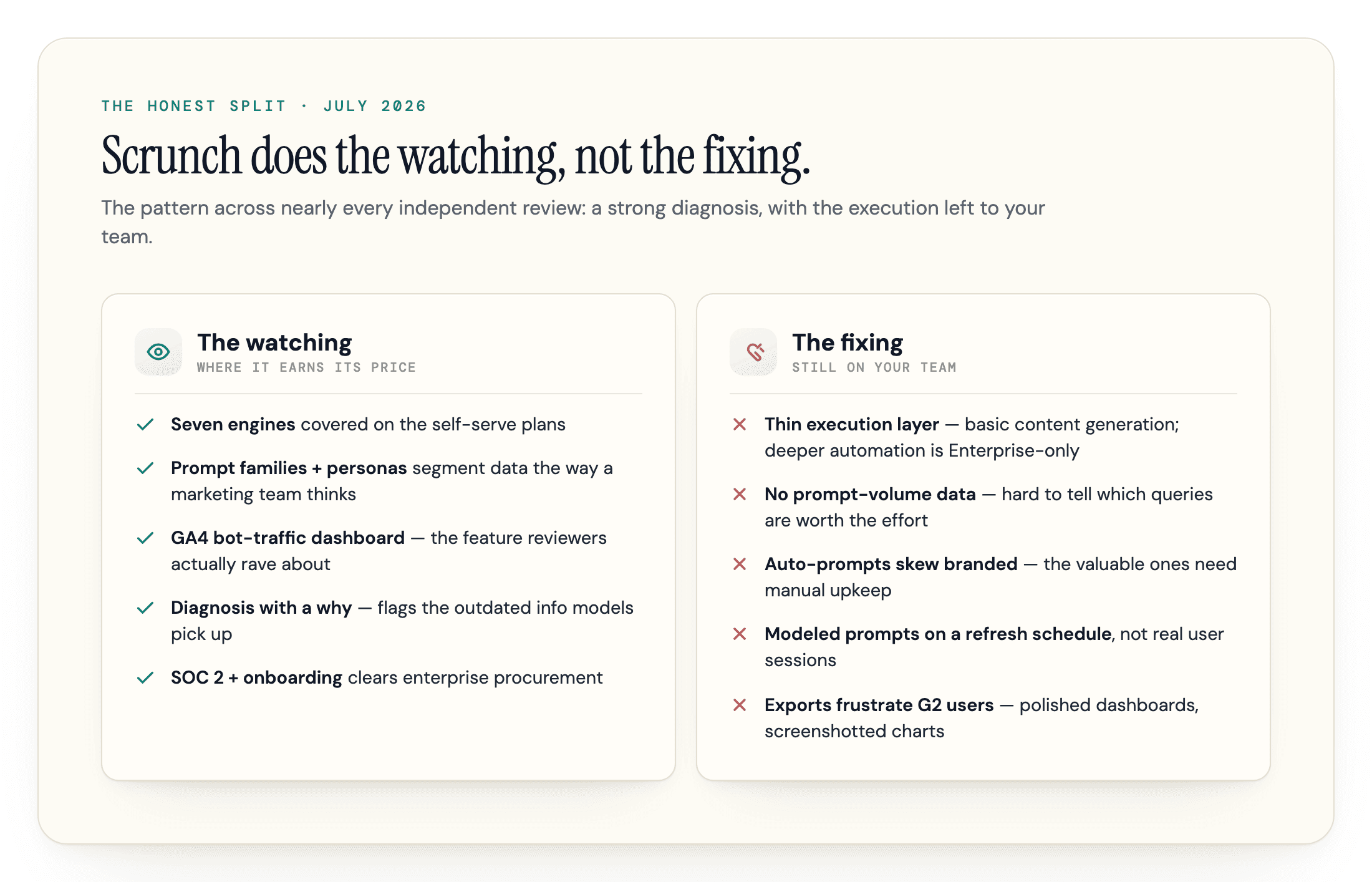
The fairest way to read Scrunch is that it is very good at one half of the problem. Here is the split.
On strengths, the engine coverage runs deep on Enterprise (nine engines), though the self-serve Core plan covers four (ChatGPT, Perplexity, Google AI Overviews, and Copilot) as of August 2026; the prompt and persona system lets you segment visibility data the way a real marketing team thinks, and the GA4 bot-traffic dashboard is the feature people actually rave about because it turns crawler activity into a slide a client will understand. The diagnostic side is strong too: Scrunch does not just say you are absent, it cross-references answers to suggest why, flagging outdated or contradictory information the models are picking up. It carries SOC 2 compliance and offers hands-on onboarding, which matters for enterprise procurement. None of that is in serious dispute.
The weaknesses cluster around a single theme, and it is worth stating plainly because it is the most common complaint across nearly every independent review: Scrunch tells you what is wrong but does little to fix it. Its execution layer is thin. The self-serve plans include only basic content generation and limited page optimization, and the deeper automation, including the Agent Experience Platform and advanced content work, is reserved for Enterprise. It does not repair schema, push fixes into your CMS, or run outreach, so as one third-party review put it, the platform shows you where your brand is invisible, and then it mostly stops. Insights become a backlog. Your team works through it by hand. Reviewers also note that Scrunch does not expose prompt-volume data, so you cannot easily tell which queries are worth the effort, and that the auto-generated prompts lean too branded, leaving you to add and maintain the valuable ones manually. Two more concerns recur: Scrunch tracks a modeled set of prompts on a refresh schedule rather than capturing real user sessions, so a competitor-built review argues the trends can lag what buyers actually see; and several G2 users say the polished dashboards are hard to export, leaving them screenshotting charts, though Looker Studio access on the agency and Enterprise tiers eases that.
Two things temper those criticisms. The sharpest of them are published by direct competitors like Profound and Analyze, who have an obvious interest in Scrunch looking incomplete, so weigh their framing accordingly. And the execution gap is partly a category trait, not a Scrunch defect; most pure monitoring tools share it.
In our experience building geotoolbox, the deeper issue under all of this is reachability. When a brand shows near-zero visibility, the cause is often a blocked crawler or a JavaScript-only render rather than weak content, and a share-of-voice chart alone cannot tell those two apart. Scrunch's page audits do check crawlability, to its credit, but that signal sits separately from the visibility numbers, so a flat result can still mislead you about the cause. It is worth confirming first.
Is Scrunch AI Worth It? Who Should Use It
Whether Scrunch is worth $250 a month comes down to one question: do you have someone to act on what it finds? The tool produces a strong diagnosis, and a diagnosis is only valuable if it reaches a team that can ship the fix.
It is a good fit for mid-market and enterprise brands, and for agencies running visibility for multiple clients, where the persona segmentation, competitor benchmarking, and client-ready reporting earn their keep. If you have an in-house content or engineering function that can turn "we are uncited for these ten prompts" into published pages, Scrunch gives that team a sharp, well-organized worklist. The SOC 2 compliance also clears procurement bars that cheaper tools stay silent on, which matters in regulated industries.
It is a poor fit for solo marketers and small teams. If you are one or two people tracking a handful of prompts, you can replicate much of the monitoring by running your own questions through ChatGPT and Perplexity and logging who gets named, and the $250 entry price is hard to justify against that. It is also a stretch if you expected an all-in-one that finds the gap and fills it, because the built-in optimization is basic and most of the filling is still on you. And if revenue attribution is what you need, tying AI mentions to pipeline, that is not Scrunch's strength.
If you land in the "skip it" camp, or you want the reachability and citation foundation before you pay for monitoring at all, the alternatives below are organized by the job you are actually trying to get done, the same way our full guide to the best GEO tools groups the wider market.
The Best Scrunch AI Alternatives in 2026
There is no single drop-in replacement, because the right alternative depends on whether your problem is price, action, enterprise depth, or simply whether the engines can reach you. Here are the names that come up most, judged on that basis.
Scrunch AI vs Profound
Profound is the alternative Scrunch gets measured against most, so it is worth a direct look. Profound is one of the category's best-funded players, having raised $96 million at a billion-dollar valuation, and it does the things Scrunch only does lightly: daily data refreshes, proprietary prompt-volume data so you know which queries matter, and built-in content workflows. It also starts cheaper, at $99 a month against Scrunch's $250, though its depth and its price climb fast at the top. The short version: Profound is the heavier research platform with the prompt-volume edge, while Scrunch leans on persona segmentation, multi-brand workspaces, and the Sitecore tie-in. Our Profound alternatives guide goes deeper on where each lands.
Peec AI is the community's affordable-depth favorite, with a starter plan around €85 a month, a clean interface, and unlimited seats, which makes it the tool teams most often name when they leave a pricier platform. Otterly.ai is the cheapest serious starting point, from about $29 a month with a free trial, simple by design. AirOps sits at the opposite end of the monitoring-versus-action split: it is built to turn visibility findings into produced content at scale, so it goes further on execution than Scrunch's basic built-in optimization. AthenaHQ is the closest enterprise-depth alternative for large organizations, with self-serve pricing around $295 a month.
geotoolbox, which we make, is the direct budget comparison: plans run from $99 a month ($79 billed annually) with a 7-day free trial — roughly a third of Scrunch's $250 entry price — covering visibility tracking across up to eight engines plus the check the category usually buries: whether the AI crawlers can reach and render your pages at all. Scrunch's page audits cover part of that reachability job too, but as a separate signal from the visibility numbers; geotoolbox leads with it, and a free AI crawler check flags the blocks that quietly turn the AI crawlers away before you pay anything. The honest caveat, since it is ours: our prompt-volume intelligence does not match a research platform's real-conversation dataset, so if persona-level research depth is the job, weigh Scrunch and Profound first; if tracking plus reachability is the job, the trial makes the case cheaper than this paragraph can. For the wider field, our rundown of the best AEO tools compares the standalone platforms, and our share of voice guide covers the metric most of them sell.
| Tool | Best for | Entry price (mid-2026) | Honest note |
|---|---|---|---|
| Scrunch AI | Enterprise/agency monitoring | $250/mo (Core) | Strong diagnosis; thin on execution |
| Profound | Enterprise research + workflows | $99 Starter / $399 Growth | Daily data, prompt volume; enterprise into the thousands |
| Peec AI | Affordable team depth | ~€85/mo | Clean UI, unlimited seats; community favorite |
| Otterly.ai | Cheapest serious start | ~$29/mo | Simple by design; thin for power users |
| AirOps | Action, not dashboards | Quote-based | Turns findings into produced content |
| AthenaHQ | Enterprise depth | ~$295/mo | Closest big-org alternative to Scrunch |
| geotoolbox | Reachability + tracking | From $99/mo ($79 annual), 7-day free trial | About a third of Scrunch's entry price; free crawler check, all 8 engines from the Pro tier (disclosure: ours) |
Frequently Asked Questions
What does Scrunch AI do?
Scrunch AI is an AI search visibility platform that tracks how your brand appears in AI assistant answers across ChatGPT, Claude, Gemini, Perplexity, Google AI, and Meta. It monitors mentions, sentiment, citations, and share of voice, audits whether AI crawlers can read your pages, and flags where competitors are getting cited instead of you.
Who owns Scrunch AI?
Sitecore, the enterprise digital-experience software company, acquired Scrunch on June 3, 2026, for a reported $225 million (per Bloomberg; Sitecore did not officially disclose terms). The product still runs under the Scrunch name, but it is now part of a larger martech stack rather than an independent startup, which is worth weighing when you consider its long-term roadmap.
Who is the CEO of Scrunch AI?
Chris Andrew is the chief executive. He co-founded the Salt Lake City company in 2023 with CTO Robert MacCloy, and both previously worked at Hearsay Systems. Before the Sitecore acquisition the company raised a $15 million Series A led by Decibel, part of roughly $26 million in total backing per its own site.
How much does Scrunch AI cost?
Self-serve entry is $250 a month with a 7-day free trial (no credit card), plus a custom Enterprise tier. As of August 2026 the page shows a four-engine Core plan at $250 (earlier in 2026 some visitors also saw a seven-engine Starter/Growth ladder, since retired). Confirm the current plan on scrunch.com.
Is Scrunch AI worth it?
It is worth it for mid-market, enterprise, and agency teams that have the content or engineering capacity to act on what it finds, since its value is in the diagnosis, not the fix. It is hard to justify for solo marketers or small teams tracking a few prompts, who can replicate much of the monitoring manually for free.
What is the best free Scrunch AI alternative?
There is no free tool that fully replaces Scrunch, but you can track a small prompt set by hand by running your questions through ChatGPT and Perplexity and logging who gets named. A free trial like geotoolbox's (which we make) or Otterly's covers basic monitoring, and in our case a free check of whether AI crawlers can reach your site at all.
The Bottom Line
Scrunch AI is a capable, broad monitoring platform that does the watching half of AI visibility well, and as a Sitecore company it now has the backing to keep building. The caveat most reviews land on is real: it shows you the gap and leaves the closing to you, at a price that only makes sense if you have a team to do that work.
Before you pay for any monitor, though, rule out a failure that a share-of-voice chart can quietly hide: a page the AI engines cannot fetch. A blocked crawler produces the same flat zero as weak content, and no share-of-voice dashboard can tell the two apart. Our free AI Readiness scan checks it in about two minutes, fetching and rendering your pages the way the AI crawlers do. Confirm reachability first, fix anything it flags, then pick the tracker that matches the job you actually need — and if that job is tracking plus reachability without Scrunch's $250 entry price, the 7-day geotoolbox trial is the direct test. The cheapest tool is the problem you avoid paying to measure.
Sources
- Scrunch Pricing - Scrunch, 2026 (current Core and Enterprise pricing, prompts, free trial, engines tracked) -
scrunch.com/pricing - Sitecore Acquires Scrunch - PRNewswire, June 3 2026 (acquisition announcement, executive quotes, 500+ brands) -
prnewswire.com/news-releases/sitecore-acquires-scrunch-to-help-brands-influence-discovery-and-buying-decisions-in-the-ai-search-era-302790214.html - Scrunch AI Raises $15 Million Series A - PRNewswire, July 2025 (Series A, investors, Salt Lake City HQ, CEO Chris Andrew, AXP) -
prnewswire.com/news-releases/scrunch-ai-raises-15-million-series-a-to-rebuild-the-internet-for-ai-consumption-302510915.html - Scrunch | The AI Customer Experience Platform - Scrunch, 2026 (positioning, product modules, named customers) -
scrunch.com - Scrunch AI on Capterra - Capterra, 2026 (third-party reviews, ratings, legacy pricing reference) -
capterra.com/p/10030499/Scrunch-AI