
If you are searching for Profound alternatives, you have probably already hit one of three walls: the price, the complexity, or a specific thing it does not do. The honest answer most listicles bury is that there is no single drop-in replacement for Profound. It bundles three different jobs into one expensive platform, and the right alternative depends on which of those jobs you actually need.
So this guide is organized by job, not by a self-serving ranking. Pick the row that matches your problem, and skip the rest.
Why People Look for Profound Alternatives
Profound is the category leader for a reason: it raised $180 million at a $1.8 billion valuation in September 2026, seven months after its $96 million Series C, and now serves more than 1,000 enterprise brands, 16% of the Fortune 500 among them. The category it leads exists because AI answers now absorb the click that used to reach your site: Ahrefs' 2026 re-run of its study found AI Overviews linked to a 58% lower click-through rate for the top organic result, and Pew Research found people click a search result on just 8% of searches with an AI summary, versus 15% without. So most people leaving Profound are not unhappy with its data. They leave for one of three concrete reasons.
Price, with no middle ground. This is the big one. As of September 2026 Profound no longer publishes a self-serve tier for brands at all. Its pricing page offers a free Trial (50 prompts a day for 7 days, on ChatGPT, Gemini, and Google AI Overviews) and then Enterprise on request, with deals reported in the $2,000 to $5,000+ range. Agencies get a separate self-serve plan, Agency Growth: $99 a month base plus $399 a month per full client workspace (add-on).
The sentiment in community threads is that the market sits stuck between tools that feel too simple and Profound, which feels too expensive. Teams that just want to track a few dozen prompts do not want to start a four-figure conversation to do it.
Deep data, no clear next step. The second complaint is not about accuracy, it is about action. G2 reviewers describe dashboards that "show us where we stand, not what to do about it," and note that the platform "can be overwhelming without someone dedicated to managing it." Profound is reporting-first. If you do not have an analyst to turn its data into a content plan, a lot of that depth goes unused.
Reliability friction. The third, quieter reason is the usual SaaS wear: G2 reviews mention bugs like a watched-URL tab that fails to delete entries and dashboards that hang for 15 seconds. Minor on their own, annoying at the price.
None of this makes Profound a bad tool. It makes it a specific tool, priced for a specific buyer. If you are not that buyer, the question is which job you are trying to get done.
Why There's No One-to-One Profound Alternative
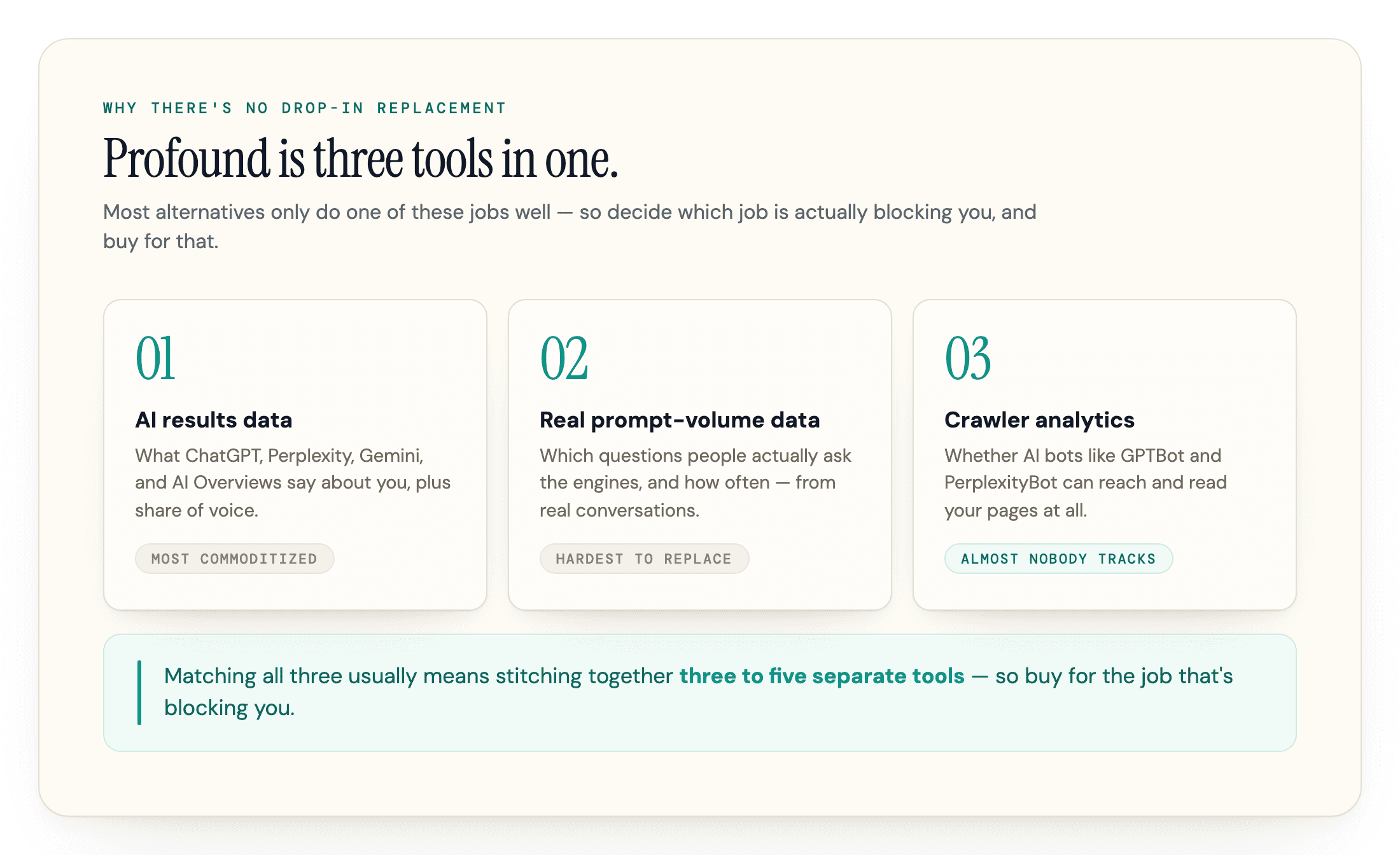
Here is the framing that saves you from buying the wrong thing. Profound feels irreplaceable because it quietly does three separate jobs at once, and most alternatives only do one of them well.
- AI results data. What the models actually say about you, across ChatGPT, Perplexity, Gemini, and Google's AI Overviews, plus your share of voice against competitors. This is the part everyone calls "AI visibility tracking," and it is the most commoditized.
- Real prompt-volume data. Which questions people actually ask the engines, and how often. Profound's edge here comes from a large pool of real conversations, so it can tell you a prompt is worth optimizing for. Most alternatives estimate this from traditional search volume, which is a rough proxy at best.
- Crawler analytics. Whether AI bots like GPTBot and PerplexityBot are reaching and reading your pages at all. This is the dimension almost nobody tracks, and it is the one that decides whether the other two ever produce a number above zero.
Nick Lafferty, Profound's own head of growth, makes the point bluntly in his Profound alternatives breakdown (posted on his own site, not Profound's): matching all three dimensions usually means stitching together three to five separate tools. It's a notable admission to see in writing from inside the company itself. So instead of hunting for the one tool that replaces Profound, decide which of the three jobs is actually blocking you, and buy for that.
The Best Profound Alternatives, by the Job You're Hiring For
If You Already Pay for an SEO Suite
If you already run an SEO platform, the cheapest "alternative" might be an add-on you already have access to, not a new subscription.
SE Ranking now sells its AI tracking two ways. There is SE Visible, a standalone product from $99 a month with a 10-day trial, and there is the original AI Search add-on layered onto its SEO suite, at €79 a month or €63.20 on annual billing for European buyers, as of September 2026. The add-on is the sensible one if you already live in its dashboards. Ahrefs' Brand Radar and the Semrush AI Visibility Toolkit do the same for their respective ecosystems, surfacing AI mentions and citations next to your keyword and backlink data. None of these will match a dedicated platform's depth on prompt-volume intelligence, but consolidating AI metrics into a tool your team already opens daily has real value, and you avoid paying twice for overlapping data. For the broader field of dedicated options, our rundown of GEO tools compares the standalone platforms by capability and price.
If You Want Action, Not Just Dashboards
The loudest complaint about Profound is that it tells you what is happening but not what to do about it. Profound has started closing that gap itself: alongside its February 2026 Series C it launched Profound Agents, which builds orchestration and automation into the platform, though still at enterprise pricing. A separate class of tools is built around the same gap for everyone else.
AirOps positions itself around AI-native content execution at scale, turning visibility findings into actual content production rather than another report. Trakkr markets itself directly against Profound on this point, pairing tracking with an "action layer" of recommendations, and it ships crawler analytics on every plan, which it argues Profound underweights. Treat vendor-versus-vendor claims like these as marketing until you test them, but the category is real: if your problem is "I have the data and still do not know what to ship," an action-first tool solves a different bottleneck than a better tracker would.
If You Need Enterprise Governance and Procurement
Some teams leave Profound for the opposite reason: they need even more, with the security paperwork to match.
AthenaHQ is frequently named as the closest in depth for large organizations, with self-serve pricing at $295 a month ($245 a month billed annually, as of June 2026) and an enterprise tier above that. Brandlight targets the same governance-heavy buyer.
The thing to check here is not features but compliance: Profound is cited as the platform that most clearly clears bars like SOC 2 Type II, and many cheaper alternatives are simply silent on certifications. If you work in finance or healthcare, that silence is a procurement blocker, so confirm it in writing before you switch.
If You Just Want Cheaper Visibility Tracking
This is what most people searching for alternatives actually need: see whether the engines mention you, track it over time, and watch a few competitors, without a four-figure bill.
Otterly.ai is the simplest place to start, with its Lite plan at $29 a month as of August 2026 and a free trial. It monitors mentions and links across the major engines with a clean, low-friction setup. The common knock is the flip side of that simplicity: power users find it thin once they want depth.
Peec AI is the community's default "bigger but still affordable" pick, with a starter plan around €85 a month. People consistently praise its clean interface, unlimited seats, and direct founder support, and it raised a $21 million Series A in late 2025, so it is not a weekend project. It is the tool most often named when someone on a forum says they left Profound for something saner. If Peec itself is what you are weighing alternatives to, our Peec AI alternatives guide covers that field directly.
LLMrefs and Rankscale round out the budget tier, with entry plans well under $100 a month; Rankscale starts at $20 a month, and it publishes the same figure in euros — €20, not a converted premium — on a credit-based model with broad engine coverage. Both are spot-check tools rather than research platforms.
geotoolbox, which we make, belongs in this tier as well: plans from $99 a month ($79 billed annually) open with a 7-day free trial, and the entry Starter covers ChatGPT, Perplexity, and Google AI Overviews, the same three-engine count as Profound's free Trial (ChatGPT, Gemini, and Google AI Overviews), without a call with sales. All eight engines are available on higher tiers. It is also the tool in this tier built around the check most trackers leave out: whether the AI crawlers can reach your pages at all, so you fix the silent zero instead of paying to measure it. One caveat, stated plainly because it is ours: our prompt-volume intelligence does not match Profound's real-conversation dataset. The 7-day trial is the honest way to judge the rest. If price is your main constraint, start here or with the other cheaper trackers in this section and upgrade only when you hit a real wall.
The Dimension Most Trackers Bury: Can AI Even Reach Your Pages?
Every tool above answers some version of "what do the engines say about me." Most of them stop short of the question underneath it: can the engines read your site at all. That is a different job from Profound's entirely.
The reason this matters is blunt. You can rank first on Google and still be invisible to ChatGPT, Claude, Gemini, and Perplexity, because a web application firewall (WAF) rule or a JavaScript-only render is quietly turning their crawlers away. A share-of-voice tracker will faithfully report that zero as if it were a content problem, when the real cause is that the bot never fetched the page, which is why confirming reachability belongs before any content work.
geotoolbox's free Agent Readiness scan does that check: it fetches and renders each page the way the AI crawlers do and flags the blocks that cause silent zeros. In our scans, that mechanical layer is one of the most common reasons a brand shows near-zero AI visibility while it ranks perfectly well in Google.
To be fair, this check is not unique to one tool. Trakkr, for one, reports AI crawler activity as part of its tracking. But among the visibility trackers most teams actually compare, a dedicated reachability check is the missing first step, not a standard feature, and it is worth running before you pay for anything that assumes your pages are already readable.
A Pricing Reality Check
Two cautions before the table. First, these tools change their tiers constantly, so treat every figure as a starting point reported in mid-2026 (Profound's rechecked September 26, 2026), not a quote. Second, the figures disagree across sources more than you would expect: Profound's entry tier alone got cited anywhere from $99 to $499 depending on who was writing, and by September 2026 the brand page shows only a free Trial and custom Enterprise pricing; the $99 Starter and $399 Growth brand tiers were withdrawn, and agencies buy a separate plan, Agency Growth ($99 a month base plus $399 a month per full client workspace, as an add-on). Which is the whole point: verify the current number on the vendor's own page before you commit.
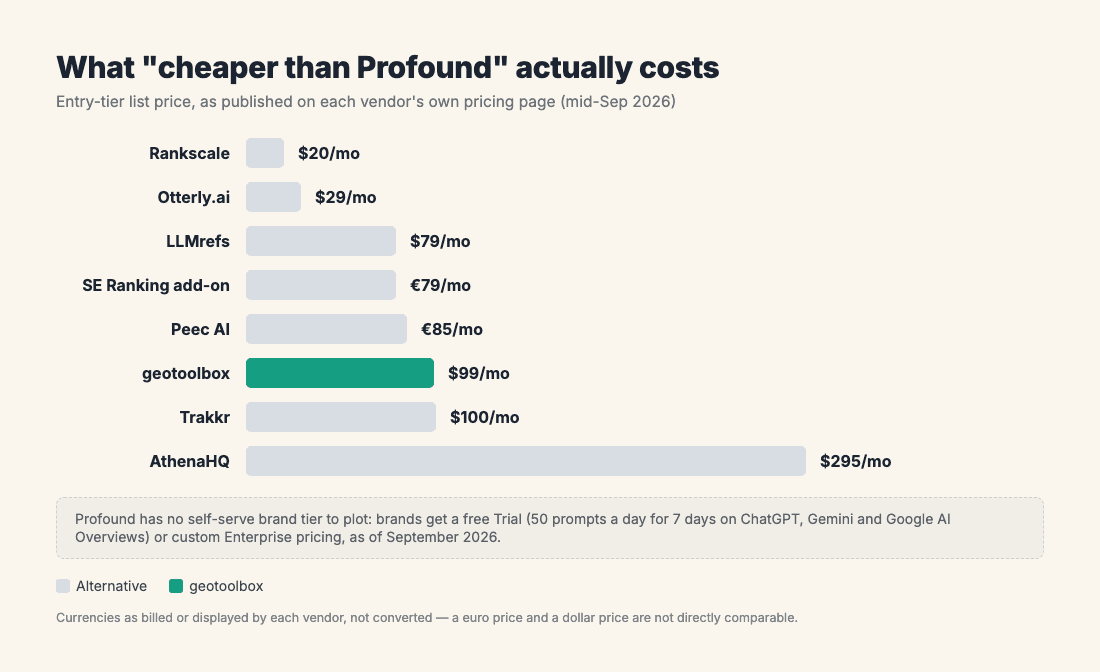
| Tool | Best job | Reported entry price (mid-2026) | Note |
|---|---|---|---|
| Otterly.ai | Cheapest start | ~$29/mo | Free trial; simple by design |
| Rankscale | Budget tracking | ~$20/€20/mo | Broad engine coverage; credit-based |
| LLMrefs | Budget tracking | ~$79/mo (promotional rate) | Lightweight tracker |
| Trakkr | Action layer | $100/mo (billed USD, converted at checkout) | First scan in minutes |
| Peec AI | Affordable depth | ~€85/mo | Community favorite; unlimited seats |
| SE Ranking / SE Visible | SEO-suite users | SE Visible from $99/mo; suite add-on €79/mo (€63.20 annual) | Add-on if you already use SE Ranking; SE Visible if not |
| AthenaHQ | Enterprise depth | ~$295/mo (~$245/mo annual) | Closest to Profound for big teams |
| AirOps | Content execution | Quote-based | Action, not just reporting |
| Profound | Enterprise research | Free Trial / Enterprise (custom) | Self-serve brand tiers withdrawn by September 2026; enterprise reported into the thousands |
| geotoolbox | Tracking + reachability | From $99/mo ($79 annual), 7-day free trial | 3 engines on Starter, up to all 8 by tier; also checks crawler access |
One framing worth borrowing from Trakkr's own analysis, with the caveat that it comes from a direct competitor: judge cost per prompt, not the sticker price. A plan that looks cheap but only tracks 15 prompts can cost more per question answered than a pricier plan that tracks 100. Do the division before you decide.
How to Choose: Match the Tool to the Job
You do not need to pick a single winner. Match the tool to the job in front of you, and only build a small stack if you genuinely need more than one dimension.
The solo or small-team setup (under ~$100/mo). Start with one budget tracker. geotoolbox's $99 Starter covers both jobs that matter most for a small site in one subscription — are we visible, and can we be fetched — while Otterly and Peec AI start cheaper on the visibility job alone, without bundling in a reachability check.
The SEO-team setup. If you already run Ahrefs, Semrush, or SE Ranking, turn on their AI add-on before buying anything new. Add a dedicated tracker only when the add-on's depth runs out, which usually means you have outgrown spot-checks and need real competitor share of voice. Our guide to tracking AI visibility covers what to measure once you do.
The agency or enterprise setup. This is where a small stack is honest rather than wasteful: a research-grade platform like Profound or AthenaHQ for prompt-volume intelligence, an action tool if your team ships content at volume, and a reachability layer so a client's blocked crawler does not quietly tank a campaign you are being paid to run. The point is not to own every tool, it is to cover the three dimensions without buying five overlapping trackers. If the real question is whether to run this in-house at all, weigh agency versus software first.
Whatever you pick, the choice gets easier once you have framed it as a job rather than a brand. "I need to know if AI can see my site" and "I need competitor share of voice for a board deck" are different problems, and no single subscription is the best answer to both.
Frequently Asked Questions
What is the cheapest Profound alternative?
Otterly.ai is usually the cheapest serious starting point, with its Lite plan at $29 a month as of August 2026 and a free trial. Rankscale is also low-cost, from $20 a month — the same figure in euros — with broad engine coverage on a credit-based model. Both are aimed at solo marketers and small teams who want to validate AI visibility before spending more.
Is there a free Profound alternative?
Partly. AthenaHQ's Essential tier is free with a $25 credit (300 credits) across five engines and unlimited team members, and Profound itself now has a free Trial (50 prompts a day for 7 days, on ChatGPT, Gemini, and Google AI Overviews). Beyond that, you can track a small prompt set by hand by running your questions through ChatGPT, Perplexity, and Google's AI Overviews and logging who gets named. There is no free tool that fully replaces Profound's paid prompt-volume research, because that dataset comes from real conversations no free product has access to.
Peec AI vs Profound: which is better?
They serve different buyers. Peec AI is the affordable, simpler choice that small and mid-size teams most often name when leaving Profound, with a starter plan around €85 a month and unlimited seats. Profound offers deeper enterprise research and proprietary prompt-volume data at a much higher price. If you do not have an analyst dedicated to the data, Peec's clearer interface is usually the better fit.
What is the best Profound alternative for a small team?
Peec AI if you want depth and seats for a whole team, Otterly.ai if one person just needs a clean monthly reading. The deciding question is usually who looks at the data: tools with unlimited seats earn their higher price only when more than one person logs in.
Run the Cheaper Check First
Before you pay for any Profound alternative, rule out the failure that no tracker will warn you about: a page the AI engines cannot fetch. A blocked crawler or a JavaScript-only render produces the exact same zero as weak content, and a share-of-voice dashboard cannot tell the two apart.
geotoolbox's free Agent Readiness scan checks whether the major AI crawlers can reach and render your pages. Start there, fix anything it flags, then choose a tracker for the job you actually need — if you want tracking and reachability from a single tool, a 7-day geotoolbox trial settles it in a week. The cheapest alternative is the problem you avoid paying to measure.
Sources
- Profound Raises $180M Series D at $1.8B Valuation - GlobeNewswire, September 2026 (Series D funding, valuation, 1,000+ enterprise brands, 16% of the Fortune 500) -
globenewswire.com/news-release/2026/09/15/3362180 - Nick Lafferty's Profound alternatives breakdown - Profound's head of growth, personal site, 2026 (three-dimension framework; why no single tool replaces Profound) -
nicklafferty.com/blog/profound-alternatives - As AI Threatens Search, Profound Raises $96 Million - Fortune, 2026 (Profound funding, valuation, enterprise scale) -
fortune.com/2026/02/24/exclusive-as-ai-threatens-search-profound-raises-96-million-to-help-brands-stay-visible - Profound raises $96M Series C at $1B valuation - Profound, February 2026 (Series C announcement, before the September 2026 Series D; Profound Agents launch) -
tryprofound.com/blog/profound-raises-96m-series-c - Peec AI Raises $21M to Help Brands Adapt - TechCrunch, 2025 (Peec AI Series A) -
techcrunch.com/2025/11/17/as-consumers-ditch-google-for-chatgpt-peec-ai-raises-21m-to-help-brands-adapt - AI Overviews reduce clicks: 2026 update - Ahrefs, 2026 (click-through impact of AI answers, data citation) -
ahrefs.com/blog/ai-overviews-reduce-clicks-update - Google AI Overviews Hurting Clicks - Search Engine Land / Pew Research, 2025 (click behavior on AI-summary searches) -
searchengineland.com/google-ai-overviews-hurting-clicks-study-459434