
Real estate SEO can't reliably put an agent's website above Zillow for "homes for sale in [city]." It can put your name, your Business Profile and your neighborhood knowledge in front of buyers and sellers when they choose an agent, in Google's map pack and in AI answers.
When we asked ChatGPT, Gemini, Google AI Mode and Perplexity for the best agents in Dallas, Phoenix and Atlanta, ChatGPT cited an agent's or brokerage's own site in 4 of 24 answers, and rating or referral sites in 18.
Where Real Estate SEO Still Works for Agents
What Is Real Estate SEO?
Real estate SEO, also searched as realtor SEO or SEO for realtors, is the work that gets an agent, team or brokerage found when potential clients use search engines, Google Maps and AI assistants. It pays off on searches for your name, the map pack for agent searches, and questions about the neighborhoods you work in.
Your name matters more than most agents assume. In NAR's 2026 Member Profile, the typical REALTOR® earned 28% of their 2025 business from repeat clients and another 22% from referrals by past clients. Referred sellers often search your name before calling, and a thin profile can cool the referral. Give them an about page with your license number, brokerage, years in the market and recent sales.
What Google Shows for Agent Searches
On November 15, 2026, we ran six searches for each of Dallas, Phoenix and Atlanta, twice, with the location set to that city. Organic rankings shifted between pulls, so the second column reports map packs and AI Overviews, and notes where they changed; the third column is what we saw in the organic results.
| Search type | Map pack and AI Overview | Who held the organic results | What to build |
|---|---|---|---|
| "homes for sale in [city]" | Map pack in 1 of 3 cities; AI Overview in 5 of 6 pulls | Portals and agent search pages; a site other than the big portals ranked first in all 3 cities in one pull, only in Atlanta in the other | Hard to hold citywide; aim at neighborhood and own-listing pages |
| "realtor [city]" | Map pack in all 3 cities | Portal agent directories, Yelp, brokerages | A complete Google Business Profile with steady reviews |
| "best real estate agent in [city]" | Map pack in all 3 cities | Rating and referral sites | Profiles on the sites that rank agents, plus reviews |
| "sell my house [city]" | Map pack in all 3 cities in the first pull, 2 in the second | Cash buyers, referral sites, Zillow | A seller page: valuation, process, recent sales |
| "living in [city]" | No map pack; AI Overview every time | YouTube, Reddit, Facebook groups, a few agent sites | Neighborhood and relocation guides, video |
| "[city] housing market" | No map pack; AI Overview every time | Redfin, local news, economists, agent blogs | A monthly market report |
Agent searches bring up the map pack; "living in" and housing market searches brought up AI Overviews every time. Our local SEO guide covers how map rankings work.
To pick targets, start with the queries Search Console's Performance report already shows for your site, add the questions in Google's autocomplete and People Also Ask, and check volume with a keyword research tool. Long-tail keywords like "[neighborhood] condos for sale" bring fewer searches but clearer intent. Group terms that share an intent on one page, so two of your pages don't compete for the same search.
Google Business Profile Rules for Agents, Teams and Brokerages
Local SEO for real estate agents starts with your Google Business Profile, which puts you in the map pack.
Losing it to a suspension was the most common complaint in the agent threads we read on Reddit and Google's help forum, mostly from agents who work from home, share a brokerage office or switched brokerages. Many of those cases trace back to the rules below, from Google's Business Profile guidelines; some were Google's own errors.
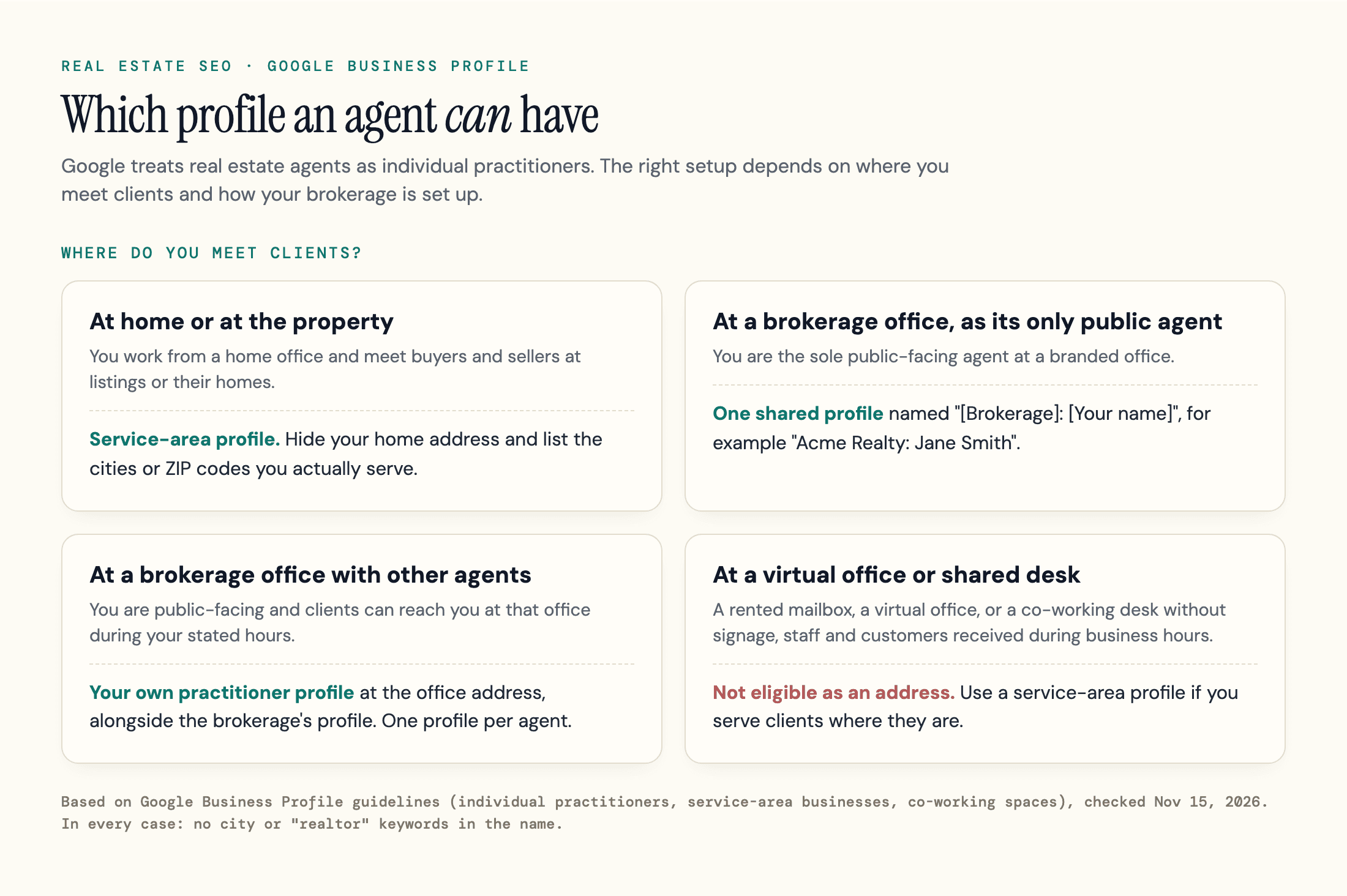
Which profile you can have depends on where you meet clients and how your brokerage is set up.
You Count as an Individual Practitioner
Google lists "insurance or real estate agents" as individual practitioners, alongside doctors and lawyers.
You can have your own profile if you work in a public-facing role and "can be contacted directly at the verified location during stated hours." At an office with several agents, the practitioner profile's title should carry only your name. If you are the only public-facing agent at a branded office, Google says it's best to share one profile named "[brand/company]: [practitioner name]".
A Home Office Usually Means a Service-Area Profile
Google's rule for service-area businesses is direct: "you should hide your business address from customers." List the cities or ZIP codes you actually serve instead. A rented mailbox or virtual office is not eligible, and a co-working desk qualifies only with signage, staff and customers received during business hours. Agents at cloud brokerages without a local office often run into this rule.
Use Your Real Name, No Keywords
Names such as "Jane Smith Dallas Real Estate Agent" break Google's guidelines, which list marketing taglines, service descriptions and location details among the things a business name must not include.
If your profile carries only your name, put your brokerage in the description and on your website: NAR's Code of Ethics (Standard of Practice 12-5) requires REALTORS® to show the firm's name "in a reasonable and readily apparent manner" in advertising, and state license rules add their own display requirements.
Categories, Reviews and Local Links
Use "as few categories as possible": for most agents, "Real estate agent" alone, without "Real estate agency" for the brokerage that contains you.
Ask every closed client for a review in the same neutral words, with no incentive, and reply to each one. Google's review content policy says merchants should not "request that specific content be included," so never suggest what to write. Add photos of listings and your office as you go.
Google's local ranking help page bases prominence partly on "how many websites link to your business." For an agent, realistic local backlinks are your brokerage's agent page, a school or charity event you support (Google asks that paid links carry "sponsored" or "nofollow"), a quote in local news, and the lenders, inspectors and builders you work with (never trade links for referrals).
Keep your name, brokerage and phone identical on those sites and on Bing Places, Apple Business Connect and Yelp.
If Your Profile Is Suspended
Fix the cause before you appeal: hide a home address that shows publicly, or rename the profile to your real name.
When you switch brokerages, change the address once you work from and can be reached at the new office, and ask the old brokerage to transfer the profile if it owns it. Decline ownership requests you don't recognize, including ones from listing apps.
IDX and Listing Pages: What Can Rank and What Can't
An IDX feed puts MLS listings on your site, but those listing pages rarely rank. The same description and photos appear on Zillow, Realtor.com, the listing brokerage and hundreds of other agent sites.
Google handles that with deduplication. Its canonicalization documentation describes picking the page it considers "the most representative from a set of duplicate pages" and showing that one. For a syndicated listing, that page is almost never a small agent site. Duplicate MLS text isn't penalized; your copy just isn't the one Google shows.
That is why agents on Reddit keep asking whether their IDX subscription is worth paying for. Buyers browse listings in the Zillow and Redfin apps, and a framed IDX search loads its pages from the vendor's domain, not yours. Keep it for visitors who arrive for other reasons.
Here is how to treat each kind of page an IDX setup creates:
| Page type | Index it? | Why |
|---|---|---|
| Your own listings, with photos and copy you have rights to | Yes | Add details the MLS text lacks; check your listing agreement and MLS rules |
| Other brokers' listings with the stock MLS text | Usually no | Duplicates of pages Google already shows elsewhere |
| A few city or ZIP search pages you curate | Yes | Your own area summary gives Google a page worth ranking |
| Filters, sort orders and map views | No | Thousands of near-identical URLs that waste crawling |
| Neighborhood or building pages that include a filtered feed | Yes | Your own writing, photos and data around the feed make them unique |
| Sold listings you closed | Yes, as a sold page | Proof of local sales; check your MLS's rules for showing sold data |
| Expired listings from other brokers | Remove them (404 or 410) | Stale pages that send searchers nowhere |
Two technical checks prevent most IDX problems. First, ask your vendor whether listing pages are served on your domain (a subfolder or subdomain) or inside an iframe. Only the first can rank as your page. Second, don't block a page in robots.txt if you also want it noindexed: Google's noindex documentation says a blocked crawler "will never see the noindex" rule.
When you do want a set of IDX pages indexed, give each one a reason to exist. A neighborhood page with a market summary, your photos and a filtered feed qualifies; a thousand filter combinations don't. Our guide to canonical tags explains how to point duplicates at the version you want counted.
Neighborhood, Seller and Relocation Content
The pages that win for agents answer questions portals answer badly: what a neighborhood is like, what your house is worth, what moving to a city involves. In the Reddit threads we read, agents who reported steady organic leads named neighborhood guides and long-running local posts over generic "10 tips for buyers" articles.
Build them in this order:
- Neighborhood and community pages. One page per area you actually sell in: housing types and price ranges, commute times, parks, HOA rules, your own photos, recent sales, and a filtered listing feed. Start with the five to ten areas your keyword research shows people search for, and finish them before adding more.
- A seller page. Valuation, your process, the sales you took part in and the questions sellers ask before listing.
- Relocation guides. A guide with real cost and commute detail can be the source the AI Overviews on "living in [city]" searches cite. Bank of America's 2026 Homebuyer Insights Report found that 20% of prospective buyers and homeowners used AI tools for homebuying research in the past year (32% of Gen Z), and researching neighborhoods was one of the top uses.
- A monthly market report. Median price, days on market and inventory for your area. Keep one page and update it each month, and check your MLS's rules on citing its data.
- Video and social. Short neighborhood tours on YouTube, embedded on the matching page, with the same clips in Facebook neighborhood groups, which showed up in our "living in" results.
On each page, put the term your keyword research found for that area in the title tag, the H1 and a short URL such as /neighborhoods/oak-lawn. Link every neighborhood page to your seller page and market report with descriptive anchor text. One test: if another city's name could be swapped in and the page still read true, it is too thin.
If you need dozens of area pages, our guide to programmatic SEO covers how to scale them without thin, copy-pasted pages.
The Fair Housing Line
Neighborhood content also carries a legal risk that none of the seven ranking guides we read mention. Under federal fair housing rules, 24 CFR 100.75 treats "words, phrases, photographs, illustrations, symbols or forms which convey that dwellings are available or not available to a particular group of persons" based on a protected class as discriminatory advertising.
The NAR Code of Ethics (Standard of Practice 10-3) goes further and adds sexual orientation and gender identity.
In practice, describe places, not people:
- Fine: "Walkable to the light rail and the riverside parks."
- Cut: "Perfect for young families," which signals a preference based on familial status.
The related steering rule covers telling buyers, because of a protected class, that they would not be "comfortable or compatible" with existing residents. Subjective "safe" labels and demographic widgets invite that reading, so skip them, and check state and local laws, which can add protected classes. For schools, state facts (district name, distance) and link to official district data rather than calling schools good or bad.
What ChatGPT, Gemini, AI Mode and Perplexity Cite When Someone Asks for an Agent
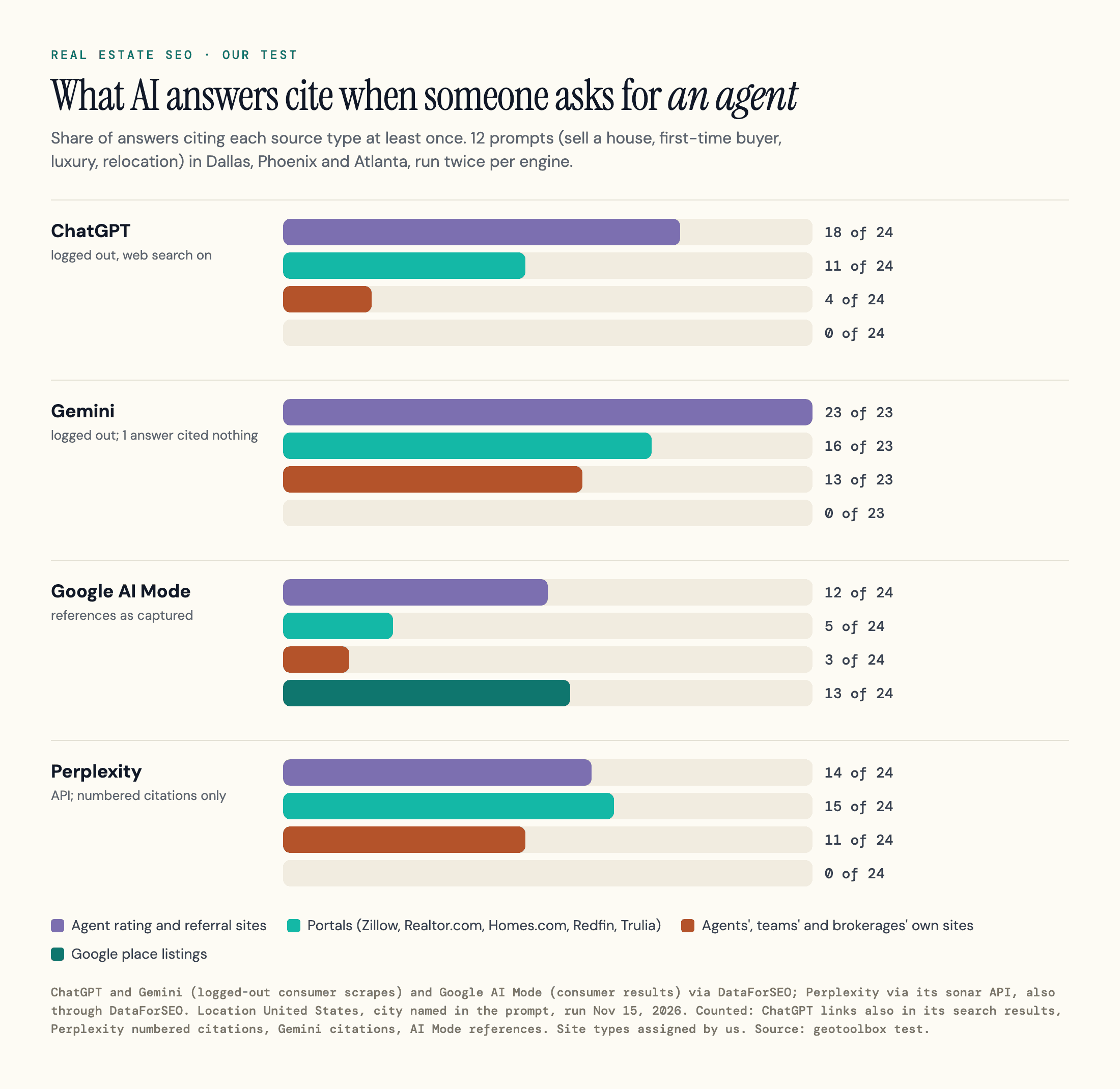
When someone asks an AI assistant to recommend an agent, rating and referral sites show up in most ChatGPT, Gemini and Perplexity answers. How often agents' own sites appear depends on the engine, and Google AI Mode leans on Google's place listings.
We ran this test at geotoolbox on November 15, 2026. Four prompts asked for an agent to sell a house, a first-time buyer's agent, a luxury agent and a relocation realtor, each in Dallas, Phoenix and Atlanta, for example "Who is the best real estate agent in Dallas, Texas to sell my house? Recommend a few and explain why. Cite sources."
A fifth prompt, about choosing a brokerage, was read by ChatGPT, Gemini and AI Mode as a question about which brokerage to join, so we left it out.
Each prompt ran twice in ChatGPT and Gemini (logged out; ChatGPT with web search on), Google AI Mode and Perplexity's API, through DataForSEO with the location set to the US, not the city. That gave 96 answers, 95 with sources. We counted the sources each engine listed in its answer (for ChatGPT, only links also in its search results; for Perplexity, numbered citations), and we sorted sites into types ourselves.
| Engine | Answers citing rating or referral sites | Citing portals | Citing agent or brokerage sites | Citing Google place listings |
|---|---|---|---|---|
| ChatGPT | 18 of 24 | 11 of 24 | 4 of 24 | 0 of 24 |
| Gemini | 23 of 23 | 16 of 23 | 13 of 23 | 0 of 23 |
| Google AI Mode | 12 of 24 | 5 of 24 | 3 of 24 | 13 of 24 |
| Perplexity | 14 of 24 | 15 of 24 | 11 of 24 | 0 of 24 |
Zillow appeared in 41 of the 95 answers, RealTrends in 34, FastExpert in 25 and HomeLight in 18. In every engine, rating and referral sites appeared in more answers than agents' and brokerages' own sites.
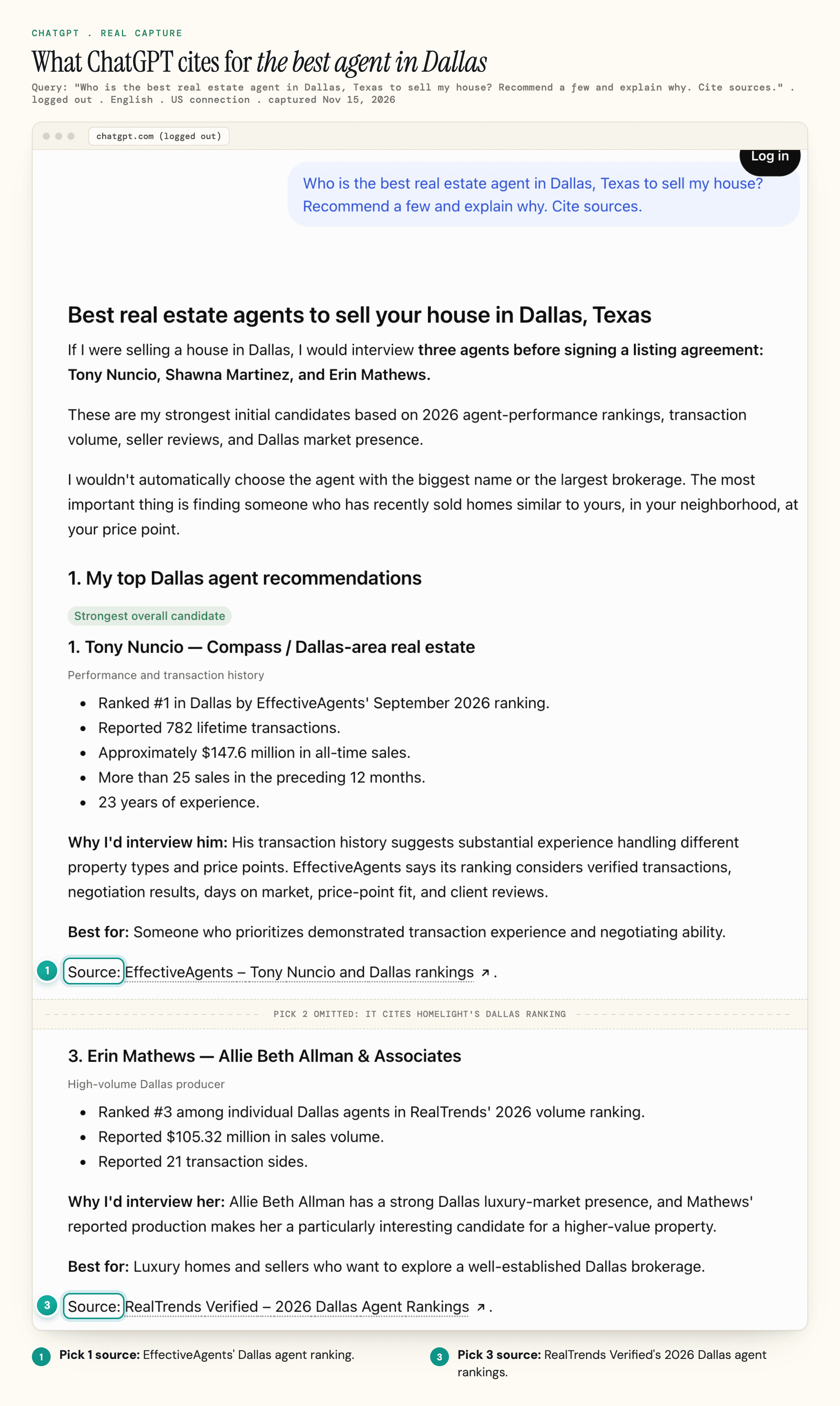
The two answers below are separate ChatGPT captures from the same day. In the Dallas answer, each of the first three picks cites an agent-ranking site: EffectiveAgents, HomeLight and RealTrends.
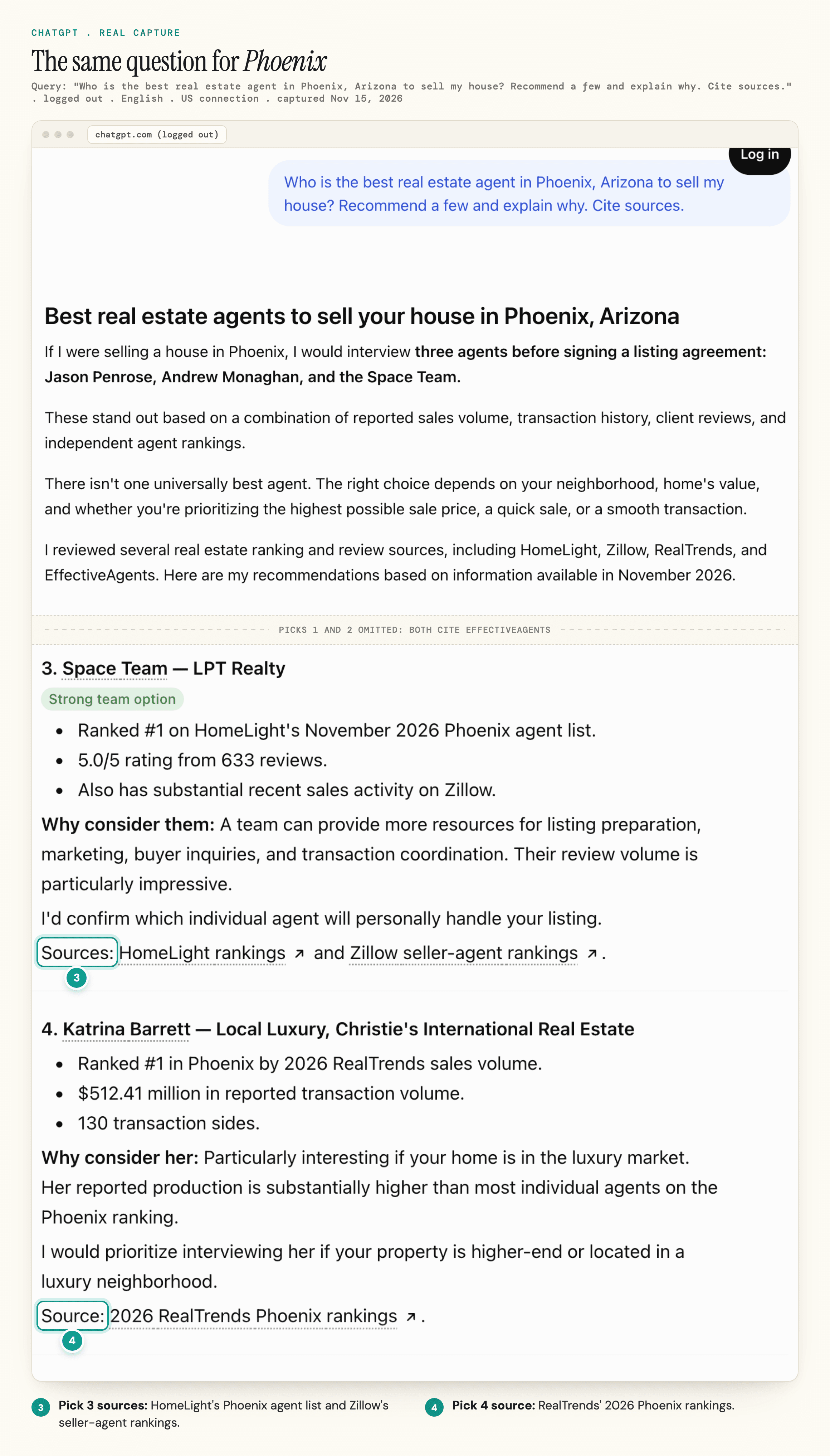
The Phoenix answer named its sources up front: HomeLight, Zillow, RealTrends and EffectiveAgents.
Gemini and Perplexity cited agent or brokerage sites in about half their answers. The test covers one day, three large metros and logged-out or API versions of each engine; signed-in or in-city answers can differ.
Local Falcon's Realtor AI Visibility Index, from a company that sells local rank tracking, ran 37,500 searches in the 100 largest US cities. It found that 91.5% of the RealTrends-ranked, website-publishing agents it checked were "never cited once," and that 18 of the 25 most-cited agent websites carried a "best real estate agents in [city]" page.
Be careful copying that: NAR's Standard of Practice 12-10 bars "otherwise misleading consumers" in online content, and state rules may limit unproven "best" claims.
What to do with this:
- Keep your Zillow and Realtor.com profiles complete and matching your Business Profile
- Submit your production to RealTrends Verified when submissions reopen, if you qualify; its rankings come from submitted production, not self-description
- Read the terms of agent-matching services such as HomeLight and FastExpert before joining
- Keep your Google Business Profile complete, since AI Mode draws on Google's place listings
- Earn mentions and backlinks from local news, and join city subreddits as yourself, within their self-promotion rules; Gemini and AI Mode cited Reddit threads in our test
For engine-specific tactics, see our guides to Google AI Mode SEO and SEO for ChatGPT.
Schema and Technical Basics Worth Your Time
In real estate website SEO, technical SEO basics such as schema and site speed matter, but less than most ranking guides suggest, and some of their advice is out of date.
Mark up your brokerage or team as a RealEstateAgent, a Schema.org subtype of LocalBusiness, and each agent as a Person, with sameAs links to your Google, Zillow and Realtor.com profiles. That can help engines connect those profiles into one entity.
Google's search gallery lists no real estate listing result, and Google says its AI features need no "special optimizations." Our guide to schema markup for AI search covers the rest.
For speed, IDX widgets and image-heavy listing pages are a common problem.
Compress listing photos and give them descriptive file names and alt text, as Google's image guidelines recommend.
Test the site on a phone, since Google indexes the mobile version of your pages, and aim for "good" Core Web Vitals (Largest Contentful Paint at or under 2,500 ms, Interaction to Next Paint at or under 200 ms, layout shift at or under 0.1). Our technical SEO guide covers the full crawl.
| Advice you'll still hear | What to do instead |
|---|---|
| Run Google's Mobile-Friendly Test | Google retired it starting December 1, 2023; use Lighthouse or PageSpeed Insights |
| Add review schema for star ratings on your site | Google's review snippet guidelines allow local business reviews only on sites that review other businesses; collect reviews on Google and the portals |
Cost, Timeline and How to Measure It
In Ahrefs' survey of 439 SEO providers, last updated in 2024, those serving local markets averaged $1,557 a month, against $2,917 for SEO overall. They are cross-industry averages, but a fair check on a quote.
Agents in the threads we read described two complaints: cold callers offering to get them "to the top of Google," and web developers quoting a monthly SEO add-on without saying what work it buys. Before you pay anyone, ask what they will change each month (pages, backlinks, Business Profile), which searches they expect to move and how they will show leads. Nobody can guarantee a ranking or a mention in ChatGPT.
Business Profile fixes often show up in calls before new pages show up in rankings, which can take months, so track both from the start.
Measure three things, monthly:
- Search Console. Which queries and pages get impressions and clicks, especially your name, neighborhood names and seller terms.
- Business Profile performance. Calls, direction requests and website clicks from your profile.
- Leads to closings. A call-tracking number on your website only (keep your main number on every listing), GA4 key events for form submissions, and a lead-source field in your CRM, so a closed sale can be traced to search, a portal or a referral.
Run an SEO audit each quarter; our SEO audit checklist covers the site side.
Check Your Own City Next
Run our four prompts for your own city (an agent to sell a house, a first-time buyer's agent, a luxury agent, a relocation realtor) in ChatGPT, Gemini, Google AI Mode and Perplexity each month, and note which sites they cite and whether your name appears. Treat the sites they cite as leads to check, not a guaranteed fix list.
Then check that AI crawlers aren't blocked from your site. geotoolbox's free AI Readiness check runs five basic checks, including robots.txt, AI crawler access and your sitemap. A pass rules out blocked crawlers but won't earn citations by itself.
Frequently Asked Questions
Is SEO dead for real estate agents in 2026?
No. Portals hold most listing searches, but agents still win their name search, the map pack and local questions.
Do realtors need a website if they're on Zillow?
Yes, if you want leads you don't pay a portal for. Your website is where your neighborhood pages, seller page and market reports live, and where referred clients check you out.
Can ChatGPT generate real estate leads?
Not directly: it can name you, but the buyer still has to contact you. In our test ChatGPT cited rating sites and portals far more often than agents' own websites, so complete, reviewed profiles there are a sensible place to start.
Is SEO free for real estate agents?
The clicks are free, but the work costs your time or, if you hire help, usually a monthly retainer.
Sources
- SEO Link Best Practices for Google - Google Search Central -
developers.google.com/search/docs/crawling-indexing/links-crawlable - RealTrends Submissions - RealTrends Verified -
realtrends.com/realtrends-submissions - The Feature Sheet: 2026 Member Profile - National Association of REALTORS® -
nar.realtor/news/economists-outlook/the-feature-sheet-2026-member-profile - Google Business Profile guidelines - Google -
support.google.com/business/answer/3038177 - Tips to improve your local ranking on Google - Google Business Profile Help -
support.google.com/business/answer/7091 - Prohibited & restricted content - Maps User Generated Content Policy Help -
support.google.com/contributionpolicy/answer/7400114 - What is URL canonicalization - Google Search Central -
developers.google.com/search/docs/crawling-indexing/canonicalization - Block Search indexing with noindex - Google Search Central -
developers.google.com/search/docs/crawling-indexing/block-indexing - 24 CFR 100.75, Discriminatory advertisements, statements and notices - eCFR -
ecfr.gov/current/title-24/subtitle-B/chapter-I/part-100/subpart-B/section-100.75 - 24 CFR 100.70, Other prohibited sale and rental conduct - eCFR -
ecfr.gov/current/title-24/subtitle-B/chapter-I/part-100/subpart-B/section-100.70 - 2026 Code of Ethics and Standards of Practice - National Association of REALTORS® -
nar.realtor/about-nar/governing-documents/code-of-ethics/2026-code-of-ethics-standards-of-practice - The Realtor AI Visibility Index - Local Falcon, August 2026 -
localfalcon.com/research/the-realtor-ai-visibility-index - 2026 Homebuyer Insights Report - Bank of America -
about.bankofamerica.com/en/making-an-impact/homebuyer-insights-report - RealEstateAgent - Schema.org -
schema.org/RealEstateAgent - Structured data markup that Google Search supports - Google Search Central -
developers.google.com/search/docs/appearance/structured-data/search-gallery - Image SEO best practices - Google Search Central -
developers.google.com/search/docs/appearance/google-images - AI features and your website - Google Search Central -
developers.google.com/search/docs/appearance/ai-features - Mobile site and mobile-first indexing best practices - Google Search Central -
developers.google.com/search/docs/crawling-indexing/mobile/mobile-sites-mobile-first-indexing - Mark events as key events - Google Analytics Help -
support.google.com/analytics/answer/13128484 - Review snippet structured data - Google Search Central -
developers.google.com/search/docs/appearance/structured-data/review-snippet - Defining the Core Web Vitals metrics thresholds - web.dev -
web.dev/articles/defining-core-web-vitals-thresholds - The role of page experience in creating helpful content - Google Search Central Blog -
developers.google.com/search/blog/2023/04/page-experience-in-search - How Much Does SEO Cost? - Ahrefs -
ahrefs.com/blog/seo-pricing