
Most advice on SEO for dentists stops at Google. Patients now also ask AI assistants which dentist to see, so we checked what those answers show.
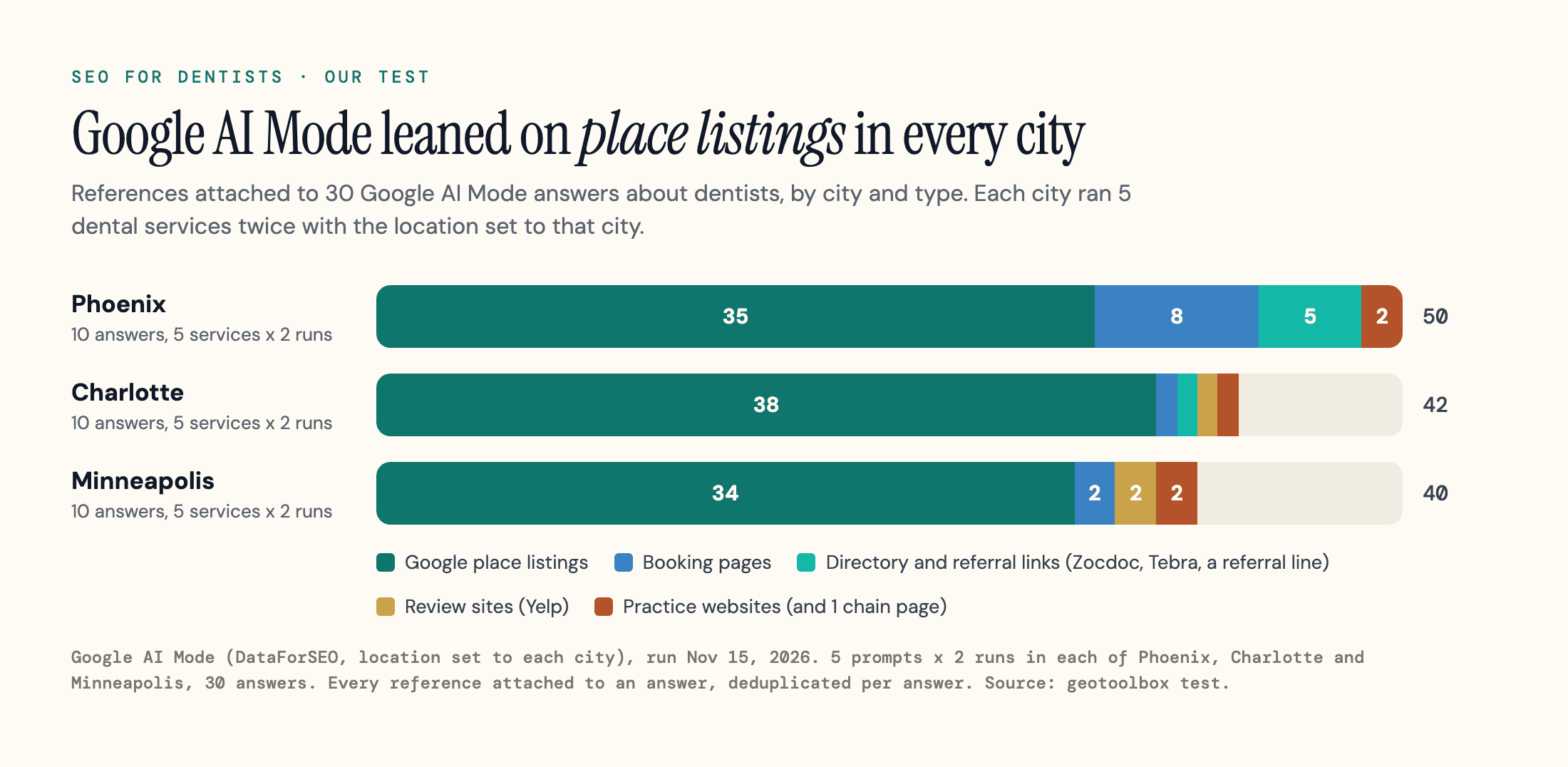
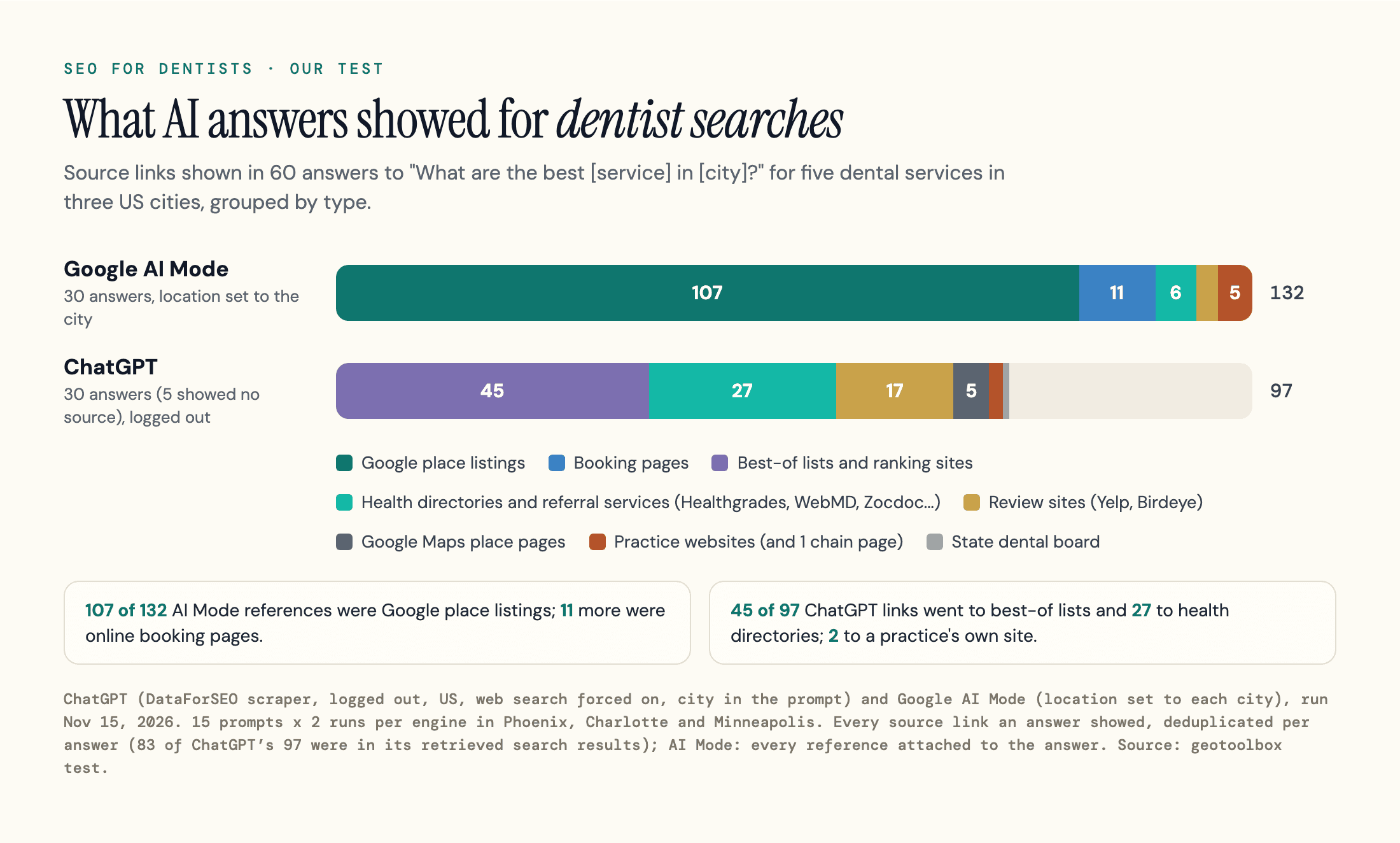
For this guide, geotoolbox asked ChatGPT and Google AI Mode for the best dentists, implant dentists, emergency dentists, pediatric dentists and Invisalign dentists in three US cities, 60 answers in all. 107 of AI Mode's 132 references were Google Business Profile listings. ChatGPT's source links went mostly to best-of lists and health directories; two went to a practice's own site. Its practice cards did link practice websites.
So in our test, AI answers cited the profile and the directory listings far more often than the practice website. In our contractor SEO test, Google AI Mode leaned on listings for trades too: 59 of its 84 sources were Google business listings.
What SEO for Dentists Covers in 2026
SEO for dentists is the work of getting a dental practice shown when nearby patients search for a dentist or a treatment, and turning those searches into booked appointments.
Patients meet your practice in three places in local search: the map pack, which reads your Business Profile, reviews and distance; the organic results, which read your website page by page; and AI answers from ChatGPT and Google AI Mode, which build a short list from whatever sources each engine trusts.
The mechanics of the first two are the same as for any local business, and our local SEO guide covers them. Three things differ for a practice:
- Dental pages are health content, so Google holds them to a higher bar for expertise and accuracy
- HIPAA reaches into your review replies and your website tracking tags
- Patients search by treatment (implants, Invisalign, an emergency), so each treatment needs its own page
What AI Assistants Show When Patients Ask for a Dentist
In our test, AI answers rarely cited a practice's own website as a source.
How We Ran the Test
On November 15, 2026, we asked "What are the best [service] in [city]?" for dentists, dentists for dental implants, emergency dentists, pediatric dentists and Invisalign dentists in Phoenix, Charlotte and Minneapolis: 15 prompts, each run twice in ChatGPT and twice in Google AI Mode, 60 answers.
The plain "dentists" prompt, run in the same cities on the same day, is the control. With six answers per service and engine, read the differences as patterns, not rates.
ChatGPT ran logged out with web search on, from a US connection, with the city in the prompt; AI Mode ran with its location set to each city. We collected the answers through DataForSEO, counted every source link an answer showed, and sorted sources into types after reading them, using category definitions written before the run (a state dental board type was added afterwards). Every prompt asked for the "best" dentists, which favors best-of lists, and the two runs of a prompt often differed: ChatGPT showed 39 links in one round and 58 in the other.
AI Mode Built Its Answers from Business Profiles
AI Mode showed 132 references across its 30 answers, and 107 of them were Google place listings, the same Business Profile data that feeds Google Maps.
The other 25 were 11 online booking tools such as Flexbook and NexHealth, 6 directory and referral links (3 of them Zocdoc profiles from one answer), 4 practice websites, 3 review pages and 1 ClearChoice consultation page. Seven carry tracking tags that name Google as the source, which suggests AI Mode took them from the listing rather than from the practice's site. 34 of its 123 practice cards also carried a website link; we counted cards separately from references.
ChatGPT Built Its Answers from Lists and Directories
ChatGPT showed 97 source links in 25 of its 30 answers, and five answers showed none. Best-of lists made up 45, directories and referral services 27 (Healthgrades, WebMD, Opencare and the National Orthodontic Registry among them), and Yelp and Birdeye pages 17, including Birdeye's city lists. Its search retrieved 83 of the 97; the other 14 were Yelp, Google Maps and state dental board links it added.
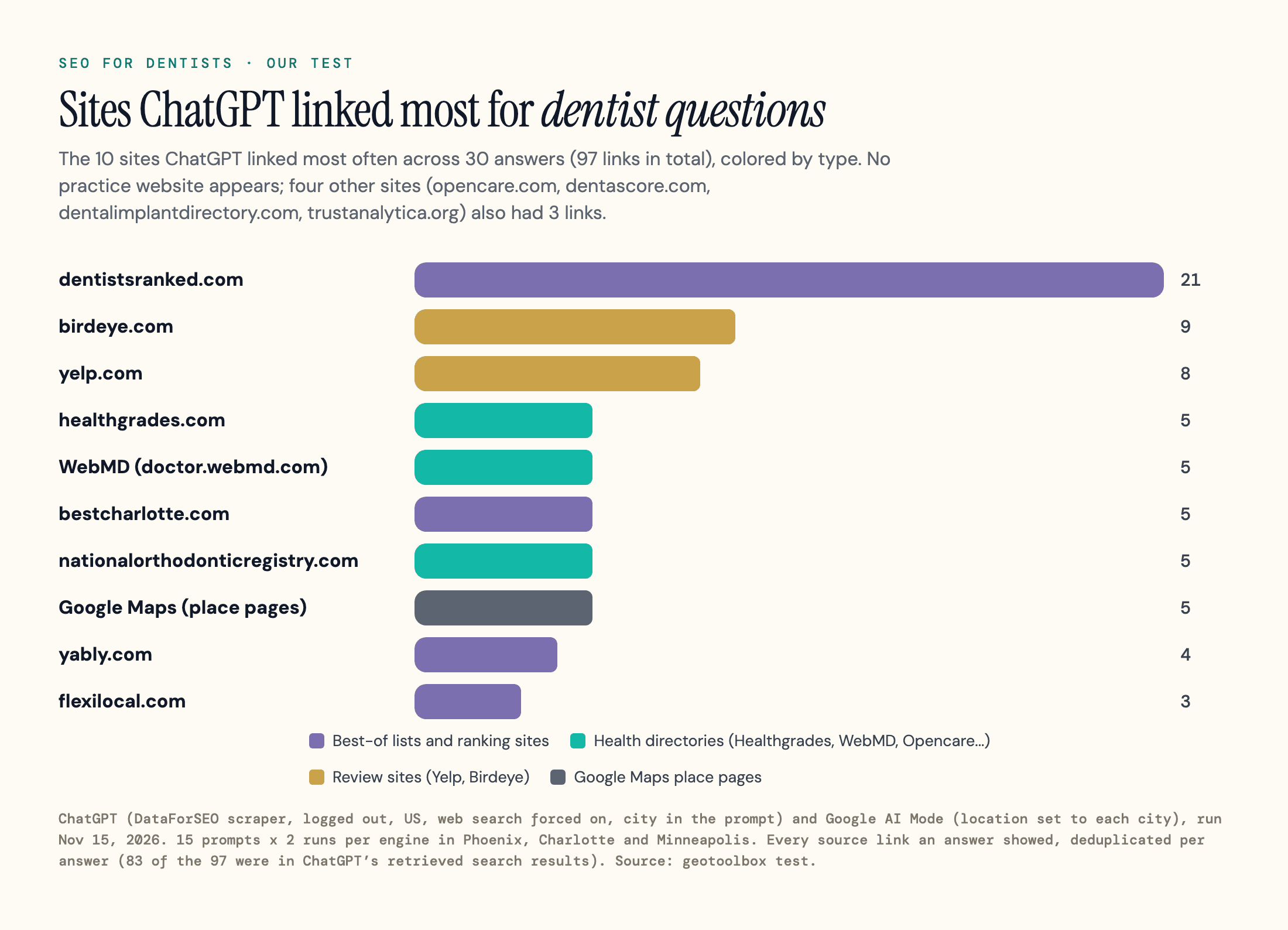
One list site, dentistsranked.com, supplied 21 of the 97. ChatGPT linked a practice's own site as a source twice, both in one Phoenix implant answer. Every answer also showed practice cards, 169 in all, and 168 linked the practice's website, but its cited pages were lists and directories.
Treatment Prompts vs the Generic Control
The generic "dentists" prompt never cited a practice website on either engine. On treatment prompts, practice sites showed up, but rarely: AI Mode cited three practice pages on emergency prompts (two of them emergency-dentist pages) and one Invisalign page, while ChatGPT's two came in one implant answer.
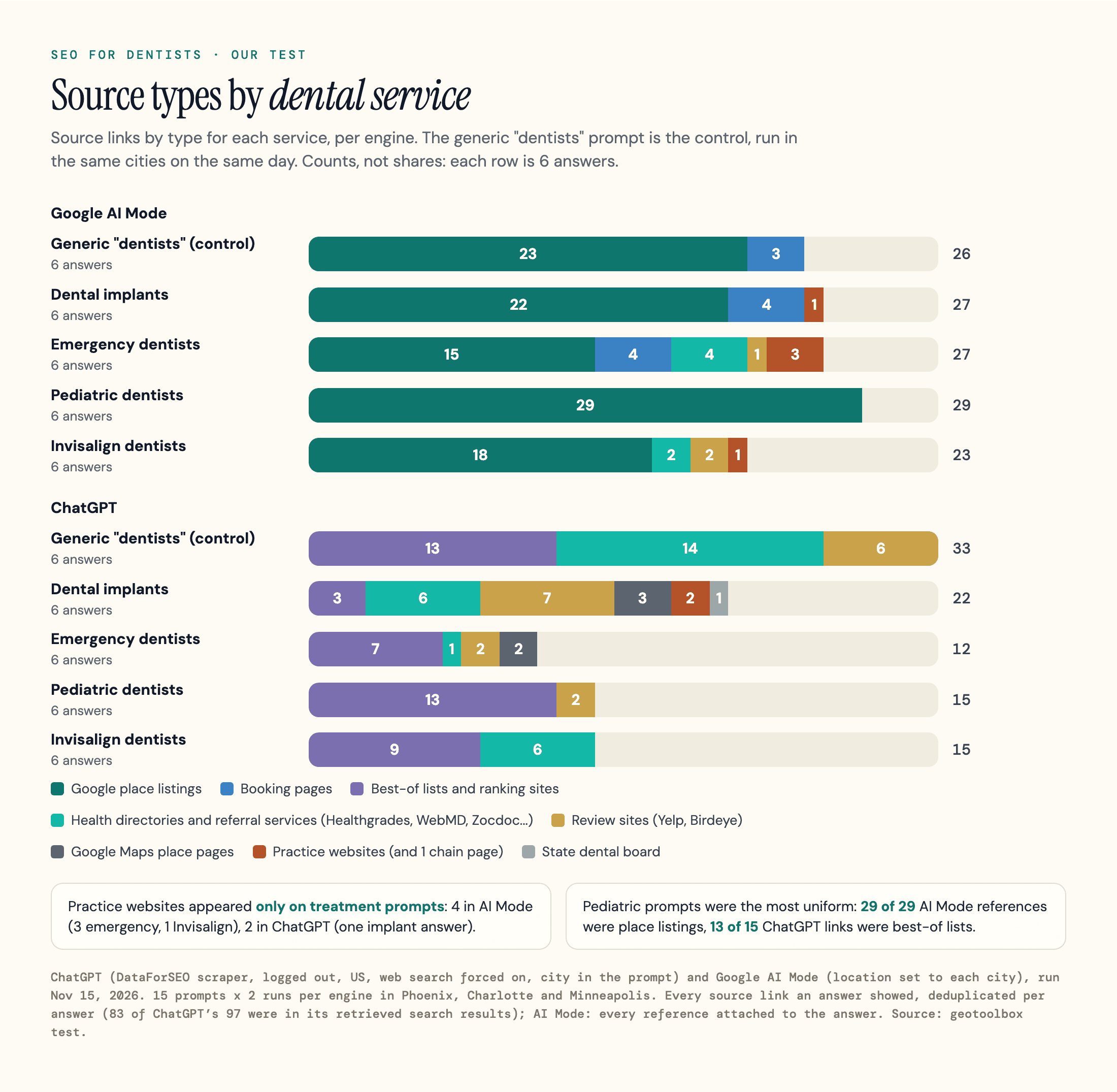
The source mix also differed by service, though six answers per row is a small sample. For pediatric dentists, all 29 AI Mode references were Google place listings, and 13 of ChatGPT's 15 links were best-of lists. Emergency prompts drew AI Mode's widest mix: place listings, booking pages, Zocdoc profiles, three practice sites and a referral line.
For AI answers, that shifts weight to the profile, reviews and directory listings; the website still holds the treatment pages your profile links to.
Set Up a Google Business Profile for a Dental Practice
Your Business Profile is what AI Mode cited most in our test, and it feeds the map pack. Google says local results depend mainly on relevance, distance and prominence. Distance is out of your hands; the four settings below are not.
Choose Your Categories
Across the 300 Google Maps results we pulled for the test (217 distinct listings, some ranking in several searches), 148 results used Dentist as the primary category, 47 used Pediatric dentist and 30 used Emergency dental service. As secondary categories, 124 results listed Cosmetic dentist and 95 Emergency dental service. Google's guidelines ask you to choose the most specific category that represents your core business and to use as few categories as possible, so add secondary ones only for core services, such as emergency care you staff for.
Keep the profile name to your real-world practice name: Google's guidelines say details such as the city or services belong in the other fields, not in the name.
Add Services and a Booking Link
List each treatment as a service in the profile, with a short description, and set the booking link. AI Mode showed booking pages directly in our test, including Flexbook and NexHealth pages and Zocdoc profiles, so a working booking link may be one route from an AI answer to your calendar.
Keep Hours Accurate
If you take emergencies, show the hours you really answer the phone. In our test, AI Mode spelled out opening times only in its emergency answers, and its practice cards showed an Open or Closed status on every service, so wrong hours send patients elsewhere.
Give Dentists Their Own Profiles
Google's guidelines for individual practitioners allow a dentist their own profile if they are public-facing and can be contacted directly at the verified location during stated hours. With several such dentists, each profile carries only the dentist's name and the practice keeps its own. When a dentist is the only public-facing practitioner of a branded office, Google says it's best to share one profile, named with the brand and then the dentist.
Reviews: Get More Without Breaking HIPAA or Google's Rules
Reviews feed the map pack, the AI Mode cards and the directory profiles ChatGPT linked. Three sets of rules limit how you ask for them and how you reply.
Google's Review Rules
Google's Maps content policy bars incentives for reviews, discouraging negative reviews and asking only happy patients. It also bars pressure on the premises, review quotas for staff and asking patients to mention a staff member by name. Ask every patient the same way, after the visit, with your review link. The ADA adds that some jurisdictions may prohibit soliciting reviews, so check your state dental board's rules first.
The FTC's Fake Review Rule
The FTC's Consumer Reviews and Testimonials Rule took effect on October 21, 2024. It bans fake reviews and incentives tied to a positive or negative review, with civil penalties for knowing violations.
HIPAA in Your Review Replies
A reply that confirms someone is your patient can disclose protected health information, even when the patient posted under their own name. The ADA's guidance warns that even "Thank you for coming in" can violate HIPAA, and suggests a plain "Thank you!" for positive reviews. In 2022 a California practice, New Vision Dental, paid $23,000 to HHS and accepted a corrective action plan after disclosing patient information in replies to online reviews.
The same rule covers testimonials and before-and-after photos on your own site. In a 2025 settlement, the director of HHS's Office for Civil Rights said a valid, written HIPAA authorization is generally necessary before a provider posts a patient's information in a website testimonial. Before publishing a story that identifies a patient, get a valid, written HIPAA authorization.
For a negative review, reply in general terms about how the practice works and invite the person to call the office. Never mention a visit, a treatment, a name or insurance.
| Situation | Safer | Riskier or prohibited |
|---|---|---|
| Asking for reviews | Send every patient the review link by text or email after the visit | Asking only patients you expect to be happy; discounts or gifts for reviews |
| Staff involvement | Staff mention that a review link will follow | Review quotas for staff; asking patients to name a dentist or hygienist; pressing patients in the office |
| Replying to praise | "Thank you!" | "Glad your implant went well, see you at your next cleaning" |
| Replying to a complaint | A general statement about your standards and an invitation to call | Confirming the visit, treatment, cost or insurance |
This is general guidance, not legal advice; a healthcare attorney can confirm what applies in your state.
Build Treatment Pages and Dentist Bios Google Can Trust
Give every treatment you want patients for its own page: implants, Invisalign, emergency care, pediatric dentistry, crowns, veneers. A patient searching "dental implants Phoenix" wants a page about implants at your office, not a one-line entry in a services list.
A useful treatment page answers what the patient is weighing before they call:
- Who the treatment suits, and who it does not
- What happens at each visit, and how long the whole process takes
- Recovery and aftercare
- What drives the cost, and which insurance plans or financing you accept
- Which dentist does it, with a link to their bio
- How to book, with the phone number and booking link above the fold
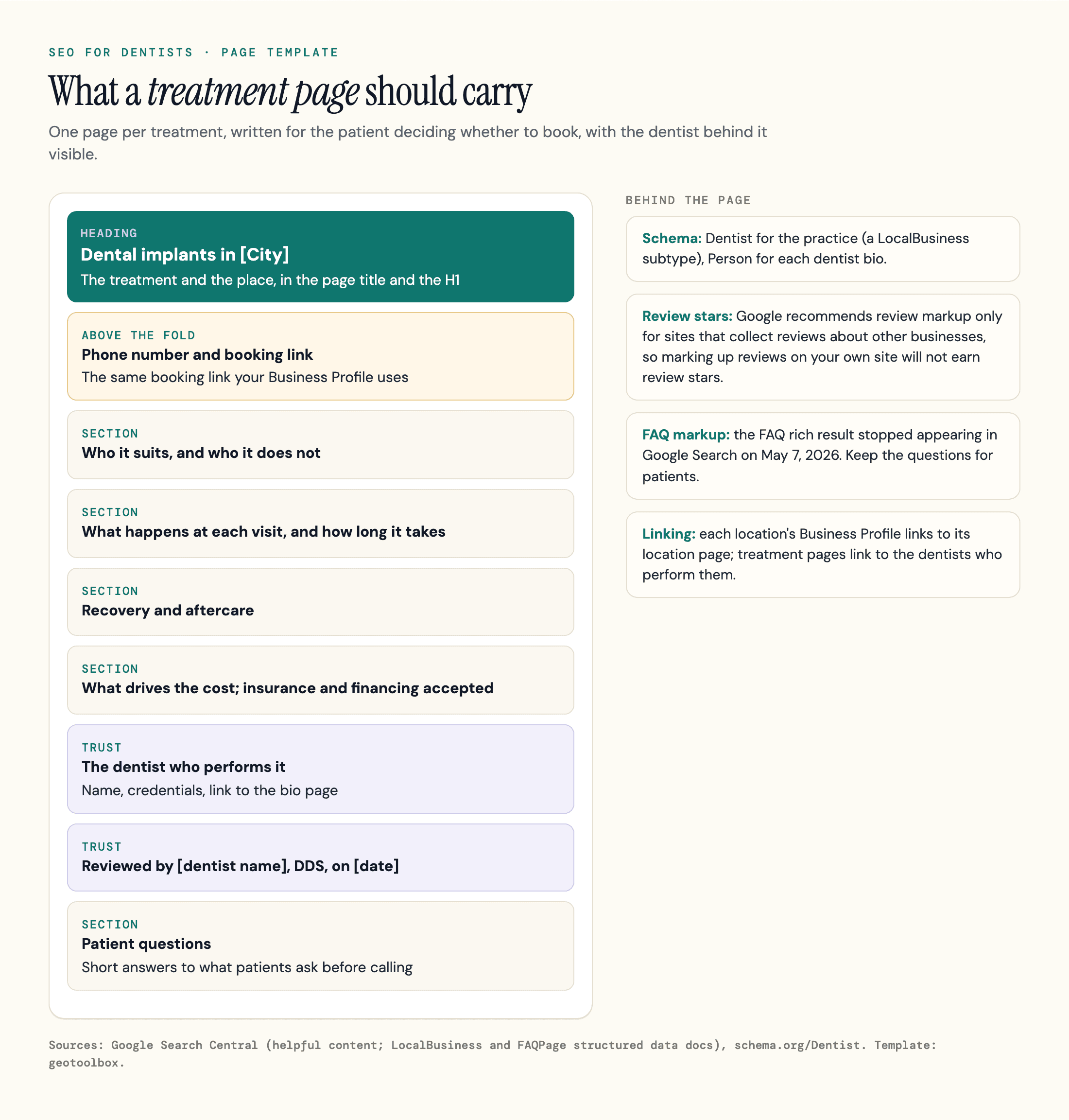
Who wrote a treatment page matters. Google's guidance on helpful, reliable content asks whether a page is "written or reviewed by an expert or enthusiast who demonstrably knows the topic well". Put the reviewing dentist's name, credentials and a review date on each treatment page, linked to a bio with their degree, license and specialties. Our guide to E-E-A-T for AI search covers how those signals carry into AI answers.
If you run several offices, give each location its own page with its address, hours, dentists and the treatments offered there, and link it from that location's Business Profile.
Keywords, Titles and Patient-Question Articles
Build the page list from the words patients use, as Google's SEO Starter Guide advises: treatment plus city, urgent needs and insurance questions. Give each page a title that names the treatment and the city, and a short meta description unique to that page.
Articles that answer patient questions, such as what to do about a knocked-out tooth, reach potential patients who are still researching. Link each one to the matching treatment page with descriptive link text, so readers and Google both find the page that books the visit.
Schema for Dental Practices
Schema is code that labels a page's facts for search engines. Mark the practice up with the Dentist type, a subtype of LocalBusiness and MedicalBusiness, and each bio with Person. Google's LocalBusiness documentation requires only the name and address, and its review snippet rules limit local business stars to sites that collect reviews about other businesses, so marking up reviews on your own site will not earn review stars. One older tactic no longer pays either: Google's FAQ rich result stopped appearing in Search on May 7, 2026. Keep the questions on the page for patients. Our schema guide for AI search goes deeper.
Directories and Best-Of Lists AI Engines Read
Neither replaces your site, but ChatGPT's answers in our test leaned on both.
Health Directories
Check your profiles on the directories ChatGPT linked (Healthgrades, WebMD's provider directory, Opencare) and on Yelp; AI Mode also linked Zocdoc. Some are paid services: Opencare charges a fee after each patient visit it sends. Keep the name, address, phone, hours and dentists identical everywhere.
Local Best-Of Lists
Check the lists that rank dentists in your city. dentistsranked.com, the site ChatGPT linked most often in our test, states on its site that its rankings can't be bought and that paid placements are labelled Featured. Read how each list picks practices and correct wrong details where you can. Our ChatGPT citations guide explains how ChatGPT picks pages to cite.
Local Links
Google's local ranking guidance counts how many websites link to your business toward prominence. For a practice, the realistic links are local: community sponsorships, local news, the dental associations you belong to and specialists who refer patients to you.
Technical Basics for a Dental Website
Make sure each treatment and location page loads fast on a phone, has its own URL and is not blocked from indexing; our technical SEO guide has the full checklist. Two checks are specific to dental and AI search.
Tracking Tags on Booking and Patient Pages
Ad and analytics tags on booking pages and patient portals can pass patient information to the tag vendor. HHS guidance on online tracking technologies says tags on logged-in pages such as portals generally have access to protected health information, and tags on a public booking page may too. On June 20, 2024, a federal court struck down one part of that guidance: treating an IP address plus a visit to a public page about a condition or provider as protected. HHS says it is evaluating next steps. Review what each tag sends with a qualified HIPAA adviser; a vendor that receives protected health information needs a business associate agreement (BAA), and some tags may need to go.
AI Crawler Access
If your robots.txt blocks the crawlers AI engines use, those engines may not fetch your pages. Our free AI crawler checker reads your robots.txt and shows which of 34 AI crawlers it allows or blocks.
Hiring a Dental SEO Agency: Cost, Proof and Ownership
Agency prices for dental SEO run from about $500 to over $5,000 a month. One agency's pricing guide puts basic local work at $500 to $1,200 a month and the most aggressive campaigns at $2,500 to $5,000+. These are sellers' figures. We found no independent survey of what practices pay.
Commenters on r/Dentistry describe paying for a year of SEO with nothing to show for it, and warn about agencies that keep the website and ad accounts when the contract ends. Google's own advice on hiring an SEO says no one can guarantee a #1 ranking.
Own your accounts before anyone starts work. A Business Profile can have several owners but only one primary owner, and that should be someone at the practice, with the agency added as a manager. The same goes for the domain, the website hosting, Google Analytics, Search Console and any ad accounts. If the agency or its call-tracking and form tools will handle patient information, ask for a BAA: HHS expects one with any vendor that receives protected health information from your site.
| Ask | A good answer | A red flag |
|---|---|---|
| Can I see results for a current dental client? | Search Console or Analytics screenshots showing year-over-year growth, with permission | Only rankings for terms nobody searches, or "results are confidential" |
| Who owns the site, profile and accounts? | You do; they are added as managers or users | The agency owns them, or the site is licensed and stays with them |
| What do you report each month? | Calls, booking requests and new patients by source, plus the work done | A ranking report alone |
| What are the contract terms? | Month to month after a short start period, with a clear notice period | Long lock-ins, or terms that change when you ask about cancelling |
Measure New Patients, Not Rankings
A ranking report does not tell you whether the phone rang. Track the path from search to a patient in the chair, monthly.
| What to track | Where to find it | What it tells you |
|---|---|---|
| Calls, direction requests, website clicks and bookings from the profile | Business Profile performance | Combined profile interactions from Search and Maps; match them to booked visits separately |
| Clicks and impressions by page and query | Search Console | Which treatment pages earn organic visits |
| AI Overview and AI Mode impressions by page | Search Console's generative AI report | Which pages Google shows in its AI answers |
| Form submissions and online bookings | Google Analytics key events | Which pages turn visits into requests |
| Calls by source | Call tracking numbers on the site | How many calls came from search versus ads or referrals |
| New patients and production by source | Your practice management software, plus "How did you hear about us?" at intake | Whether the channel pays for itself |
Business Profile bookings only count when appointments go through a booking provider connected to the profile.
Search Console added a generative AI report for all sites on August 31, 2026; it shows impressions. Visits from ChatGPT's practice cards are harder to attribute: only 4 of the 168 card links in our test carried a utm_source=chatgpt.com tag, and 46 carried a Google-source tag, so those visits can look like Google traffic. Our guide to tracking AI visibility shows how to separate them, and geotoolbox's free AI readiness check scores your domain on five basics AI crawlers need, such as robots.txt access and a sitemap.
Frequently Asked Questions
Is SEO still worth it for dentists now that patients use AI?
Yes, but the work has widened beyond the website: the profile, reviews and directory listings now feed AI answers too.
Is it worth paying someone for SEO?
It depends on what you can do in-house. The profile, review requests and directory listings take staff time more than skill, so many practices can run them. Treatment pages, technical fixes and measurement are where outside help earns its fee, as long as you keep ownership of every account and judge the agency on booked patients.
Sources
- Our dental AI test: 60 ChatGPT and Google AI Mode answers plus Google Maps baselines, run Nov 15, 2026 - geotoolbox
- Prohibited & restricted content (Maps user contributed content policy) - Google -
support.google.com/contributionpolicy/answer/7400114 - Consumer Reviews and Testimonials Rule: Questions and Answers - Federal Trade Commission -
ftc.gov/business-guidance/resources/consumer-reviews-testimonials-rule-questions-answers - Protect your practice's reputation: managing online reviews - American Dental Association -
ada.org/en/resources/practice/legal-and-regulatory/managing-dental-practice-online-reviews - HHS Civil Rights Office settlement with New Vision Dental - U.S. Department of Health and Human Services -
hhs.gov/hipaa/for-professionals/compliance-enforcement/agreements/new-vision - Guidelines for representing your business on Google - Google Business Profile Help -
support.google.com/business/answer/3038177 - Creating helpful, reliable, people-first content - Google Search Central -
developers.google.com/search/docs/fundamentals/creating-helpful-content - Dentist - Schema.org -
schema.org/Dentist - Latest documentation updates (FAQ rich result removal, May 2026) - Google Search Central -
developers.google.com/search/updates - Introducing Search Generative AI performance reports in Search Console - Google Search Central Blog, June 3, 2026 -
developers.google.com/search/blog/2026/06/gen-ai-performance-reports - SEO Starter Guide - Google Search Central -
developers.google.com/search/docs/fundamentals/seo-starter-guide - HHS Office for Civil Rights settles HIPAA investigation of Cadia Healthcare Facilities - HHS, 2025 -
hhs.gov/press-room/ocr-settles-hipaa-with-cadia-healthcare-facilities.html - Review snippet (Review, AggregateRating) structured data - Google Search Central -
developers.google.com/search/docs/appearance/structured-data/review-snippet - Use of online tracking technologies by HIPAA covered entities and business associates - HHS -
hhs.gov/hipaa/for-professionals/privacy/guidance/hipaa-online-tracking - Manage your Business Profile owners & managers - Google Business Profile Help -
support.google.com/business/answer/3403100 - Dental SEO cost: monthly fees, scope, and contract terms - Titan Web Agency, updated Oct 30, 2026 -
blog.titanwebagency.com/dental-seo-services-cost