
A link building platform is any software that helps you earn, find, or buy backlinks. That one definition covers at least five very different kinds of product, which is why most "best link building platforms" lists are close to useless. They rank a backlink research tool against a guest-post marketplace against a managed agency, as if you would ever choose between them.
You would not. You pick the category that fits the job you are stuck on, then the tool inside it.
This guide sorts the platforms by type, names the ones worth paying for in 2026, and answers the question every roundup skips: do the links you build still matter now that your buyers read AI answers instead of scrolling ten blue links? They do. The goal just moved.
What a Link Building Platform Actually Is
The term covers five categories. They solve different parts of the job and are often combined, but the tool that is best at one is rarely the one you want for another.
- Backlink research and monitoring tools show you who links to any site, your own or a competitor's. This is the analysis layer, not acquisition. Ahrefs and Semrush live here.
- Outreach and prospecting platforms run the manual work: finding the right contact and a verified address, then managing email sequences at scale. Hunter and Snov.io handle the contact data; Pitchbox, Respona, and BuzzStream run the campaigns. The two layers are usually stacked.
- Link marketplaces sell placements directly. You browse publishers, filter by metrics, and pay for a post. Collaborator, Adsy, and Getfluence work this way.
- Journalist and reactive-PR platforms connect you to reporters who need a source, so you earn an editorial mention by answering a query. Qwoted, Featured, and the revived HARO sit here. This is the affordable route to the press mentions that matter most for AI visibility.
- Managed services and digital PR do the work for you, from a single placement to a full campaign that earns coverage in real publications.
The cost, the control, and the penalty risk change sharply as you move through that list. A research subscription is cheap and risk-free. A marketplace is fast but puts the quality bar entirely on you. The table below shows the split.
| Platform type | What it does | Best for | Rough cost | Penalty risk |
|---|---|---|---|---|
| Research and monitoring | Audit any site's backlinks; find prospects and broken links | Strategy, competitor analysis, tracking | ~$100-200/mo | None |
| Outreach automation | Run and track email campaigns at scale | Teams sending hundreds of pitches | ~$50-500/mo | None (you still earn the link) |
| Prospecting and email data | Find the right contact and a verified email | Solo SEOs and small outreach teams | ~$30-100/mo | None |
| Link marketplaces | Buy placements from listed publishers | Speed and volume, when you can vet quality | ~$50-500 per link | Medium to high |
| Journalist / reactive PR | Answer reporter queries to earn editorial mentions | Earning press mentions on a budget | Free to ~$100/mo | None |
| Managed services and digital PR | Done-for-you outreach, placements, or press | Brands with budget and no time | ~$1,500-10,000/mo | Low to high (depends on the vendor) |
Read that table as a decision tree, not a ranking. The rest of this guide takes each category in turn, but first, the question that decides whether any of this is worth doing in 2026.
Do Backlinks Still Matter for AI Search?
Yes, but the reason changed, and that change should steer which platform you pick.
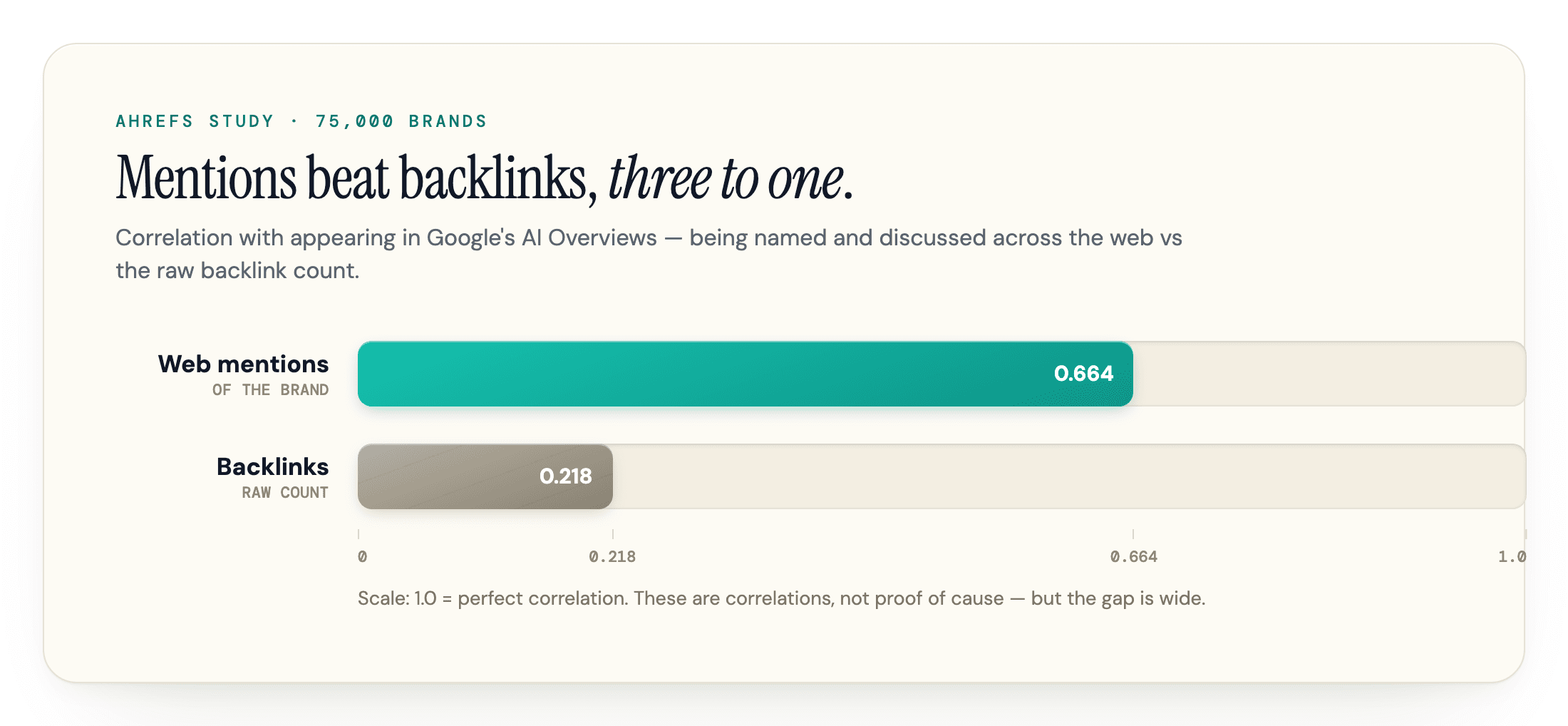
For Google's classic ranking, links are still foundational. A page with relevant, trusted backlinks tends to rank better. For AI search, the link matters less directly. Backlinks help your page get discovered and indexed, which is the precondition for an engine retrieving it at all, but they are not the thing that gets you quoted. That is a step beyond the link itself.
The data is worth being precise about. Ahrefs studied 75,000 brands and measured what correlated with showing up in Google's AI Overviews. Web mentions of the brand correlated at 0.664; backlinks at 0.218, per the Ahrefs brand-mentions study. Both are correlations, not proof of cause, and Ahrefs says as much. But the gap is wide: being mentioned, named, and discussed across the web correlated with AI visibility roughly three times as strongly as the raw backlink count. Taken alone, that means links by themselves barely move AI citations, which is true. What moves them is the work behind a good link: the relevance, the relationships, the reason a real site chose to link to you in the first place. Semrush's study of the most-cited domains in AI answers points the same way, with community and editorial sources like Reddit ranking among the most-cited domains across engines.
That is good news for anyone still building links. The work that earns a strong editorial link (a useful resource, original data, a genuine relationship with a publisher) is the same work that earns a brand mention and an AI citation. A guest post on a relevant industry site builds a link and puts your name in front of the model that later answers a buyer's question. A digital PR campaign earns a backlink and a sentence of context that an engine can quote.
So the platform you choose should be judged on whether it produces that kind of link, the kind tied to a real publisher and a real audience, or just a URL on a page nobody reads. The cheap end of the marketplace world fails that test. Digital PR passes it easily. Most of this guide is about telling those apart, because the trust signals that make content citable and the entity signals AI engines use to understand your brand are downstream of the same relevance-first link work, not separate from it.
Backlink Research and Monitoring Tools
Start here even if you never plan to buy a link. Research tools tell you who links to your competitors, which of their pages earn the most links, and what is worth chasing. Every other category works better when you point it at targets these tools surfaced.
Ahrefs and Semrush are the two that matter. Ahrefs is the backlink specialist of the pair, with one of the freshest, broadest indexes and the cleanest workflow for finding prospects: pull a competitor's referring domains, filter by traffic and relevance, and export a target list. Its link building guide is also the reference most practitioners learned from. Semrush bundles backlink data into a wider suite, so if you already pay for it for keywords and rank tracking, its Backlink Gap and Link Building tools cover most of the same ground without a second subscription. For a full head-to-head on their keyword and backlink data using real first-party numbers, see our Semrush vs Ahrefs comparison.
This category also covers backlink monitoring tools, the narrower job of watching your own profile: which links you gained, which went missing, and whether a toxic batch appeared overnight. Most monitoring lives inside Ahrefs and Semrush, with cheaper standalone options like Linkody and Monitor Backlinks for teams that only need the watch function.
Skip a dedicated research tool if you are buying a handful of links a year through a managed service: a $100-plus monthly subscription to audit them is overkill. Ask the vendor for the metrics and spend the money on the placement instead. Research tools earn their keep when you run outreach yourself and need a steady supply of vetted prospects.
Outreach and Prospecting Platforms
This is where most real link building happens: you find sites worth a link, identify the right person, and pitch them something they actually want. Two layers of software support it.
The outreach layer manages campaigns. Pitchbox is the enterprise standard, built for agencies running hundreds of sequences with team reporting, and priced accordingly. Respona pairs outreach with built-in prospecting and is the common pick for content-led teams. BuzzStream is the long-running option for smaller teams that want a CRM for relationships without enterprise pricing. None of these are wrong; they differ mostly on scale and budget. For teams that want outreach folded into a broader sales-style cadence, Postaga and Instantly handle campaign automation and deliverability at a lower entry price.
The prospecting layer finds the contact. Hunter is the best-known email finder: drop in a domain and it returns verified addresses with a confidence score. Snov.io does the same job and adds a built-in drip sequencer, so a solo SEO can prospect and send from one tool instead of stitching two together.
Cold outreach reply rates are low, and no tool changes that. A well-targeted, genuinely useful pitch to a relevant site might land a handful of links per hundred sends, and a generic one lands close to zero. Software does not fix a weak pitch or an irrelevant target; it just lets you send more of them faster. That is exactly why the research step comes first.
Who should skip the outreach stack. If you cannot commit time to writing pitches and following up, do not buy outreach software, because it only multiplies effort you are putting in. A marketplace or a managed service will get you links with far less of your own labor. Outreach platforms pay off for teams that treat link building as an ongoing process, not a one-time purchase.
Link Marketplaces
A link marketplace is a catalog of publishers willing to host a paid post. You filter by domain rating, topic, traffic, and price, place an order, and a placement appears. It is the fastest way to get a link and the easiest place to waste money.
Collaborator is one of the larger transparent marketplaces, with metrics shown per publisher and traffic data attached to each listing. Adsy and Getfluence cover overlapping inventory, with Getfluence leaning toward larger, premium media placements. WhitePress rounds out the category. Most marketplaces sell two products: a fresh guest post written around your link, or a niche edit, also called a link insertion, where your link is added to an article already published. Niche edits look more natural but give you less say over the surrounding context. Either way, the platform is just software; the quality of any single link is on you.
The numbers explain why vetting is not optional. A study of more than 400,000 link-selling sites by Link-Finder put the global median at $180 per backlink, with a wide spread by market: a French site runs around $87, while a German one is closer to $430. The same study found that 42.2% of the sites selling links had zero organic traffic, and only 6.5% had a domain rating above 60. Most of what a marketplace will sell you sits on a site few real people visit, which does little for ranking and less for AI citation.
Quality is only one of two axes, though, and the second one catches people out. Buying a link that passes ranking signal violates Google's link spam policy regardless of how good the site is. A paid dofollow link from a high-traffic, perfectly relevant publisher is still a policy violation; the compliant version carries a rel="sponsored" or rel="nofollow" attribute and is not meant to pass ranking credit. Marketplaces sell dofollow placements anyway, which is the risk you accept when you buy one. A single bought link is already a violation, but what tends to trigger an actual penalty is volume and velocity: bulk dofollow orders month after month, over-optimized anchor text, or links from a private blog network (PBN), the highest-risk source of all. A few placements from genuinely relevant, trafficked sites are a milder risk than that, but they are not a compliant one, and it is worth being honest with yourself about which you are doing.
Who should skip marketplaces. If you cannot read a backlink profile and judge whether a site's traffic and metrics are real, do not buy from a marketplace yet, because you will overpay for links that hurt you. Learn to vet first (the checklist is further down), or buy through a managed service that vets for you.
Reactive PR and Journalist-Request Platforms
This is the most underused category, and the cheapest way to earn the kind of editorial mention the AI data rewards. Journalist-request platforms send out reporter queries; you answer with a quote, and if the journalist uses it, you earn a mention and often a link in a real publication. No payment to the publisher, no policy risk, and the placement is genuinely editorial.
The landscape shifted recently, so the names matter. HARO, the original, was folded into Cision's Connectively and then discontinued in December 2024; a version reopened under the HARO name in 2025, though many users report it is now flooded with AI-generated answers and thin on quality control. The platforms worth your time now are Qwoted, which verifies both journalists and sources, and Featured (formerly Terkel), which runs structured expert questions. Source of Sources is a free option that filled part of the HARO gap.
The catch is effort, not money. Winning a placement means writing a genuinely useful, specific answer fast, and most of your responses will go unused. But a single mention in a publication a reporter trusts does more for both your authority and your AI visibility than a stack of bought links, which is why this category punches well above its price.
This category is wrong for you if you cannot turn around a sharp, quotable answer within a few hours of a query landing, because the response rate will frustrate you. It rewards subject-matter experts who can write, not teams that want to outsource and forget.
Managed Services and Digital PR
When you have budget but no time, you outsource the whole process. This category runs from white-label link building services that resell placements to full digital PR agencies that earn coverage in real publications. The price range is wide, and so is the quality, so the same vetting rules apply, just aimed at the vendor instead of the link.
Two sub-types are worth separating. Blogger outreach and guest posting services handle volume: they pitch and place posts on relevant blogs, often reselling marketplace inventory with a markup. Digital PR is the higher end, and it is the category that matters most for AI visibility. A PR campaign earns editorial mentions in the press, the kind of trusted, talked-about coverage that correlated most strongly with showing up in AI answers in the Ahrefs data above. Tools like Brand24 and Prowly support that work by tracking mentions and managing media relationships, so you can see which placements actually generated coverage and conversation.
The trade-off between doing this yourself and hiring out is the same one we cover in hire an agency or use a tool. A managed service buys back your time and, with a good vendor, applies vetting you might not have. A bad one resells the same zero-traffic marketplace links at triple the price and reports on domain rating alone.
Who should skip managed services. If your budget is under a few hundred dollars a month, you cannot buy quality digital PR, and the cheap "managed" packages at that price are usually bulk marketplace links with a dashboard. Either build links yourself with the outreach stack above, or save until you can afford a vendor whose placements you would be proud to show a client.
How to Vet a Link Building Platform Before You Pay
Whatever category you choose, the same checks separate a link worth having from one that wastes money or earns a penalty. Run a site or a vendor through these before you spend.
- Check organic traffic, not just domain rating. Domain rating is easy to inflate. Pull the site in a research tool and confirm it gets steady organic search traffic to relevant pages. The Link-Finder data found 42% of link-selling sites have none, and a site no one visits is rarely worth a link whatever its rating says. The exception is a genuinely authoritative low-traffic site, a trade body or a university page, where relevance carries the value.
- Confirm topical and audience relevance. A link from a site your buyers might actually read carries more weight, for both Google and AI engines, than a high-rating link from an unrelated niche. Relevance is the signal that builds topical authority.
- Cross-check the metrics for manipulation. Compare the domain rating against an independent measure like Majestic's Trust Flow versus Citation Flow, and look at the ratio of referring domains to total backlinks. A site with a strong score but a thin, spiky, or redirect-fed link profile has been gamed. Genuine authority looks gradual and broad.
- Demand placement proof and reporting. A credible vendor shows you the live URLs. If a service guarantees rankings, will not name the sites, or reports only "DR 50+ links delivered," walk away.
- Watch the link attributes and velocity. Know whether links are dofollow or carry
rel="sponsored", and avoid any pattern that adds dozens of dofollow links a week. Sudden velocity from low-quality sources is the classic penalty trigger.
In our experience, the platforms that survive this checklist are the ones backed by a trafficked site and a genuine readership. The ones that fail it are usually the cheapest, the fastest, and the most aggressively marketed, which is exactly why the checklist exists.
Which Platform Should You Actually Use?
Pick by the bottleneck you are stuck at. Which tool tops a generic list is beside the point.
You need to find prospects and contacts. Start with a research tool to build target lists, then a prospecting tool like Hunter or Snov.io for verified emails. This is the cheapest stack and the right starting point for most in-house SEOs.
You are sending pitches and losing track. Add outreach software. Solo or small team, BuzzStream or Postaga; agency scale, Pitchbox or Respona. The tool is for managing volume, so only buy it once you have the volume to manage.
You want links without the labor. Go to a marketplace like Collaborator for listings you can filter and vet yourself, or Adsy for broader inventory, and run every one through the checklist above. Speed in exchange for doing your own quality control.
You want authority and AI citations. Start with journalist platforms like Qwoted or Featured for editorial mentions on a budget, then move up to digital PR when you can fund it. These are the slowest routes and the ones most likely to earn the brand mentions that get you quoted in AI answers. They are also, telling enough, the categories with the least software to sell you: the highest-value link work is mostly skill and relationships, not a subscription, which is why the affiliate-heavy roundups tend to skip past it.
Most teams end up with a small stack across two categories: a research tool plus one acquisition method that fits their time and budget. Resist buying one of everything. The same discipline applies to the writing side, where a focused set of content optimization tools beats a drawer full of overlapping subscriptions.
Measuring Whether Your Links Earn AI Citations
Here is the gap most link-building platforms still leave open. They help you build or buy links, and a research tool will tell you the links exist. What they will not show you is whether that work changed what AI engines actually say about your brand. The bigger suites have started adding AI-visibility tracking, but tying a specific link campaign to a movement in AI answers is still mostly guesswork.
That is the metric that now matters. If the point of a relevant, trusted link is to get your brand into the answers ChatGPT, Perplexity, and Google's AI Overviews hand your buyers, then the result you track is your AI citation rate, and learning how to track AI visibility is its own job, separate from building the links. A campaign that adds twenty links but never moves your presence in AI answers spent its budget on the wrong kind of link.
This is the loop geotoolbox is built around. We track where your brand shows up across the major AI engines, so you can watch a digital PR push or a batch of placements against a real change in AI share of voice instead of guessing. It is the same reason a focused set of GEO tools belongs next to your link building stack: building the links is half the job, and proving they earned you citations is the half everyone skips.
The Short Version
Stop shopping for "the best link building platform." Decide which job you are stuck on, pick the category that fits it, and judge any tool, marketplace, or agency on whether it produces links a real audience actually sees. That is the kind of link most likely to support a Google ranking and an AI citation alike.
Then close the loop. If you are spending on links to win the AI answers your buyers now read, measure that. See where your brand currently shows up across the engines with the free AI readiness check, then track whether your link work moves the needle in geotoolbox's Domain Overview. Building links you cannot measure is how budgets disappear; building links you can tie to citations is how you prove the work.
Frequently Asked Questions
Are link building services worth it in 2026, or am I just paying for garbage?
They are worth it only if you vet what you buy. The Link-Finder study found 42% of link-selling sites have zero organic traffic, so most cheap packages are close to worthless. A handful of relevant, trafficked placements beats a bulk order of fifty every time, and that is the difference between a service worth paying for and one to avoid.
How much should I pay for a backlink?
The global median is around $180 per link, with a wide spread by market and quality. Price should track the site's real organic traffic and topical relevance, not its domain rating, which is easy to inflate. If a link costs $30 and the site has no traffic, you are paying for a number on a dashboard.
Is buying backlinks against Google's guidelines?
Buying links that pass ranking signal violates Google's link spam policy, and paid placements are supposed to carry a rel="sponsored" or rel="nofollow" attribute. Enforcement is uneven, but the risk is real. Bulk-buying dofollow links at high velocity is the pattern that gets sites penalized, not the occasional vetted placement.
Do backlinks still matter for AI search like ChatGPT and Perplexity?
Yes, but indirectly. Backlinks help your page get discovered and indexed, while brand mentions correlated about three times as strongly as backlinks with showing up in Google's AI Overviews in Ahrefs's 75,000-brand study. The same relevance-first work earns both the link and the citation.
What is the difference between a link building tool, a marketplace, and a service?
A tool helps you find, manage, or analyze links yourself. A marketplace sells you placements you buy directly from listed publishers. A service does the whole job for you, from outreach to placement. Cost and hands-off convenience rise as you move from tool to marketplace to service.
How can I tell if a backlink is good quality before I buy it?
Check that the site gets real organic search traffic to relevant pages, confirm topical relevance to your niche, and cross-check its domain rating against trust and citation flow for signs of manipulation. Then demand a live placement URL, not just a promised metric. No traffic or no transparency means skip it.
Sources
- Ahrefs, brand mentions vs backlinks correlation with AI Overviews (75,000 brands) -
ahrefs.com/blog/ai-overview-brand-correlation - Ahrefs, Link Building for SEO: The Beginner's Guide -
ahrefs.com/seo/link-building - Google Search Central, spam policies (link spam and paid links) -
developers.google.com/search/docs/essentials/spam-policies - Semrush, the most-cited domains in AI answers -
semrush.com/blog/most-cited-domains-ai - Link-Finder, backlink pricing study (400,000+ sites) -
link-finder.net/link-building-services