
More of your buyers now start their research with ChatGPT or Perplexity than with Google, and if you are not in those answers, you are not on the shortlist. Demand for AI SEO agencies has grown to match. This guide sorts the credible ones by the job they are best at, then shows you something most agency-written lists will not: how to pressure-test any firm's citation claims yourself, and when hiring one is the wrong move.
One disclosure up front. We are geotoolbox, an AI visibility tracker with a small GEO service, so we are on this list too, in last place, with a real drawback spelled out. Fair warning while you read: this guide often lands on "measure first, and a tool may be enough," and tracking is what we sell, so weigh the advice against how self-limiting it turns out to be. The rest is the whole picture with the hype removed.
What an AI SEO Agency Actually Does
An AI SEO agency helps your brand show up when people ask ChatGPT, Perplexity, Google's AI Overviews, or Gemini for a recommendation. The job title changes depending on who you ask. Some call themselves a GEO agency (generative engine optimization), some an answer engine optimization agency, some an LLM SEO agency. Across the AI engines we tested for this guide (ChatGPT, Perplexity, Gemini, and Google's AI Overviews, queried in July 2026), those terms describe the same job.
The demand behind this is real, not hype. In G2's 2026 research, 51% of B2B software buyers now start their research with an AI assistant rather than Google, up from 29% a year earlier, and one in three ended up buying from a vendor they had not previously heard of. Yet CommonMind found that while 93% of B2B SaaS marketers call AI visibility critically important, only 14% report a mature, documented strategy for it. That gap between urgency and readiness is the market these agencies serve.
The work itself has shifted. Traditional SEO chases a ranking. AI SEO chases a mention: being the source an AI names, cites, or recommends inside its answer. That is a different target, and it needs a different set of deliverables.
A real AI SEO engagement usually spans the following:
- An AI visibility audit and ongoing monitoring across each engine, not a single snapshot
- Content restructured for extraction, so an answer-first passage can be lifted cleanly into a generated response
- Entity and schema work, so models can connect your brand to the right topics and facts
- Topical authority, the same depth-and-coverage play SEO has always rewarded
- Digital PR and third-party citations, because models weight what other sites say about you
- Prompt-level tracking, measuring a frozen set of buyer questions on a schedule
One point every engine agreed on: GEO complements traditional SEO, it does not replace it. AI systems still pull from the web index, so crawlability, structured data, and content quality remain the foundation. If you want the terms straight, our explainer on GEO vs AEO vs SEO untangles them. The rest of this guide covers who does this work well, what it costs, and how to check that any agency's claims are real before you sign.
Is "AI SEO" Just Rebranded SEO? An Honest Answer
If you have spent five minutes in a marketing forum, you have seen the accusation: AI SEO is old SEO with a find-and-replace on the sales deck. It is worth taking seriously, because it is partly true.
The fundamentals have not moved. Google's own guidance is blunt that there is no secret trick for AI features. The same helpful content, structured data, and crawlable pages that won rankings are what make you eligible to be cited. An agency that sells you a brand-new "AI methodology" while ignoring your technical foundation is selling you a label.
But the work on top of that foundation is genuinely new, and the data shows why. In Ahrefs' study of 863K keywords, the share of AI Overview citations coming from top-10-ranked pages fell from 76% in July 2025 to 38% eight months later. Ranking in the top 10 no longer guarantees you get cited. Being cited now depends on how a passage reads to a model, whether your entity is clear, and whether other sources corroborate you, none of which a rank-tracking dashboard measures.
It is worth keeping the hype in check from the other direction too. In 6sense's 2025 Buyer Experience Report, nearly all buyers used AI models during the journey, but mostly to summarize and organize research, not to replace it, and they still averaged around sixteen interactions with the vendor they chose. AI is reshaping how buyers discover and shortlist, not vaporizing the rest of the funnel. An agency selling you a world where AI does everything is overselling as badly as one pretending nothing changed.
So the short answer: the base is SEO, and the new layer is real. A legitimate agency respects both. A repackaged one charges for the rename. One piece of the new layer that most teams miss entirely is reachability, whether AI crawlers can even fetch your pages, which we cover in our guide to AI crawlers.
How We Ranked These Agencies (and Why There Is No Single "#1")
One note on method, since this category is full of lists that hide theirs. We are on this list ourselves (disclosed above), in last place, with a real drawback, and not first.
We deliberately do not assign a composite score out of 50 or 100. When we ran the same buyer prompts across ChatGPT, Perplexity, Gemini, and Google's AI Overviews in July 2026, each engine cited a materially different set of agencies. A single blended number would paper over that variance and imply a precision that does not exist. It is also the exact move that makes most "best agency" scorecards untrustworthy: the author sets the criteria, then wins its own contest.
That matters because the category is noisy. When we looked at the wider pool of content ranking and being cited for this query, most of it was agency-owned blog posts and a scattering of low-authority content farms, with few genuinely independent sources. The incentive to publish a self-flattering roundup is enormous, and buyers have caught on, which is why many now assume these lists are seeded until proven otherwise. We would rather earn the opposite assumption.
One signal did hold up. Across those July 2026 runs, iPullRank was the one agency that showed up consistently across more than one engine. Everyone else moved around depending on which model we asked, which is itself the lesson: there is no universal leaderboard, only a best fit for your segment and budget.
Instead of a score, we weighed several things: whether a firm actually surfaced across the engines when we ran the prompts; whether its claimed strengths held up across the other agency roundups we cross-checked, not just its own marketing; how it fares against the pain points real buyers report in communities; and which segment it genuinely fits. Where a firm is strong in one lane and weak in another, we say so in the "watch for" instead of averaging it into a misleading total.
So we have sorted the list by job, given each firm a plain verdict, and flagged what to watch. Treat it as a shortlist to pressure-test, not a leaderboard.
The Best AI SEO Agencies in 2026, by Use Case
| Agency | Best for | Pricing model | Watch for |
|---|---|---|---|
| iPullRank | Enterprise technical GEO | Retainer, ~$12k+/mo | Enterprise-only floor |
| Onely | Enterprise, full-journey GEO | Retainer, ~$10k+/mo | Not built for SMB budgets |
| Omniscient Digital | B2B SaaS content-led growth | Retainer | Content-first, lighter on technical |
| First Page Sage | Thought-leadership GEO | Retainer | Fintech-leaning; check vertical fit |
| Siege Media | Content and digital PR that earns citations | Retainer, from ~$11k/mo | Light on technical GEO |
| Seer Interactive | Data and analytics-driven SEO | Hourly / project, $10k+ min | Integrated shop, not an AI specialist |
| Tinuiti | Enterprise full-funnel performance | Custom / enterprise | AI sits inside a broad program |
| Single Grain | Growth-stage, multi-channel | Retainer, $10k+ min | Generalist breadth over GEO depth |
| Searchbloom | Mid-market, flexible terms | Retainer | Ranks itself #1 on its own list |
| Optimist | B2B SaaS specialists | Roadmap from $7.5k; retainer from $3k/mo | Narrow ICP ($10M-$500M ARR) |
| Coalition Technologies | Ecommerce and broad-market | Retainer | Self-claims "#1"; generalist |
| geotoolbox | Measurement-first, verify before you buy | $925 audit; retainer from $3,500/mo | Small, founder-led; not enterprise full-service |
A note on the price figures below: they are floors as published by each firm or reported in the roundups we cite, not quotes. Treat them as starting points and confirm on your own call.
iPullRank - best for enterprise technical GEO
The one name that held up across more than one AI engine in our tests. iPullRank built its reputation on deep technical SEO and now frames AI work as "relevance engineering," the retrieval-layer craft of making content extractable and entities unambiguous. If you run a large, complex site and your blocker is architecture rather than blog volume, this is the strongest fit. Watch for the price: this is an enterprise engagement, typically starting around $12,000 a month, and the AI-specific practice is newer than the technical SEO it rests on.
Onely - best for enterprise, full-journey GEO
Onely (which surfaced in Google's AI Overview for this query when we checked) pairs technical execution with mapping the full customer journey rather than isolated keywords. Good for enterprise brands that want one partner across discovery to conversion. The same caveat as iPullRank applies: pricing starts around $10,000 a month, so it is not built for a small-business budget.
Omniscient Digital - best for B2B SaaS content-led growth
If your growth model is content and your buyers are other businesses, Omniscient has the case studies, including large organic gains for SaaS brands. Their strength is editorial depth and topical authority, which travels well into AI citations. Watch for the flip side: it leans content-first, so pair it with technical help if your foundation needs work.
First Page Sage - best for thought-leadership GEO
First Page Sage leans into authority and thought leadership as the engine for citations, and it shows up in AI answers for exactly that positioning. Strong if you sell on expertise, particularly in finance-adjacent categories. Watch for vertical fit: the playbook is tuned for B2B authority plays and is a weaker match for transactional or local businesses.
Siege Media - best for content and digital PR that earns citations
Siege is a content and link machine, and in an AI world those earned mentions on third-party sites are exactly what models weigh. If your gap is off-site authority and citations, this is a proven pick. Watch for the balance: Siege leans content and PR over the technical and entity side of GEO, so it works best when your site fundamentals are already solid. Engagements commonly start around $11,000 a month.
Seer Interactive - best for data and analytics-driven SEO
Seer is an analytics-first agency that folds GEO into a broader, measurement-heavy practice. A good fit for data-mature teams that want AI search inside a rigorous reporting culture. Watch for specialization: Seer is a full-service shop, not an AI-only boutique, so if you need a dedicated GEO team, ask exactly who does that work.
Tinuiti - best for enterprise full-funnel performance
Tinuiti is one of the largest independent performance agencies, best known for managing media and organic together at scale for retail and consumer brands. AI search sits inside that full-funnel offering rather than standing alone. The fit is enterprise brands that want AI visibility managed alongside paid, by a team that already handles their broader marketing. Watch for scale: a boutique GEO problem can get lost inside a program this broad, so make sure the AI scope is named explicitly in the contract and someone owns it.
Single Grain - best for growth-stage, multi-channel teams
Single Grain wraps SEO and content into a wider growth program, pairing organic with paid and content strategy, which suits growth-stage companies that want several channels under one roof and one point of contact. Watch for depth: breadth is the selling point, so if GEO is your single most important problem, a dedicated specialist will likely go deeper than a generalist juggling four channels.
Searchbloom - best for mid-market with flexible terms
Searchbloom is a well-reviewed mid-market SEO shop with a documented framework and flexible engagement terms, which lowers the risk of a long lock-in. Watch for the obvious, which to its credit Searchbloom flags itself: it publishes its own "best AI SEO companies" list that ranks Searchbloom first, and says so openly on the page. The work looks solid; read that self-ranking the same way you should read this one.
Optimist - best for B2B SaaS specialists
Optimist is narrowly focused on B2B SaaS and is unusually transparent about pricing, publishing a roadmap fee and month-to-month retainers rather than hiding everything behind a call. It reports strong LLM-referral results for software clients. Watch for the ICP: the model is tuned for SaaS companies in a specific revenue band, so it is a weaker fit outside that lane.
Coalition Technologies - best for ecommerce and broad-market
Coalition runs a productized AI SEO and GEO offering with a large case-study library and strong ecommerce experience. Watch for the marketing: Coalition describes itself, in its own page metadata, as "the #1 AI SEO (GEO) agency," which is a self-made claim, not a measurement or a third-party award. Treat it as a capable generalist and verify the specifics for your niche.
geotoolbox - best for measurement-first buyers who want to verify before they buy
Full disclosure, this is us. geotoolbox is an AI visibility tracker with a small, founder-led done-for-you service. Our angle is measurement: we start with a fixed-price AI visibility audit at $925 — below the $1,000-to-$10,000 one-off-audit band later in this guide — so you can see where you actually stand across engines before committing to anything ongoing, and our free tools let you run the baseline yourself. The retainer, from $3,500 a month, is one of the two lowest published figures on this list, because the tracker does the measurement work a larger team bills hours for. Watch for a couple of real limits. We are the newest and smallest name here, with the thinnest public case-study record. And we sell a tracker, so we have a standing incentive to point you toward ongoing measurement, which is exactly why we tell you to run the baseline yourself first. We also left ourselves out of the cross-engine test above, since scoring ourselves on our own list would prove nothing, and we are only one of many small, founder-led GEO shops that could sit in this lane. If you need an enterprise full-service team or a big content-production engine, several firms above are a better fit, and we will say so.
What AI SEO Agencies Cost in 2026
Few agencies publish rates, so buyers get quoted anything from under $1,000 to $50,000 a month with no anchor. Here is the range we saw hold up across several agency pricing guides and our own engine research.
| Engagement | Typical cost | What it buys | Time to results |
|---|---|---|---|
| One-off audit | $1,000-$10,000 (one-time) | Baseline across engines, gap analysis, roadmap | Days |
| Small / local | $1,000-$5,000 | Technical fixes, schema, a few optimized pages | Citations in 2-4 weeks |
| Mid-market | $5,000-$12,000 | Full stack: content, entity, digital PR, per-engine tracking | Movement in 3-6 months |
| Enterprise | $12,000-$50,000+ | Technical depth at scale, multi-team programs | Revenue impact 6-12 months |
| Freelancer | $75-$150/hr or $1,500-$4,000/mo | One specialist, narrower scope | Varies with capacity |
| In-house hire | $70,000-$110,000/yr + tools | Full control, dedicated focus | Slow to hire, then ongoing |
A couple of numbers are worth committing to memory. If you already pay for SEO, bolting GEO onto that retainer commonly runs a 20-30% uplift rather than a second full invoice, though scoped add-ons run higher, so ask what a bigger delta actually buys. And on the low end, Searchbloom treats anything under roughly $1,000 a month as a warning sign, usually thin, automated work rather than real strategy.
If you are wondering why two agencies quote wildly different numbers for the same brief, it comes down to a few cost drivers: how many pages you need optimized, whether new content creation is included or just optimization of existing pages, how much off-site citation and digital PR work is in scope, and how deep the entity and technical work goes. A quote is really a scope, so compare what each price actually buys, line by line, not the headline figure. Two "$5,000 a month" proposals can describe completely different amounts of work.
The timelines matter as much as the price. Technical fixes can produce citation pickup within a few weeks, but meaningful movement takes 3 to 6 months, and revenue impact 6 to 12. Any agency promising full results much faster than that is overpromising. A sensible way to de-risk the spend is to start with a one-off audit rather than a twelve-month retainer, so you buy a baseline before you buy a commitment.
There is also an ongoing-cost reality that pricing pages gloss over: AI citations tend to be less durable than a hard-won ranking. Models favor fresh sources, so a page that earns citations can quietly slide out of answers over the following months if nothing keeps it current. Part of any retainer therefore goes to defending citations you already have, not just earning new ones. That is normal, but it is worth asking an agency to split those out, so you know how much of your spend is maintenance rather than growth.
How to Verify an Agency's Results Yourself (The 20-Minute Test)
Here is the part few agency-written listicles will teach you, because it lets you check their work. You do not need to take a citation screenshot on faith. You can reproduce any agency's core claim yourself, before or during an engagement, and the quick version takes about twenty minutes.
The trap is that AI answers are non-deterministic. Ask ChatGPT the same question twice and you can get different brands. That means a single screenshot proves almost nothing, and it is exactly how a weak agency cherry-picks a lucky session. The fix is to test for consistency, not for one good result.
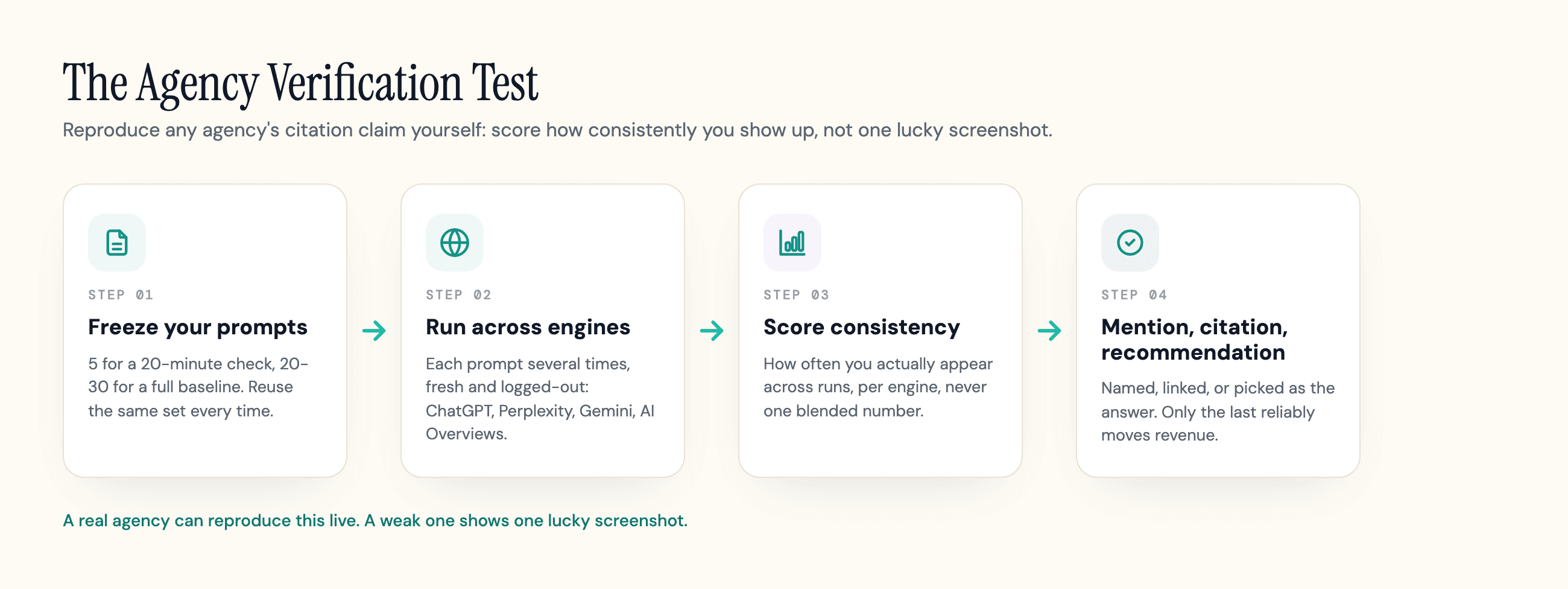
There is a fast version and a thorough one.
The 20-minute triage. Pick 5 buyer-intent prompts, the real questions a customer asks ("best [your category] for [use case]"). Run each in 3 fresh, logged-out sessions across the pair your buyers actually use, usually ChatGPT and Perplexity. That is thirty queries in about twenty minutes, enough to catch an agency showing you one lucky screenshot.
The full baseline takes about half a day, or a tracker runs it for you on a schedule. Freeze 20 to 30 prompts and run each across all of them, 3 to 5 rounds apiece: ChatGPT, Perplexity, Gemini, and Google's AI Overviews. Logged-out matters, or your own history skews the answer.
Either way, score the same things:
- How often you actually appear, not whether you appeared once. As a rough read, showing up in under a fifth of runs means you are effectively invisible, a fifth to a half is fragile, and consistent presence is the goal. Movement only counts if you measure the same prompts before and after.
- Per engine, never blended. A brand can hold real share of voice in Perplexity and be invisible in Gemini the same week, because each engine cites a different source mix. One combined number hides that spread.
- Mention, citation, or recommendation. Being named in passing is a mention. Named with a source link is a citation. Named as the answer is a recommendation, and only the last reliably moves revenue. An agency that reports "visibility went up" without saying which one moved is not telling you enough.
Whatever an agency reports should survive you re-running these prompts. If it does not, that tells you what you needed to know. You can run the triage by hand or start with our free AI Readiness check and go from there. Either way, the number is yours to reproduce, not theirs to assert.
Proving It Actually Drove Pipeline
Visibility is not the finish line, pipeline is, and AI search makes that link hard to see. Most AI referrals are effectively zero-click: someone reads a recommendation in ChatGPT, then shows up days later by typing your name into Google. So the measurement stack has to be layered, and an agency that cannot describe it is guessing.
Four signals, used together, get you close enough to brief a CFO:
- Segment AI referral traffic in GA4. Filter for
chatgpt.com,perplexity.ai, Gemini, and Copilot referrers so AI-sourced sessions stop hiding inside direct. - Add a "how did you hear about us" field to your forms. Self-reported attribution catches the zero-click journeys that no tracking script can follow.
- Watch branded search and direct traffic for lift in the weeks after your citations climb. A rise with no new campaign is often AI discovery cashing out.
- Tie your AI-bot server logs to accounts that convert. Standard analytics miss most AI bot hits because those bots do not run JavaScript, so reachability lives in the logs, not the dashboard.
No single signal is clean. Together they let you say whether the spend is working, which is more than "our visibility score went up" will ever tell you.
Red Flags: Spotting a Repackaged or Overpriced Agency
The engines we tested converged on the same warning signs, and they line up with what burned buyers say in marketing forums. Any one of these should slow you down.
- "Guaranteed rankings" or "guaranteed AI citations." No one controls a probabilistic model's output. A guarantee is a sales tactic, not a capability, and it was the most-cited red flag in our tests.
- They cannot name the platforms they monitor. If an agency says it "optimizes for AI search" but cannot tell you it tracks ChatGPT, Perplexity, Gemini, and AI Overviews separately, there is no real measurement underneath.
- Reporting that is only rankings and traffic. In a world where less than a third of searches send a click, a dashboard with no AI-specific metric is measuring the wrong thing.
- Suspiciously cheap retainers. "AI SEO" under about $1,000 a month is usually automated output with no human review, the "AI slop" buyers complain about after the fact.
- A second full retainer on top of your existing SEO. GEO layered onto SEO commonly runs a 20-30% uplift, sometimes more. Being charged for a whole second service for work that overlaps your current one is the double-billing pattern buyers describe as predatory.
- A single-screenshot case study. As the 20-minute test shows, one lucky citation is not evidence. Ask for consistency across runs.
- A "best AI SEO agency" list the agency wrote to include itself. Whether it ranks first or, like this one, discloses its own entry lower down, the incentive is the same. Buyers have started flagging these as seeded content designed to teach AI models a fake consensus. Read every self-including list, this one included, with that in mind.
- An agency that offers to build that for you. Some will sell you seeded roundups and fake-consensus content as a "citation" service. It can work briefly, but it is a brand risk that communities and platforms are actively policing, not a durable strategy.
The common thread is a firm that sells a story it will not let you check.
Questions to Ask Before You Sign
Bring these to the first call. The good answers are specific; the bad ones are vague or defensive.
- Show me a live prompt where your own agency, or a named client, appears in ChatGPT or Perplexity right now. Not a screenshot from March. A firm that does this work can reproduce it in the meeting.
- What is in this scope that is not already in my existing SEO retainer? This is the anti-double-billing question. A straight answer separates a real add-on from a rename.
- Do you report per engine, or as one blended score? The right answer is per engine, because the source mixes differ. A single number is a warning.
- Do you track mentions and citations separately? Being named and being linked are different outcomes. An agency that conflates them is not measuring carefully.
- Give me a first-90-days plan, and a named condition under which you would tell me it is not working. A willingness to define failure is the strongest signal of an honest partner.
- How do you track which AI bots actually crawl my pages? Standard analytics miss most AI bot traffic because those bots do not run JavaScript, so this needs server or edge-level logging. If they have not thought about it, they are guessing at reachability.
- How much of the monthly retainer defends existing citations versus earning new ones? AI citations decay as content ages, so maintenance is real work. A firm that has an answer has been doing this long enough to have seen the decay.
- What are the terms: minimum commitment, notice period, and who owns the prompt set, tracking data, and content if we part ways? This is where lock-in hides. You want to leave with your data and your pages, not start over.
This is the diligence the category now demands.
When You Should Not Hire an AI SEO Agency
Few agency-authored lists include this section, because every quote is a yes. Here are the cases where the answer is not yet, or not at all.
Your buyers are on Google Maps, not ChatGPT. If you run a local business and your demand is "coffee shop near me," people are still tapping the map pack, not asking an assistant for a shortlist. Spend on local SEO first. AEO can wait until your category actually gets asked about in AI.
Your technical foundation is not fixed. Paying for off-site citation building while AI crawlers cannot even reach your pages is buying the roof before the walls. Fix crawlability, structured data, and answer-first content first. That is often in-house work, and it is the layer everything else depends on.
Your category has no AI demand yet. Some niches barely surface in generative answers. Run the 20-minute test on your own buyer prompts. If no engine is returning brands like yours, there is little for an agency to optimize toward right now.
You can run the baseline and basics yourself. If your team can freeze a prompt set, fix schema, and write clear answer-first pages, you may not need a retainer at all, just a tracker to watch progress. We wrote a full breakdown of that trade-off in GEO services versus software.
You need everything, not just GEO. If organic, paid, social, and PR are all gaps, a GEO-only boutique is the wrong shape. Hire a broader team, or a specialist for the one channel that is actually holding you back.
Knowing when to walk away is worth more than any shortlist. An agency that agrees you are not ready yet is one worth remembering for when you are.
Agency, Freelancer, In-House, or a Tool
An agency is one of several ways to get this work done, and it is not always the right one.
An agency (typically $3,000 to $12,000 a month) buys breadth and a team. It fits when GEO is a real priority, your budget supports it, and you would rather manage outcomes than tasks. The risk is paying agency rates for work a single person could do.
A freelancer ($75 to $150 an hour, or a light monthly retainer) is cheaper and often just as skilled for a focused scope. The trade-off is capacity and continuity: one person gets sick, gets busy, or moves on.
An in-house hire ($70,000 to $110,000 a year plus tools) gives you control and full-time focus, which suits companies where AI visibility is a permanent, strategic channel. The cost is time: hiring a genuinely good GEO practitioner in a two-year-old field is slow.
A tool-first approach is the cheapest and the most underrated. If your team can run the baseline, fix the basics, and act on what a tracker shows, you may not need any of the above yet, just measurement. This is the path we build for at geotoolbox, and we would rather tell you to start here than sell you a retainer you are not ready for. The best AI visibility tools guide compares the trackers, and our agency-versus-software breakdown walks through the decision in more depth.
Most teams end up combining these over time: measure with a tool, hire a specialist or agency for the heavy lift, then keep watching with the tool. The order that rarely works is signing a long retainer before you have measured anything at all.
The Short Version
Choosing well in this category comes down to a few moves. Measure your baseline first, so you know where you actually stand across engines. Use the list above as a shortlist, matched to your segment and budget. Then pressure-test any pitch with the 20-minute triage and the questions above before you sign anything.
If you want a rule of thumb: an enterprise site whose blocker is technical points to iPullRank or Onely; a B2B SaaS team that grows through content points to Omniscient; an ecommerce brand points to Coalition; a buyer who wants the measurement verified before committing points to our own $925 audit; and if your budget is under a few thousand a month, do not hire yet, run the baseline yourself first. That is a starting point, not a verdict, and anyone who promises you more certainty than that is overselling.
If you want to start with the measuring, you can run the baseline yourself for free. Our AI Readiness check shows where you stand and whether AI crawlers can even reach you, which is the first thing most agencies should be fixing anyway. If you would rather have the work done for you, our founder-led GEO service is one option among the good firms above, and we will tell you if you are better served by a tool or by someone else on this list.
Frequently Asked Questions
What is an AI SEO agency?
An AI SEO agency helps your brand appear in AI-generated answers from ChatGPT, Perplexity, Google's AI Overviews, and Gemini. The terms GEO agency (generative engine optimization) and AEO agency (answer engine optimization) describe the same job. The work spans technical fixes, content restructured for extraction, entity and schema work, digital PR, and per-engine citation tracking.
How much does an AI SEO agency cost in 2026?
Retainers typically run from about $1,000 a month for small businesses to $12,000 or more for enterprise programs, with mid-market engagements around $5,000 to $12,000. One-off audits run $1,000 to $10,000. Adding GEO to an existing SEO retainer usually adds a 20-30% uplift, sometimes more. Anything under roughly $1,000 a month is generally automated work, not real strategy.
Are AI SEO agencies worth it?
It depends on your situation. An agency is worth it when AI visibility is a real priority, your buyers actually use AI to research your category, and your technical foundation is sound. It is not worth it if you are a local business whose buyers use Maps, if your site fundamentals are broken, or if your team can run the baseline and basics in-house. Measure first, then decide.
Is GEO just rebranded SEO?
Partly. The fundamentals, technical health, structured data, and content quality, are the same ones traditional SEO always rewarded, and Google's own guidance says there is no separate trick. But the new layer is real: ranking in the top 10 no longer guarantees a citation, so per-engine tracking, entity work, and answer-first content are genuinely different skills. A legitimate agency respects both; a repackaged one charges for the rename.
How do I verify an agency's AI citation claims?
Run the 20-minute triage: freeze 5 buyer-intent prompts (20 to 30 for a full baseline), run each several times in fresh, logged-out sessions across the engines your buyers use, and score how consistently your brand appears rather than trusting a single screenshot. Read the results per engine, and separate mentions, citations, and recommendations. Anything an agency reports should survive you reproducing it yourself.
Can my current SEO agency do AI SEO, or do I need a separate one?
Sometimes your current agency can, if it already does strong technical SEO and is genuinely tracking AI engines. Ask what is in the AI scope that is not already in your retainer, and whether it reports per engine. If the answer is vague or it wants a full second retainer for overlapping work, that is the double-billing pattern to avoid. A specialist is only worth it when it does something your current partner demonstrably cannot.
Sources
- G2 - The Answer Economy: 2026 AI Search Insight Report -
learn.g2.com/g2-2026-ai-search-insight-report - CommonMind - The 2026 State of AI Visibility in B2B SaaS -
commonmind.com/blog/state-of-ai-visibility-in-b2b-saas - 6sense - 2025 B2B Buyer Experience Report -
6sense.com/science-of-b2b/buyer-experience-report-2025 - Ahrefs AI Overview citation study, via Search Engine Journal -
searchenginejournal.com/google-ai-overview-citations-from-top-ranking-pages-drop-sharply/568637/ - SparkToro - Less Than a Third of Google Searches Send a Click (2026) -
sparktoro.com/blog/in-2026-less-than-one-third-of-google-searches-still-send-a-click/ - Google Search Central - AI features and your website -
developers.google.com/search/docs/appearance/ai-features - Fuel Online - AI SEO Pricing 2026 -
fuelonline.com/ai-seo-geo/ai-seo-pricing-aeo-geo-cost-2026/ - Demand Local - How to Price GEO Services -
demandlocal.com/blog/how-to-price-geo-services/ - Searchbloom - Best AI SEO Companies (pricing + red-flag threshold) -
searchbloom.com/strategy/best-ai-seo-agency-companies-services-usa/