
Is SEO dead? No. But if you are waiting for the old deal, rank number one and collect the click, that part is genuinely dying, and the numbers back up the dread you are feeling.
Search did not disappear. It split. The work of getting found is still very much alive, but the payoff is moving from the click you earn by ranking to the mention you earn by being citable. You can see the shift in the question itself: people are asking AI assistants whether SEO is dead far more than they were a year ago.
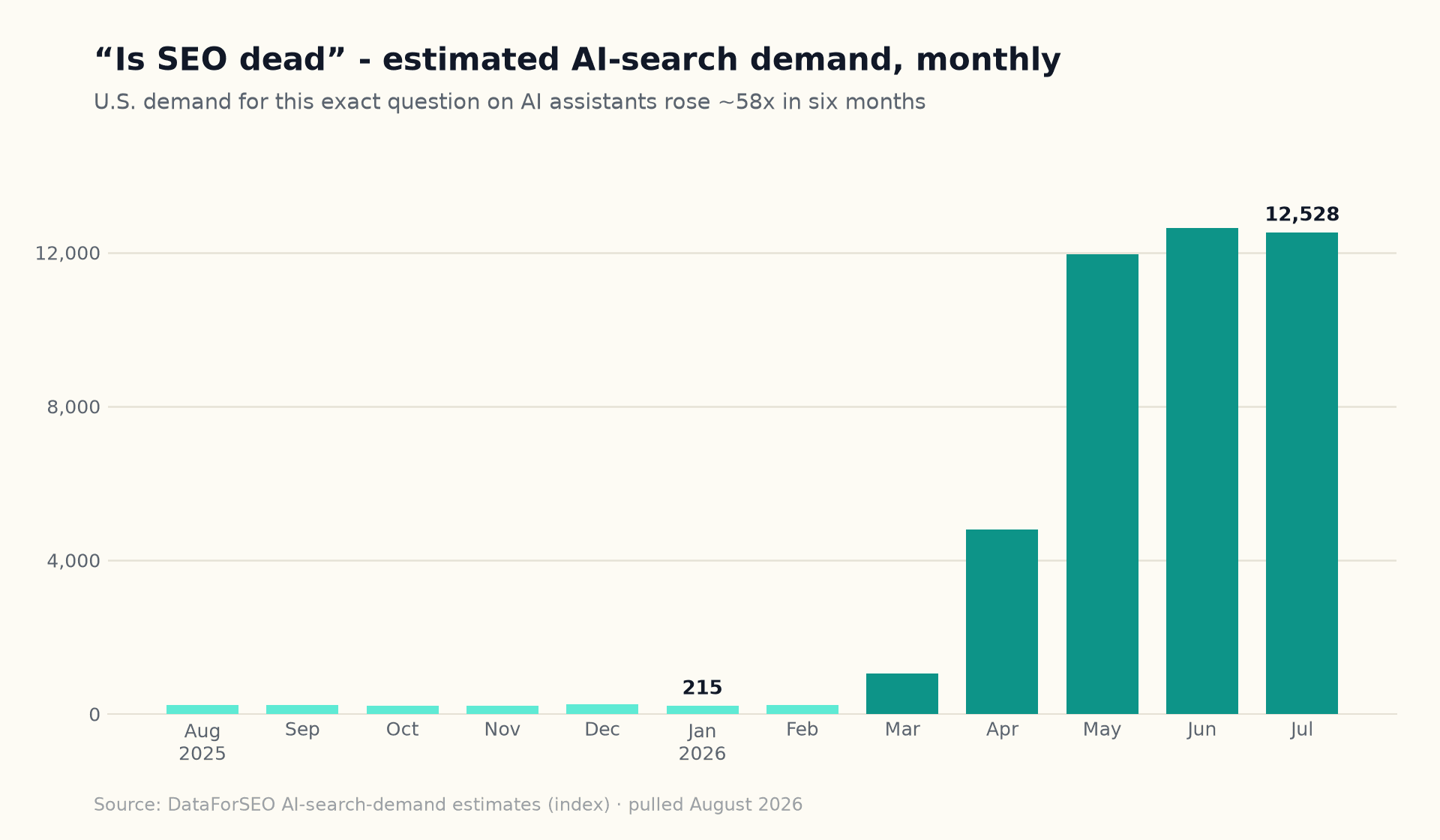
The Short Answer: SEO Isn't Dead, the Click Is
SEO is not dead. What is dying is the reflex that ranking number one hands you a click. Two things that used to move together, your position and your traffic, have come apart.
A page can sit in the top three and still lose half its clicks to an AI summary parked above it. A page that ranks nowhere near the first screen can get quoted inside an AI answer. Position and payoff have decoupled, and once you see that, most of the "SEO is dead" panic resolves into a more useful question: how do you earn attention when the click is no longer guaranteed?
The discipline is not ending; the job is changing. It is moving from "rank a page and harvest the click" to "be the source an answer engine reaches for." Generative engine optimization (GEO) is the name for that second job, and it sits on top of SEO, not in place of it. Everything below is the evidence.
Why It Feels Dead: Rankings Hold, Traffic Falls
The most common version of this complaint is not "I dropped in the rankings." It is "I am still number one and my traffic fell off a cliff anyway." That pattern is real, and if that is your situation, you are not imagining it or doing SEO wrong.
Here is what changed. When Google shows an AI summary at the top of the results, people click far less. A Pew Research Center study of 68,879 real searches, published in July 2025, found users clicked a result just 8 percent of the time when an AI summary was present, versus 15 percent when it was not, and only 1 percent clicked a link inside the summary itself. The answer is delivered on the page; the trip to your site never happens.
Zoom out and the same story holds at scale. SparkToro's 2026 analysis of US clickstream data found 68 percent of Google searches now end without a click at all, the zero-click majority. Not all of that is AI, and it is worth saying so plainly: maps, knowledge panels, ads, and on-SERP answers were eating clicks long before AI Overviews arrived. But AI summaries widened a gap that was already there.
The click-through damage is measurable. Seer Interactive's September 2025 study found organic click-through rate on queries with an AI Overview fell roughly 65 percent, from 1.76 percent in June 2024 to 0.61 percent by September 2025, close to Seer's own "cut by nearly two-thirds." So the frustration is legitimate. The click leaked out of the funnel while your ranking stayed exactly where it was, and that is a different problem than "SEO stopped working." Some operators say this feels structural rather than like a normal algorithm cycle, and on the click economics, they are right. For how these summaries pick and place sources, see our breakdown of Google AI Overviews.
What Actually Died (and What Didn't)
"SEO is dead" is too blunt. Something specific died, and confusing it for the whole discipline is what sends people into a panic. What died is commodity informational content: the page that existed only to answer a simple question a machine can now answer in one paragraph.
If your traffic came from "what is X" or a thin definition post, an AI summary now resolves that query without a click, and it is not coming back. Publishers of that kind of content report the steepest declines, some watching once-huge informational sites shrink to a fraction of their old traffic. That is the part of SEO that actually died.
What did not die is anything an answer box cannot replace. Bottom-of-funnel and transactional pages still convert, because the searcher needs to do something, not just know something. High-trust and local queries still send clicks, because a person hiring an accountant or a photographer has to vet the actual business, not read a summary about the concept. Original data, first-hand experience, and truly unreplicable content still earn attention, because a model cannot regurgitate what only you have.
| Losing ground fast | Holding or growing |
|---|---|
| Commodity "what is / how to" explainers a summary now answers | Bottom-of-funnel and transactional pages (the searcher needs to act) |
| Thin listicles and definition posts written for a snippet | Local and high-trust queries where people vet a real business |
| Keyword-density pages with no original angle | Original data, research, and first-hand experience |
| Volume-play content that only restated common knowledge | Brand and entity authority that answers get built around |
This is where the "is SEO still relevant" question actually lands. It is relevant exactly where it was always strongest: intent that ends in an action, trust that has to be earned, and information only you can provide. The commodity middle is what the machines took.
The Real Shift: Ranking No Longer Equals Being Cited
The mechanism underneath all of this is a split you can measure. Ranking and getting cited have come apart. Ahrefs' tracking of AI Overview citations found the share that also rank in Google's organic top 10 fell from about 76 percent in its July 2025 study to 38 percent in its March 2026 report. Put the other way, roughly 60 percent of the sources an AI answer now quotes sit outside the top 10, and about a third rank nowhere in the top 100.
That breaks the oldest reflex in SEO: earn authority, rank higher, collect the traffic. A Surfer analysis of roughly five million AI citations found domain authority barely correlates with being cited, close to zero across the AI surfaces it studied. Authority is not worthless. It still helps you rank, and on Google's own AI Overviews, which are built on the ranked index, ranking still feeds citation. It is on the pure-LLM surfaces, the ones that assemble answers their own way, where the old signals matter least.
There is a reason brand still counts even when domain authority does not. A page-level signal only pays off if that exact page is the one the model pulls. A brand or entity signal pays off whenever the model composes an answer about your category, because it is reaching for what it associates with the topic, not ranking a URL. The unit that gets cited is shifting from the page to the entity, which is what people mean when they say brand signals matter for AI.
You can watch the split on the query that brought you here. As of mid-August 2026, the US Google results for "is seo dead" open with an AI Overview that cites a handful of sources, including a Reddit thread that is also the number-one organic result, while a Forbes article on the first page is not cited at all. Page-one presence alone did not guarantee a citation. Community and forum pages punch well above their ranking in these answers, which says something about what the systems reach for. AI results also vary by user and shift over time, so read this as a dated snapshot, not a fixed rule.
And being cited is worth it. On informational queries, Seer's 2026 data puts a cited page at about 2.1 percent click-through against 0.9 percent when an Overview appears without citing you, its own "+120 percent" on the unrounded figures. Seer flags that the uncited figure is dragged down by one outlier account; strip it out and the gap narrows to roughly 2.1 versus 1.6 percent. Either way a cited page beats an uncited one, though both still trail the click-through those queries earn with no Overview at all. So the game is less "rank or die" than "get cited or get skipped," and that is a job you can work on.
Has the Bottom Fallen Out? The Part Nobody Reports
Almost every "SEO is dead" article ends at the cliff: click-through collapsed, the end. The data has a second chapter that rarely gets quoted.
After the initial drop, the decline stopped. In Seer's larger 2026 panel of 53 brands, click-through on AI-Overview queries bottomed near 1.3 percent in December 2025 and rebounded to about 2.4 percent by February 2026, an 85 percent jump in two months (panel-wide, across all query types, so above the informational-only figure in the last section). That panel tracks a different, larger set than the September 2025 study above, so the absolute numbers are not directly comparable. Seer calls it a leveling out at a new normal; we would put it plainly: stabilization, not a return to pre-AI baselines, since 2.4 percent still sits below the 3.8 percent those same queries earn with no Overview at all. Two months is also too little to call a durable floor.
The premise that Google itself collapsed does not hold either. StatCounter still put Google at about 91 percent of search-engine share in mid-2026. Google did not lose its grip; its own results page just started answering more queries in place. And the much-hyped replacement, direct traffic from ChatGPT and other AI assistants, is still tiny for most sites: Ahrefs measured it at 0.1 percent of referral traffic across 35,000 sites in early 2025, and 2026 estimates still put it well under one percent. It is growing fast, and much of AI's real effect shows up indirectly, as branded searches and direct visits after someone reads about you in an answer, which is exactly why the raw referral number understates it. Anyone telling you AI search already replaced Google traffic is selling something.
So both things are true at once. The click economics did get worse and are not going back to 2020, while the channel stabilizes at a new level and a second, citation-based way of getting found opens up beside it. That is not a dead discipline. It is one mid-reinvention, which is a more annoying thing to manage, because the work changed rather than ended.
So What Is Replacing SEO? The Acronyms, Defined
Ask five articles what replaces SEO and you get five answers, which is why the question feels unanswerable. Part of the confusion is that the loudest "SEO is dead" case and the "SEO evolved" case often prescribe the same thing. When Inc. columnist Joe Procopio declared SEO dead, his remedy was to build a direct audience and, echoing a Daily Mail editor he quoted, lean into branded search and unreplicable content. That is not the opposite of evolution. It is a description of it, minus the word.
It is fair to be skeptical of the vocabulary here. A lot of what gets sold as GEO is repackaged SEO with a new invoice, and some of it is snake oil. So be precise about what is actually new: the fundamentals below, crawlable pages, clear structure, real authority, a well-defined entity, are the same SEO work they always were. The work is not new. The scoreboard is. You are now optimizing to be the retrieved and cited source, not only the ranked one, and if a "GEO service" cannot tell you which of those two it is changing, it is selling you the invoice.
That is the frame for the new alphabet. None of these terms replace SEO; they are layers on that same foundation.
| Term | What it optimizes for | Where it plays | Relationship to SEO |
|---|---|---|---|
| SEO (search engine optimization) | Ranking a page so it earns the click | Google and Bing results | The foundation everything else stands on |
| GEO (generative engine optimization) | Getting cited or mentioned inside AI-generated answers | ChatGPT, Perplexity, Google AI Mode and Overviews, Gemini | A layer on top of SEO, not a swap |
| AEO (answer engine optimization) | Being the direct answer to a question | Featured snippets, voice, answer boxes, AI answers | The snippet-era ancestor of GEO |
| LLMO (large language model optimization) | Shaping how models represent your brand | The underlying models themselves | Often used interchangeably with GEO |
The short version: SEO gets you into the index an answer engine reads from; GEO is the work of being the thing it quotes. If you want the deeper taxonomy, our GEO vs AEO vs SEO breakdown is the triage page, and GEO vs SEO covers how to split a budget between the two. AEO vs SEO sets Google's own guidance against the citation studies. What none of them are is a reason to stop doing SEO. You cannot be cited from an answer engine that cannot crawl, read, and trust your page in the first place.
What Still Works, and What's Just Folklore
Most wasted GEO effort comes from confusing what actually holds up with what is folklore. The panic around "SEO is dead" has spawned a fresh crop of cargo-cult tactics, things that sound like GEO but do nothing.
Start with what genuinely moves the needle. Models favor current, correct sources, so freshness and accuracy count for more than they used to. Answer engines lift self-contained passages, which puts a premium on clear headings, direct answers, and clean schema that make a page easy to extract. The strongest signal is often off your own page entirely: getting mentioned and cited across the web does more than anything you can publish about yourself. And the basics still apply, since a fast, crawlable, trustworthy site is one a model can actually use. That last part is E-E-A-T for AI search, and it did not go anywhere.
Now the folklore. The biggest one is llms.txt, a proposed file that supposedly tells AI models how to read your site. It sounds official and takes an afternoon to feel productive about. Ahrefs checked 137,210 domains and found 97 percent of llms.txt files received zero requests in a month, and no major AI engine has committed to reading it as a retrieval or citation signal. We will say that against our own interest: geotoolbox ships llms.txt tools, and the data still says almost nobody consumes the file.
| Holds up under the data | Folklore and busywork |
|---|---|
| Freshness, accuracy, and genuinely original information | Chasing domain authority as if it buys citations (it barely correlates) |
| Extractable structure: clear headings, direct answers, clean schema | Publishing an llms.txt file and expecting AI traffic |
| Third-party mentions and digital PR (being cited elsewhere) | Keyword density and word-count targets |
| Technical health: fast, crawlable, trustworthy | More commodity content to "feed the algorithm" |
If you want the constructive version of the left column as a workflow, we wrote the step-by-step playbook for optimizing for AI search separately. The one-line summary: earn mentions, be extractable, stay accurate, and skip the rituals. For the tools that speed up the production side, we sorted the AI SEO tools by job.
Is SEO Still Worth It? The Measurement Problem
The verdict, since the title asked a yes-or-no question: yes, SEO is still worth investing in, as the foundation your AI visibility is built on, but only if you change what you measure. Keep grading the channel on rankings and raw organic clicks and it will look like it is dying, because those are the two numbers AI broke. The value moved to citations, brand mentions, and the branded searches and direct visits that follow when someone reads about you in an answer.
That is why it is so hard to defend to a boss or a board. The most painful version of "SEO is dead" is not technical, it is a marketing lead losing a budget fight because leadership read a headline. The reframe: blog clicks are down, but the brand is showing up in the answers people act on. The problem is that most teams cannot yet see that second half. Semrush's 2026 AI Visibility Index reported that 45 percent of marketing leaders cannot accurately measure their brand's visibility in AI answers, and only 9 percent have tools to track all the relevant metrics across platforms.
So change the scoreboard. When clicks go flat, these are the numbers that show whether SEO is still working.
| Measure this | What it tells you | Where to read it |
|---|---|---|
| AI citation and mention rate | Whether engines quote you, not just rank you | AI-visibility tracking; manual prompt checks |
| Branded search and direct traffic | Demand and "dark" visits created by answers you appear in | Search Console; GA4 direct and unassigned channels |
| Conversions, not clicks | Whether the traffic you keep still pays | GA4 or your CRM |
| Rank on high-intent, transactional queries | The SEO that AI has not eaten | Your rank tracker |
Two honest caveats before you build that dashboard. AI answers are nondeterministic: they change from one run to the next, by user, location, and session, so any AI-visibility number, ours included, is a sampled estimate across many checks, not a rank you look up once. And a lot of AI's effect is unattributable by design, since people read an answer, never click, and arrive later as branded or direct traffic, so expect your own numbers to undercount it.
Does the traffic that does arrive convert better? Vendors claim it does, sometimes dramatically, but no independent study has confirmed a durable multiplier, so treat those figures as marketing until someone replicates them. Be clear-eyed about the ceiling too: a doubled click-through on a cited page beats being skipped, but a citation is not a sale, and it has not been shown to pay back the way a ranked, clicked page once did. Pretending otherwise is just the old hype pointed in a new direction.
One remedy is worth naming precisely because it does not route to anything we sell: the surest hedge is to not depend entirely on Google, or on being cited at all. An owned audience, an email list, a community, a channel of your own, is the one asset an answer engine cannot sit in front of. Beyond that, the work is measurement, and full disclosure, that is also our line of business: we build tools that track AI brand mentions, so treat our conclusion with the skepticism any vendor deserves. The third-party studies here are not ours, and the takeaway would hold if we sold nothing: start instrumenting whether AI engines can reach your pages, whether they cite you, and what branded search and direct traffic do afterward. Those are the numbers that tell you SEO is working when the old ones say it is dead.
The Bottom Line
SEO is not dead. The click you used to get for free is dying, and the discipline is splitting into two jobs: ranking to earn clicks, and being citable to earn mentions. Pretending nothing changed is how you lose. So is torching a channel that still holds up wherever intent, trust, and original information live.
The next question is usually "so where do I even start?" Start by finding out whether the AI engines can see you at all, because a page a crawler cannot read is a page no answer can cite. Our free AI readiness check scans your site for the reachability and structure issues that keep you out of AI answers, and it is the fastest way to turn "is SEO dead" from a feeling into a to-do list. The obituary was premature; the job just changed.
Frequently Asked Questions
Is SEO still worth it in 2026?
Yes, as the foundation your AI visibility sits on, but only if you change what you measure. Rankings and raw organic clicks now understate SEO's value because AI Overviews absorb many clicks. The payoff has shifted to citations, brand mentions, and the branded searches and direct visits that follow, so grade the channel on those instead.
What is replacing SEO?
Nothing is replacing it; a layer is being added on top. Generative engine optimization (GEO) is the work of getting cited inside AI answers, and it depends on the same crawlable, structured, trustworthy pages that SEO produces. Answer engines cannot quote a site they cannot read, so SEO remains the foundation the newer layer stands on.
Is SEO dead now with AI?
No. What died is commodity informational content that an AI summary can now answer without a click. Bottom-of-funnel pages, local and high-trust queries, and original content still earn attention. Google also still handles over 90 percent of search, so the audience did not leave; the results page just answers more questions itself.
Will AI kill SEO?
It is changing SEO, not killing it. Click-through on AI Overview queries fell sharply, then stabilized at a lower level, while a second path to visibility, being cited in AI answers, opened alongside it. The skill set shifts toward earning mentions and being extractable, but the underlying job of getting found is very much intact.
Is SEO worth learning in 2026?
Yes, if you learn the version that is growing rather than the one that is shrinking. Chasing rankings for commodity informational content is a dead end. The durable skills are technical health, content structure, entity and brand building, digital PR, and measuring visibility across both search and AI answers, and they transfer directly into generative engine optimization. That is why the field is changing rather than closing.
Sources
- Google users are less likely to click on links when an AI summary appears - Pew Research Center, July 2025 -
pewresearch.org/short-reads/2025/07/22/google-users-are-less-likely-to-click-on-links-when-an-ai-summary-appears-in-the-results - In 2026, less than one-third of Google searches still send a click - SparkToro, June 2026 -
sparktoro.com/blog/in-2026-less-than-one-third-of-google-searches-still-send-a-click - AI Overview impact on Google CTR, September 2025 update - Seer Interactive, November 2025 -
seerinteractive.com/insights/aio-impact-on-google-ctr-september-2025-update - AI Overview impact on Google CTR, 2026 update - Seer Interactive, April 2026 -
seerinteractive.com/insights/aio-impact-on-google-ctr-2026-update - Google AI Overviews CTR shows early signs of recovery - Search Engine Land, April 2026 -
searchengineland.com/google-ai-overviews-ctr-recovery-study-475566 - Only 38% of AI Overview citations rank in the top 10 - Ahrefs, March 2026 -
ahrefs.com/blog/ai-overview-citations-top-10 - AI traffic research: how much traffic AI sends - Ahrefs, March 2025 -
ahrefs.com/blog/ai-traffic-research - llms.txt study: 97% of files got zero requests - Ahrefs, June 2026 -
ahrefs.com/blog/llmstxt-study - Domain authority and AI citations - Surfer, July 2026 -
surferseo.com/blog/domain-authority-impact-on-ai-citations - Expanded 2026 AI Visibility Index (126M prompts) - Semrush, June 2026 -
semrush.com/news/463141-semrush-releases-expanded-2026-ai-visibility-index-analyzing-126-million-ai-search-prompts - Search engine market share - StatCounter GlobalStats, 2026 -
gs.statcounter.com/search-engine-market-share - AI search-demand estimates for "is seo dead" - DataForSEO AI Optimization API, pulled August 2026 -
dataforseo.com - SEO Is Dead, According to Google - Inc. (Joe Procopio), May 2025 -
inc.com/joe-procopio/seo-is-dead-according-to-google/91193051