
Search engine optimization (SEO), generative engine optimization (GEO), and answer engine optimization (AEO) are not three competing strategies. They are the same core job aimed at different surfaces: SEO gets you ranked, AEO gets you picked as the direct answer, and GEO gets you cited inside an AI's response. Most of the work behind all three is shared.
SEO vs GEO vs AEO at a Glance
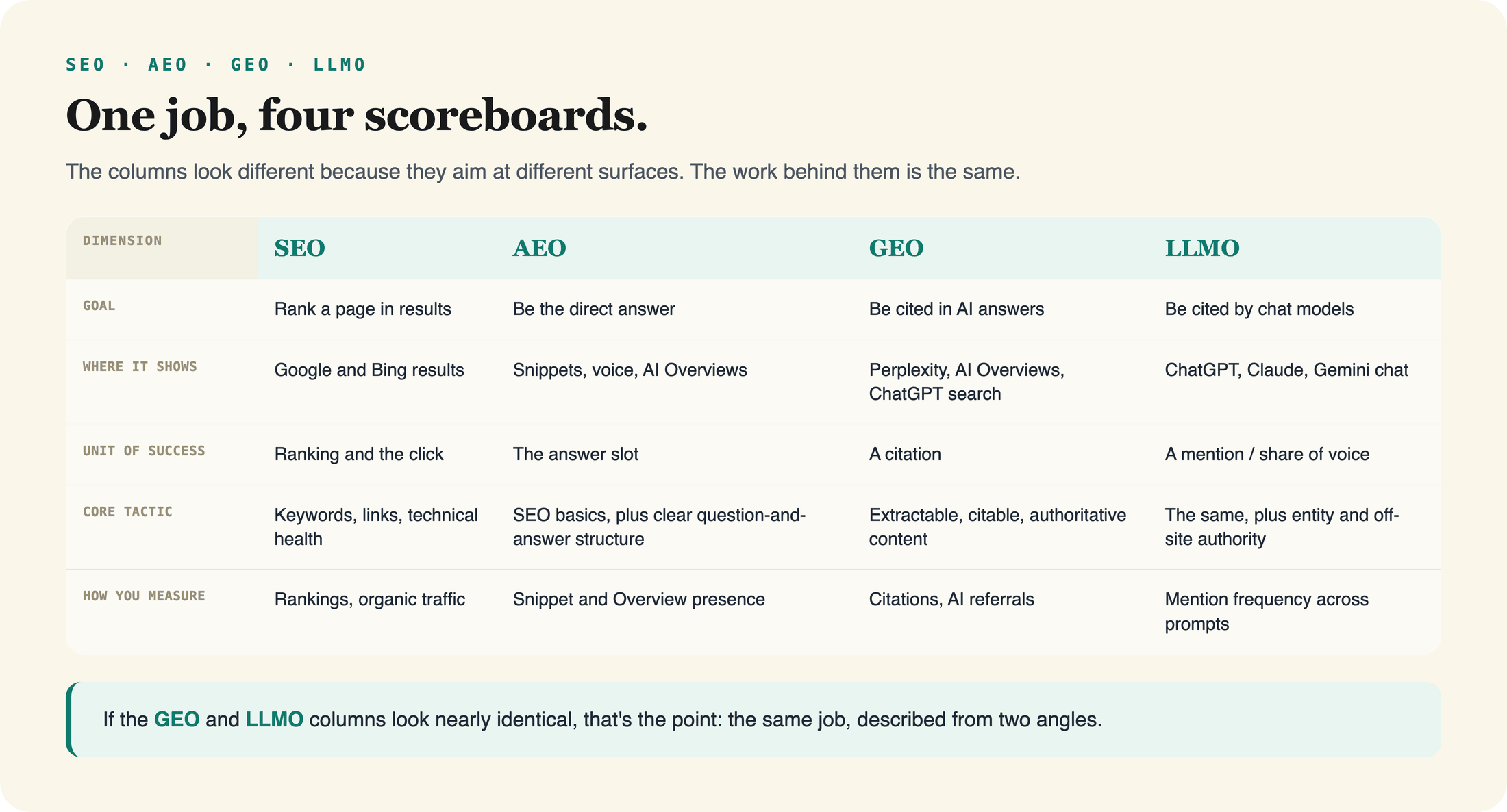
Here is the whole comparison in one table, with LLMO (large language model optimization) included because you will see it used as a fourth name for the same work.
| Dimension | SEO | AEO | GEO | LLMO |
|---|---|---|---|---|
| Goal | Rank a page in results | Be the direct answer | Be cited in AI answers | Be cited by chat models |
| Where it shows | Google and Bing results | Snippets, voice, AI Overviews | Perplexity, AI Overviews, ChatGPT search | ChatGPT, Claude, Gemini chat |
| Unit of success | Ranking and the click | The answer slot | A citation | A mention / share of voice |
| Core tactic | Keywords, links, technical health | SEO basics, plus clear question-and-answer structure | Extractable, citable, authoritative content | The same, plus entity and off-site authority |
| How you measure | Rankings, organic traffic | Snippet and Overview presence | Citations, AI referrals | Mention frequency across prompts |
If the GEO and LLMO columns look nearly identical, that is the point: they are the same job described from different angles. The definitions live in our guides to generative engine optimization, answer engine optimization, and LLMO, and the practitioner playbook is in our LLM SEO guide.
Found, Selected, Quoted
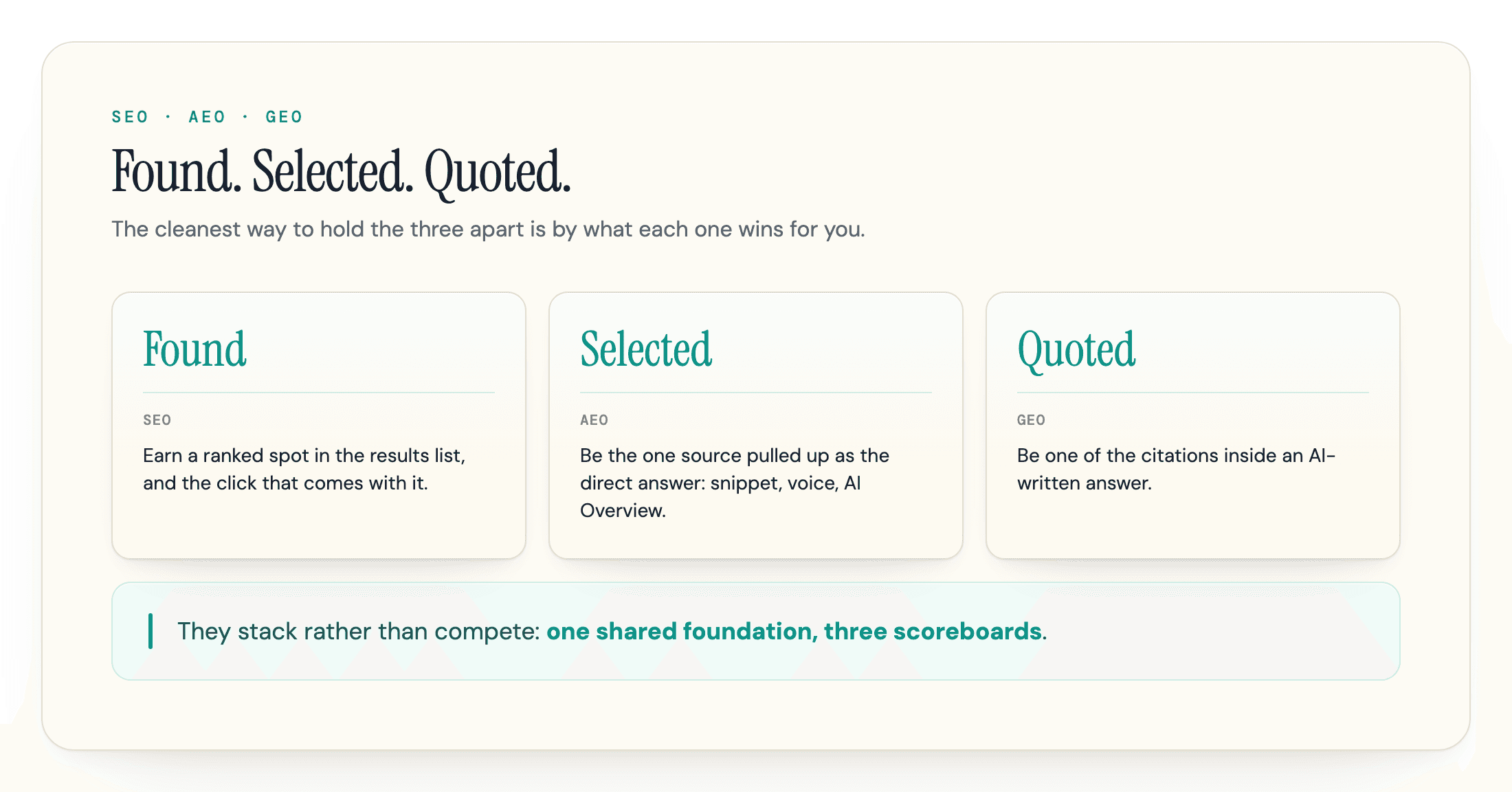
SEO gets you found. It earns a ranked spot so a search engine puts your page in front of someone. That has been the game for two decades, and it still is for the large share of searches that return a list of links.
AEO gets you selected. When a search shows a featured snippet, a voice answer, or a Google AI Overview, one source, sometimes a few, gets pulled up as the answer. AEO is the work of being that source, and our answer engine optimization best practices checklist covers how.
GEO gets you quoted. When a generative engine like ChatGPT or Perplexity writes a fresh answer and lists a few citations, GEO is the work of being one of them.
They stack rather than compete. To be quoted in an AI answer you usually need to be findable and selectable first, which is why strong SEO sits underneath both of the others rather than rivaling them.
Most people weigh them two at a time, so here is each pairing on its own.
GEO vs SEO
SEO earns a ranked position in a list of links; GEO earns a citation inside an AI-written answer. SEO's unit of success is a click from a fixed position. GEO's is a mention in a probabilistic answer that can change from one prompt to the next.
Two practical differences follow. First, GEO leans harder on entities: models weigh how consistently your brand is named and described across the web, not just who links to you, which is why entity SEO carries more of the load. Second, GEO has no "position 1" to defend. Success becomes a share of answers rather than a position you hold, and a page that never cracks Google's top 10 can still earn AI citations, especially for related or fan-out prompts. And no, this GEO has nothing to do with geographic targeting; the questions below untangle that name collision. For the two-way trade-off in depth, including how to split the budget, when SEO still wins, and how to migrate, see our GEO vs SEO deep-dive.
AEO vs SEO
For Google's own AI features, AEO is still SEO, and the differences show up on the other engines and in measurement. Featured snippets, voice responses, and Google AI Overviews each pull a few sources up as the direct answer. Google's guide to generative AI features says optimizing for generative AI search "is optimizing for the search experience, and thus still SEO," and lists llms.txt, content chunking, and special schema among the things you can skip for Google Search.
Winning the answer slot can still cost the click that a ranking would have earned. Our AEO vs SEO comparison covers what Google says to skip, where the engines differ, and how to measure each. Our guide to getting cited in AI Overviews covers the Google mechanics.
GEO vs AEO
GEO and AEO are the blurriest pair: AEO wins you the answer slot on search surfaces, while GEO wins citations inside generated, conversational answers. Plenty of vendors use the terms interchangeably. The day-to-day difference is what you track: for AEO, whether you hold the answer slot; for GEO, how often you are cited across prompts and engines.
The two are converging as Google folds more generation into search itself. Google AI Mode is the clearest example: a fully generated search surface where the AEO habit of direct answers and the GEO habit of citable, sourced claims pay off at the same time.
How Much Actually Overlaps
Here is the part vendors tend to undersell, because it is harder to bill for: most of the work is the same. In the audits we run, roughly 80% of what makes a page rank also makes it citable: authority, genuinely useful content, clean structure, schema, fast and crawlable pages, a clear brand identity. Do those well and you are most of the way to all three at once. Semrush is more conservative, putting strong SEO at halfway to GEO. Either way, the overlap is at least half the job.
The label on the work matters less than doing it, and Google says as much: there is no special markup that wins AI features, just helpful content. The IIT Delhi and Princeton researchers who coined the term GEO found the highest-impact tactics were adding citations, quotations, and statistics, which is to say writing genuinely sourced, credible content. That is not a new discipline. It is good content practice measured against a new surface.
So treat the shared majority as one program, not three. The mistake is buying separate "GEO," "AEO," and "SEO" services that re-sell you the same fundamentals at three price points. Run the fundamentals once. The differences are real but small, and they are where the remaining slice lives.
What's Genuinely Different
The slice that does not transfer comes down to how AI answers get built.
A search engine crawls, indexes, and ranks pages, then hands you a list. A generative engine does something else: it reads your question, often breaks it into sub-questions, retrieves passages from several sources, and writes one answer that blends them. How AI search works covers that loop. Optimizing for it changes a few things.
Visibility becomes probabilistic. In search you rank or you do not. In an AI answer the same prompt can surface different sources on different days, so success is a share of voice across many prompts rather than a fixed position.
Ranking stops guaranteeing inclusion. A page can sit at the top of Google and never get cited, because the model selects extractable, trustworthy passages, not backlink counts. The gap is measurable and widening: per Ahrefs' 863,000-SERP study, only 38% of AI Overview citations ranked in Google's top 10 for the same query in March 2026, down from 76% in July 2025, a drop Ahrefs ties partly to Google pulling sources from related fan-out queries. The rest came from pages in positions 11 to 100 or beyond the top 100 entirely, about 31% each. Query fan-out is that sub-query step at work: a page can get cited for winning a sub-query no rank tracker shows you. We see it in our own testing: ask ChatGPT what separates GEO, AEO, and SEO, and the pages it cites are mostly fresh, acronym-first comparison pages that do not rank in Google's top 10 for the same question.
The pattern holds beyond Google. Across ChatGPT, Gemini, and Copilot, only about 12% of cited URLs rank in the top 10 for the original prompt, per Ahrefs' August 2025 study of 15,000 long-tail queries, with each of the three under 9% individually. Perplexity sits outside that 12% figure and is reported separately at about 29%.
And measurement is immature. Many AI answers send no click and no referrer, so you track citations and brand mentions instead of sessions, the kind of share-of-voice that tools like geotoolbox put on a 0-to-100 scale (we compare the whole tracker market in our guide to the best GEO tools). Attribution leaks too: some of the AI-referred visits that do happen arrive without a referrer and land in analytics as direct traffic, so whatever your reports attribute to AI is an undercount. Any such score, ours included, samples probabilistic answers, so it is a trend line, not a census. That is the new part of the job, and it is the slice the AEO and GEO surfaces reward differently.
The Shared Prerequisite Everyone Skips: Reachability
Before you weigh SEO against GEO against AEO, there is one gate all three share, and it is the most commonly broken: can the engines reach your pages at all?
Traditional crawlers and AI crawlers both need to fetch your content, but the AI ones are stricter in one way: most read raw, static HTML and do not run JavaScript. Three things quietly lock them out:
- A robots.txt rule that disallows the crawlers that actually fetch pages for live answers and citations: OAI-SearchBot and ChatGPT-User (OpenAI), Claude-SearchBot and Claude-User (Anthropic), and PerplexityBot and Perplexity-User (Perplexity). Blocking the training-only crawlers (GPTBot, ClaudeBot) keeps your content out of model training but does not stop you being cited; it is these retrieval crawlers you have to leave in.
- A firewall or bot-management rule that challenges non-browser traffic even when robots.txt allows it
- Client-side rendering that leaves an AI crawler looking at a near-empty page
None of this shows up in a normal content audit, and none of the optimization above matters until it is fixed. It is also the cheapest win, usually a same-day change. Confirm reachability first; our AI search playbook walks the checks. Then decide where to spend the rest of your effort.
Which Should You Prioritize?
Since the foundation is shared, "which one" is really a question of where to spend the incremental effort. The honest answer depends on your business and where you are losing or missing visibility. Start with the diagnosis.
- You rank well but watch clicks fall to AI Overviews. Your SEO is working, but an AI Overview is associated with a 58% lower click-through rate for the top result, per Ahrefs' re-run across 300,000 keywords published in February 2026 on December 2025 data (against a December 2023 pre-AI-Overviews baseline), and the hit runs down the whole first page, from 50.8% at position 2 to 19.4% at position 10. The answer reaches users before they reach you. Lean into AEO and GEO so you are inside that answer, not just under it.
- You are invisible when people ask an AI about your category, even though you rank. This is a pure GEO gap. Focus on extractable, citable content and off-site authority so models quote you.
- You are a new or low-authority site. Build the SEO foundation first. The tie between rankings and citations is loosening, but AI engines still favor established, crawlable sites with real authority, so there is no shortcut around being findable and credible.
Business model sharpens it further:
| If you are | Prioritize | Because |
|---|---|---|
| A local service business | AEO | Customers want one nearby answer via a voice assistant or a quick AI query |
| B2B or SaaS (long buying cycle) | GEO | Buyers use AI to compare options; the win is being the recommended brand |
| A media site or publisher | SEO | An ad-impression model needs the site visits that ranked links bring |
| New or low-authority | SEO foundation | Authority compounds, and citations follow rankings you do not have yet |
In every case the move is the same shared foundation plus one emphasis.
If you want a number to anchor the split, Onely's GEO-vs-SEO guidance is representative of what agencies publish: a default framework of 80-90% of effort on the SEO foundation to 10-20% on GEO, narrowing to 85/15 for enterprise programs, with the GEO slice growing toward 20% for brands in categories AI assistants already answer heavily, like travel, retail, and IT. Treat that as one agency's starting point, echoed widely in AI answers. Our own bias is toward something smaller and cheaper: keep the SEO budget intact, carve out enough to fix reachability and stand up citation tracking, and let what the tracking shows justify every shift after that.
Is SEO Dead?
No, and the people selling you that line usually have a "GEO package" ready. SEO is changing shape, not dying. "SEO is dead" is a headline that resurfaces every few years and has always been wrong. Our is SEO dead breakdown goes through what the data actually shows.
What is true is that the click is under pressure. Per SparkToro's June 2026 analysis of Similarweb clickstream data, 68% of US Google searches ended without a single click in the first four months of 2026, up from the 60.45% SparkToro reported for 2024 using a different panel (Datos). As AI answers more queries directly, organic traffic for some sites is sliding, and Bain estimates a 15% to 25% drop as AI search adoption rises. The pressure is real, and it is the actual reason GEO and AEO matter.
But the response is to extend SEO, not abandon it. Keep the scale in view: a peer-reviewed Marketing Science study of 973 ecommerce sites (April 2026) measured ChatGPT referrals at under 0.2% of all sessions, roughly 200 times smaller than Google organic, over August 2024 to July 2025. Industry benchmarks land in the same low-single-digit territory: Conductor's benchmark of 1,215 enterprise domains put AI referrals from all engines at 1.08% of site traffic in its July 2026 update, small but growing month over month on average.
The fundamentals that earn a ranking (reachable pages, clear answers, real authority) are the same ones that earn a citation. And whether AI visitors convert better is still contested: a 94-site ecommerce study found ChatGPT referrals converting 31% higher than non-branded organic search (1.81% vs 1.39%, Visibility Labs data reported February 2026), while the larger Marketing Science dataset places ChatGPT referrals below traditional channels like organic search on conversion, though ahead of paid social.
Either way the scoreboard shifts from pure traffic toward citations, brand mentions, and the quality of the visits you do get. For the wider evidence base, our field report on what the 2026 AI-search data shows reconciles the studies.
Frequently Asked Questions
Is GEO the same as AEO?
Nearly. If you have to separate them: AEO targets the answer slot and, for Google's own AI features, is still SEO, while GEO adds an authority discipline, being quotable and trusted enough for a model to cite. In practice you run them as one program with two scoreboards.
Do I need all three?
You need the shared foundation that powers all three, plus one area of emphasis picked by where you are actually losing visibility. A single content and technical program can carry all of it.
Should I cut my SEO budget to fund GEO?
No. GEO rides on the pages and authority your SEO budget already builds, so cutting it undermines both. Most teams get further by reallocating a small slice toward reachability fixes, clearer answers on key pages, and AI visibility tracking.
Which should I start with?
Reachability, always; it is usually a same-day fix. Then give your SEO foundation and chosen emphasis at least a quarter before judging results, because AI engines reward authority that builds slowly.
Can GEO replace SEO?
No. Generative engines retrieve from crawled, indexed, authoritative sources, which is exactly what SEO builds. Drop the SEO foundation and there is nothing for an AI engine to find or cite. GEO extends the same work to a new surface; it does not replace it.
What is AIO, and how does it relate?
It depends on who is using it. Many marketers use AIO for "AI optimization," another synonym for the GEO and LLMO work in this guide, while plenty of SEO sources use AIO as shorthand for Google's AI Overviews. You will also see AISO for "AI search optimization." Ask which sense is meant; the work underneath does not change.
More Questions
Is GEO just SEO rebranded?
Partly. Much of what sells as GEO is repackaged SEO fundamentals, which is why the term draws skepticism. The new slice is optimizing for probabilistic, citation-based answers and measuring share of voice instead of rankings.
Is GEO the same as geo-targeting or local SEO?
No, the name is a collision. In geo-targeting and local SEO, "geo" means geographic: showing results or ads based on location. Here GEO stands for generative engine optimization, getting cited in AI-written answers, and it has nothing to do with where your users are.
Where to Start
One job, three emphases: that is the whole comparison. The brands that win across all of them are reachable, clear, and genuinely authoritative, the same traits that have always defined good search work.
So start at the gate everyone forgets: can AI crawlers actually reach and read your most important pages? geotoolbox's free AI-Readiness Score checks the crawler-access foundations in seconds, and the Content Analyzer grades how citable a page is. Fix what it flags, keep your SEO foundation strong, then lean into whichever surface your customers are using to find you.
Sources
- GEO: Generative Engine Optimization - Aggarwal et al. (IIT Delhi, Princeton, et al.), KDD 2024 -
arxiv.org/abs/2311.09735 - AI features and your website - Google Search Central -
developers.google.com/search/docs/appearance/ai-features - Optimizing your website for generative AI features on Google Search - Google Search Central, last updated July 10, 2026 -
developers.google.com/search/docs/fundamentals/ai-optimization-guide - GEO vs. SEO: A Comparative Guide for Digital Marketers - Semrush (SEO-to-GEO overlap claim, data citation) -
semrush.com/blog/geo-vs-seo - Goodbye Clicks, Hello AI: Zero-Click Search Redefines Marketing - Bain & Company, 2025 -
bain.com/insights/goodbye-clicks-hello-ai-zero-click-search-redefines-marketing - In 2026, Less than One Third of Google Searches Still Send a Click - SparkToro, June 2026 (data citation) -
sparktoro.com/blog/in-2026-less-than-one-third-of-google-searches-still-send-a-click - Update: 38% of AI Overview Citations Pull From The Top 10 - Ahrefs, March 2026 (data citation) -
ahrefs.com/blog/ai-overview-citations-top-10 - AI Overviews reduce clicks: 2026 update - Ahrefs, February 2026 (December 2025 data, 300,000 keywords) -
ahrefs.com/blog/ai-overviews-reduce-clicks-update - Only 12% of AI Cited URLs Rank in Google's Top 10 for the Original Prompt - Ahrefs, August 2025 (data citation) -
ahrefs.com/blog/ai-search-overlap - ChatGPT Referrals to E-Commerce Websites: How Do LLMs Compare Against Traditional Channels? - Kaiser & Schulze, Marketing Science, April 2026 -
pubsonline.informs.org/doi/10.1287/mksc.2025.0489 - ChatGPT ecommerce traffic converts 31% higher than non-branded organic search - Search Engine Land, February 2026 (Visibility Labs data) -
searchengineland.com/chatgpt-vs-non-branded-organic-search-conversions-470321 - The 2026 AEO/GEO Benchmarks Report - Conductor, updated July 2026 (data citation) -
conductor.com/academy/aeo-geo-benchmarks-report - GEO vs SEO: What's the Difference in 2026? - Onely, March 2026 (budget-split recommendation) -
onely.com/blog/geo-vs-seo