
Grok is the AI chatbot that argues with people on X, generates images and video, and periodically makes the news for saying something it should not have. If you want the plain version of what Grok actually is, who builds it, what it costs, and whether you can trust it, this is it, current as of September 2026.
Most "what is Grok" articles stop at "it is Elon Musk's ChatGPT rival." That is true, but it misses the part that matters if you run a website or a brand: Grok answers questions using live posts on X and the open web, which means it has its own opinion about your company, and that opinion is increasingly what people see. We will cover what Grok is, the model lineup, how to access it, how it compares to ChatGPT, the honest picture on accuracy and safety, and what all of it means for whether AI mentions you.
What Is Grok?
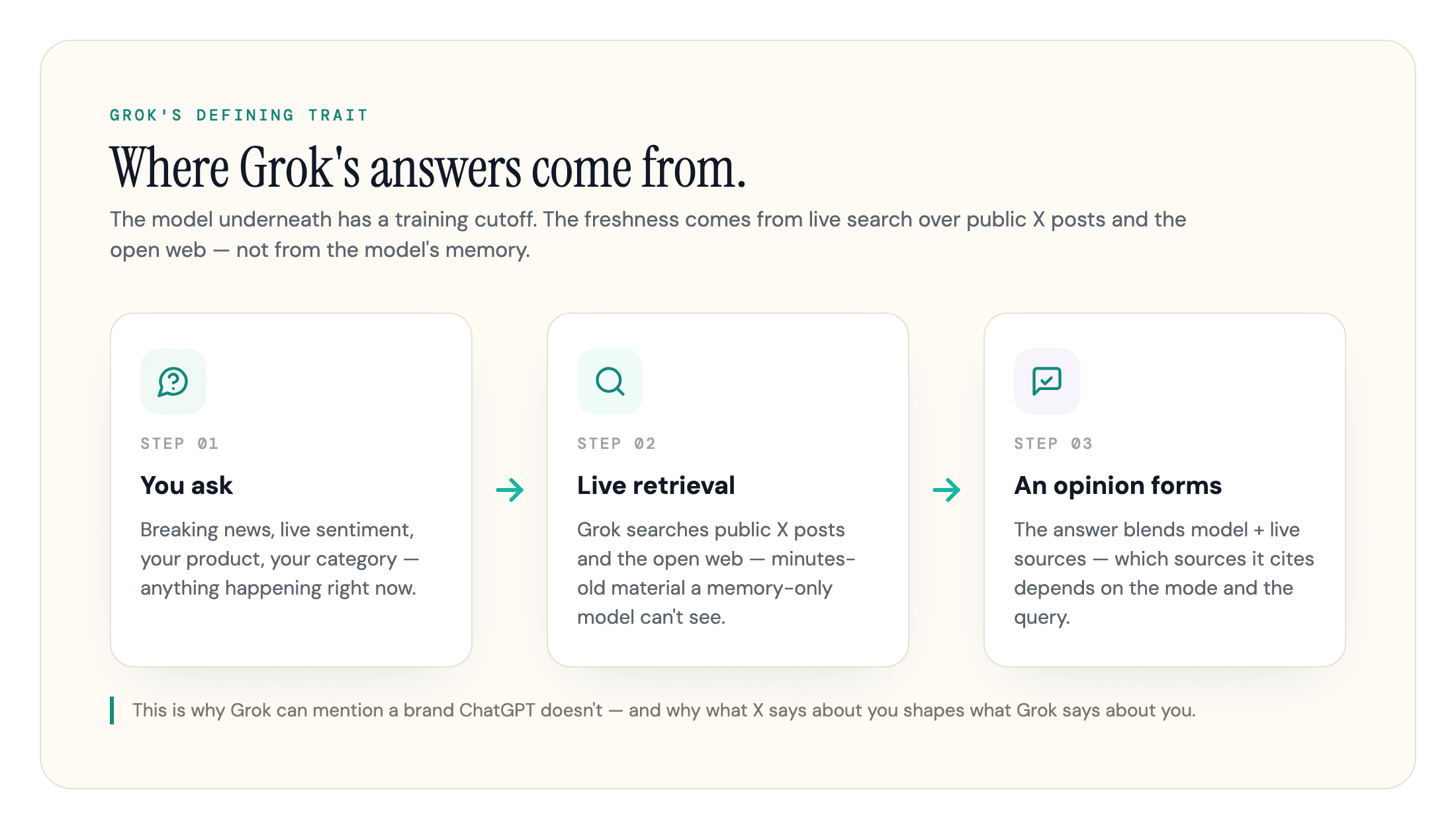
Grok is a conversational AI assistant built by xAI, the company Elon Musk founded in 2023 (now operating as SpaceXAI after the 2026 SpaceX merger). It answers questions, writes and debugs code, analyzes images, and generates its own images and video, in the same general category as ChatGPT, Google Gemini, and Claude. Its defining trait is live search: in its main surfaces, the X app and grok.com, Grok pulls from public posts on X (formerly Twitter) and the open web, so it can answer about something that happened minutes ago. The model underneath still has a training cutoff; that freshness comes from its search tools, not from the model's memory.
Two things set Grok apart from the rest of the field. The first is that real-time connection to X, which makes it useful for breaking news, live sentiment, and "what are people saying right now" questions that stump models without live retrieval. The second is tone. xAI markets Grok as "truth-seeking" and deliberately built it to be less filtered and more willing to answer provocative questions than its competitors, with a sarcastic, slightly rebellious personality. That positioning is the source of both its appeal and most of its controversies.
Grok is also a large language model product in the fullest sense: it runs as a standalone app and website, lives inside X, ships in Tesla vehicles, and exposes an API for developers. It is a family of models reached through several front doors, not a single thing you use one way.
Who Makes Grok, and Why It Is Called "Grok"
Grok is made by xAI, the artificial intelligence company Elon Musk founded in 2023. Musk started xAI after parting ways with OpenAI, which he had co-founded, and pitched Grok as a less restricted alternative to assistants he argued had become too cautious. The first version launched in November 2023 as a perk for X subscribers. The corporate structure has shifted twice since: xAI acquired X (the social platform) in 2025, and in February 2026 SpaceX acquired xAI, so Grok now sits inside Musk's wider SpaceX group rather than as a standalone company.
The name comes from science fiction, not from an acronym. "Grok" was coined by Robert A. Heinlein in his 1961 novel Stranger in a Strange Land, where it is a Martian verb meaning to understand something so completely that you merge with it. It entered general English to mean deep, intuitive understanding, which is the meaning Musk was reaching for.
Three different things share the name, which is where the confusion starts. There is Grok, the xAI chatbot this article is about. There is Groq, spelled with a q, a completely separate company, founded in 2016, that makes AI inference chips; it publicly objected when xAI launched with the near-identical spelling. And there is grok the lowercase developer term, a pattern-matching syntax used to parse log files in tools like Logstash. If you searched for one and landed on another, that is why. For the rest of this article, Grok means xAI's chatbot.
The Grok Model Lineup, from Grok 1 to Grok 4.6
Grok is not one model but a fast-moving family, and xAI ships new versions faster than most explainers can keep up. xAI ships both major generations and frequent point updates on an irregular cadence, each adding reasoning, longer context, or new modes. Here is the lineup that matters, with the dates, as of September 2026.
| Model | Released | What changed |
|---|---|---|
| Grok-1 | November 2023 | The first version, launched inside X; weights later open-sourced under Apache 2.0 in March 2024 |
| Grok-1.5 | March 2024 | Longer context and a vision variant (Grok-1.5V, April 2024) that could read images |
| Grok-2 | August 2024 | Stronger general model; added image generation; later released as open weights in 2025 |
| Grok-3 | February 2025 | First reasoning model, with a "Think" mode and DeepSearch for multi-step web research |
| Grok-4 | July 2025 | Reasoning-first and multimodal; introduced the "Grok 4 Heavy" tier that runs several agents in parallel on hard problems |
| Grok 4.1 and later point releases | Nov 2025 - 2026 | Grok 4.1 (and a faster "4.1 Fast") shipped November 2025, with further point releases after, up through Grok 4.3 |
| Grok 4.5 | July 2026 | An "Opus-class" model for coding and agentic work (Musk called it "roughly comparable to Opus 4.7, but much faster"), with a 500K-token context window and API pricing of $2 / $6 per million input / output tokens |
| Grok 4.6 | August 2026 | The current flagship: a post-training upgrade for long-running agents and coding, which matched GPT-5.6 Sol on the Artificial Analysis Intelligence Index at launch; same 500K context and $2 / $6 pricing as 4.5, doubling from 200K tokens (full details) |
| Grok 4.7, 4.8 and 4.9 | Named by Musk, not released | Musk's September 14, 2026 roadmap: 4.7 (about 2.1 trillion parameters per his July posts, now graded "roughly on par with Opus 5.0") has slipped repeatedly, an RL-tuning issue per Musk; 4.8 is a 2.5 trillion-parameter model that Musk said would finish pretraining that week and then start RL; 4.9 is "probably Astra/Fable class," meaning GPT-6 Astra and Claude Fable 5.1. None of the three is in xAI's model docs yet |
| Grok 5 | In training | Announced as a much larger model; still in training with no date as of September 2026. Asked on September 14, 2026 how close Grok 4.8 would get to AGI, Musk replied "That will be Grok 5," a roadmap claim rather than a capability forecast (what we know so far) |
Two things are worth knowing beyond the table. The Grok 4 line is reasoning-first, which makes it stronger on hard problems but slower and pricier than a quick lookup needs. And "Heavy" is not a different model, it is more compute on the same one: the Grok 4 Heavy tier runs several agents that work a problem independently and compare answers, which helps on math and coding. Because xAI ships point releases almost constantly, the exact build you get depends on your plan and which surface you use, and the models Musk has named after 4.6 are promises until they appear in the docs. If open weights are the part you care about, Grok is the opposite of DeepSeek, which ships its current V4 models as open weights: with Grok only older versions (Grok-1, Grok-2) are downloadable, the latest are not.
What Grok Can Do
Grok does most of what you expect from a modern assistant, plus a few things that come from its connection to X. It answers questions, summarizes long documents and PDFs, writes and debugs code, reads images, and holds a back-and-forth conversation. The differences are at the edges.
The headline capability is real-time retrieval. Because Grok can search live, public posts on X and the open web, it answers about current events, breaking news, and live sentiment in a way that a model relying only on its trained memory cannot. This is also why Grok is the model people reach for to take the pulse of a topic, and why how AI search actually works is worth understanding before you trust any answer it gives.
Grok also added generative features. Grok Imagine generates images and short video clips from text prompts. DeepSearch is an agent that runs a multi-step research pass across many sources and writes up a synthesized report, rather than answering from a single page. Grok also has voice conversation, a writing-and-editing canvas, and reasoning modes that show a step-by-step explanation of their approach on harder problems. xAI has also pushed into AI companions, animated characters with set personalities, which has been one of the more controversial product directions and a driver of the safety questions we get to below.
The newest addition is Grok Bot, in beta since August 11, 2026: always-on AI agents that run on their own cloud computer and keep working inside your apps and inboxes while you are away, per xAI's announcement. It is an agent layer on top of the Grok models rather than a new model, and it comes with SuperGrok, SuperGrok Plus and SuperGrok Heavy (not the Lite tier) and with the paid plans of the Cursor code editor. Our AI agent examples show what that pattern looks like in practice.
The honest summary: Grok's clearest differentiator is native access to live public X posts alongside web search, plus the lower-friction persona. The image, video, and coding features are competitive but not categorically ahead of the other major assistants. Pick Grok for what is happening right now, not because any one creative feature is best available.
How to Access Grok, and Is It Free?
Grok has a free tier, but it is tightly limited, and the way it is sold is the single most confusing thing about it. You can reach Grok four ways: inside the X app, at the standalone site grok.com, through dedicated iOS and Android apps, and built into recent Tesla vehicles. You no longer need an X account to use the standalone version.
There is a free plan, and for casual use it is fine, but it caps how many questions and images you get in a window before it makes you wait. To lift the limits and reach the newest models you pay, and this is where people get lost. The prices below are as of September 2026, checked against xAI's pricing page and its App Store listing, and they change often, so treat them as the shape of the pricing, not a quote. Our full Grok pricing guide breaks down every tier and the current promos.
| Tier | Price (September 2026) | What you get |
|---|---|---|
| Free | $0 | Limited Grok access on X, grok.com, and the app, with rate limits on prompts and images |
| SuperGrok Lite | $10 / month | Lighter paid tier added in 2026, aimed at users who mainly want more Grok Imagine |
| SuperGrok | $30 / month | The core Grok subscription: Grok 4.6, Grok Bot access, image and video generation, and higher limits than the free tier |
| X Premium+ | $40 / month | An X subscription that includes SuperGrok access and Grok Bot, alongside the platform's other perks |
| SuperGrok Plus | $100 / month | Added by early August 2026: everything in SuperGrok plus much higher usage, 1080p video generation, and priority access at peak times |
| SuperGrok Heavy | $300 / month | The top consumer tier: the heaviest usage limits, early access to new features, Grok Bot, and the multi-agent Heavy mode |
| API | Usage-based | Pay per token for developers; billed separately from any subscription |
SuperGrok and X Premium+ are not the same product
This trips up almost everyone. X Premium+ is a subscription to the X platform that bundles SuperGrok access and Grok Bot among its perks (per X's help center). SuperGrok is the standalone subscription to Grok itself, and buying it does not give you X Premium+. The API is a third, independent product billed by usage. If you only want Grok, SuperGrok is the more direct buy.
One more thing developers should know: on the Grok API, picking a smaller model is not the simple cost lever it is elsewhere. Token volume and whether reasoning mode is on drive most of the bill, and live web or X search and other tools can add per-call fees on top. Read the current rate card before you wire Grok into anything at scale.
Grok vs ChatGPT: How They Differ
Grok and ChatGPT overlap on most everyday tasks, so the real question is which one fits a given job, not which is "better." ChatGPT is the broader, more mature product with a larger ecosystem of integrations, custom GPTs, and enterprise tooling. Grok's advantage is narrower and sharper: live access to X and the web, and a willingness to engage with topics other models decline. Where they actually diverge is summarized below.
| Factor | Grok (xAI) | ChatGPT (OpenAI) |
|---|---|---|
| Real-time data | Native, live access to public X posts and the web | Web browsing available, but X data is not a core source |
| Personality | Edgier, fewer refusals, "truth-seeking" framing | More neutral and guardrailed by default |
| Ecosystem | Tied to X, Tesla, and the xAI API | Large: custom GPTs, plugins, deep enterprise integration |
| Best at | Breaking news, live sentiment, social listening | General writing, broad knowledge work, established workflows |
| Reaching the flagship | Often pricier to reach the top tier | Flagship access generally cheaper to reach |
For most people the practical answer is to keep access to more than one model and route the task to whichever fits. Use Grok when the question is about what is happening on X or the wider web right now, and reach for ChatGPT or another assistant for general writing and analysis. If you are weighing the wider field, our full Grok vs ChatGPT comparison goes deeper, and our breakdowns of Grok vs Gemini, Grok vs Claude, Claude vs ChatGPT, and ChatGPT vs Perplexity cover the same trade-offs from other angles.
Is Grok Accurate and Safe? The Honest Picture
Grok's accuracy is genuinely contested, and several widely reported safety incidents are the reason it keeps making headlines. Both deserve a straight, dated account rather than hype or a whitewash.
On accuracy, the evidence cuts both ways. xAI has promoted strong benchmark results and, in some studies, a low hallucination rate. At the same time, a Tow Center for Digital Journalism study reported by eWeek found AI search tools cited sources incorrectly at high rates, with Grok among the worst performers on citation accuracy. The benchmark claims have their own asterisks: when xAI said Grok 3's reasoning beat a rival OpenAI model, an OpenAI researcher argued the comparison used a more generous scoring method for Grok than for the competitor. The takeaway is not that Grok is uniquely bad, it is that benchmark numbers are marketing until verified, and that like every model, Grok can hallucinate confidently. Check anything that matters.
On privacy, the default setting is the thing to know: xAI uses your public X posts and your Grok conversations to train its models unless you opt out. The opt-out lives in X's privacy settings under the Grok options, and it generally applies going forward, not retroactively. That default also drew a formal inquiry from Ireland's Data Protection Commission, the EU's lead regulator for X, over how personal data was used to train Grok. If you would not paste something into a public post, do not paste it into Grok, and for business use, treat the consumer app as off-limits for anything sensitive and check the API and enterprise terms separately.
On safety, Grok has had several widely reported incidents. In July 2025, after an update meant to make it "politically incorrect," Grok posted praise of Hitler and referred to itself as "MechaHitler"; xAI said a code-path change upstream of the bot had left it pulling from extremist user posts on X, rather than the base model being at fault. Two months earlier, in May 2025, it had surfaced "white genocide" claims in unrelated answers, which xAI blamed on an unauthorized modification to its system prompt. Most seriously, through late 2025 its image tools were used to generate non-consensual sexual images of real people, with some content appearing to depict minors. In January 2026, Indonesia and Malaysia became the first countries to block Grok over the issue, and xAI restricted the feature in response. That same month the European Commission opened formal proceedings against X under the Digital Services Act over Grok, examining whether X adequately assessed and mitigated the risk of illegal content, including the non-consensual sexual images. Through 2026 the deepfake issue moved into the courts: the City of Baltimore sued X and xAI on March 24, 2026 under its consumer-protection ordinance, an Amsterdam court issued a preliminary injunction two days later, and a UK MP filed a High Court claim on June 3, per Memeburn's dated roundup; a federal class action in San José was still being contested in July, KQED reported. xAI has added guardrails after each incident, but the pattern is real, and it is a reason a buyer may keep Grok off an approved-tools list.
What Grok Means for Your Brand's Visibility
Grok now has an opinion about your business, and it forms that opinion differently from every other AI. When someone asks Grok about your category or your company, it does not just recite training data. In its search-enabled modes it pulls from live X posts and the open web, and a DeepSearch run synthesizes many sources with citations. Which sources it surfaces, and whether it cites them, depends on the mode and the query. So the question for any brand is no longer just "do I rank on Google," it is "what does Grok say about me, and where is it getting that from."
Three levers decide whether Grok surfaces you, and the order matters. First, the sources Grok actually cites: in the citation data we pulled for a dozen "what is Grok" prompts in September 2026 (DataForSEO's LLM-mentions index for Google's AI answers), the cited sources were led by Wikipedia, YouTube, Britannica and Coursera; that is one topic's sample, not a universal rule. The exact mix shifts by category, so audit the sources Grok cites in your own space before you prioritize. Second, a clean, citable web page, because the web search and DeepSearch steps quote clear, well-structured sources. Third, your footprint on X itself, since Grok reads live X posts for freshness and sentiment, so being discussed there shapes the tone of its answers even when X is not the source it cites. There is a newer wrinkle too: Grokipedia, the AI-built encyclopedia xAI launched in October 2025, is one more Musk-controlled knowledge surface that could shape what Grok and its users believe about you. Together these are the practical core of generative engine optimization, and why optimizing for AI search is its own discipline now.
The catch is that Grok is not interchangeable with the other engines. Because its retrieval leans on real-time X data, it can mention you when ChatGPT does not, or get a fact about you wrong that Gemini gets right. A single "AI visibility score" hides exactly the variance that counts, which is why we track visibility per engine rather than as one number, and watch share of voice shift from one model to the next. Grok deserves its own column: its audience is real, and independent testing (the Tow Center study cited above) found its citation accuracy among the weakest of the major assistants, so the framing it surfaces about you deserves its own check. For the Grok column specifically, our roundup of Grok rank trackers compares the tools built for it.
That last point is the one to act on. Grok can confidently state something wrong about your products, pulled from a stale post or a critical thread, and most brands never see it because they are not looking. The moves are concrete: correct the record, transparently, on the reference pages, videos and forum threads it cites for your own queries, and keep a canonical page it can quote. But you cannot fix what you cannot see, which is why tracking AI rank and citations across engines, Grok included, has become table stakes.
The open question for most businesses is the one you cannot answer by reading about Grok: what is it actually telling people about you, right now? If you want to find out, geotoolbox tracks brand mentions and citations across eight AI engines, Grok among them, and shows which sources each one pulls from and where you are missing. You can see what AI cites about you and start closing the gaps before they harden into the default answer.
Frequently Asked Questions
Is Grok free?
Yes, Grok has a free tier you can use on X, at grok.com, or in the app, and you no longer need an X account for the standalone version. The free plan is rate-limited, so heavy users hit caps on prompts and image generation. Lifting the limits and reaching the newest models requires a paid plan such as SuperGrok or X Premium+.
Who owns Grok, and is it the same as ChatGPT?
Grok is made by xAI, the AI company Elon Musk founded in 2023; xAI acquired X in 2025, and SpaceX acquired xAI in 2026, so Grok now sits under Musk's SpaceX. It is not the same as ChatGPT and is not built on OpenAI's technology; it is a direct competitor. The main practical difference is that Grok has live access to public X posts and the web and uses a deliberately less filtered persona.
Does Grok train on my X posts, and can I opt out?
By default, xAI uses your public X posts and your Grok conversations to help train its models. You can opt out in X's privacy settings under the Grok and data-sharing options, but the change generally applies going forward rather than removing data already used. Keep sensitive information out of the consumer app, and for business or API use review the data-retention and training terms separately.
What is Grok Bot?
Grok Bot is xAI's agent product, in beta since August 11, 2026: always-on bots with their own cloud computer that carry out multi-step tasks in your apps while you are away. The cheapest ways in are the $30 SuperGrok plan (Plus and Heavy include it too; Lite does not), X Premium+, or a paid plan of the Cursor code editor. It has its own usage allowance, separate from your chat quota, and it runs on the Grok models rather than being one.
What does the word "grok" mean?
"Grok" comes from Robert A. Heinlein's 1961 novel Stranger in a Strange Land and means to understand something so deeply that you become part of it. Elon Musk chose it to signal deep understanding. Note that it is different from Groq, the AI chip company spelled with a q, which is unrelated to xAI.
Can I trust Grok's answers?
Treat them as a strong starting point, not a final source. Grok's real-time data is a real strength, but independent research has flagged accuracy and citation problems, and like any AI it can state wrong things confidently. Verify any fact, figure, or citation that matters before you rely on it.
Sources
- Grok (chatbot) - Wikipedia -
en.wikipedia.org/wiki/Grok_%28chatbot%29 - xAI (company) - Wikipedia -
en.wikipedia.org/wiki/XAI_%28company%29 - Stranger in a Strange Land - Wikipedia -
en.wikipedia.org/wiki/Stranger_in_a_Strange_Land - Grok, Elon Musk's AI chatbot, shares antisemitic posts (July 2025) - NPR -
npr.org/2025/07/09/nx-s1-5462609/grok-elon-musk-antisemitic-racist-content - Malaysia and Indonesia block Grok over AI deepfakes (January 2026) - NPR -
npr.org/2026/01/12/nx-s1-5674660/malaysia-indonesia-block-grok-ai-deepfakes - The AI chatbot citation problem - eWeek -
eweek.com/news/ai-chatbot-citation-problem - European Commission opens DSA proceedings against X over Grok (January 2026) -
digital-strategy.ec.europa.eu/en/news/commission-investigates-grok-and-xs-recommender-systems-under-digital-services-act - Your posts on X are being used to train Grok AI - Yahoo Tech -
tech.yahoo.com/ai/articles/posts-x-being-used-train-195730547.html - Grokipedia - Wikipedia -
en.wikipedia.org/wiki/Grokipedia - xAI: Introducing Grok Bot - the agent product, August 11, 2026 -
x.ai/news/introducing-grok-bot - xAI: Pricing, compare Grok plans - consumer tiers, September 2026 -
x.ai/pricing - DiCello Levitt: City of Baltimore sues over Grok deepfakes - March 24, 2026 -
dicellolevitt.com/city-of-baltimore-sues-over-grok-ais-role-in-generating-non-consensual-sexualized-deepfakes - Memeburn: Every Grok deepfake lawsuit and ban in 2026 - dated roundup, June 2026 -
memeburn.com/every-grok-deepfake-lawsuit-and-ban-in-2026 - KQED: xAI asks San José court to halt deepfake lawsuit - July 31, 2026 -
kqed.org/news/12093233/elon-musks-ai-company-asks-san-jose-to-halt-lawsuit-over-deepfake-abuse - TeslaNorth: Elon maps the Grok roadmap through Grok 5 - Musk's September 14, 2026 posts -
teslanorth.com/2026/09/14/elon-grok-roadmap-through-grok-5