
Most answer engine optimization (AEO) advice hands you twenty tactics and no way to tell which ones work. This is the version that sorts them. Below are the AEO best practices that actually move AI citations in 2026, ordered by what to fix first and marked tested or merely claimed, so you can audit a real page against them instead of guessing.
How to Use This Checklist
The checklist is nineteen practices, and the order is deliberate. Work top to bottom, because the practices near the top decide whether the ones below them ever get a chance to matter.
One rule governs the whole list: if an AI engine cannot reach your page, nothing else on it counts. A perfect answer-first page that returns a 403 to PerplexityBot earns zero citations. So reachability comes first, then structure, then everything that makes a reachable, well-structured page worth quoting.
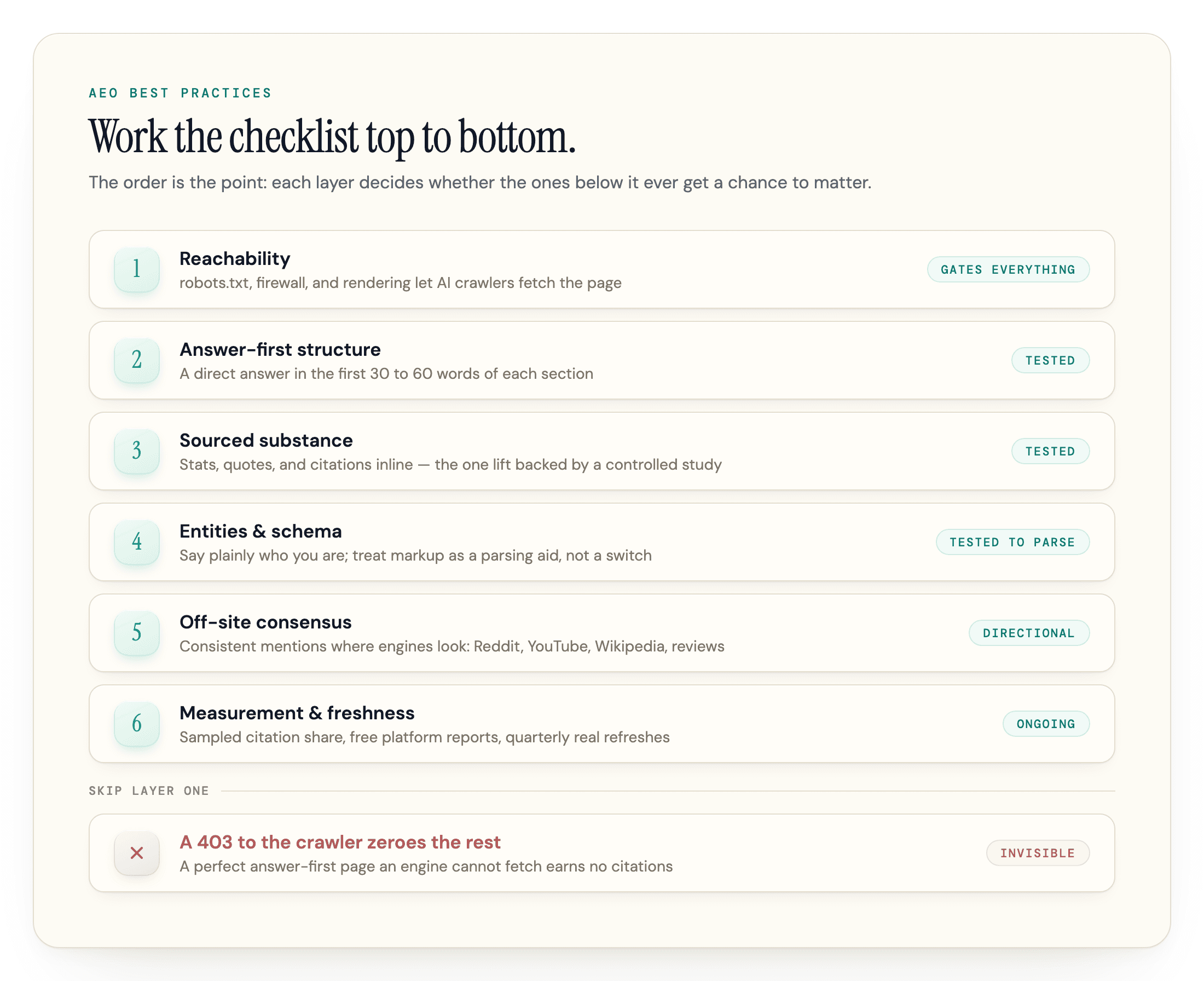
Every practice here carries a tag. TESTED means a study or our own scans across the sites we audit verified it. CLAIMED means it sounds right and gets repeated, but the evidence is thin, single-vendor, or missing. Most AEO advice circulating in 2026 is CLAIMED. Spend your effort on the TESTED parts first, and treat the rest as worth trying, not worth betting the quarter on.
This is the checklist, not the primer. For what the term means, start with what answer engine optimization is, and for how it differs from classic SEO, read AEO vs SEO. For the order to implement it on a real site, our step-by-step AI search playbook runs the same ground as a sequence. This page is the reference you audit a finished page against.
Start with Reachability: Can AI Engines Even Fetch Your Page?
Confirm an AI crawler can actually retrieve the page before you optimize a word of it. This is the most overlooked best practice and the highest-impact one, because it gates every practice below. It is also the one almost no AEO guide leads with. Three things block fetches, in rough order of how often we see them.
robots.txt rules that disallow named AI crawlers such as GPTBot, OAI-SearchBot, ClaudeBot, or PerplexityBot (Google-Extended is a control token rather than a crawler, and it does not govern AI Overviews). The exact user-agent strings are documented by the platforms themselves, including OpenAI's crawler reference. A plugin or a cautious default often adds these blocks without anyone deciding to. The check is binary: either the bot is allowed or it is not.
Bot-management and firewall rules. A Cloudflare or similar rule that challenges non-browser traffic catches AI crawlers as collateral, even when robots.txt says Allow. In our experience scanning sites, this is the single most common reachability failure, and the owner almost never intended it. robots.txt is a request; the firewall is what actually answers the bot.
JavaScript-only rendering. If the answer loads client-side and the crawler does not execute scripts, the bot receives a near-empty page. The industry argues about whether AI crawlers parse JavaScript. Skip the argument: fetch the page as the bot and read what comes back. If the rendered answer is in the HTML the crawler receives, you are fine; if it is not, you have a problem no amount of schema will fix. Our guide to JavaScript SEO shows which bots run scripts and how to run that comparison.
Check the robots layer first
Reachability is the cheapest win on this page and the easiest to get wrong. The free AI Crawler Checker shows which AI bots your robots.txt allows or blocks, with the exact line to fix. To confirm what a bot actually receives, the Content Analyzer fetches the page as each crawler and diffs the JavaScript and no-JavaScript versions.
Common mistake: treating a robots.txt Allow as proof of reachability. The firewall and the renderer get the last word, and both fail silently.
Structure Every Page Answer-First
Put a direct, self-contained answer in the first 30 to 60 words of each section, then expand. Generative engines lift that lead block close to verbatim. Bury the answer under three sentences of setup and the model has nothing clean to quote, so it skips you for a competitor who led with the answer. This is the rewrite that does most of the work, and it is mostly about where you put the sentence, not how many you add. The content optimization tools that score term coverage can confirm a page still covers the topic after you move the answer up.
Four habits make a page extractable, and they map to how people prompt. People ask AI assistants far longer, more conversational questions than the two or three words they type into Google, so headings shaped like the full question match the query better than terse labels.
- Lead with the answer. The first sentence under a heading answers the heading directly, qualifiers included, then the detail follows for the human who wants it.
- Write headings as questions. Use the actual question as an H2 or H3, then answer it immediately underneath.
- Keep chunks self-contained. Each section should make sense if a model lifts it alone. Cut back-references like "as mentioned above"; they break the moment a passage is extracted on its own. For where this habit ends and the chunking folklore begins, see the content chunking debate.
- Use lists and tables for structured facts. Comparisons, steps, and specs extract more cleanly as a table than as prose, which is part of why this article is built as one.
TESTED in our scans: retrieval systems observably pull the lead passage and quote it, and answer-first placement is the cross-industry consensus. Position data now backs it at scale: a Kevin Indig analysis of 1.2 million AI answers, published February 2026, found 44.2 percent of its 18,012 verified ChatGPT citations pointed to the first 30 percent of the content. The sentence-level craft of writing passages that get cited goes deeper on this.
Common mistake: opening a section with context and easing into the answer. That reads well to a human and badly to a machine. Move the answer up; keep the context below it.
Give Engines Something Worth Quoting
Back claims with specific, sourced facts, because models reach for attributable detail over vague assertion. This is the one substance practice with hard research behind it. The study from IIT Delhi and Princeton that defined generative engine optimization found that adding citations, quotations, and statistics raised a source's visibility in AI answers by up to 40 percent. Specificity is the lever.
In practice that means three moves:
- Replace "many businesses see strong results" with a real number and where it came from.
- Add a short quote from a named expert or a primary source where it supports a claim.
- Cite the origin of each statistic inline, in the same sentence as the number, not in a list at the foot of the page.
Inline attribution matters more than a tidy reference section. When the number and its source sit together, the quote and the credit travel as one unit. Park the statistic in a footer "Sources" block instead and the pairing breaks as soon as a section is extracted alone.
The other half of substance is information gain: a fact, data point, or angle a reader cannot get from the ten pages that already rank. Original survey data, a first-hand result, a framework no one else uses. Engines and readers both reward the page that adds something. There is no published density rule here, so ignore advice that prescribes one stat per 150 words. Add a fact because it is true and useful, not to hit a ratio.
TESTED: the citations-and-stats lift is one of the few AEO claims tied to a controlled study. The experience and expertise signals that surround it are well supported too.
Common mistake: manufacturing data to look authoritative. Invented or unsourced numbers degrade the page and the trust you are building. If you do not have a real figure, do not fake one.
Make Entities and Schema Machine-Clear, Without Overselling Either
State plainly who you are and what each thing is on first mention, and use schema as a parsing aid rather than a growth hack. Define your brand, product, or core concept the first time it appears, in a clean subject-verb-object sentence an engine can resolve. Keep the brand name consistent across the page and your off-site profiles so the model attaches one clear entity to the topics you cover instead of a fuzzy one. This is where most of the citation-relevant clarity actually lives.
The same clarity compounds at the site level as topical authority. Cover a subject in depth across a pillar page and the cluster of articles around it, linked together, so an engine treats you as a source on the topic rather than a page that mentioned it once. Breadth on one subject beats a thin page each on ten.
Schema markup helps, with a caveat the hype skips. Google's own guidance on AI features states there is no special structured data required to appear in AI Overviews. We have seen no credible test showing FAQ or Article schema lifting citations on informational pages, and the one place schema clearly earns its keep is commerce, where it de-dupes products and powers price-and-review grids. So mark up Article, FAQPage, and Organization because it makes your page easier to parse, not because it flips a citation switch. The full evidence review and implementation stack are in schema markup for AI search.
The same standard applies to llms.txt. CLAIMED: that an llms.txt file lifts AI rankings or citations. It does not. Google does not use it as a Search or AI Overviews signal. What changed in 2026 is that Chrome added an llms.txt audit to Lighthouse as an agentic-browsing best practice, so it is now low-cost infrastructure for AI agents navigating your site. Add it for that reason, after reachability and structure, and our breakdown of whether llms.txt is worth it covers the few site types that benefit most.
Common mistake: treating schema or llms.txt as the thing that gets you cited. Both support good content. Neither substitutes for it.
Build Off-Site Authority and Consensus
Earn consistent, accurate mentions across the sources engines trust, because corroboration decides what a model is willing to repeat. A claim echoed across several independent, credible sites is safer for an engine to state than one that lives only on your domain. This is where AEO diverges most from on-page SEO, and it is the half most teams skip because it does not show up in a backlink report.
When we measured which sources AI engines actually cite for answer-engine questions, the same handful dominated: YouTube, Google's own documentation, Reddit, Wikipedia, and the occasional university page. That is the off-site map for this topic. Three places carry weight in general:
- Community and reference sites. Active, accurate presence on Reddit and Quora, and a Wikipedia entry if you genuinely qualify, show up disproportionately in AI citations.
- Video. A YouTube presence on your topic gives engines another corroborating, citable source, and it is especially underused for unglamorous B2B terms.
- Third-party lists and review sites. Inclusion in "best X" roundups and profiles on G2 or Trustpilot acts as a grounding anchor engines lean on to verify brand claims.
The mindset shift is that consistent brand mentions often matter more than raw backlink count. A model weighing whether to repeat a claim about you counts how many independent places describe you the same way, not how many links point at your homepage. Several vendor studies put numbers on this, finding third-party sources multiple times more likely to be cited than your own domain, but those are single-vendor figures. CLAIMED: the exact multiplier. TESTED enough to act on: the direction, which our own citation data and every engine's behavior agree on. The engine-specific tuning, like what gets a brand cited in ChatGPT, sits on top of this same foundation.
Common mistake: chasing high-authority backlinks while ignoring unlinked mentions. For citation, an accurate description on a relevant forum thread can outweigh a link with no context.
Measure Citations, Not Just Clicks
Track whether engines mention you, because clicks no longer tell the whole story. Ahrefs' 2026 re-run of its study ties AI Overviews to a 58 percent lower click-through rate for the top organic result, so a first-place ranking no longer guarantees the visit. And 68% of US Google searches in the first four months of 2026 ended without a click, per Similarweb panel data SparkToro published in June 2026, up from the 60.45% SparkToro reported for 2024 on a different panel, so the click was never the whole scoreboard and its share keeps shrinking. AI answers have no full Search Console equivalent yet, so you triangulate a few imperfect signals and watch the trend, not a single number.
Five things are worth tracking:
- Citation share, sampled. Run your core questions through ChatGPT, Perplexity, and Google's AI Overview and record whether you appear versus competitors. One catch most guides miss: LLM answers are weighted random samples, so the same prompt returns different sources on different runs. Ask each question several times and track the rate you appear, not a single screenshot.
- The platforms' own reports. Search Console's generative AI performance report (June 2026) counts impressions in AI Overviews and AI Mode, rolled out to all sites worldwide as of August 31, 2026; Microsoft's free Clarity Citations (generally available since May 2026) shows which pages Copilot and Bing's AI answers cite, plus the grounding queries that retrieved them. Each covers only its own engine's surfaces, so they complement the sampled checks above rather than replacing them.
- AI referral traffic. Segment visits from chatgpt.com, perplexity.ai, and similar. The number undercounts reality because many assistants strip the referrer, and AI referral is still a small share of total traffic for most sites today, so read it as a trend line, not a revenue column.
- Branded search lift. When an AI names you, a share of those people search your brand directly. Rising branded queries in Search Console alongside flat non-branded clicks is a fingerprint of AI-driven demand.
- Reachability, re-checked. Confirm crawlers can still fetch key pages after any site change. A new firewall rule undoes everything above without warning.
Track more than one engine, because they cite differently. In Ahrefs' August 2025 overlap study of 15,000 prompts, only about 12 percent of AI assistant citations ranked in Google's top 10 for the same prompt, with ChatGPT, Gemini, and Copilot each under 9 percent while Perplexity reached 29 percent (our ChatGPT vs Perplexity comparison breaks this down), so a single-engine check misses where you are winning or losing. Even AI Overviews have drifted from the rankings: by March 2026, only 38 percent of AI Overview citations ranked in the organic top 10 for the same query, down from 76 percent in July 2025, partly because Google's query fan-out pulls sources from sub-query results instead. Tools that track your position across engines turn scattered manual checks into a baseline, and geotoolbox scores the result on a 0-to-100 AI visibility scale. Start by measuring your AI visibility before you change anything.
Common mistake: judging one before-and-after and quitting. Engines cite a shifting fraction of eligible pages; judge progress over weeks.
Keep It Fresh, and Fix What AI Gets Wrong
Treat AEO as maintenance, not a one-time project, because citations decay and engines drift. A page an engine cites today can drop out of the answer within months as fresher sources appear, since fresher pages are widely observed to get pulled into AI answers more often than stale ones (a correlative finding, not a guarantee). A controlled May 2026 study of 252,000 citation trials across six models moved this beyond correlation: a recent timestamp and explicit price information consistently helped a page win the citation, while formatting-only edits barely registered. So keep a visible last-updated date, refresh your priority pages on a roughly quarterly cadence, and update the facts rather than just bumping the date.
The practice no other guide covers is correcting the record. AI models will state wrong facts about your brand, and a confident wrong citation is worse than none. There is no "request reindex" button for a model's memory, so the fix is indirect: find the misdescription by prompt-tracking your brand across engines, then correct the authoritative source the model is leaning on, including your own pages and the third-party profiles that feed it. Expect lag, because engines update on their own schedule. Our guide to AI hallucinations about your brand covers how to find and unwind them.
Two anti-patterns waste the most effort in 2026. The first is optimizing for an engine instead of a reader, which produces interchangeable "vanilla" content that adds nothing an engine cannot already synthesize. The second is gaming: keyword-stuffed FAQs and manufactured numbers. Both lose as engines get better at rewarding genuine information gain. The surface keeps shifting too, with AI Overviews past 2.5 billion monthly users and AI Mode past 1 billion as of Google I/O in May 2026, and agentic browsers arriving. Our AI Mode SEO guide covers that surface. The work underneath is stable: reachable, clearly answered content backed by real authority.
Common mistake: publishing once and moving on. A page that earned a citation in March can quietly lose it by summer.
The 2026 AEO Best Practices Master Checklist
Run a page through this before you call it done. Work top to bottom, since a failure near the top makes the rows below it moot. The evidence column is the point: tick the tested rows first, treat claimed as worth trying, and never let a claimed practice crowd out a tested one.
| Category | Best practice | Pass condition | Evidence |
|---|---|---|---|
| Reachability | AI bots allowed in robots.txt | GPTBot, OAI-SearchBot, ClaudeBot, PerplexityBot are not disallowed | Tested |
| Reachability | Firewall and CDN allow bots | AI user-agents get a 200, not a 403 or challenge | Tested |
| Reachability | Renders without JavaScript | The answer sits in the HTML the crawler receives | Tested |
| Structure | Answer-first | First 30 to 60 words of each section answer its heading | Tested |
| Structure | Question-shaped headings | H2 and H3 phrased as the question a user would ask | Tested |
| Structure | Self-contained chunks | Each section makes sense lifted on its own | Tested |
| Structure | Lists and tables for facts | Comparisons, steps, and specs are structured, not buried in prose | Tested |
| Substance | Sourced stats inline | Each number paired with its source in the same sentence | Tested |
| Substance | Information gain | At least one fact or data point not on competing pages | Claimed |
| Substance | No invented data | Every statistic traces to a real source | Tested |
| Entities | Entity defined on first mention | Brand and concepts stated plainly, named consistently | Tested |
| Entities | Topical authority | Subject covered in depth across internally linked pages | Claimed direction |
| Schema | Article, FAQPage, Organization valid | Validates and aids parsing; not relied on for citations | Tested to parse, claimed to cite |
| Infrastructure | llms.txt (optional) | Present as agentic-browsing infra, not expected to lift rankings | Claimed |
| Off-site | Consistent brand mentions | The same description appears across trusted third-party sources | Claimed direction |
| Off-site | Presence where AI cites | Reddit, YouTube, Wikipedia, and review sites cover your topic | Measured |
| Measurement | Citation share, sampled | Core questions run several times across three or more engines | Tested method |
| Freshness | Visible date and refresh cadence | Priority pages updated about quarterly | Tested |
| Governance | Brand described correctly | No uncorrected AI misdescription of your brand | Practice |
Frequently Asked Questions
Is AEO actually different from SEO, or just rebranded?
It overlaps heavily, and the term is partly marketing. But the behavior underneath is genuinely shifting, because answer engines select and cite pages differently than Google ranks links, and they lean on off-site corroboration more than backlink count. Most AEO work builds on SEO fundamentals rather than replacing them. The full comparison, including where GEO, AEO, and SEO actually diverge, is its own breakdown.
Does AEO work differently on WordPress, Shopify, or a custom stack?
The practices are identical; the failure points differ. WordPress blocks usually come from an SEO plugin's robots defaults, Shopify rarely blocks bots but buries answers in apps that render client-side, and custom stacks fail most often at the CDN or firewall layer. Audit the layer your platform actually controls.
Does AEO hurt my Google rankings?
Nothing on this list conflicts with Google's guidelines. Google's own guide does say that for Google Search you can skip breaking content into tiny chunks, llms.txt files, and special schema markup, which is why this list treats self-contained sections as readability, schema as a parsing aid, and llms.txt as optional rather than as Google ranking levers. Answer-first structure and sourced claims are also classic featured-snippet tactics. The one trade-off is editorial, not algorithmic: answer-first writing can feel abrupt, so keep the narrative depth below the lead rather than deleting it.
Do I need a separate page per question?
No. A model extracts sections, not whole pages, so one well-structured page can win citations for several adjacent questions if each H2 answers its own question cleanly. Split into separate pages only when the questions attract genuinely different searchers.
How many pages should I optimize before expecting results?
Start with five, not fifty. Depth on the pages that already rank or earn links produces measurable citation movement faster than shallow edits across the site, and it gives you a clean before-and-after to judge the practices against.
How do FAQs help with AEO?
An FAQ hands the engine exactly what it extracts: a question phrased the way people prompt, followed by a self-contained answer. That is the structural win, and it works whether or not you add FAQ schema, since Google states no special markup is required for AI features. The failure mode is stuffing an FAQ with keyword variations of the same question; engines increasingly ignore that pattern.
How do I track AEO progress?
Sample your core questions across ChatGPT, Perplexity, and Google's AI Overview several times each, and track the rate you appear rather than any single run. Add the free platform reports where available (Search Console's generative AI performance report for Google surfaces, Microsoft Clarity Citations for Copilot and Bing), plus AI referral traffic and branded search lift as corroborating trend lines.
How long until AEO works, and how often should I refresh?
Reachability fixes can take effect within days; content and citation changes are slower, so judge them over weeks. Refresh priority pages about quarterly. One scheduling tip the cadence advice skips: align refreshes with real changes (pricing, features, data), because a bumped date with unchanged facts is the pattern engines are learning to ignore.
Where to Start
Do not try to do all nineteen rows at once. Pick your five best pages, the ones that already rank or earn links, and run them through the checklist top to bottom. Fix reachability first; it is the failure most sites carry without knowing it, then work down to structure and substance. Depth on a few pages beats shallow edits on a hundred. And you are earlier than it feels: in an Acquia-commissioned Researchscape survey of 500-plus US and UK marketers published September 2025, 62 percent had watched search clicks decline, yet only 20 percent had started implementing AEO.
If you would rather not check each row by hand, geotoolbox's free AI Readiness check runs 5 foundational infrastructure checks in seconds, starting with whether your robots.txt blocks the major AI crawlers. It is the AI bot debugger we built for our own audits, so it tells you what is breaking the fetch. Fix what it flags, then work down the checklist by hand.
Sources
- GEO: Generative Engine Optimization - Aggarwal et al. (IIT Delhi + Princeton), KDD 2024 -
arxiv.org/abs/2311.09735 - AI features and your website - Google Search Central -
developers.google.com/search/docs/appearance/ai-features - Optimizing your website for generative AI features on Google Search - Google Search Central, updated July 10, 2026 -
developers.google.com/search/docs/fundamentals/ai-optimization-guide - AI Overviews reduce clicks: 2026 update - Ahrefs, 2026 (data citation) -
ahrefs.com/blog/ai-overviews-reduce-clicks-update - Only 12% of AI Cited URLs Rank in Google's Top 10 for the Original Prompt - Ahrefs, August 2025 -
ahrefs.com/blog/ai-search-overlap - Update: 38% of AI Overview Citations Pull From The Top 10 - Ahrefs, March 2026 -
ahrefs.com/blog/ai-overview-citations-top-10 - Overview of OpenAI Crawlers - OpenAI -
developers.openai.com/api/docs/bots - In 2026, Less than One Third of Google Searches Still Send a Click - SparkToro / Similarweb panel, June 2026 -
sparktoro.com/blog/in-2026-less-than-one-third-of-google-searches-still-send-a-click - 44% of ChatGPT citations come from the first third of content: Study - Kevin Indig via Search Engine Land, February 2026 -
searchengineland.com/chatgpt-citations-content-study-469483 - What Gets Cited: Competitive GEO in AI Answer Engines - arXiv, May 2026 -
arxiv.org/abs/2605.25517 - AEO vs SEO: Transforming Digital Strategy for AI Answers - Acquia / Researchscape survey, September 2025 -
acquia.com/blog/why-answer-engine-optimization-aeo-next-big-thing-digital-strategy-and-why-most-brands-arent - Google I/O 2026 opening keynote - Google, May 2026 -
blog.google/innovation-and-ai/sundar-pichai-io-2026 - llms.txt (Lighthouse) - Chrome for Developers -
developer.chrome.com/docs/lighthouse/agentic-browsing/llms-txt