
You can rank first and still be missing from the answer. Google now shows an AI Overview on roughly a fifth of searches — 20.5% of keywords in Ahrefs' analysis of 146 million search results — with Conductor's benchmark measuring 25.11% across 21.9 million searches and some trackers reporting higher still, and when it does, the synthesized answer and its handful of cited sources sit above your blue link. Getting into that answer is a different game from ranking. No tricks, because there are none.
What "Ranking" in an AI Overview Actually Means
Ranking in an AI Overview means being one of the sources cited inside the generated answer at the top of the results, not holding a position in the list of links below it. Those are two different outcomes from the same search.
AI Overviews are not a niche feature: Google put their reach at over 2.5 billion monthly users in June 2026, with AI Mode past one billion. And they skew heavily toward informational and question queries. A 55,393-query academic study run in March and April 2026 measured a 13.7% trigger rate across trending queries, jumping to 64.7% on question-form queries. For those queries, the overview is the first thing a user reads, and often the last. AI Overviews are only one surface in a wider shift; our 2026 state of AI search report maps the whole field.
So the goal shifts. You are no longer only competing for a rank. You are competing to be the source Google's overview pulls from and names. For the broader picture of how this fits the wider shift, see our guide on what generative engine optimization is.
Why Ranking #1 Doesn't Guarantee a Citation
A top ranking helps, but it does not buy you a citation. This is the single most common point of confusion, and the source of the "I rank first and still lost the traffic" frustration.
The two are linked but not the same. Ahrefs found that about 38% of AI Overview citations also rank in the organic top 10, down from roughly 76% in mid-2025. Read that two ways: a majority of cited pages now come from outside the top 10, and the overlap between ranking and citation is shrinking. Ranking is a meaningful but weakening signal, not a guarantee. Independent measurement points the same way: the same March-April 2026 academic study found that nearly 30% of the domains cited in AI Overviews do not appear anywhere in the co-displayed first-page results, evidence of a source selection mechanism distinct from Google's ranking algorithm.
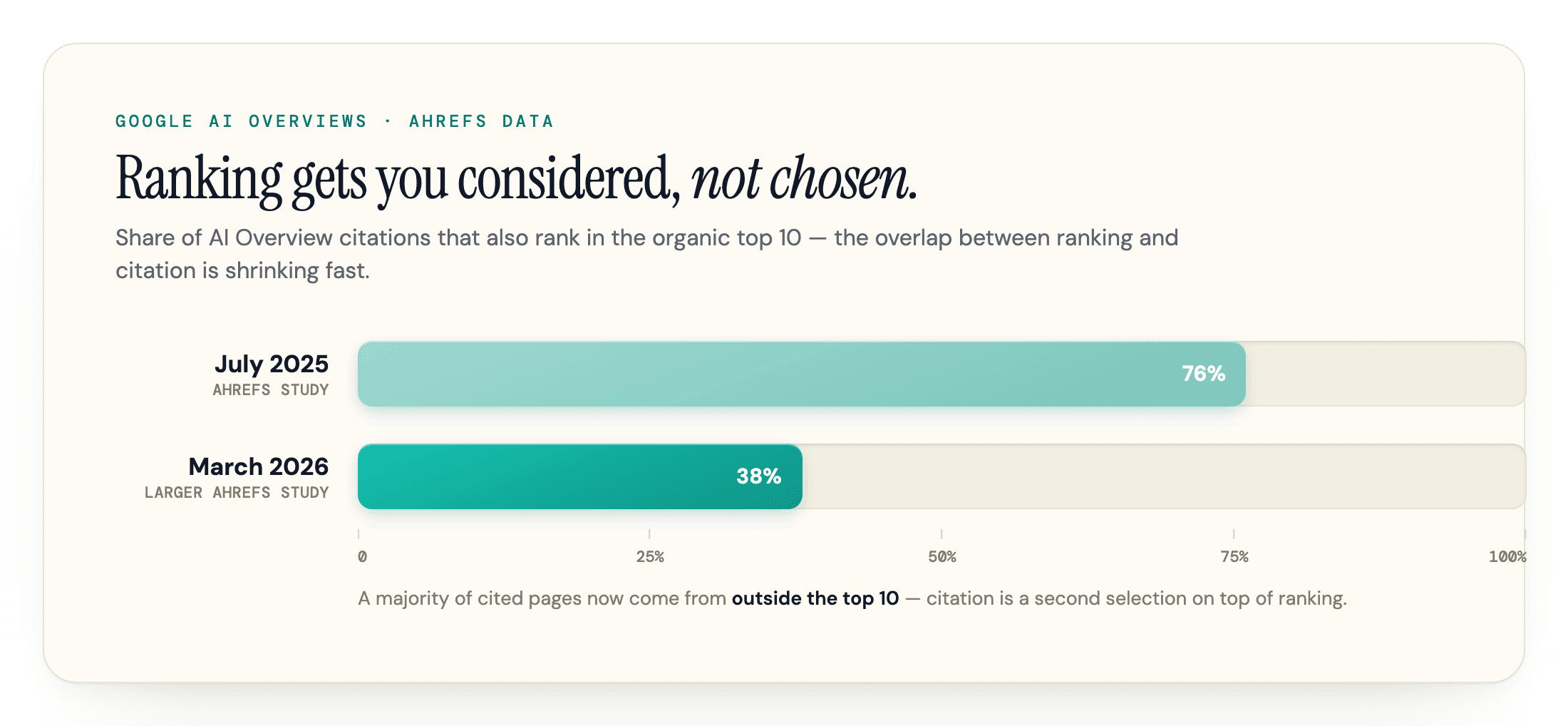
The reason is that ranking logic and citation logic are different systems. Ranking asks "which page best deserves this position." Citation asks "which passage best supports this specific sentence in the answer." A page can win the first and lose the second by burying its answer or being hard to extract.
The Prerequisite Everyone Skips: Can Google Reach and Render Your Page?
Before any content tactic matters, Google has to be able to fetch your page and see the content on it. If it cannot, you are not eligible for the overview, full stop. A lot of "how to rank in AI Overviews" advice skips this entirely.
Two failure modes are common and invisible:
- The page is blocked or not indexed. AI Overviews draw from Google's normal Search index, so a page that is not indexed and eligible for a snippet cannot be cited. A stray robots rule or a
noindexleft in place quietly removes you. If Google picked a duplicate as the canonical URL, that duplicate is the version it is likely to link. - The content only exists after JavaScript runs. If your answer is injected client-side and the rendered HTML Google processes is nearly empty, there is nothing to extract. The page may look fine to you and be blank to the crawler.
In our experience auditing pages with Geotoolbox, one of the most common reasons a well-ranked page is never cited is not content quality. It is a render failure: a JavaScript error, a blocked resource, or a timeout leaves the indexed HTML missing the answer, and nobody notices because the page looks perfect in a browser, where the scripts run fine.
This is the cheapest win available because it is binary: either Google can render your answer or it cannot. Confirm it before optimizing a single sentence. The free AI-Readiness Score checks the crawler-access foundations; verifying what actually renders takes a live fetch, which is what the Content Analyzer does. Then move on to the content work.
How AI Overviews Pick Their Sources
AI Overviews are generated by Gemini, grounded on results retrieved from Google's Search index. (AI Overviews are one of four Gemini surfaces; Gemini SEO covers getting cited across all of them, and Claude vs Gemini looks at how that same model performs as an assistant.) Understanding that loop tells you where to intervene.
When you enter a query, Google expands it into many related sub-queries, a process called query fan-out, and retrieves candidate passages for each. The overview is then written from the passages that best support each part of the answer. The practical consequence is large: you are rarely competing for one phrase. You are competing across a whole neighborhood of sub-questions.
The data backs this up. A Surfer study reported by Search Engine Land found pages were about 161% more likely to be cited when they ranked across the fan-out sub-queries, not just the head term. Breadth of coverage on a topic beats a single optimized page.
Two takeaways follow. First, cover the adjacent questions around your topic so you can be retrieved on the sub-queries. Second, corroboration matters: a claim echoed across trusted sources is safer for the model to repeat. For the underlying mechanics across engines, see how AI search works and our definition of query fan-out.
What Google Officially Says (and What That Rules Out)
Here is the part many guides leave out, because it deflates half their advice. Google has stated plainly that there is no special trick for AI Overviews.
Its guidance on AI features says you do not need to create new machine-readable files, AI text files, or markup, and that there is no special schema.org structured data for AI features. To be eligible, "a page must be indexed and eligible to be shown in Google Search with a snippet." AI Overviews run on the same index and the same helpful-content fundamentals as classic Search. In May 2026 Google reinforced the point with a dedicated guide to optimizing for generative AI features, which says this work is "still SEO" from Google's perspective and that creating content people find unique, compelling, and useful will likely influence your presence in generative AI search more than any other suggestion in the guide.
That rules out a lot of what gets sold. There is no AI-Overview schema to add, and no file you can drop in to force inclusion. On llms.txt specifically: Google's own generative-AI guide says you do not need it for Search or AI Overviews, though Google did add an llms.txt audit to Chrome Lighthouse on May 5, 2026, under Lighthouse's new agentic-browsing category, which is a separate concern from ranking. Anyone selling an "llms.txt for AI Overviews" fix is selling something Google's own documentation says you do not need. (What structured data does and does not do across every AI engine is covered in schema markup for AI search.)
The honest version: there is no shortcut. What works is being indexed, reachable, genuinely helpful, and easy to extract.
How to Make Your Page Citable
Once Google can reach and render your page, citability comes down to making your answer easy to lift. Run this checklist on the pages you want cited.
| # | Move | Why it works for AI Overviews |
|---|---|---|
| 1 | Answer in the first 40-50 words | The model lifts the direct answer; an inverted-pyramid lede gives it a clean passage to quote |
| 2 | Use lists and tables for structured facts | 78% of AI Overviews contain an ordered or unordered list (Surfer), so list-friendly content is extracted more often |
| 3 | Favor density over length | Grounding plateaus around 540 words per page; past that, extra length dilutes coverage without increasing what gets selected |
| 4 | Add citable substance | Specific, sourced statistics and quotes lift generative-engine visibility by up to 40% (pre-AI-Overview GEO research) |
| 5 | Cover the sub-questions | Pages that rank across the fan-out are far more likely to be cited |
| 6 | Show E-E-A-T and freshness | Clear authorship, sourcing, and a visible update date support inclusion on YMYL (Your Money or Your Life) and fast-moving topics |
Two Notes That Trip People Up
Two of these deserve a note. On length, Dan Petrovic's analysis of Google's grounding chunks found that what Google selects from a single page plateaus around 540 words (about 3,500 characters), against a fixed per-query grounding budget of roughly 2,000 words split across sources, which is why pruning a bloated section often helps more than adding to it. On lists and structure, Surfer's AI Overviews study is the source for the 78% figure.
A quick example of move #1, using the same heading:
Buried: "There are many factors that influence how often you should post on social media, and it really depends on your audience, platform, and goals..."
Answer-first: "Most brands should post 3 to 5 times per week on social media. Here is how that shifts by platform and audience." The second version gives the overview a clean, liftable sentence; the first gives it nothing.
None of this is AI-Overview-only. It is the same answer-first, extractable structure that wins across engines, which is why the step-by-step version lives in our how to optimize for AI search playbook.
Off-Site: Where AI Overviews Already Look
AI Overviews do not only cite your own pages. They lean on the sources Google already trusts for a topic, and for many queries that means YouTube videos, active Reddit and forum threads, and third-party "best of" list posts. Being present and accurately described in those places is part of getting cited, and our cross-engine guide to how to get cited by AI covers how the other engines weigh those same surfaces.
The move is not to spam them. It is to make sure your brand shows up, correctly, in the places the overview already pulls from: a relevant video, an honest mention in a community thread, inclusion in a credible roundup. A claim that only lives on your own domain is weaker than one corroborated across these surfaces. This is the off-site half of earning an AI citation.
How to Measure AI Overview Citations
This is where AI Overviews get genuinely hard, and where honesty matters. Google Search Console bundles AI Overview clicks in with regular organic clicks; there is no native segmentation for "clicks from the overview." The reporting gap began to narrow on June 3, 2026, when Google launched generative AI performance reports in Search Console showing impressions broken down by pages, countries, devices, and dates — with AI Overviews and AI Mode counted together in a single generative-AI bucket you cannot split, plus a twin report for Discover — the rollout started with a subset of sites and, as of August 31, 2026, covers all websites worldwide. Clicks are still not broken out, so you still cannot get a clean, complete count of overview-driven clicks, and any tool claiming a precise one is overstating what is knowable.
What You Can Actually Track
What you can do is triangulate, and a dedicated way to track your AI Overviews makes the first two checks repeatable:
- Citation presence. Run your core questions and record whether your domain appears in the overview, and who is cited instead.
- Citation share of voice. Track that presence across a set of prompts over time, versus competitors.
- Click-through rate (CTR) reframe. Expect lower click-through where an overview appears. Ahrefs measured roughly a 58% lower CTR for the top organic result when an AI Overview is present, so judge success by citation presence and assisted conversions, not raw clicks alone.
Track the trend, not a single number. A monitoring view that tracks your AI visibility over time turns scattered manual checks into a baseline you can report on.
Frequently Asked Questions
Why am I not cited even though I rank #1?
Diagnose in this order: confirm the page is indexed and snippet-eligible, fetch it without JavaScript to confirm the answer survives, then check whether the cited competitors answer the question in their opening lines while yours arrives later. In practice the fix is usually one of those three, and the first two take minutes to rule out.
Can you control whether you appear in an AI Overview?
Not directly; inclusion is earned probabilistically, not switched on. Control runs the other way, and it got a real switch: on June 3, 2026 Google began testing a Search Console toggle that opts a site out of AI Overviews, AI Mode, and AI Overviews in Discover while keeping it in classic Search, which Google says is not used as a ranking or inclusion signal elsewhere in Search. It started with a subset of UK properties, with Google beginning to respect the setting on June 17, 2026 under a binding Competition and Markets Authority conduct requirement, and by August 31, 2026 Google had rolled it out to every property worldwide. It works at property level, with child properties inheriting from their parent, and it does not cover the Gemini app, which is governed separately by Google-Extended. For most sites this is the wrong lever: opting out withholds your content from the answer without bringing the click back, so it is really for publishers who want to hold content back, not for anyone chasing AI visibility. Until you have a reason to reach for it, the blunt levers remain: nosnippet/max-snippet rules remove you (along with your snippets), and a noindex removes you entirely. Everything else is influence, not control. And if what you want is to stop seeing AI Overviews as a searcher, that is a different problem with its own fixes: see turning off AI Overviews.
Is SEO dead in 2026?
No, but the scoreboard changed. The work that earns rankings still feeds AI Overviews, while the payoff increasingly arrives as a citation instead of a click. Budget for both outcomes when you judge whether a page is performing.
Do AI Overviews use schema or llms.txt?
Neither is an inclusion lever. Schema still earns classic rich results and helps machines disambiguate your entities, which is reason enough to keep it. llms.txt is for AI agents browsing your site, a different audience from Google's overview pipeline.
How do I track AI Overview citations?
Build a fixed prompt set of 10 to 20 core questions, check them on a schedule rather than ad hoc, and log who is cited each time. The competitor column of that log is the real asset: it tells you which pages to study and displace. For the engine-specific playbooks, see getting cited in ChatGPT and Perplexity.
How often do AI Overviews appear?
Ahrefs measured AI Overviews on 20.5% of keywords across 146 million search results, Conductor's AEO/GEO benchmark measured 25.11% across 21.9 million searches, and a 55,393-query academic study measured 13.7% on trending queries in March and April 2026; the exact rate depends on query mix. Every measurement agrees on the shape: the rate is consistently highest on informational and question queries (64.7% in that study), which is where most content marketing lives.
Start with What You Can Control
The unglamorous part is the effective part, and the first move costs nothing.
Start with the prerequisite the other guides skip. Geotoolbox's free AI-Readiness Score checks whether the crawler-access foundations are in place, and the Content Analyzer verifies rendering and grades how citable the page is. Fix that first, then work down the checklist.
Sources
- AI features and your website - Google Search Central -
developers.google.com/search/docs/appearance/ai-features - Optimizing your website for generative AI features on Google Search - Google Search Central, 2026 -
developers.google.com/search/docs/fundamentals/ai-optimization-guide - New opportunities, control and insights for website owners - Google, June 2026 -
blog.google/products-and-platforms/products/search/new-controls-website-owners - Introducing Search Generative AI performance reports in Search Console - Google Search Central, June 2026 -
developers.google.com/search/blog/2026/06/gen-ai-performance-reports - Measuring Google AI Overviews: Activation, Source Quality, Claim Fidelity, and Publisher Impact - Xu, Iqbal & Montgomery, 2026 -
arxiv.org/abs/2605.14021 - Share of AI Overview citations that rank in the top 10 - Ahrefs, 2026 (data) -
ahrefs.com/blog/ai-overview-citations-top-10 - AI Overviews and click-through rate - Ahrefs, 2026 (data) -
ahrefs.com/blog/ai-overviews-reduce-clicks-update - AI Overview fan-out rankings boost citation odds (Surfer study) - Search Engine Land, 2025 -
searchengineland.com/ai-overview-fan-out-rankings-boost-citation-odds-study-466426 - Google AI Overviews appear on 21% of searches (Ahrefs data, 146M search results) - Search Engine Journal, November 2025 -
searchenginejournal.com/google-ai-overviews-appear-on-21-of-searches-new-data/560471 - The 2026 AEO/GEO Benchmarks Report (25.11% AIO prevalence, 21.9M searches) - Conductor -
conductor.com/academy/aeo-geo-benchmarks-report - Google adds llms.txt check to Chrome Lighthouse - Search Engine Land, May 2026 -
searchengineland.com/google-llms-txt-chrome-lighthouse-478246 - What opting out of Google's AI search features means now - Search Engine Journal, August 2026 -
searchenginejournal.com/what-opting-out-of-googles-ai-search-features-means-now/584321 - AI Overviews study (78% contain a list) - Surfer, 2025 (data) -
surferseo.com/blog/ai-overviews-study - How big are Google's grounding chunks? - Dan Petrovic, DEJAN AI, 2025 -
dejan.ai/blog/how-big-are-googles-grounding-chunks - GEO: Generative Engine Optimization - Aggarwal et al., 2023 -
arxiv.org/abs/2311.09735