
Grok 4.5 is xAI's cheaper, faster answer to the frontier: a coding-focused model that Elon Musk calls "Opus-class," shipped on July 8, 2026. The reality is narrower than the headline. It sits a notch below the top models on raw intelligence, but it does frontier-adjacent work for a fraction of the cost, and it is fast. This covers what Grok 4.5 actually is, what it really costs, and why a new AI model matters even if you never write a line of code. (xAI has since released Grok 4.6 on August 12, 2026 and Grok 4.7 on September 21, 2026, both at the same $2/$6 price and 500K context; this page covers 4.5 specifically.)
Is Grok 4.5 Out? What xAI Just Launched
Yes. Grok 4.5 went public on July 8, 2026, released by SpaceXAI, the entity xAI now operates under. It is a model built for coding, agentic tasks, and knowledge work, not a chatbot upgrade, and it shipped as the default model inside xAI's coding agent, Grok Build.
The headline framing came from Elon Musk, who called it an "Opus-class model, but faster, more token-efficient, and lower cost." That claim is doing a lot of work. If you have used xAI's Grok before, the important shift is that 4.5 is aimed at people who ship software and do professional work, not at people asking a chatbot for trivia.
One catch shaped the launch: Grok 4.5 was not available in the European Union on day one. According to xAI's announcement, every EU market was excluded at the July 8 launch, with availability "expected in mid-July" while xAI completed the EU AI Act evaluations that apply to a model classified as carrying systemic risk. It hit that window: xAI confirmed on July 16, 2026 that Grok 4.5 is now fully available across Europe, so EU users can reach it through SpaceXAI's products and the API.
What's New in Grok 4.5
The defining detail is who helped train it. Grok 4.5 was trained alongside Cursor, the AI coding editor, using real developer-session data. Cursor's launch note describes it as the first model built for more than software engineering, tuned on long-running, in-codebase agent workflows rather than static code snippets. That is the source of most of its coding strength, and also of one of its credibility questions.
The training run itself was large. xAI says Grok 4.5 was trained across tens of thousands of NVIDIA GB300 GPUs, with reinforcement learning spanning hundreds of thousands of multi-step engineering tasks and heavy data filtering and deduplication. The stated goal was per-token intelligence, getting more out of each token rather than simply generating more of them.
You will see claims that Grok 4.5 runs on a new "V9" foundation with roughly 1.5 trillion parameters, a jump from Grok 4.3's smaller base. Treat those numbers as unconfirmed. They come from secondary coverage and leaks, not from xAI's own model card, which publishes no parameter count or architecture. If parameter counts matter to your decision, note that this one is unverified. For context on why "bigger" does not automatically mean "smarter," a mixture-of-experts design can carry a huge parameter count while only activating a fraction per request.
On the product side, Grok 4.5 was the default model in Grok Build, xAI's terminal coding agent that can run up to eight parallel sub-agents, at launch; xAI's Grok 4.7 announcement now lists Grok Build among the places the newer model is available. It sits in the same release cadence that produced the still-unreleased Grok 5: ship narrower, capability-specific models fast rather than wait on one general flagship.
Grok 4.5 Benchmarks: What the Numbers Show
This is where the marketing and the numbers diverge. xAI's prose says Grok 4.5 exceeds comparable leading models. Its own benchmark chart says something more mixed. Across four of the coding benchmarks xAI published, Claude Fable 5, then Anthropic's most capable model, posts the top score on all four, and Grok 4.5 only stays close on one of them.
| Coding benchmark | Grok 4.5 | Fable 5 (max) | GPT-5.5 (xhigh) | Opus 4.8 (max) |
|---|---|---|---|---|
| DeepSWE 1.0 (pass@1) | 62.0% | 66.1% | 64.31% | 55.75% |
| DeepSWE 1.1 (mini-swe-agent) | 53% | 70% | 67% | 59% |
| Terminal Bench 2.1 | 83.3% | 84.3% | 83.4% | 78.9% |
| SWE-Bench Pro (resolve rate) | 64.7% | 80.4% | 58.6% | 69.2% |
The picture is competitive, not dominant. Grok 4.5 beats GPT-5.5 on SWE-Bench Pro but trails Opus 4.8 and Fable 5 there, and it is closest to the leader on Terminal Bench 2.1. These are also xAI's own figures (reported by MarkTechPost from the launch chart), with competitor numbers pulled from their system cards and leaderboards, so treat them as a vendor's best case and verify on your own tasks.
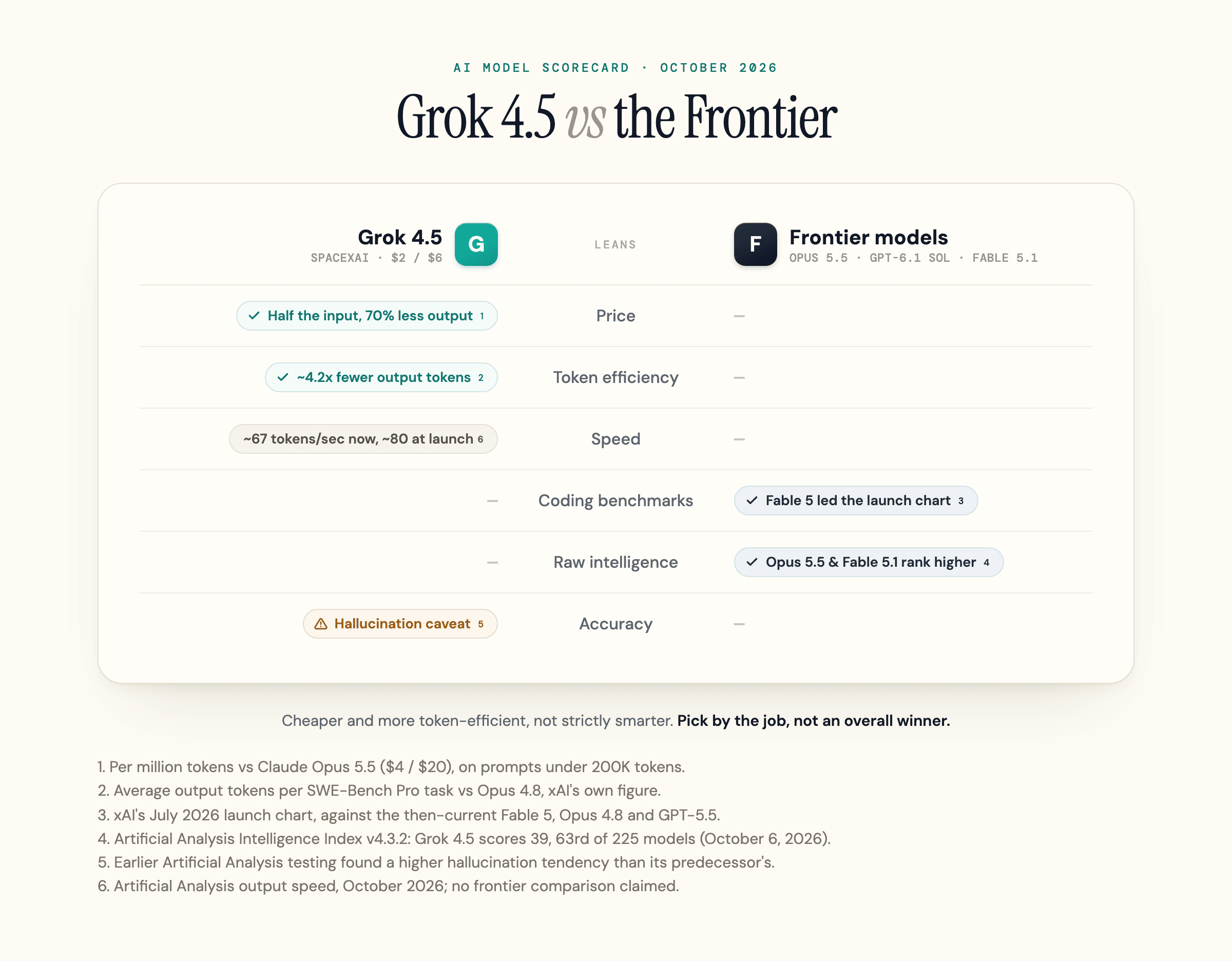
Independent testing lands in the same place. On the Artificial Analysis Intelligence Index (current version v4.3.2), Grok 4.5 scores 39 and ranks 63rd of 225 models as of October 6, 2026, behind the frontier leaders rather than level with them, and Artificial Analysis now lists it as deprecated, benchmarking only the default workload. Scores from older index versions are not comparable, so we cite only the current one. Artificial Analysis's earlier testing flagged a reliability caveat: its hallucination tendency looked higher than its predecessor's, even as its factual knowledge improved. A model that knows more but states wrong answers with more confidence is exactly the failure mode you do not want in legal, financial, or client-facing work, so verify anything high-stakes rather than trusting a confident reply.
Musk pitched Grok 4.5 as "Opus-class," but his more precise comparison was narrower: "roughly comparable to Opus 4.7, but much faster," referencing the previous Opus generation rather than the then-current Opus 4.8 (Anthropic has since moved the tier on again to Opus 5, and then to Opus 5.5 on September 22, 2026). That gap between his own two framings tells you most of what you need to know.
The coding numbers also deserve extra scrutiny for a specific reason: the model was co-trained with Cursor on Cursor's own workflows, and Cursor left its own CursorBench test out of the launch comparison after flagging a training overlap. That does not taint the other benchmarks, but it is a reason to run your own trials before trusting any leaderboard. If you want the fuller side-by-side, our Grok vs Claude comparison breaks down where each model actually pulls ahead.
Grok 4.5 Pricing: The $2/$6 Headline and the Real Cost
Price is where Grok 4.5 makes its actual case, with one catch that the headline rate hides. It costs $2 per million input tokens and $6 per million output tokens, with cached input at $0.30 per million and a 500,000-token context window, per xAI's model docs. Against the current frontier, that is half the input price and 70% less on output than Claude Opus 5.5 ($4/$20), and the same $2 input as GPT-6.1 Sol with 40% less on output ($10), on prompts under 200,000 tokens.
The catch is a price cliff at 200,000 tokens. xAI publishes a tiered table, not a flat rate: past that point input goes to $4, cached input to $0.60, and output to $12. And it is a cliff rather than a marginal tier, because in xAI's own words, "requests whose prompt reaches 200k tokens are billed at the higher rate for all tokens in the request." A 201,000-token request costs roughly double a 199,000-token one. On a model sold on its 500,000-token window, the advertised $2/$6 only holds across the bottom 40% of that window, which is worth knowing before you design a long-context workload around it. One quiet trade-off worth noting: that 500,000-token window is smaller than the multi-million-token windows some earlier Grok variants advertised, so if you were feeding the model very large codebases or documents, 4.5 is a step down on context.
| Model | Input / 1M | Output / 1M | Context |
|---|---|---|---|
| Grok 4.5 | $2 ($4 ≥200K) | $6 ($12 ≥200K) | 500K |
| Claude Opus 5.5 | $4 | $20 | 1M |
| GPT-6.1 Sol | $2 ($4 >272K) | $10 ($15 >272K) | 1.05M |
| GPT-6 Luna (cheap tier) | $0.10 ($0.20 >272K) | $0.50 ($0.75 >272K) | 1.05M |
The headline is real, but it is not your final bill. xAI's built-in API tools (web search, X search, code execution, document search) carry separate per-call fees, so a tool-heavy agent run costs more than the token math alone. Budget from a real workload, not just the headline rate.
For most buyers the comparison that matters is against the model they already pay for. Grok 4.5 is confirmed on OpenRouter at the same $2/$6 and 500K context, routed through the gateway if you do not want to sign up for xAI directly. If you are weighing it against the OpenAI side, the current GPT-6 family undercuts it clearly only at the Luna tier: GPT-6 Luna is $0.10/$0.50, a twentieth of Grok 4.5's input price and a twelfth of its output price, on a 1.05M window rather than 500K. GPT-6.1 Sol, the tier above, matches Grok's $2 input but charges $10 on output against $6. Against consumer Grok plans, our Grok pricing breakdown covers SuperGrok and the free tier.
Speed and Token Efficiency: Where Grok 4.5 Actually Wins
If the benchmarks are mixed and the price is a win, efficiency is the knockout. Artificial Analysis currently measures Grok 4.5 at about 67 tokens per second (it was around 80 at launch), and xAI claims about twice the token efficiency of comparable leading models overall, solving tasks in under half the steps.
The efficiency number is the one worth internalizing. On SWE-Bench Pro, Grok 4.5 resolved tasks using about 15,954 output tokens on average, against roughly 67,020 for Opus 4.8, a gap of about 4.2x fewer output tokens per task (xAI's own figure). Output tokens are the expensive half of the bill, so that efficiency stacks on top of the lower per-token rate. The combined effect is an effective cost per coding task that is close to an order of magnitude lower than Opus 4.8 on that benchmark, at least on prompts that stay under the 200,000-token pricing threshold, even though Grok 4.5 is a step behind the top tier on raw capability. That is the whole pitch: not the smartest model, but by some distance the cheapest way to get frontier-adjacent work done, especially across a long context window where token counts pile up.
How to Access Grok 4.5
Access is genuinely fragmented, which trips up a lot of people. The model ID is grok-4.5, and you can reach it several ways:
- Grok Build, xAI's terminal coding agent, where it was the launch default (
x.ai/cli); Grok 4.7 is now offered there too - Cursor, on all plans
- The SpaceXAI console and API directly, for your own integrations
- SuperGrok and X Premium, for chat-style consumer use
- Gateways like OpenRouter, Vercel, and Cloudflare, if you already route models through one
Cursor's free promotional window closed in July, and xAI has run free trial usage in Grok Build since, so check the current offer before you pay. The EU was the one market that launched late: the model was blocked across every member state at the July 8 launch, and a VPN was the only workaround people reported, until xAI confirmed full European availability on July 16, 2026. EU teams can now use it directly.
If you handle client or regulated data, check the plan terms before you connect anything. On xAI's free and consumer tiers, conversations may be used to improve the models. Only the Business and Enterprise plans guarantee your data is excluded from training.
The Grok Build Repo-Upload Problem
If you are evaluating xAI's coding CLI rather than just the model, this belongs in the decision. In mid-July 2026 a researcher publishing as cereblab captured traffic from Grok Build 0.2.93 and showed it packaging the developer's entire tracked repository, full Git history included, to an xAI-controlled cloud storage bucket, rather than only the files relevant to the task.
The specifics are what make it serious. On a 12 GB repo, traffic to the model endpoint was around 192 KB while 5.10 GiB went to storage. A canary file the model was explicitly instructed never to open was recovered verbatim from the uploaded bundle, which establishes that the upload was independent of anything the model actually read. A tracked .env file's credentials were stored unredacted. And the user-facing privacy toggle did not stop it: with "improve the model" switched off, uploads continued and the server kept reporting trace upload as enabled.
xAI shipped a server-side fix on July 13, 2026, and the uploads stopped in repeat testing. The company also addressed it publicly: Elon Musk confirmed the uploads had happened and said prior user data would be deleted, and xAI documented a zero-data-retention policy and added a privacy endpoint. So this is a disclosed and remediated issue rather than an open one.
Two caveats are worth keeping in view. The upload code reportedly remains in the binary, gated by a server-side flag that could be flipped back without a client update. And the response came through social posts rather than a formal security advisory, so no independent audit has confirmed the deletion and the number of affected accounts was never disclosed. Confirmed and addressed, in other words, but not independently verified.
None of this touches the Grok 4.5 model itself or the API. It is specifically the Build CLI, and specifically a reason to check what a coding agent uploads before pointing it at a repository with anything sensitive in it.
What Grok 4.5 Means for AI Search and Your Brand
This part matters if you market a brand rather than build software. Grok answers questions using live posts on X and the open web, which means it forms a view of your company and repeats it to anyone who asks. Grok 4.5 does not change that mechanism, but it changes the volume. The query "grok 4.5" alone is already drawing heavy AI-search interest, and a model that is cheaper and faster gets embedded in more products, which means more AI answers get generated, more often, in more places.
That is the shift worth planning around. A cheaper agentic model lowers the cost of every AI answer, so AI search stops being a novelty surface and becomes a distribution channel you either show up in or you do not. The lever is the same one it has always been for answer engine optimization: write pages that state facts cleanly enough to be lifted into an answer, and earn the kind of third-party mentions that models treat as corroboration.
In our experience, the brands that get cited by AI are rarely the ones with the most content. They are the ones whose key facts are structured, current, and repeated across sources an engine already trusts. If you are not sure whether Grok or any other engine currently mentions you, that is measurable. You can track your AI share of voice the same way you would track rankings.
Should You Use Grok 4.5? The Verdict
The trade is consistent: give up a little raw capability, get a lot of cost and speed back. That tells you exactly when to reach for it.
It is the right pick for cost-sensitive, tool-heavy agentic and coding work, especially high-volume implementation where the 4.2x token efficiency compounds across thousands of runs. If you are paying frontier prices to have a model grind through routine engineering tasks, Grok 4.5 does most of that work for a fraction of the bill.
It is the wrong pick when accuracy is non-negotiable. For legal, financial, or client-facing output where a confident wrong answer is expensive, the higher hallucination rate is a real liability, and a top-capability model earns its premium. Anyone who needs the single strongest model on raw reasoning should look at Fable 5.1, Opus 5.5, or GPT-6 Astra instead.
Whichever model you route to, the marketing question is the same: does it mention your brand when someone asks? The models change every few weeks, but AI visibility is now a channel worth measuring. Our free AI Readiness check shows you whether AI engines can actually crawl, read, and cite your site, which is the first thing to fix before you worry about which model won this week.
Frequently Asked Questions
Is Grok 4.5 available in Europe?
Not at launch, but yes now. Grok 4.5 shipped on July 8, 2026 with every EU market excluded while xAI completed the EU AI Act evaluations, with availability "expected in mid-July." It met that window: xAI confirmed on July 16, 2026 that Grok 4.5 is fully available across Europe, so EU users no longer need the VPN workaround people relied on at launch.
How much does Grok 4.5 actually cost?
The API rate is $2 per million input tokens and $6 per million output tokens, with cached input at $0.30. That is the headline, not the whole bill. Prompts that reach 200,000 tokens are billed at double those rates across the entire request. Built-in tools like web search, X search, and code execution each cost $5 per 1,000 invocations on top of tokens, and the agent decides how many calls to make, so a tool-heavy run can spend more on tools than on tokens. Reasoning tokens also bill at the $6 output rate even though you never see them. For chat use, access comes through SuperGrok or X Premium instead.
Is Grok 4.5 really "Opus-class"?
That is Elon Musk's phrasing, and it overstates the case. Independent testing on the Artificial Analysis Intelligence Index (v4.3.2) scores it 39, 63rd of 225 models as of October 6, 2026, behind frontier leaders like Claude Opus 5.5 and Fable 5.1. Musk's own precise comparison was "roughly comparable to Opus 4.7," a generation behind the Opus 4.8 that was current at launch, and Anthropic has since shipped Opus 5 and then Opus 5.5.
Is Grok 4.5 better than Grok 4.3?
For coding and agentic work, yes. Grok 4.5 is the successor xAI tuned specifically for those jobs, and it superseded Grok 4.3 as the interim flagship while Grok 5 trains, before being followed by Grok 4.6 and 4.7. The trade-offs: it lists at a higher per-token rate than 4.3, its context window is smaller than some earlier Grok variants, and its hallucination tendency runs higher, so if you rely on very long-context runs or need maximum factual reliability, test before you switch.
More Questions
Is Grok 4.5 good for coding?
It is competitive. It beats GPT-5.5 on SWE-Bench Pro, but Fable 5 leads every coding benchmark xAI published, and the numbers are xAI's own. Because it was co-trained with Cursor, run your own trials before trusting its coding scores.
Does Grok 4.5 hallucinate a lot?
In Artificial Analysis's earlier reliability testing, its hallucination tendency looked higher than its predecessor's, even as its factual knowledge improved, so it can state a wrong answer with more confidence. Enable web search to ground its responses, and verify anything you cannot afford to get wrong.
Sources
- Introducing Grok 4.5 - SpaceXAI -
x.ai/news/grok-4-5 - Grok 4.5 model docs - xAI -
docs.x.ai/developers/models/grok-4.5 - Grok 4.5 on the Artificial Analysis Intelligence Index -
artificialanalysis.ai/models/grok-4-5 - Introducing Grok 4.5 - Cursor -
cursor.com/blog/grok-4-5 - SpaceXAI Releases Grok 4.5 - MarkTechPost -
marktechpost.com/2026/07/08/spacexai-releases-grok-4-5 - Grok 4.5 on OpenRouter -
openrouter.ai/x-ai/grok-4.5 - xAI pricing and server-side tool fees - xAI -
docs.x.ai/developers/pricing - Grok Build uploads entire Git repositories - The Hacker News -
thehackernews.com/2026/07/grok-build-uploads-entire-git.html