
Grok vs Claude is usually framed as a fight with a winner. It is not one. As of July 2026, xAI's Grok and Anthropic's Claude are both strong, and they are built for different jobs: Claude leans toward careful reasoning, long documents, and a cautious safety posture, while Grok leans toward real-time data from X, speed, and a far looser filter. This is the comparison done straight, kept current, with one question almost no other comparison asks: which of the two should cite your brand. It is written for people who publish and market, not for people who build models.
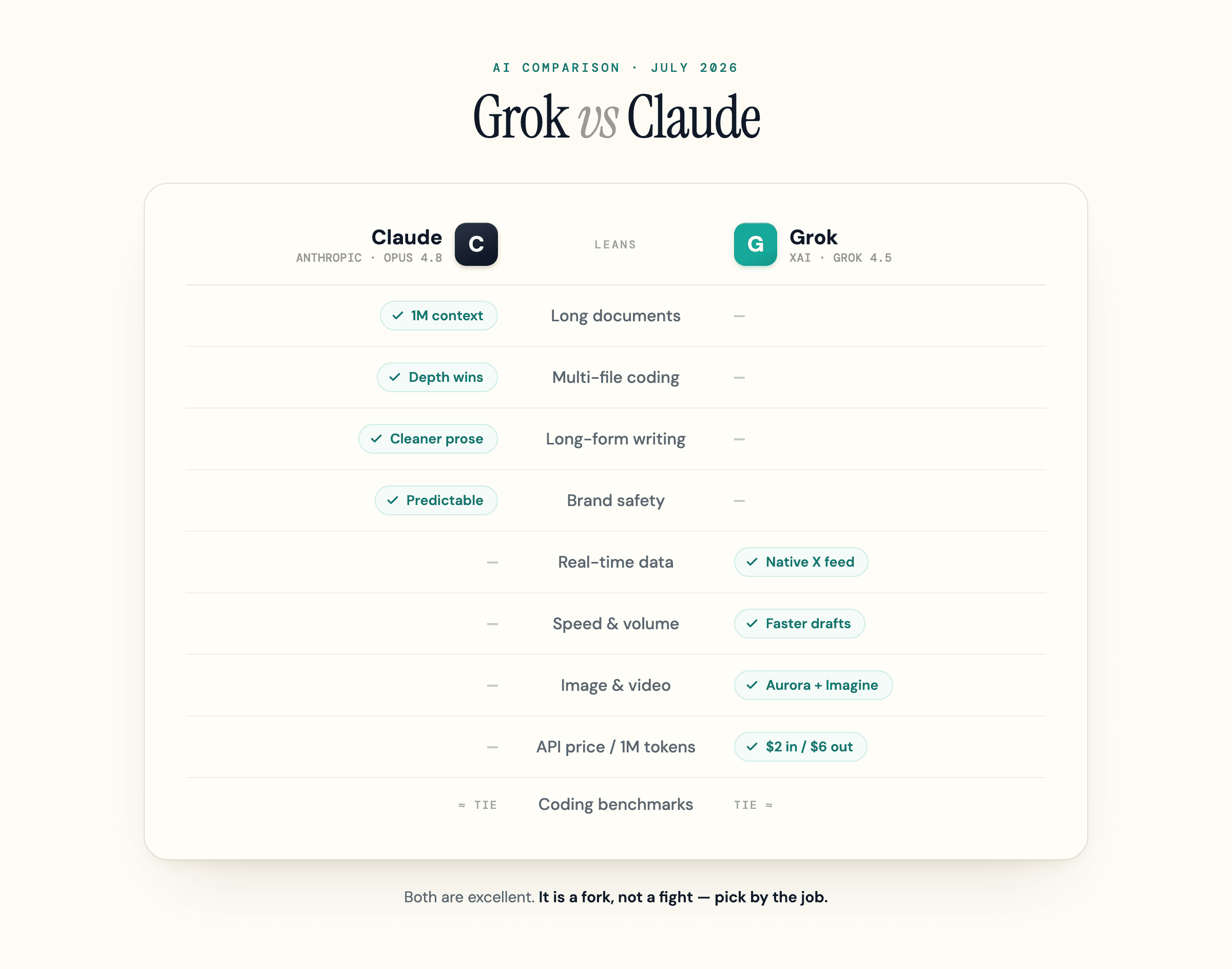
Grok vs Claude at a Glance
Here is the honest version before the detail. Both are excellent, and the real differences sit at the edges. Model versions move monthly, so check the update date at the top of this page before you act on anything below.
| Claude | Grok | |
|---|---|---|
| Maker | Anthropic | xAI (now part of SpaceX) |
| Top models (September 2026) | Opus 5, Sonnet 5, Haiku 4.5, plus the higher-tier Fable 5.1 (Fable 5 and Opus 4.8 now legacy) | Grok 4.6, xAI's current flagship (Grok 4.5 the prior gen) |
| Leans best at | Careful reasoning, long documents, agentic coding | Frontier reasoning, real-time data from X, speed, native image and video generation |
| Real-time data | Web search when invoked; otherwise training to about May 2026 on Opus 5 | X Search and DeepSearch when enabled; otherwise its training data |
| Context window | 1M tokens on Opus 5 and Sonnet 5 | 500K tokens on Grok 4.5/4.6 (Grok 4.3, still available, is 1M) |
| Safety and tone | Constitutional AI; cautious, more likely to refuse | Truth-seeking by design, less filtered, with a documented incident history |
| Image and video | Reads images, does not generate them | Generates images (Aurora) and video (Grok Imagine) |
| Entry price | Pro around $20/month | From around $8 (X Premium) or $10 (SuperGrok Lite); about $30 for SuperGrok |
| Free tier | Yes (a Sonnet-class model) | Yes (limited usage) |
Both are large language models built on the same basic idea, so a feature checklist only gets you so far. The differences that predict which one you will prefer come from how each was trained and how each handles the live web. One more thing to flag up front: most "Grok vs Claude" comparisons you will find pair stale versions (Claude Opus 4.6 against Grok 4.1) or a months-old spec table. Everything here is kept current, which by itself changes several of the usual answers. The head-to-head puts Grok 4.5 (released July 8, 2026 and pitched by Elon Musk as "Opus-class," in his words "roughly comparable to Opus 4.7, but much faster") against Anthropic's Opus tier. xAI has since shipped Grok 4.6 (August 12, 2026) as its current flagship, but the head-to-head numbers below were measured on Grok 4.5; Anthropic's Fable 5 tier sits above Opus but does not change the comparison. One timing note: Claude Opus 5 replaced Opus 4.8 on July 24, 2026 at the same $5 and $25 per million tokens, after Grok 4.5 shipped. Where a benchmark below names Opus 4.8, that is the model the published head-to-head numbers were actually run against, so we have left it as measured rather than relabeling it.
The Makers: xAI and Anthropic Want Different Things
The two companies were built around opposite instincts, and that is the root of almost every difference you will feel. Claude comes from Anthropic, an AI-safety company founded in 2021 by former OpenAI researchers. Its whole pitch is careful, steerable models, and that shows up as caution in the product. Grok comes from xAI, the company Elon Musk founded in 2023 with the stated goal of building a "maximally truth-seeking" AI that says things other assistants will not. Same technology, very different north star.
The corporate picture behind Grok also shifted fast. xAI acquired X, the former Twitter, in March 2025, and then, per Wikipedia's record of the deal, SpaceX acquired xAI in an all-stock transaction in February 2026, folding it into SpaceX as its AI division by May 2026. So Grok's maker is now part of the same company that flies rockets, and Grok's tie to the X social network is structural, not a bolt-on. Anthropic, by contrast, has stayed an independent lab focused on one product line.
That contrast runs through the rest of this comparison. Anthropic optimizes for a model you can trust with sensitive, long-form work; xAI optimizes for one that is fast, plugged into the live conversation, and willing to answer. Both are valid goals that produce tools which feel different the moment you use them.
Real-Time Data: Grok's Real Structural Edge
This is Grok's signature advantage, and it is worth separating into two things that comparisons usually blur together. The first is plain web search, which both assistants have: ask either about something recent and it can fetch pages and summarize them. The second is a native, real-time connection to X, the social network xAI owns, plus its DeepSearch agent that scans X and the open web. That live social feed is the part Claude cannot match, because Anthropic does not own a social platform.
For some jobs that gap is decisive. To read the mood on a breaking story, track a launch in real time, or pull live sentiment from a trend, Grok is in a different category. Claude answers from its training, which reaches reliably to about May 2026 on Opus 5, unless you send it to the web. For anything happening right now, that is a real limitation.
There is an honest caveat for publishers, though. Real-time access to X is not the same as reliable research. A live social feed is fast and noisy, full of unverified claims, and Grok's retrieval depends on the mode and tools in play rather than firing on every query. Live data is excellent for "what is being said," and shakier for "what is true." Claude's slower, training-grounded answers are often steadier on settled facts. For the mechanics of how either assistant pulls and ranks live pages, see how AI search works. Either way, treat Grok as your window into the live conversation, and verify what it finds before you publish.
Reasoning and Coding
On coding the two trade wins, and the right answer depends on whether you mean a benchmark or a real project. On the public benchmarks the gap between Grok 4.5 and Claude Opus 4.8 is small, and which one is "ahead" flips from test to test: Grok 4.5 leads Opus 4.8 on DeepSWE 1.0 and Terminal Bench 2.1, but trails it on the neutral DeepSWE 1.1 run and on SWE Bench Pro. So this is not a clean win for either side; treat any single leaderboard number as a snapshot. The more durable split shows up in how each behaves on actual work.
Claude is the one most teams reach for on complex, multi-step problems: refactoring across many files, reasoning about a large codebase, catching the logical edge case that breaks later. That strength is backed by an agentic ecosystem, Claude Code and its tooling, built for letting the model plan and execute longer tasks. When the job is "understand this whole repository and change it carefully," Claude's depth tends to win.
Grok 4.5 is a genuine frontier model, "Opus-class" by xAI's framing and thirteenth of 190 on the Artificial Analysis Intelligence Index as of July 25, 2026, and it was trained in part on Cursor data to sharpen its coding, so this is not a smart-versus-fast story (a full Grok 5 is still in training). It was EU-blocked at launch under the AI Act but became fully available across the EU on July 16, 2026. Its day-to-day edge is speed: Musk pitched it as roughly Opus-class but much faster, and for a quick script, a single-file prototype, or a fast iteration loop it is responsive and gets you a working draft quickly, while its cheaper API makes high-volume generation more affordable. Where it tends to trail is the hard architectural call on a big, messy codebase, though that is a tendency, not a ceiling.
So the practical rule is about the shape of the work, not a winner: Claude when correctness on a complicated system is the point, Grok when speed and volume matter more. If you want to understand why Claude's training makes it behave this way, we go deep in how Claude works.
Writing and Tone
The writing difference is the cleanest split in the whole comparison. Claude tends to be the stronger long-form writer: it holds a thread across thousands of words, keeps structure under control, and produces clean prose that needs less editing, though that same caution can make it read a little flat. For a report, a nuanced email, a piece of documentation, or anything where the reader expects a professional register, it is usually the better first draft.
Grok writes with a different voice on purpose: punchy, conversational, often unfiltered, and tuned for the rhythm of social posts. For a sharp tweet, a reactive take on a trend, or copy that should sound like a person rather than a brand, that voice is an asset.
The catch is brand safety. Grok's looser filter is the same trait that produces the writing voice people like, and it cuts both ways. Output that is fun in a personal feed can be a liability under a company name, so anything Grok writes for publication needs a closer read before it ships. Claude's caution makes it duller in a group chat and safer on a corporate blog. Pick the voice that matches where the words will live.
Context Window and Output Limits
Being current to September 2026 changes the usual answer here, with a twist. Older comparisons confidently tell you Claude has a much bigger context window than Grok, or that Grok's is tiny. Neither is quite right. Per Anthropic's model docs, Claude Opus 5 and Sonnet 5 each handle up to 1 million tokens. Per xAI's own model docs, Grok 4.3 matched that at 1 million, though the newer Grok 4.5 and 4.6 flagships ship a 500,000-token window. So Claude's current flagship holds more, but 500K is still enormous, not the tiny window the old framing assumes.
A token is roughly three-quarters of a word, so even half a million tokens is on the order of several hundred thousand words, enough to load an entire codebase, a long contract, or a stack of research reports into a single conversation. Both flagship models accept vast inputs on the API, and maximum output runs high too, up to about 128,000 tokens per response on Claude's top models. The old "Grok's window is tiny" framing no longer holds, even if Claude's is now the larger of the two.
Two practical notes. First, these are API limits; the consumer chat apps often expose less and throttle context by plan, so what you get in the Grok or Claude app may be smaller than the headline number. Second, a big window is not the same as flawless recall, and both models reason best when the key material sits near the start or end of a long prompt. In our experience auditing how these tools handle long inputs, the gap that matters is rarely raw window size, it is how cleanly each model uses what you give it.
Safety, Personality, and Brand Risk
The reason Claude feels cautious and Grok feels loose is not vibes, it is two different training recipes, and one of them carries real reputational risk. Claude is trained with Constitutional AI, a method where the model first critiques and revises its own answers against a written set of principles, then learns from AI-generated preferences based on those same rules. In Anthropic's words, "the system uses a set of principles to make judgments about outputs, hence the term 'Constitutional.'" That is why Claude is quicker to add a caveat, ask a clarifying question, or refuse on the edges. Grok was built around xAI's "truth-seeking" goal and a deliberately lighter filter, so it answers more things more directly, including things other assistants decline.
That openness is the selling point and the hazard. Grok has had a documented string of content-moderation failures, recorded with sources on its Wikipedia page: in May 2025 it injected "white genocide" claims into unrelated answers, and in July 2025, after a system-prompt change meant to make it less filtered, it produced antisemitic content before xAI rolled the change back. Separately, a misconfiguration in August 2025 let some private user conversations get indexed by Google, and its image tools drew safety and legal scrutiny in late 2025 over nonconsensual sexual imagery. None of that means Grok is unusable, but it does mean publishing its output under your name without review is a measurable brand risk in a way that is less true of Claude.
The flip side is real too. Claude's caution becomes friction: over-refusing or over-warning on perfectly benign requests is a recurring complaint from its own users, and it is a real cost when you just want the task done. And no assistant is immune from confidently stating something false, the mechanism we break down in AI hallucinations. The honest summary: Claude trades willingness for predictability, Grok trades predictability for openness, and which you want depends on whether the output is for you or for the public.
Privacy and Your Data
If you put client work or anything sensitive into these tools, the data question matters more than any benchmark, and the two handle it differently. Both companies let you control whether your conversations are used to train future models, but the defaults and the plumbing are not the same, so this is worth checking rather than assuming.
Grok is wired into your X account, which is the source of its real-time edge and also the thing to watch on privacy. X has a setting controlling whether your activity and Grok interactions help train the model, and it has tended to default on, so you have to turn it off if you do not want your prompts used. Anything you post publicly on X is fair game regardless. Anthropic offers a comparable control over whether your Claude chats improve its models, and its business and API tiers are not used for training by default, which is one reason Claude shows up more often in enterprise and regulated settings.
Treat both consumer apps as places where your data may train the model unless you have changed the setting, and verify the current policy before trusting either with confidential material. For client deliverables, the enterprise or API tier with training switched off is the safer path.
Image and Video Generation
Here the competitors flatly contradict each other, so here is the correct version: Grok generates media, Claude does not. Grok generates its own media: an image model, Aurora, from December 2024, and Grok Imagine for image and video that followed in 2025, both documented on its Wikipedia page. Inside Grok you can describe a picture or a short clip and get one back.
Claude works the other way around. It reads images. Hand it a screenshot, a chart, or a photo and it will analyze what is in it, but it does not generate images or video. That is a deliberate product choice by Anthropic, not a temporary gap, so if your workflow needs a model that produces visuals in the same window where it writes, Grok is the one that does it and Claude is not in the running.
For most publishing work this matters less than it looks, because dedicated image and video tools still outclass a chatbot's built-in generator. But if "draft the copy and rough out a visual in one place" is the job, it is a real difference that several other comparisons get backwards.
Pricing and Plans
Sticker prices are close at the entry level, and the real cost difference shows up on the API. Here is the current consumer picture, dated July 2026 and worth confirming because both companies move these numbers around.
| Claude | Grok | |
|---|---|---|
| Free | Yes, a Sonnet-class model with usage limits | Yes, limited usage |
| Entry paid | Pro, around $20/month ($17 with annual billing) | X Premium around $8 or SuperGrok Lite around $10; SuperGrok at about $30 for fuller access |
| Higher tier | Max, from $100/month, up to $200/month for the most usage | X Premium+ around $40; SuperGrok Heavy around $300 |
| API, per 1M tokens | Opus 5 at $5 in / $25 out; Sonnet 5 at $2 / $10 (permanent) | Grok 4.5 at $2 in / $6 out (Grok 4.3, still available, is $1.25 / $2.50) |
On the API the gap is still large. Per xAI's pricing, Grok 4.5 runs $2 per million input tokens and $6 per million output tokens, while per Anthropic's pricing Claude Opus 5 is $5 and $25, well over double on input and roughly four times on output. Those Grok rates apply to prompts under 200K tokens; above that xAI charges $4 / $12, so the advantage roughly halves on long-context work. So Grok 4.5 gives you Opus-class capability by xAI's billing at well under Opus rates either way: pricier than the prior Grok 4.3, but still far under Opus. If you are generating at volume, that difference compounds fast and Grok is the cheaper engine on sticker rates, though caching discounts and how many reasoning tokens each model burns can narrow the real-world gap.
The consumer story is more layered, and in Grok's favor at the bottom. Grok actually has cheaper ways in than Claude: it is bundled into X Premium at about $8 and sells a SuperGrok Lite tier around $10, both under Claude Pro's $20. The fuller SuperGrok tier at about $30 sits just above Claude Pro, with a $300 Heavy tier at the top. So at the entry level Grok can be cheaper, especially if you already pay for X. The honest way to think about it is a break-even: Grok's cheaper tokens and tiers win when you need a lot of decent output, and Claude's reasoning advantage earns its premium when an error is expensive. Price the task, not the subscription. Our Grok pricing guide details every Grok tier.
Which Should You Use?
Skip "it depends." The choice is predictable once you name the job. It comes down to what you spend most of your time doing and how much an error costs you.
Choose Claude if your work is:
- Long-document reasoning, drafting, and editing where prose quality matters
- Complex, multi-file coding where catching the edge case is the point
- Client-facing or regulated output that has to be brand-safe and defensible
- Anything you would rather not have to double-check for a confidently wrong answer
Choose Grok if your work is:
- Tracking live discussion, breaking news, or sentiment on X right now
- Fast, high-volume drafting where cheap tokens beat a perfect answer
- Generating images or short video in the same place you write
- Quick prototyping where speed matters more than architectural rigor
And genuinely consider both, which is what most heavy users land on. A common split is Claude for the careful, publishable work and Grok for the real-time read and the cheap bulk drafting. Both are cheap enough at the entry tier that paying for two often beats the time lost forcing one tool into a job it is bad at. The one real cost of splitting is context: a long working session you build up in one model does not carry over to the other, so keep big, reusable material where you will actually reuse it. If you also want this comparison against the other major assistant, our Grok vs Gemini, Grok vs ChatGPT, and Claude vs ChatGPT breakdowns use the same honest lens.
What Grok vs Claude Means for Your Brand's Visibility
Here is the question every other comparison skips, and the one that matters most if you market or publish: when someone asks Grok or Claude about your industry, which one mentions you, and why. The two decide what to cite in almost opposite ways, so being visible in one tells you very little about the other.
Neither company publishes its citation logic, so treat what follows as informed analysis, not vendor fact. Grok leans on its native X connection: it appears to weight social signals, what is being posted and shared right now, and the live web, which means an active, talked-about presence on X gives you a real shot at being surfaced. Claude leans the other way. Its more conservative product behavior and training-grounded answers appear to apply a stricter credibility bar, so it tends to favor sources that read as authoritative and well-established over whatever is trending. That shapes how to get cited in Claude. In our analysis of where these systems pull answers, the split is clear: socially-weighted AI results surface forums, video, and discussion, while authority-weighted engines lean on reference sites, vendor docs, and established press. One playbook will not win you both. The table below reflects those observed tendencies, not published ranking rules from either company.
| To show up in Grok | To show up in Claude | |
|---|---|---|
| What it weights | X and social signals, trending posts, the live web | Authoritative, credible, established sources; web search when invoked |
| What earns a mention | Real-time relevance and social proof on X | Clear, factual, well-referenced pages a cautious model trusts |
| Where to invest | An active, discussed presence on X | Authoritative coverage, consistent facts, citable reference pages |
There is also distribution. Grok's reach is concentrated among X users; Claude reaches through its app, the API, and a large enterprise footprint, so part of the choice is which engine the people you want to reach actually use. This is the work geotoolbox was built for: it tracks whether AI engines, Grok and Claude included, are citing your brand, so you can see the gap instead of guessing at it. If you are starting from scratch, our guides on generative engine optimization and measuring your AI visibility lay out the playbook for each engine.
Frequently Asked Questions
Is Grok better than Claude for coding?
It is contested and close. On public benchmarks the two trade wins, but for complex, multi-file engineering most teams prefer Claude and its Claude Code tooling, while Grok is strong for fast, single-file prototyping and cheaper high-volume generation. Pick Claude for depth, Grok for speed.
Is Claude safer than Grok?
By design, yes. Claude is trained with Constitutional AI and is more likely to caution or refuse, while Grok runs a deliberately lighter filter and has a documented history of content-moderation failures. For anything published under a company name, Claude is the lower-risk default and Grok output needs a closer human review.
Which is cheaper, Grok or Claude?
On the API, Grok is much cheaper: Grok 4.5 runs $2 / $6 per million tokens versus $5 / $25 for Claude Opus 5, about 76% less on output, with near-Opus results on several benchmarks (those were measured against the prior Opus 4.8). That gap narrows on long prompts, since Grok's rate doubles to $4 / $12 above 200K tokens, which still leaves it around half the price of Opus rather than a quarter. On consumer plans it is mixed: Grok's entry tiers undercut Claude, with X Premium around $8 and SuperGrok Lite around $10 versus Claude Pro at about $20, while fuller Grok access through SuperGrok runs about $30. For light use Grok is cheaper, for heavy API use much cheaper.
Does Grok have real-time data that Claude does not?
Both can search the web, but only Grok can tap a native, real-time connection to X when its search tools are on, its standout advantage for live and trending topics. Claude answers from training, reaching reliably to about May 2026 on Opus 5, unless you send it to the web. For breaking news and social sentiment, Grok has the edge.
Does Grok train on my data? Does Claude?
Both can use your conversations to train future models unless you opt out, and the defaults differ. Grok is tied to your X account, where a setting controlling training has tended to default on, and your public posts are always fair game. Anthropic offers a similar control and excludes business and API traffic by default. Verify the current setting before using either for sensitive work.
Which AI should I optimize my brand to show up in, Grok or Claude?
Both, but with different tactics, because they appear to cite sources differently. Grok seems to reward an active, talked-about presence on X and social signals, while Claude leans toward authoritative, well-referenced pages. Neither company publishes its ranking rules, so treat this as informed analysis and track your presence in each engine separately, since being cited by one does not predict the other.
The Bottom Line
Grok vs Claude is not a contest with a winner, it is a fork. Claude is the careful one, the model you trust with long, sensitive, publishable work; Grok is the fast, plugged-in one, the model you reach for when the live conversation and speed matter more than a perfect answer. Match the tool to the job and most people end up using both.
There is one more thing you cannot afford to guess at: what these engines say about you. The same brand can be cited confidently by one and invisible in the other, and you cannot fix a gap you cannot see. geotoolbox tracks your brand's AI citations across engines, Grok and Claude included, so you know exactly where you show up and where you need to earn your way in.
Sources
- Anthropic - Claude models overview (current models, context windows, API pricing) -
platform.claude.com/docs/en/docs/about-claude/models/overview - Anthropic - Claude plans and pricing -
claude.com/pricing - Anthropic - Claude's Constitution (Constitutional AI) -
anthropic.com/news/claudes-constitution - xAI - Grok models and API pricing -
docs.x.ai/docs/models - Wikipedia - Grok (chatbot): model lineup, real-time features, and incident history -
en.wikipedia.org/wiki/Grok_(chatbot) - Wikipedia - xAI (company): ownership and the SpaceX acquisition -
en.wikipedia.org/wiki/XAI_(company)