
Grok and Gemini are built on opposite bets. Grok, from Elon Musk's xAI, wires itself to the live conversation on X and leans fast, blunt, and lightly filtered. Gemini, from Google DeepMind, is a multimodal model stitched into Search, Workspace, and Android. So "grok vs gemini" rarely has one winner. It has a winner per job.
This guide gives you that task-by-task answer, kept current: the real model lineups and prices (the part most comparisons get stale), the difference between Grok's X feed and Gemini's Google grounding, and one angle the other comparisons skip. The two engines pull answers from different places, so being visible to one does not mean being visible to the other. If people find your brand through AI, that last point outranks any benchmark.
One caveat up front: these rosters move almost monthly. Everything below is dated. When a launch lands, the names change before the conclusions do.
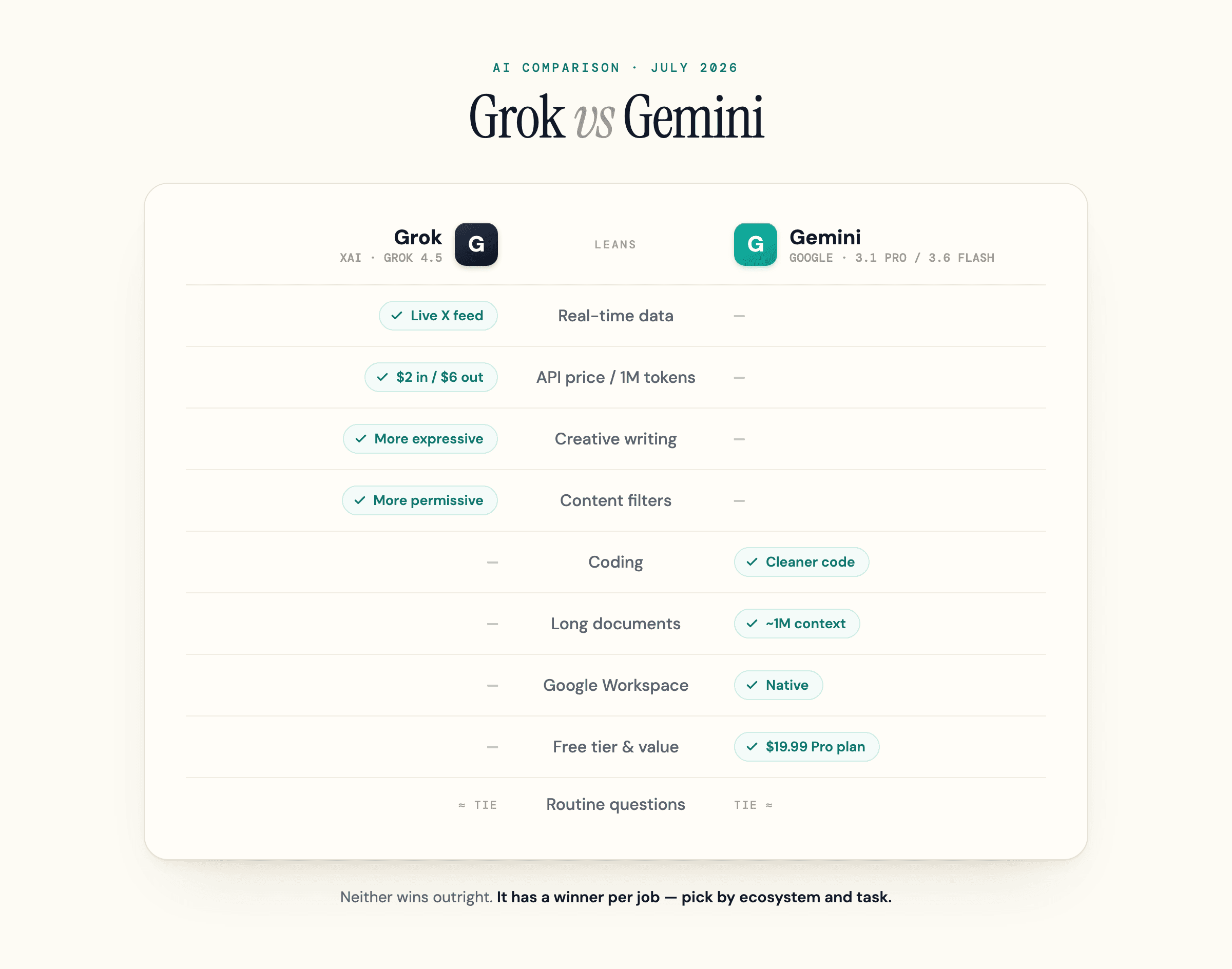
Grok vs Gemini at a Glance
Pick Grok for real-time information off X, a fast and cheap reasoning model, and a chattier tone. Pick Gemini for multimodal work, long documents, Google Workspace, image and video generation, and better free value. On a routine question, most people could not tell the two apart.
Start with the names, because that is where comparisons go wrong first. xAI's current flagship is Grok 4.6, launched August 12, 2026, with the prior Grok 4.5, Grok 4.3, and Grok 4.20 for heavier multi-agent reasoning and a cheap grok-code-fast-1 for coding. Google runs on Gemini 3.1 Pro for hard tasks and the newest Gemini 3.8 Flash (September 2, 2026, with 3.7 Flash now the previous generation), and Gemini 3.6 Flash still the app and free-tier default, and Deep Think reserved for its top tier. If a comparison still pits Grok 4 against Gemini 2.5, it is describing 2025.
| What matters | Grok (xAI) | Gemini (Google) |
|---|---|---|
| Best at | Real-time info, fast reasoning, blunt tone | Multimodal, long docs, Workspace, value |
| Real-time data | Live X (Twitter) feed, when search is on | Google Search grounding |
| Ecosystem | X / the xAI app | Gmail, Docs, Android, Search |
| Main paid plan | SuperGrok, $30/mo | Google AI Pro, $19.99/mo |
| Image / video | Grok Imagine / Imagine Video 1.5 | Nano Banana 2 / Veo 3.1 |
| Content filters | Looser, tightened in Jan 2026 | Conservative, brand-safe |
| Best for | News junkies, traders, X power users | Google users, researchers, creators |
The Models Behind Each (as of July 2026)
Both companies ship a family of models, not one. Knowing which is which saves you from paying for the wrong tier or trusting a benchmark for a model you cannot access.
On the xAI side (now operating as SpaceXAI after its 2026 SpaceX merger), Grok 4.6, released August 12, 2026, is the current general-purpose flagship, with a 500K-token context window priced at $2 / $6 per million tokens. It builds on Grok 4.5 (July 8, 2026), the "Opus-class" model trained on Cursor data, which rolled out region by region and, after an EU AI Act review, became fully available across the EU on July 16, 2026. The prior Grok 4.3 remains available with its roughly 1-million-token context, Grok 4.20 adds a multi-agent reasoning variant for harder problems, grok-code-fast-1 is the cheap, fast option for coding, and Grok 4 Heavy is the most powerful reasoning mode, gated behind the priciest plan. Grok 5 is still in training and not released, so anything you read about it is forecast, not fact. Grok runs in the xAI app, on grok.com, and inside X.
On Google's side, Gemini 3.1 Pro handles the heavy reasoning, Gemini 3.8 Flash (September 2, 2026) is the newest fast model with 3.6 Flash still the default most people use in the app, and Deep Think is the slow, high-effort mode reserved for the Ultra plan. Context runs to about 1 million tokens. Gemini is everywhere Google is: the Gemini app, Search's AI Mode, Workspace, and Android.
| Grok (xAI) | Gemini (Google) | |
|---|---|---|
| Maker | xAI (founded by Elon Musk) | Google DeepMind |
| Current flagship | Grok 4.6 (Aug 2026); Grok 4.5, 4.3, 4.20 prior-gen | Gemini 3.1 Pro; Gemini 3.8 Flash (newest) |
| Free model | Grok (limited prompts, basic media) | Gemini 3.6 Flash |
| Top reasoning mode | Grok 4 Heavy | Deep Think (Ultra plan) |
| Context window | 500K (Grok 4.5/4.6); ~1M on Grok 4.3 | About 1M tokens |
| Lives in | xAI app, grok.com, X | Gemini app, Search, Workspace, Android |
A warning that applies to every section below: the benchmark numbers you see online almost always describe an older model than the one you would pay for today. The cleanest public head-to-head is still Gemini 3 Pro versus Grok 4.1, which shipped a day apart in November 2025. Grok 4.3 and Gemini 3.5 arrived later without a tidy side-by-side, so treat the scores as a recent snapshot, not this week's truth.
Real-Time Information: Grok's X Feed vs Gemini's Google Grounding
This is the single biggest reason people pick one over the other, and it is also the most over-sold. Grok's edge is real, but it is not magic.
Grok's advantage is a direct line into X. When you ask about a breaking story, a trending post, or live sentiment, Grok can pull recent X posts with timestamps and links, which a search index can lag by hours. That makes it the stronger pick for traders, journalists, and anyone tracking a moment as it happens.
The catch is the part most write-ups miss. By default, Grok has no live knowledge at all. Per xAI's own model docs, "Grok has no knowledge of current events or data beyond what was present in its training data," and you have to enable its Web Search or X Search tools for it to go look. The real-time feed is a feature you switch on, not an always-current brain. The same caveat applies to its reputation for an unfiltered raw feed: Grok surfaces what it judges relevant from X, not a complete chronological timeline, so it can quietly miss context.
Gemini takes the other route. It grounds answers in Google Search and, on the consumer app, can read across your Gmail, Docs, and Drive when you let it. For broad current-events questions with cited sources, that breadth tends to beat Grok; for "what are people saying on X right now," it does not. We cover this split in more depth in our Grok vs ChatGPT comparison, where the same real-time-versus-grounding tradeoff plays out.
Coding and Reasoning: Who Is Actually Smarter
Here is where readers want a clean winner and the data refuses to give one. Gemini holds a slight edge on hard logic and reliable code, while Grok wins on speed, cost, and a couple of softer skills.
On the most-cited public clash, Gemini 3 Pro reached 1501 on the LMArena leaderboard in November 2025, the first model past 1500, just ahead of Grok 4.1 Thinking at 1484. The two rarely run the same test suites, but where the numbers overlap the pattern is consistent. A llm-stats side-by-side shows Gemini 3 Pro leading on hard science and math, while Grok 4.1 leads on creative writing and emotional intelligence. When Tom's Guide ran both through nine real prompts, Gemini took logic, coding, debugging, and nuanced analysis, while Grok took reasoning style, creative writing, factual accuracy, and self-awareness. Gemini won the tally, narrowly.
For coding specifically, the pattern repeats: Gemini tends to produce cleaner, more complete code and handles large codebases well, while several users report Grok generating messy or non-functional output on routine tasks. Grok's counter is economics. grok-code-fast-1 is cheap enough to run aggressively for scaffolding, bug fixes, and test generation, and its API flagship undercuts most rivals on price. If you want one model to lean on for serious development, the case still points to Gemini; if you want a fast, cheap pair-programmer for high-volume iteration, Grok earns its keep.
| Benchmark (Nov 2025) | Edge | Detail |
|---|---|---|
| Overall preference (LMArena Elo) | Gemini 3 Pro | 1501 vs Grok 4.1's 1484; first model past 1500 |
| Math (AIME 2025) | Gemini 3 Pro | Near-perfect score |
| Science (GPQA Diamond) | Gemini 3 Pro | 91.9% on graduate-level questions |
| Creative writing (v3) | Grok 4.1 | Leads Gemini 3 Pro on the Creative Writing v3 board |
| Emotional intelligence | Grok 4.1 | Leads EQ-Bench on roleplay and empathy |
| Hallucination (self-reported) | Grok 4.1 | xAI reports ~4%, down from ~12%; see the trust caveat below |
Read that table as a map of temperaments, not a scoreboard. Gemini is the careful analyst; Grok is the quick, expressive generalist, and both descriptions predate the models you would run today. Grok 4.5, launched July 8, 2026, sharpened xAI's standing without topping the field: on the Artificial Analysis Intelligence Index it landed around 13th of 190 models (as of late July 2026), behind frontier leaders like Claude Opus 5, Fable 5, and GPT-5.6 Sol, not ahead of them. The current flagship, Grok 4.6 (August 12, 2026), climbs far higher, matching GPT-5.6 Sol as the third-best model on that index. The August 2026 Grok 4.6 is now the current flagship. For the reasoning-heavy end of this debate, our Claude vs Gemini comparison covers a third contender that often beats both on careful analysis.
Multimodal, Image, and Video Generation
Gemini was built multimodal from the start, and it shows. It reads text, images, audio, and video in a single prompt, so you can hand it a recorded meeting, a chart, or a long clip and ask questions about it. Grok was text-and-image for most of its life, but Grok 4.3 added native video input, so the old line that "Grok is blind and deaf to media" is outdated. Gemini's range is still broader, especially for audio and long video, but the gap narrowed.
On generation, both engines now make images and video, which kills another stale talking point. The split is about taste versus polish.
Images
For images, Gemini's Nano Banana family (Nano Banana 2 as the default for everyone, Nano Banana Pro as a higher-fidelity option on paid AI Pro/Ultra) leans toward photorealism, anatomical accuracy, character consistency, and up to 4K output. Grok Imagine leans cinematic and stylized, generates faster, and applies fewer restrictions, though it tops out lower on resolution. People who want a believable product shot pick Gemini; people who want dramatic, moody concept art often prefer Grok. One practical difference: Gemini refuses to generate images of real public figures, where Grok is more permissive.
Video
Video is where this got genuinely competitive in mid-2026. Gemini's Veo 3.1 leads on resolution, up to 4K, and on physical realism, and it plugs into Google's wider creative stack. But Grok Imagine Video 1.5, which reached general availability in June 2026, generates longer base clips with native synchronized audio and, by xAI's own account, topped an image-to-video arena leaderboard at launch. So call the video crown contested: Gemini for polished, high-resolution output, Grok for fast, audio-native social clips. For stills with a looser hand on the filters, Grok is still the more permissive tool.
Pricing and Plans
Both restructured their plans through 2026, so old price tables mislead. Here is where they stand now, with the usual warning that these numbers move.
Both have a free tier, and for a lot of people it is enough. Grok's free plan gives limited prompts plus basic image and video generation. Gemini's free plan runs on 3.6 Flash with a 32K-token context (the 1-million-token window is a paid AI Pro/Ultra feature). It is still the more generous free option for everyday work, but for model access, not context: Google lets free users reach Flash and Pro on capped volume.
The paid plans are where the value gap opens. SuperGrok is $30 a month; Google AI Pro is $19.99 a month and, per Google's subscription rundown, bundles higher limits with storage and other Google perks. That makes Gemini the better-value mainstream plan, the verdict most reviewers land on, unless live X data is core to your work. At the top, Grok's SuperGrok Heavy runs $300 a month for the Heavy reasoning mode, while Google AI Ultra sits in the $100 to $200 range. Our Gemini pricing guide breaks down every Google tier, and our Grok pricing guide does the same for SuperGrok.
| Tier | Grok (xAI) | Gemini (Google) |
|---|---|---|
| Free | Limited prompts + basic media | Gemini 3.6 Flash, 32K context |
| Main paid | SuperGrok, $30/mo | Google AI Pro, $19.99/mo |
| Top tier | SuperGrok Heavy, $300/mo | Google AI Ultra, $100-$200/mo |
| API flagship | Grok 4.6, $2 / $6 per 1M tokens | Gemini 3.x, usage-based |
On the API side, Grok's flagship pricing is aggressive: roughly half what many comparable frontier models charge. For high-volume automation that runs to tens of millions of tokens a month, that adds up, though Gemini's cheaper Flash-class models compete hard at the low end.
Content Filters, Bias, and How Much to Trust the Answers
Grok built its name on being the less-filtered chatbot, and Gemini built its name on being the safe one. Both descriptions are still roughly true, but the gap is smaller than it was, and the reputations cut both ways.
Grok tightened sharply in early 2026. After a scandal over non-consensual sexual images of real people, xAI restricted image generation and cracked down on explicit content, and many users complained the update went too far. As one report on the change put it, Grok started blocking prompts that were not remotely unsafe, and the roleplay and creative-writing crowd that came for an unfiltered tool felt blindsided. Grok is still more permissive than Gemini, but the "anything goes" era is over.
Gemini stays the conservative choice, with more guardrails and more refusals. That suits schools, brands, and regulated settings, but the flip side is real: Gemini also refuses plenty of benign prompts, which is a steady source of user frustration.
On political bias and trust, tread carefully, because neutrality is hard to measure and the marketing tends to outrun the evidence. xAI pitches Grok as a "truth-seeking" model, but independent bias tests have pulled in different directions on it, while Gemini leans toward cautious both-sides answers. Treat any "this one is neutral" claim, from either side, as a marketing line rather than a settled finding.
The same skepticism applies to accuracy. Hallucination studies flatly contradict each other, with one crowning Grok the most reliable and another putting it well behind, and every reasoning model still misfiring on hard facts more often than its makers admit. There is no trustworthy single number here. The only safe habit with either model is to verify anything that matters against a primary source.
Privacy and Your Data
One more axis worth checking before you commit: what each does with your chats. Both default to using consumer conversations to improve their models, and both offer an opt-out buried in settings. Grok's training on public X data has drawn regulatory scrutiny, while Gemini's reach into Gmail and Docs makes its permissions worth reading before you grant them. For anything sensitive, the business and API tiers of each change the retention story, and that is the version to use.
Ecosystem, Apps, and Everyday Reliability
For a lot of people, the decision never reaches benchmarks. It comes down to where you already work.
Gemini's ecosystem is its moat. It is wired into Gmail, Docs, Sheets, Calendar, and Android, and Gemini Live can take real actions across them, like pulling a detail from your inbox or drafting in a document. If you live inside Google's tools, that integration is hard to give up, and reviewers regularly admit Grok beat Gemini on specific tests yet stuck with Gemini for exactly this reason. Grok's home turf is X. If your day runs through the feed, having the assistant right there is the mirror-image advantage.
Voice and mobile tilt toward Gemini for everyday use. Grok's voice mode is quick and free on iOS but gated behind a paid plan on Android, while Gemini Live is built into the platform and doubles as a hands-free productivity assistant.
Two honest caveats keep this from being a clean Gemini win. First, reliability: Gemini users report mid-session resets and the model occasionally degrading as if it rolled back a version, which is a real friction that benchmark wins do not capture. Second, feel: Grok reads as witty and direct, closer to talking with an opinionated friend, while Gemini is often described as smart but robotic and verbose. If rapport matters to how you work, that difference is not cosmetic. Our Grok vs Claude comparison digs further into the personality side of model choice.
What Grok vs Gemini Means for Your Brand's Visibility
Most comparisons stop at "which should I use." If you are marketing a business, the more useful question is the reverse: which of these engines will tell its users about you. And here Grok and Gemini behave so differently that being visible in one tells you almost nothing about the other.
The reason is the corpus each one draws from. Grok answers from X posts and whatever its web search surfaces, so showing up in the live conversation and on crawlable pages is what gets you mentioned. Gemini answers from Google's search index and, critically, powers AI Overviews and AI Mode, which sit in front of billions of searches. Earning a citation there means being in Google's index and genuinely worth quoting on the question. The layers only partly overlap. Both engines run an open-web search, so a page that ranks in Google is more likely to be discoverable by Grok's web search, though never guaranteed to be surfaced or cited. But the proprietary layers do not transfer: a brand all over X gets no credit inside Gemini, and a brand sitting in Google's index is not automatically in the live X conversation Grok leans on.
This is not theoretical for us. Our own pages pull steady traffic from AI engines on terms Google barely ranks us for, which is the whole point of treating AI search as its own channel. If you want the practical playbook, our guide on how to optimize for AI search covers the work that actually moves citations across engines, not just rankings on one.
Which Should You Choose?
Here is the part most comparisons dodge: most heavy users do not choose. They keep both and reach for whichever fits the task, the same way you would not use a single app for everything. Still, if you need to commit to one, the split is clear.
Choose Grok if you:
- live on X or need real-time, breaking-news and sentiment answers
- want a fast, cheap reasoning model for high-volume use
- prefer a blunt, conversational tone over a careful one
- want a looser hand on content filters
Choose Gemini if you:
- work inside Google Workspace or on Android
- need strong multimodal and long-document handling
- generate images or video, or want the better free tier and paid value
- want the safer, more brand-friendly default
If you are torn, the tie-breaker is rarely the model. It is the ecosystem you already use and the kind of answer you need most often. The gap between these two is small enough that ecosystem, price, and feel will decide it for you more than raw scores ever will.
The Bottom Line
Grok and Gemini are not really fighting for the same seat. One is the fast, plugged-into-X model with a looser tone; the other is the multimodal, Google-wired model with the better free value. Re-check in a month, because the version numbers will have changed by then.
If you market a brand, there is a more important comparison than the one you just read: whether these engines mention you at all. Since Grok and Gemini cite from different places, you have to check each separately. That is exactly what geotoolbox's Citation Interceptor does, querying eight engines including Grok, Gemini, and Google AI Overviews to surface the offsite sources each one cites, competitor pages included, and flag where your brand is missing from the answer. Knowing which model is "better" matters far less than knowing whether either one is sending people your way.
Frequently Asked Questions
Is Grok or Gemini better in 2026?
Neither wins outright. Grok is better for real-time information from X, fast and cheap reasoning, and a blunt tone; Gemini is better for multimodal work, long documents, Google Workspace, and free-tier value. Most power users keep both and switch by task rather than picking one.
Is Grok or Gemini better for coding?
Recent public testing leans Gemini for reliable, clean code and large codebases, and it won the coding prompts in head-to-head reviews. Grok's edge is speed and cost: grok-code-fast-1 is cheap enough to run constantly for routine work. For serious development, Gemini; for fast, high-volume iteration, Grok.
Which is better for real-time information, Grok or Gemini?
Grok, when its X Search and Web Search tools are switched on, because it reads live posts from X that a search index can lag. But it is not always-current by default. Gemini grounds answers in Google Search, which is broader for general current events but weaker for live social sentiment.
Is SuperGrok ($30) worth it over Gemini's $20 plan?
For most people, Gemini's $19.99 Google AI Pro is the better value, with more included and a more generous free tier. SuperGrok at $30 is worth the premium mainly if live X data is central to your work. One caveat: xAI rolls new models like Grok 4.5 out to its tiers in stages and by region (Grok 4.5 was EU-blocked at launch but became fully available across the EU on July 16, 2026), so check which model your plan actually includes before subscribing. If you just want a capable assistant, start with Gemini's free tier.
Is Grok still uncensored compared to Gemini?
Less than it used to be. A January 2026 safety crackdown tightened Grok's content rules sharply, and many users felt it went too far. Grok is still more permissive than the heavily guardrailed Gemini, but the gap has narrowed.
Which has the bigger context window, Grok or Gemini?
Gemini's flagship runs to about 1 million tokens, while Grok 4.6 sits at 500K (the prior Grok 4.3 offers 1M). Both handle long documents and codebases comfortably, but Gemini currently has more headroom. Treat the flagship figure as the practical number.
Sources
- xAI Grok model docs - Grok 4.5/4.3 specs, API pricing, and real-time search tools -
docs.x.ai/docs/models - llm-stats: Gemini 3 Pro vs Grok 4.1 Thinking - GPQA, AIME, creative writing and EQ-Bench scores -
llm-stats.com/models/compare/gemini-3-pro-preview-vs-grok-4.1-thinking-2025-11-17 - Tom's Guide: Gemini 3.0 vs Grok 4.1, 9 prompts - real-world head-to-head -
tomsguide.com/ai/i-just-tested-gemini-3-0-vs-grok-4-1-with-9-prompts-and-theres-a-clear-winner - Tom's Guide: Google Gemini 3 explained - Gemini 3 family and Deep Think -
tomsguide.com/ai/google-gemini-3-everything-you-need-to-know - PiunikaWeb: Grok moderation update backlash - the January 2026 content tightening -
piunikaweb.com/2026/01/20/grok-censoring-everything-users-say - Google AI subscriptions - Gemini consumer plan structure -
blog.google/products-and-platforms/products/google-one/google-ai-subscriptions