
Perplexity vs Claude is mostly a question about jobs, not quality. Perplexity is a search product that cites its sources and lets paid users pick the model, Claude included. Claude is Anthropic's own assistant, with web search built in. On the entry plans, which cost $17 a month billed annually, Perplexity Pro's Search model list has Claude Sonnet 5.5 only, while Claude Pro includes Opus and Claude Code. If you want sourced answers, Perplexity is built for that. If you write, analyze documents or code, Claude is the better single subscription.
Perplexity vs Claude at a Glance (November 2026)
The prices and plans below are what each vendor's pages showed on November 7, 2026, in US dollars. This comparison covers the individual plans and the apps, not API prices or business seats; for Claude's API prices see our Claude models comparison. For background, read what Perplexity is.
| What you compare | Perplexity | Claude |
|---|---|---|
| What it is | A search product that retrieves pages, cites them inline and picks a model per question | Anthropic's assistant, with web search on every plan |
| Entry paid plan | Pro: $17 a month billed annually, $20 monthly | Pro: $17 a month billed annually, $20 monthly |
| Claude models on that plan | Claude Sonnet 5.5 only, in Search | Opus, Sonnet and Haiku; Fable is paid with usage credits |
| Higher tiers | Max: $167 a month billed annually, $200 monthly; adds Claude Opus 5.5 and Fable 5.1 in Search | Max: $100 a month. Ultra: $200 a month, 10x Pro usage every week, no 5-hour limit for verified accounts |
| Agent product | Computer, paid with credits | Claude Code on Pro, Max and Ultra; Claude Cowork is merging into chat |
| Bots that fetch your pages | PerplexityBot, Perplexity-User | ClaudeBot, Claude-User, Claude-SearchBot |
Most of the 6 comparison articles we analyzed (the top-ranking ones, run through NotebookLM) frame the difference as retrieval versus reasoning. Perplexity pulls pages in real time and cites them. Claude works through complex information such as long documents and code, and it searches when that helps. Treat that as shorthand, not a rule, because Perplexity can run Claude's models and Claude searches the web too.
Does Perplexity Use Claude?
Yes, on paid plans. Perplexity says it orchestrates models from several vendors, Anthropic's Claude among them, and that Pro and Max both allow selecting a preferred model. Which Claude you can pick depends on the plan. Perplexity's table of Search models, dated October 27, 2026 and checked November 7, lists Claude Sonnet 5.5 on Pro and Max, and Claude Opus 5.5 and Claude Fable 5.1 on Max only.
Claude Pro includes Opus and offers Fable through usage credits. So if Opus is the reason you want Claude, it costs $17 to $20 a month on Claude Pro. On Perplexity it means Max, at $167 a month billed annually or $200 monthly. The trade runs both ways: Perplexity Pro's Search list also includes models Claude Pro does not offer, such as GPT-6.1 Sol, Gemini 3.8 Flash and Grok 4.7.
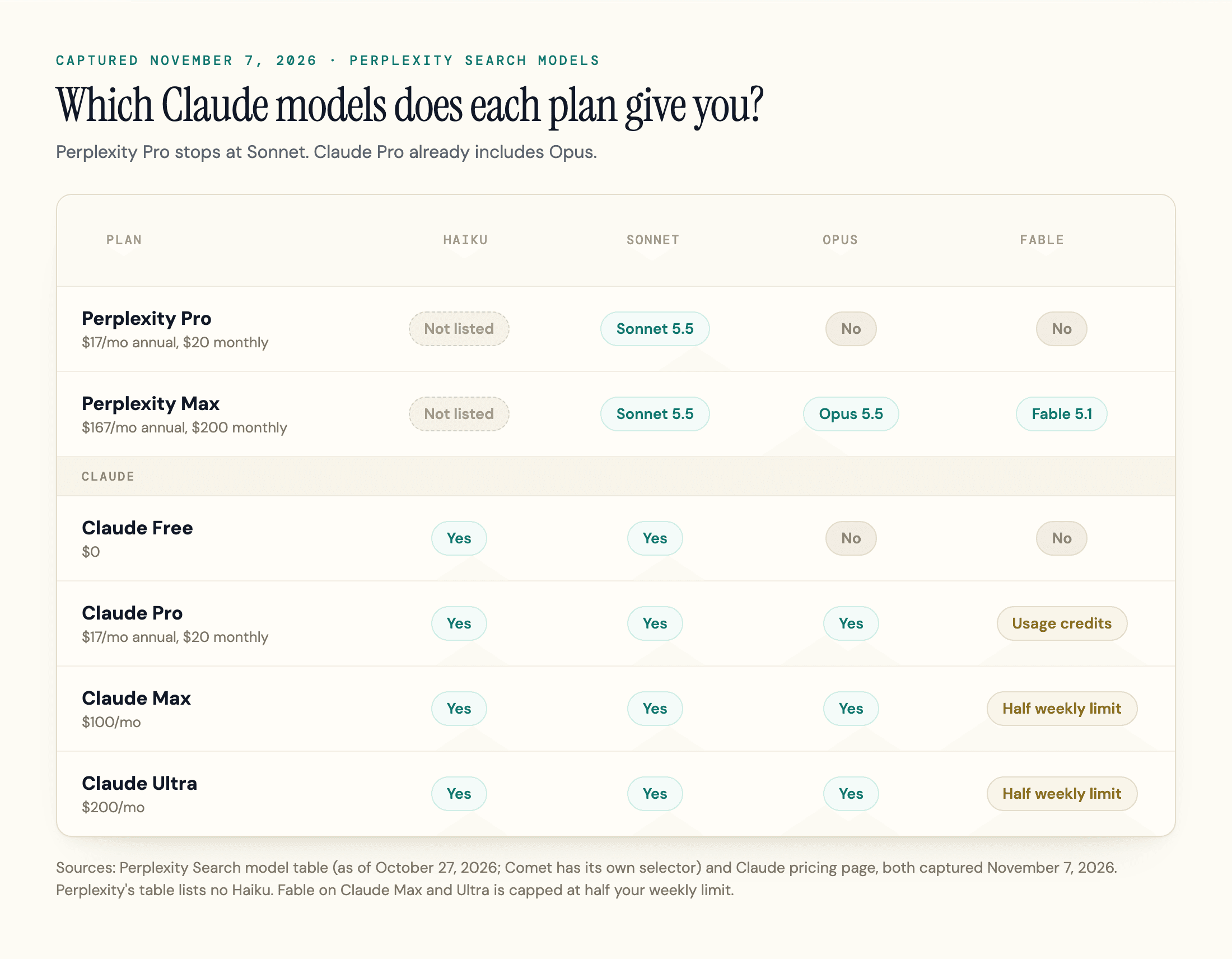
Best Picks the Model Unless You Do
Perplexity's help page says Best "picks a suitable model for each query", so Claude answers only when you choose it or Best happens to pick it. If you are paying for Claude inside Perplexity, set the model yourself.
The Table Covers Search, and It Changes
That table is for Search. Perplexity says Computer has its own model selector and availability rules, and Comet has its own model selection too, so a Pro subscriber may reach other models there. Perplexity also dates its list and says it changes as providers release and retire models, so check the model menu in your own account.
Plans and Prices: Perplexity Pro vs Claude Pro
Prices depend on the billing period. On annual billing the entry plans cost the same, $17 a month. Month to month, Claude Pro is $20, and Perplexity's own October 2026 pricing guide lists its Pro at $20 and Max at $200. Its Max help page agrees and adds $2,000 for a year. Perplexity's pricing page itself shows only the annual-equivalent price.
| Tier | Perplexity | Claude |
|---|---|---|
| Free | $0. Citations in every answer, basic AI models | $0. Sonnet and Haiku, web search, no Opus and no Claude Code |
| Pro | $17 a month billed annually, $20 monthly. Deep research, a choice of models, weekly Computer usage | $17 a month billed annually, $20 monthly. More usage than Free every 5 hours and every week, Opus, Claude Code, Fable through usage credits |
| Max | $167 a month billed annually, $200 monthly. Maximum Computer usage, 10,000 credits a month, Opus 5.5 and Fable 5.1 in Search | $100 a month. 5x Pro usage every 5 hours and every week, Fable up to half your weekly limit, $100 a month in API credits |
| Ultra | No tier above Max for individuals | $200 a month. 10x Pro usage every week, no 5-hour limit for verified accounts, $200 a month in API credits |
Captured November 7, 2026 from each vendor's pricing page, plus Perplexity's October pricing guide and Max help page for its monthly prices. Claude's Max and Ultra are priced monthly only. New Perplexity subscribers also get a one-time Computer credit bonus, 4,000 on Pro and 35,000 on Max, that expires in about 30 days.
Neither vendor publishes message counts. Claude states its limits as multiples of Pro usage across a 5-hour and a weekly window. Perplexity's cards say "More usage limits and memory" for Pro and "Highest usage limits and memory" for Max, and its comparison table gives only multipliers such as 10x. It also markets Max as "No limits on scale", so read the fine print. Computer is the exception: 100 credits equal $1, which makes Max's 10,000 monthly credits worth about $100 of Computer work, and Pro's weekly Computer usage is still rolling out gradually.
Our Claude pricing and Perplexity pricing guides cover each tier in more depth.
Research and Citations: Which One Gets Sources Right?
Perplexity is built around search, and its pricing page says every answer includes inline citations. Claude has web search on every plan, Free included, but in its merged chat and Cowork experience there is no web search toggle: Claude searches the web when it helps. For anything recent, tell Claude to search and cite.
What the Accuracy Studies Cover
We found no independent study that measures claim-level citation accuracy for both Claude and Perplexity (we searched on November 7), and the ones that exist cover different systems. One 2025 arXiv study ran 8 chatbots, Claude and Perplexity among them, through the same academic-reference prompt, but it checked whether the references were real and correct, not whether web-search citations support claims. The Tow Center's March 2025 test of 8 AI search tools found Perplexity answered 37 percent of its news queries incorrectly, against 94 percent for Grok 3. It did not test Claude. The DeepTRACE audit, posted to arXiv in September 2025, scored Perplexity's search mode at 31.6% unsupported statements and 49.0% citation accuracy, and its Deep Research mode at 97.5% unsupported and 58.0%. In the same table GPT 4.5 scored 39.8%, so Perplexity was not the outlier. A May 2026 arXiv study, Cited but Not Verified, tested Claude but no Perplexity system: its fact-check dimension scored Claude Opus 4.5 at 76.8%, Claude Haiku 4.5 at 68.9% and Claude Sonnet 4.6 at 58.7%. All of these predate today's models and use different methods, so you cannot subtract one result from another.
Human Preference Favors Claude with Search, on One Board
On Arena's Search leaderboard, dated November 6, 2026 (1,537,892 votes, 42 models), Claude Opus 4.6 with search ranks #3 at 1252 and Claude Sonnet 4.6 with search #12 at 1220. Newer Claude entries also rank above both Sonar entries: Claude Opus 5 (High) is #5 at 1240, Claude Fable 5.1 (High) #6 at 1239 and Claude Opus 5.5 (Medium) #14 at 1214. Perplexity's Sonar Reasoning Pro (High) ranks #37 at 1139 and Sonar Pro (High) #39 at 1130. Voters pick the answer they prefer, not the one whose citations hold up, the entries are model-plus-search stacks rather than subscriptions, and a Perplexity Pro subscriber can run Claude Sonnet 5.5 inside Perplexity.
We Ran the Same Research Questions Through Both
In geotoolbox's test on November 7, 2026, we put 5 questions to each engine. For 4 of them we had answers already pinned to vendor pages and the paper itself: the Max 20x rename, which Claude models Perplexity Pro includes, whether each vendor's user-triggered fetcher obeys robots.txt, and what DeepTRACE found about Perplexity. The fifth asked whether an independent study compares their web-search citation accuracy head to head, which tests whether an engine will invent one. Perplexity ran as Sonar Pro with web search, called through a data provider's API (DataForSEO) rather than Perplexity's own. Perplexity says support for its Sonar chat-completions API ended on September 27, 2026 and requests are being reformulated as Agent API requests, model by model. We cannot tell whether this call went through Sonar chat completions or the Agent API, so it may not match the engine behind today's app. Claude ran as Opus 5.5 with web search and page fetching. A separate Claude agent, shown the answers labeled A and B in shuffled order, scored each 0 to 2 against the known answers and opened the cited pages.
| Question | Perplexity Sonar Pro | Claude Opus 5.5 with search |
|---|---|---|
| Max 20x rename | Correct: Ultra, October 30, no price change, $200 a month. Cited news and blog sites only, no Anthropic page | Correct, and quoted Anthropic's help page. Added one wrong detail: that Ultra's included API credits doubled at the rename |
| Claude models on Perplexity Pro | Correct split, but said "as of November 7" for an October 27 table. Its main help link had a wrong address that returns a 404 before redirecting, and its other help links showed older models | Correct split with the October 27 date, linked the live page and warned that other help pages list older models. One claim about translated help pages had no link and could not be checked |
| Does the user-triggered fetcher obey robots.txt? | Correct. Sourced Anthropic's half through a third-party blog | Correct. Quoted both vendors' own pages |
| What DeepTRACE found about Perplexity | Wrong: gave Perplexity a citation accuracy in the 60s, which matches the You.com (68.3%) and Bing (65.8%) columns. The paper gives 49.0% for Perplexity. Left out the 31.6% unsupported figure | Correct: 49.0% and 31.6%, plus the Deep Research figures, read from the paper |
| Is there an independent head-to-head study of citation accuracy? | Correct: none found. Every source was an aggregator or blog | Correct: none found. Linked the studies themselves and set aside a self-run benchmark with no methodology |
On 4 of the 5 questions both engines met the rubric's required facts. Perplexity missed the DeepTRACE figure and scored 0 of 2 on it, so the totals were 8 of 10 against Claude's 10 of 10. The rubric scored required facts only, so Claude's extra wrong detail cost it nothing. On sourcing, the grader preferred Claude's answer on 3 of the 4 questions both got right, because it cited the vendor pages and papers themselves, and called the rename question a tie. Speed went the other way: Perplexity answered in about 2 to 3 seconds per question and all 5 calls cost under 5 cents, while the Claude agent took about 3 minutes in total, with 13 searches and 12 page fetches, on subscription quota with no per-call price.
The DeepTRACE miss is the one to remember. A fast, cited answer attached 10 links, and the grader, who checked 4 of the links, found none that supported the figure it gave.
Treat this as a log, not a ranking. It is 5 questions, run once. The Claude agent and the grader come from the same model family as the assistant that drafted this article, the A and B labels hid the engine names but not their answer styles, and the engines had different tools: Claude's run visibly fetched and read full pages, while the API returned only Sonar Pro's answer and its links. Sonar Pro is also not the Claude Sonnet 5.5 that a Perplexity Pro subscriber can pick. What it does show is that both engines made a mistake you would only catch by opening the sources.
Writing, Long Documents and Context Window
Most of those 6 articles give long-form writing to Claude. That is a shared opinion, not a measured result, but it fits how the products are built: Perplexity answers from retrieved pages, while Claude is a general assistant you can give a draft, a contract or a codebase. Claude's pricing page lists a context window of up to 1M tokens on every plan, varying by model, and Perplexity's pricing page lists none. For long-form writing that has to hold one argument across thousands of words, start in Claude and bring your sources in. For a short, sourced briefing note, Perplexity's retrieve-then-write flow is built for that.
Coding and Agents: Claude Code and Cowork vs Perplexity Computer
Claude's pricing page lists Claude Code on Pro, Max and Ultra and not on Free, and Anthropic's Ultra page lists it for terminal-based coding workflows on one subscription. Our guide to what Claude Code is covers how it works.
Perplexity's Computer is a different kind of tool. Its models page calls it an autonomous agent that can research, code, create documents and use connected tools, and its credits page prices work per task, listing an entire app or multi-day build at 15,000 or more credits.
Claude Cowork, Claude's agent for longer tasks like research and reports, is changing. Anthropic says chat and Cowork are merged into a single conversation, rolling out in stages starting with Pro, Max and Ultra, so accounts on the same plan may not see it on the same day. If a comparison treats Claude Cowork as a separate product, check its date.
- Coding: Claude Code comes with the plan and draws on its usage limits. Computer can build apps too, but it bills by the task.
- Research and report tasks: compare Computer's credit cost with the usage your Claude plan includes.
How Each One Finds (and Cites) Your Site
If you publish content, the useful question is which bots fetch your pages and what you can do about each. Both vendors split the job across separate user agents, and they handle robots.txt differently.
| Bot | What the vendor says it does | What robots.txt does |
|---|---|---|
| PerplexityBot | Surfaces and links sites in Perplexity search results; not used to crawl content for AI foundation models | Perplexity recommends allowing it in robots.txt so your site can appear in results |
| Perplexity-User | Visits a page when a user asks Perplexity a question and links to it in the answer | Perplexity says it generally ignores robots.txt rules, since a user requested the fetch |
| ClaudeBot | Collects web content that could contribute to training Anthropic's models | Restricting it signals that your future material should be excluded from training datasets |
| Claude-User | Accesses a page when a person asks Claude a question that needs it | Lets site owners control which sites user-initiated requests can reach |
| Claude-SearchBot | Analyzes pages to improve the quality of Claude's search results | Disabling it prevents indexing for search and may reduce your visibility in user-directed web search |
| Claude-Agent | Token carried by Anthropic-hosted browsers that a Claude agent drives on a user's behalf | Not one of Anthropic's robots: Anthropic says agentic browser use is different from its robots, so identify it by the Claude-Agent token |
From Perplexity's bots documentation (page dated October 29, 2026) and Anthropic's crawler help page (modified November 4, 2026).
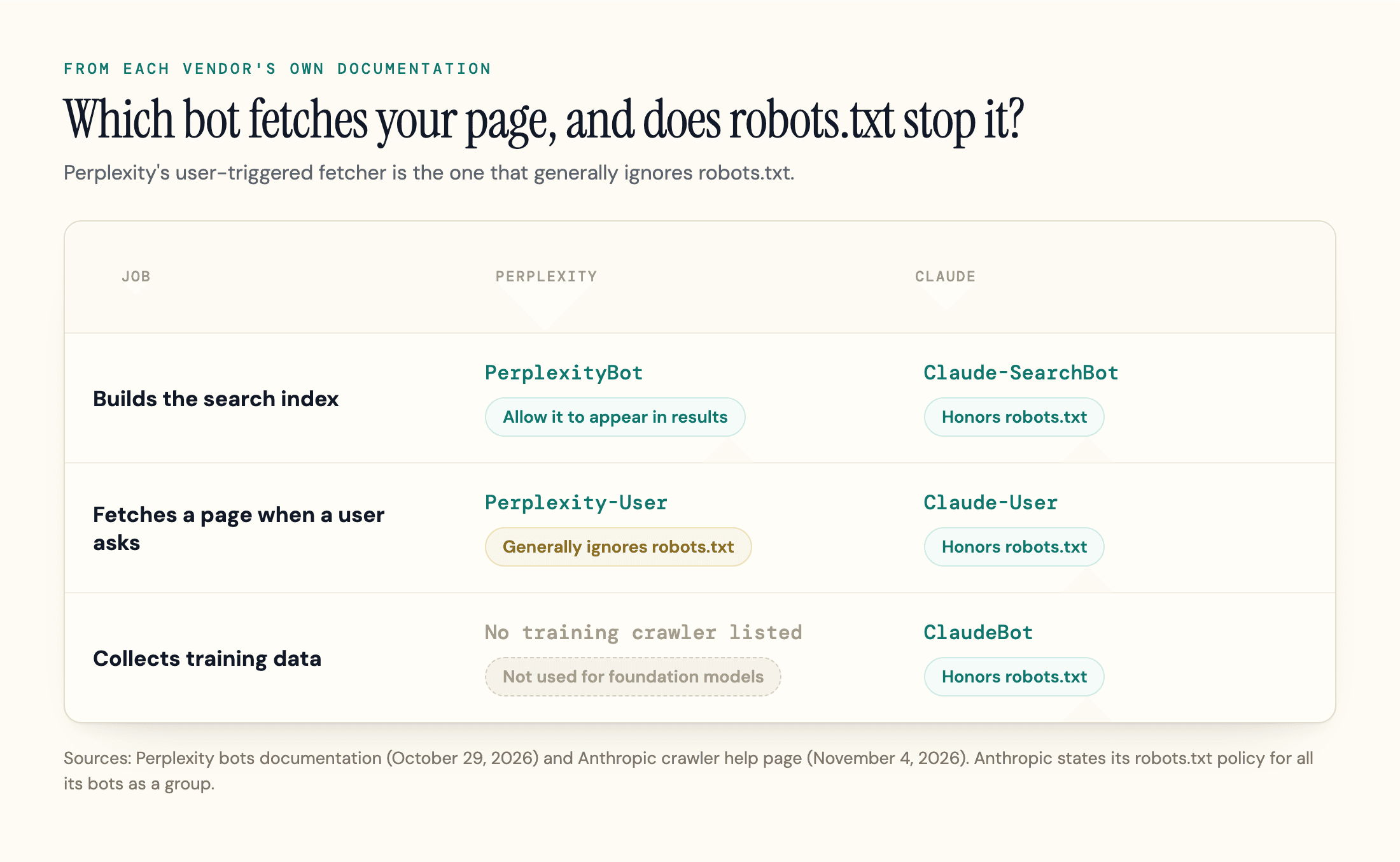
Anthropic says its bots respect "do not crawl" signals by honoring industry standard directives in robots.txt, and that a robots.txt rule naming ClaudeBot wins over a general setting. Perplexity's crawler documentation describes Perplexity-User as the one fetcher that generally ignores robots.txt. Perplexity's help center is less clear: its robots.txt article, last modified September 14, 2026, says Perplexity respects robots.txt directives and that letting users summarize a blocked URL "has been disabled". The documentation page is newer and specific to the user-triggered fetcher, so we treat Perplexity-User as the exception, but do not rely on robots.txt alone: check your server logs for its user-agent string.
To stay citable in both, allow PerplexityBot, Claude-SearchBot and Claude-User. To opt out of Anthropic's training without leaving Claude's search results, restrict ClaudeBot only. Anthropic also says it has begun recognizing a machine-readable "no AI training" preference signal, rolling out over time, though a rule that names ClaudeBot still takes priority.
We go deeper on each engine in our guides to getting cited in Perplexity and getting cited in Claude, and the full bot list is in AI crawlers and how to control them.
Which One Should You Pay For?
If you can pay for only one and you also write, analyze documents or code, take Claude Pro. It includes Opus and Claude Code, and web search comes with every plan. If most of your day is finding sources and checking them, take Perplexity Pro, which is built to search on each question and cite every answer, even though Claude's answers were the better sourced in our test.
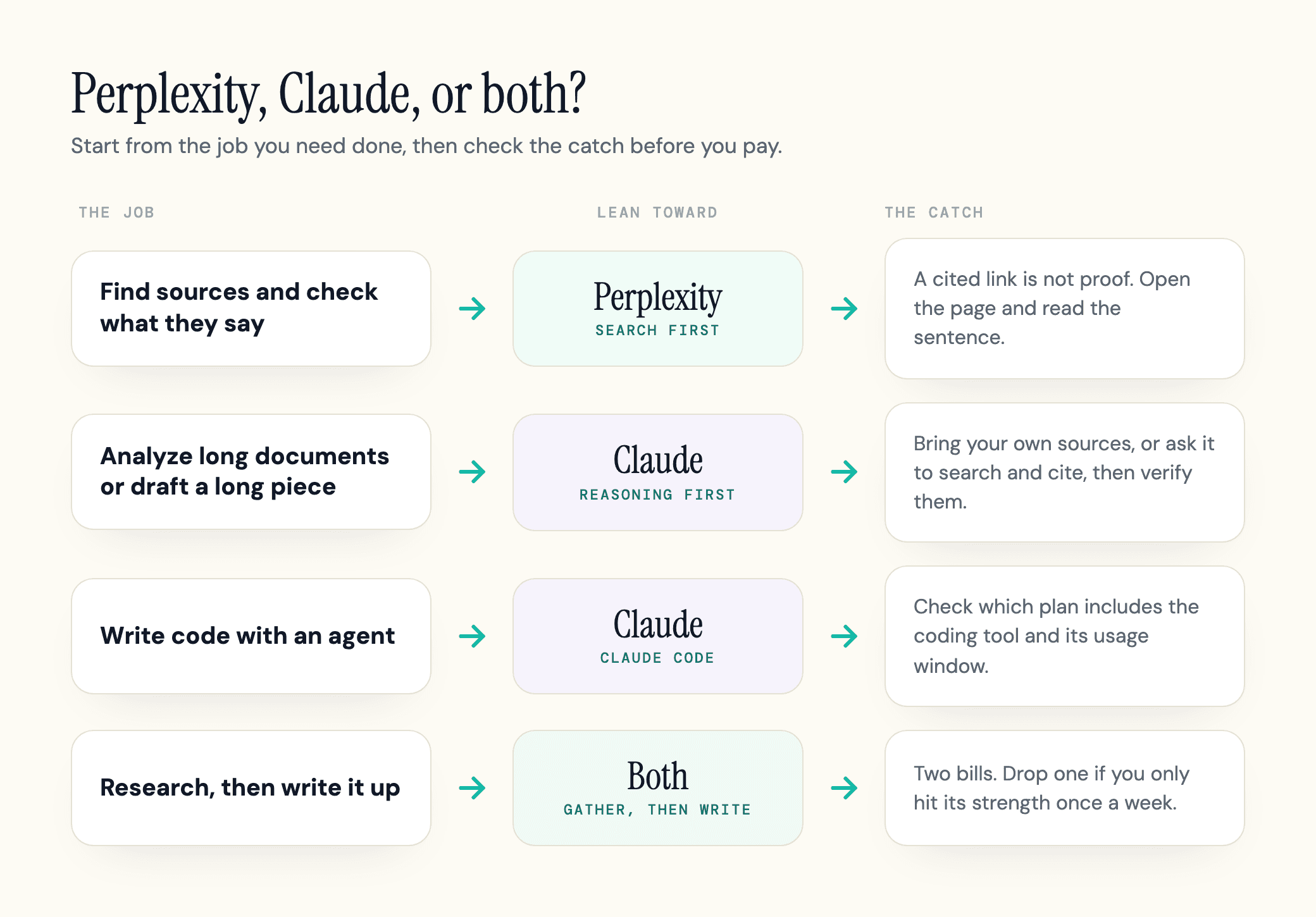
- Researchers and students: start with Perplexity for the source hunt, then read the pages it cites before you use a number.
- Developers: Claude, because Claude Code is part of the plan. Computer can build apps, but it bills by the task.
- Writers, marketers and SEOs: Claude for drafting and analysis, with Perplexity alongside for sourced background. If you publish content, read the crawler section above too, because crawl access affects whether either assistant can cite you.
- Anyone who wants both: most of those 6 articles land on the same workflow, Perplexity to gather and Claude to write. That is $17 for each Pro plan on annual billing, and you can try each free first: Claude Free includes web search, and Perplexity Free includes citations and basic models.
Our best AI model guide ranks the models behind both products by job.
Check These Before You Trust Any Comparison
Check the Lineup Date
Perplexity's model table is dated October 27, 2026, and Claude's current lineup is Fable 5.1, Opus 5.5, Sonnet 5.5 and Haiku 5.5. Posts that say Perplexity Pro includes Opus in Search, or build their advice on Sonnet 4.6, do not match that table. Perplexity's own pricing page is inconsistent too: its FAQ says Free "includes access to the top AI models" while the Free plan card says "basic AI models".
Check the Plan Names
Anthropic's Ultra page, updated October 30, 2026, says Max 20x is now Ultra, and Ultra is 10x Pro usage every week. Any post that still sells Max 20x is describing a plan that now goes by another name.
Check Whether the Product Still Exists as Described
Claude Cowork is being merged into Claude chat, and Perplexity's Computer is paid in credits that move with your plan. A comparison that treats either as fixed is a snapshot, and so is ours, which is why this page carries a re-check date of November 20.
Frequently Asked Questions
Is Perplexity Pro worth paying for if you already have Claude Pro?
Only if you hunt for sources most days. Claude Pro already includes web search, so what Perplexity Pro adds is search built into each answer with inline citations, models from several vendors, and weekly Computer usage. If that describes your work, the second $17 plan earns its place. If not, stay on Claude Pro and use Perplexity's free tier when you need a sourced answer.
Can Claude search the web like Perplexity?
Yes, on every plan, Free included. The difference is control: Perplexity is designed to search on each question, while in Claude's merged chat experience there is no toggle and Claude searches when it helps. For anything recent, ask Claude to search and to cite its sources.
Claude or Perplexity: which is better for students?
Use both free tiers first. Perplexity is built for finding sources, and most comparisons favor Claude for working through a paper you have already downloaded. Whatever you cite in an essay, open the page: DeepTRACE measured 49.0% citation accuracy for Perplexity's search mode in 2025, and we found no independent study of claim-level citation accuracy for both.
Next, Check Whether They Can Cite You
Both assistants retrieve pages through the bots above, so crawl access affects whether either can cite you. geotoolbox's free AI Crawler Checker tests which of 34 AI crawlers your robots.txt allows or blocks, PerplexityBot and ClaudeBot included, and shows the exact line to fix. It tests your robots.txt rules, which do not govern a fetcher like Perplexity-User, so pair it with a look at your server logs.
Sources
- Perplexity pricing page (Free, Pro and Max plan cards and FAQ), captured November 7, 2026 - Perplexity -
perplexity.ai/hub/pricing - AI costs: what teams pay to use AI tools (prices in USD as of October 2026) - Perplexity -
perplexity.ai/hub/blog/ai-costs - What advanced AI models are included in my subscription? (model tables as of October 27, 2026; page modified October 28) - Perplexity Help Center -
perplexity.ai/help-center/en/articles/10354919 - Perplexity Max (page modified September 14, 2026) - Perplexity Help Center -
perplexity.ai/help-center/en/articles/11680686 - How credits work on Perplexity (page modified November 4, 2026) - Perplexity Help Center -
perplexity.ai/help-center/en/articles/13838041 - Perplexity crawlers documentation (dated October 29, 2026) - Perplexity -
docs.perplexity.ai/docs/resources/perplexity-crawlers - How does Perplexity follow robots.txt? (last modified September 14, 2026) - Perplexity Help Center -
perplexity.ai/help-center/en/articles/10354969 - Migrate from Sonar to the Agent API (modified October 22, 2026) - Perplexity -
docs.perplexity.ai/docs/agent-api/migrate-from-sonar/overview - Claude pricing page, captured November 7, 2026 - Anthropic -
claude.com/pricing - What is the Ultra plan? (updated October 30, 2026) - Claude Help Center -
support.claude.com/en/articles/17728952 - Claude Cowork and chat are one Claude (updated October 30, 2026) - Claude Help Center -
support.claude.com/en/articles/16761823 - Does Anthropic crawl data from the web? (modified November 4, 2026) - Claude Help Center -
support.claude.com/en/articles/8896518 - How do Anthropic-hosted browsers identify themselves? (modified November 4, 2026) - Claude Help Center -
support.claude.com/en/articles/18234133 - AI Search Has a Citation Problem, March 2025 - Columbia Journalism Review, Tow Center -
cjr.org/tow_center/we-compared-eight-ai-search-engines-theyre-all-bad-at-citing-news.php - Assessing the performance of 8 AI chatbots in bibliographic reference retrieval, 2025 - arXiv -
arxiv.org/abs/2505.18059 - DeepTRACE: Auditing Deep Research AI Systems for Tracking Reliability Across Citations and Evidence, September 2025 - arXiv -
arxiv.org/abs/2509.04499 - Cited but Not Verified: Parsing and Evaluating Source Attribution in LLM Deep Research Agents, May 2026 - arXiv -
arxiv.org/abs/2605.06635 - Arena Search leaderboard, board dated November 6, 2026 - Arena -
arena.ai/leaderboard/chat/search