
Search "Claude SEO" and almost everything you find is about using Claude to do your SEO work. This guide is the other thing: how to get your brand cited when someone asks Claude a question. That is now possible, because Claude browses the web and links its sources. For the engine underneath that behavior, see our explainer on how Claude works, the plain-English what is Claude AI overview, or Claude vs ChatGPT for how it compares with the other major assistant.
Does Claude Browse the Web?
Yes. This trips people up, because Claude spent its early life as a closed, training-only model, and many still assume it cannot see the live web. That changed in 2025. Claude now has web search in the Claude apps, available across plans including the free tier, and through the API's web search tool.
When Claude searches, it shows its sources. Answers built from a search carry inline, clickable citations to the pages it used, the same shape of citation you see in Perplexity or ChatGPT search. When search is off, Claude answers from its training data alone, with a knowledge cutoff and no per-claim sources. So getting cited in Claude specifically means earning a place in those web-search answers. How AI search works covers the retrieve-and-cite loop in general.
The Three Anthropic Crawlers, and Why the Difference Matters
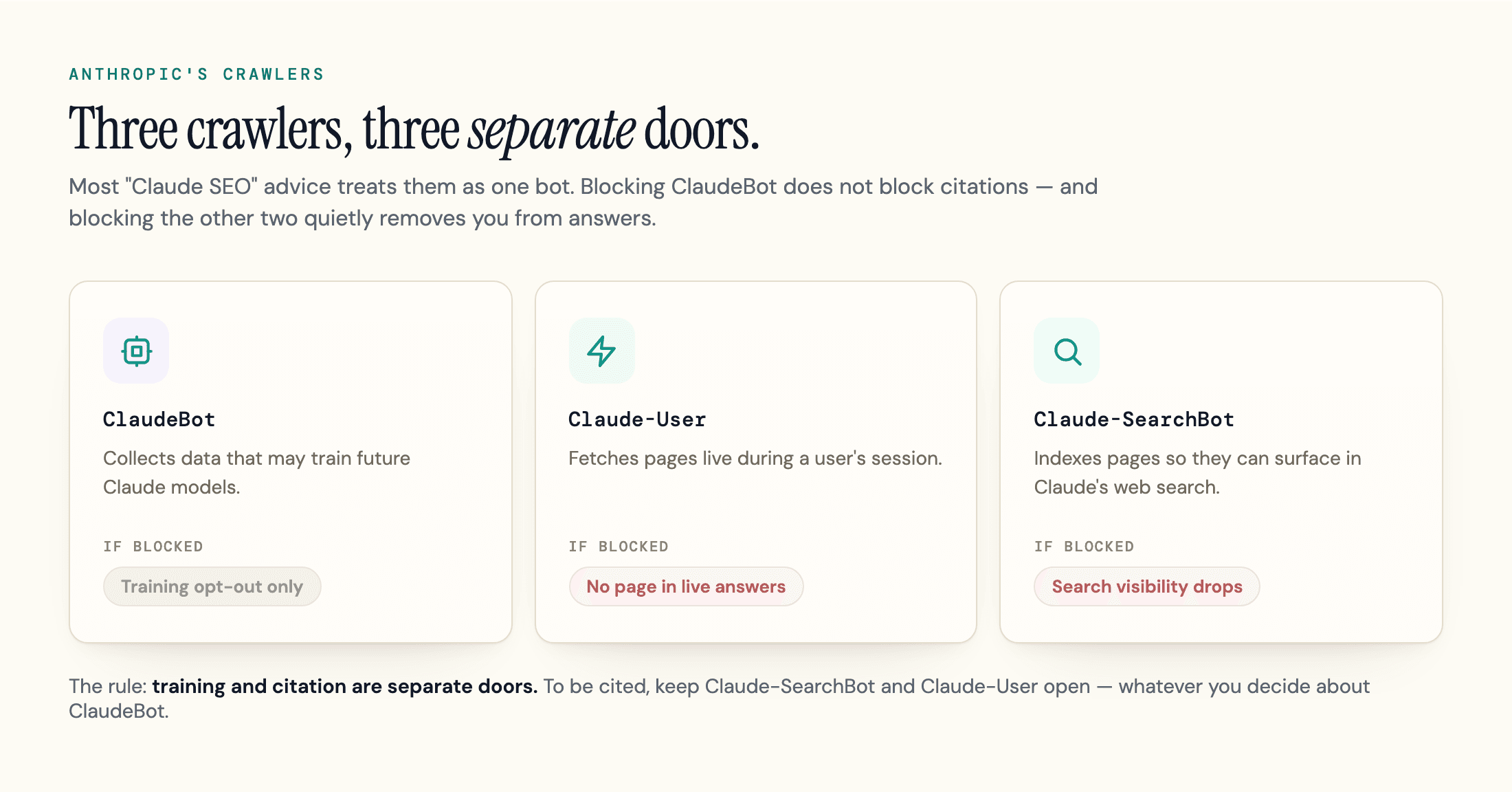
This is where most "Claude SEO" advice goes wrong. Anthropic does not run one crawler, it runs three, and they do different jobs. Getting this right is the difference between being citable and being invisible.
| Crawler | What it does | Block it and... |
|---|---|---|
| ClaudeBot | Collects data that may train future models | You opt out of training, with no effect on whether Claude cites you today |
| Claude-User | Fetches pages live during a user's session | Claude cannot pull that page into a live answer for the user |
| Claude-SearchBot | Indexes pages so they can surface in Claude's web search | Anthropic says disabling Claude-SearchBot prevents search indexing and may reduce your visibility in Claude search results. |
The names and rules are on Anthropic's crawler page, which documents the three bots separately, each controllable on its own in robots.txt. Anthropic's own warning is explicit: blocking Claude-SearchBot "may reduce your site's visibility and accuracy in user search results." The trap is treating them as one. Many sites block ClaudeBot to opt out of AI training (a fair choice) and assume they have "blocked Claude." They have not blocked citations; they have only opted out of training.
The reverse mistake is worse: blocking Claude-SearchBot or Claude-User, often by accident through a broad firewall rule, can quietly remove you from the answers you wanted to win.
The rule to remember: training and citation are separate doors. To be cited, keep Claude-SearchBot and Claude-User able to reach you, whatever you decide about ClaudeBot.
How Claude Decides What to Cite
Anthropic does not publish a ranking formula, so treat everything here as behavior we and other practitioners have observed in testing, not official rules.
The first thing to know is where Claude's search looks. It does not run a Google-scale index of its own; Claude's web search appears to be powered by Brave Search, which Anthropic lists as a data subprocessor. Profound's March 2025 spot check put an early number on it: 13 of the 15 results Claude cited across its test queries, 86.7 percent, matched Brave's top organic results. Practically, Brave visibility is a useful proxy to check, but treat it as an observed correlation, not the whole citation system; Anthropic also documents Claude-SearchBot and Claude-User as separate access paths.
From there a few patterns hold. Claude cites at the passage level, pulling a specific sentence or claim and linking it rather than listing ten results, so a clean, self-contained fact is easier to lift than a buried one. It cross-checks, favoring claims it can corroborate. And it tends to search when a question needs fresh or changing information, leaning on training memory for evergreen facts it already holds. That has a real implication: recency and specificity win citations more reliably than broad keyword coverage does.
One stylistic note. Claude is tuned to be measured and neutral, so overtly promotional copy reads as a weaker source than a plainly stated, verifiable fact. Write for a careful reader, not a sales page.
First, Can Claude Reach Your Pages?
Every citation tactic assumes Claude can fetch your page, and that assumption fails more often than people think. The reachability rules are the same ones that govern the rest of AI search: a robots.txt that blocks the wrong crawler, a firewall that challenges non-browser traffic, or content that only appears after JavaScript runs.
The JavaScript point matters more for a real-time search fetch than for a patient training crawler. If your key facts are injected client-side, a search-time fetch can see a nearly empty page and move on to a competitor whose content sits in the raw HTML. The JavaScript SEO guide lists which bots run scripts and how to test it. Confirm that Claude-SearchBot and Claude-User can reach and read your important pages before you spend time on formatting. Our AI search playbook covers the checks, and geotoolbox's free AI Crawler Checker shows which of 34 AI crawlers your robots.txt allows or blocks in seconds.
What Gets You Cited in Claude
With the page reachable, citation in Claude comes down to being the clearest, most credible source for a specific claim. The fundamentals match the rest of AI search, with a Claude-shaped emphasis.
- Lead with the answer. State the fact directly, in a self-contained sentence near the top of the relevant section. Claude lifts passages, so a clean claim it can quote in one line beats the same point spread across a paragraph. This is the heart of writing content that AI cites.
- Make it verifiable. Back claims with specific numbers, named sources, and dates. Claude cross-checks, so a corroborated, sourced statement is safer to cite than an unsupported assertion.
- Be current where it counts. Because Claude tends to search for fresh or changing information, the pages that win those citations are the ones kept up to date. A visible "last updated" date and current facts help on exactly the queries that trigger a search.
- Establish the author and the entity. A named author and clear entity signals help humans and search systems evaluate and disambiguate the source; schema is useful plumbing, but there is no public proof it directly boosts Claude citations. This is where entity SEO pays off.
- Keep the tone neutral. Promotional language reads as a weaker signal. State what is true plainly and let the facts carry the recommendation.
A note on what to skip. You will see "Claude SEO" advice insisting you add an llms.txt file. Anthropic gives no indication its search or models use it, so treat it as unproven rather than a requirement. The same reachable, clear, credible content that earns citations in ChatGPT, Gemini, and Perplexity is what earns them in Claude.
Why Claude Might Not Cite You
If Claude answers your category questions without naming you, work down this diagnostic in order:
- The search bot is blocked. The most common and most invisible cause: Claude-SearchBot or Claude-User is shut out by robots.txt or a firewall, so your content never enters the pool. Rule this out first; the rest is moot if Claude cannot read the page.
- The content is client-side rendered. Facts that load through JavaScript leave a search-time fetch looking at an empty shell.
- Nothing is fresh. On queries that trigger search, a genuinely current page is often a stronger candidate than stale content.
- The claim is not liftable. Per the checklist above, a vague or unsourced assertion is harder to quote and trust than a clean, corroborated one.
- The copy sells. Neutral, verifiable statements beat promotional phrasing.
"Claude SEO" vs "Using Claude for SEO"
The search results for this term are almost entirely the other meaning: using Claude, often through Claude Code or a plugin, to draft content, audit a site, or generate schema. This guide is the opposite job, optimizing your site so Claude cites you when it answers a question. They share a name and nothing else.
Is Claude Worth Optimizing For?
On its own, not much, though the gap is closing faster than most people realize. Claude is a smaller slice of AI chat usage than ChatGPT or Google's AI features, its web search is newer, and its retrieval is selective rather than exhaustive. The trajectory is the part to watch: Apptopia measured Claude at 10 percent of daily active users across the top seven US mobile chatbot apps in March 2026, up from under 2 percent in December 2025, still well behind ChatGPT's 38.7 percent. If you were picking one engine to obsess over, it would not be this one.
But "on its own" is the wrong framing. The work that earns a Claude citation (reachable pages, clear and current facts, named authors, real authority) is the same work that earns citations everywhere else. So the marginal cost of including Claude is close to zero: keep the two citation bots unblocked, and the content you are already writing does the rest.
The audience is worth a note too: by most usage research, Claude skews toward a technical, professional user, often exactly the high-intent reader a B2B or developer-facing brand wants. The clearest signal is on the business side: in April 2026, Anthropic passed OpenAI in business adoption for the first time among the businesses on Ramp's platform, 34.4 percent to OpenAI's 32.3 percent, per the Ramp AI Index, which reads adoption from its customers' corporate card and invoice spend. Treat Claude as one beneficiary of your wider generative engine optimization work, not a destination in itself.
Frequently Asked Questions
Does Claude cite sources?
Yes, when it uses web search, and the citations are passage-level: Claude links the specific sentence it drew on, quoting up to about 150 characters of the source text per its API documentation. The API documents cited text up to 150 characters; Claude apps also show source links, but Anthropic does not document identical citation fields or limits for the app UI.
Should I block ClaudeBot?
That depends only on your training stance. Publishers who license their content often block it; brands chasing AI visibility usually leave it open. Either way the choice does not touch citations, which ride Claude-SearchBot and Claude-User.
Does Claude use Google or Brave?
Apparently Brave. Anthropic has never announced it, but it lists Brave as a data subprocessor and researchers have matched Claude's results to Brave's. The practical takeaway: check how you rank in Brave Search, an index almost nobody optimizes for deliberately.
Can I see Claude referral traffic in analytics?
Yes. Clicks on Claude's citations arrive with claude.ai as the referrer, so you can build a GA4 segment for it. Expect it to undercount, since most answers are read without a click.
How do I check if Claude cites me?
Ask it. In a logged-out session with web search on, put the questions your customers would ask and see whether Claude names and links you. Repeat across a few runs, since answers vary.
Where to Start
Claude is not a special discipline, it is one more engine that now reads the live web and cites what it finds. Get the basics right and it follows the rest of your AI visibility work for free.
Start at the gate the citation guides skip: can Claude actually reach your pages? geotoolbox's free AI-Readiness Score checks whether the crawler-access foundations are in place, and the Content Analyzer grades how citable the page is once they are. Confirm Claude-SearchBot and Claude-User are not blocked, then make your best pages clear, current, and plainly sourced. Once the basics are in place and you want to measure whether any of it moved, we compare the best Claude rank trackers and explain what their numbers actually measure.
Sources
- Claude can now search the web - Anthropic, 2025 -
claude.com/blog/web-search - Web search tool - Anthropic API documentation -
platform.claude.com/docs/en/agents-and-tools/tool-use/web-search-tool - Does Anthropic crawl data from the web, and how can site owners block the crawler? - Anthropic (crawler reference) -
support.claude.com/en/articles/8896518-does-anthropic-crawl-data-from-the-web-and-how-can-site-owners-block-the-crawler - Anthropic appears to be using Brave to power web search for its Claude chatbot - TechCrunch, 2025 -
techcrunch.com/2025/03/21/anthropic-appears-to-be-using-brave-to-power-web-searches-for-its-claude-chatbot - Claude web search explained - Profound, March 2025 -
tryprofound.com/blog/what-is-claude-web-search-explained - Anthropic beats OpenAI on business adoption - Ramp AI Index, May 2026 -
ramp.com/leading-indicators/ai-index-may-2026 - Gen AI Chatbots: April 2026 Apptopia Data Brief - Apptopia, April 2026 -
apptopia.com/en/insights/gen-ai-chatbots-april-2026-apptopia-data-brief-chatgpt-drops-below-40-market-share