
Picking the best open source LLM in 2026 has a specific problem: the answer changes monthly, and most of the rankings you will find were right when they were written and wrong by the time you read them. This one is dated on every claim, against the update stamp at the top of this page (rankings re-checked October 18, 2026), and honest about which numbers come from vendor decks versus verified model cards. Eleven models made the cut. Their licenses differ more than their benchmark scores do, and only a handful run on hardware you can actually own.
The Best Open-Source LLMs in October 2026, at a Glance
The short answer: GLM-5.3 is our pick for the best open-source LLM, chosen for long-horizon agentic coding, and DeepSeek V4.1 Flash and Xiaomi's MiMo-V2.6-Pro are the value picks. Kimi K3 no longer leads the open-weight benchmark race: on Artificial Analysis's Intelligence Index (v4.3.2, checked October 18, 2026), Xiaomi's MiMo-V2.6-Pro tops the open field at 46.3, ahead of GLM-5.3 at 44.8, StepFun's Step 5 Preview at 43.7 and Kimi K3 at 43.6. K3's 2.8-trillion-parameter scale keeps it out of self-hosting reach for almost everyone; GLM-5.3 (753B) and MiMo-V2.6-Pro (1.02T) are the leaders a multi-GPU server can hold. One caveat on GLM-5.3: unlike GLM-5.2, it ships under a custom license, not MIT (only the smaller GLM-5.3-Flash kept MIT). Which one you should use depends on the job, the license terms you can live with, and the hardware you have.
Here is the full field, verified against official model cards and launch documentation on October 18, 2026 (Gemma 4, gpt-oss-120b and Llama 4: September 7).
| Model | Maker | Parameters (total / active) | Context | License | Best for |
|---|---|---|---|---|---|
| GLM-5.3 | Z.ai | 753B / 40B | 1M | Custom | Agentic coding, 753B footprint |
| DeepSeek V4 Pro / V4.1 Flash | DeepSeek | 1.6T / 49B and 552B / 16B | 1M | MIT | Value, world knowledge |
| Step 5 Preview | StepFun | 600B / 27B | 1M | StepFun Model License 1.0 | Agentic work, finance |
| Kimi K2.7-Code / K3 | Moonshot AI | 1T / 32B and 2.8T / 104B (K3) | 256K / 1M | Modified MIT (K2.7-Code); custom Kimi K3 License | Agent swarms, frontier scale |
| Hunyuan Hy4 Preview | Tencent | 770B / 49B | 1M | Apache 2.0 | Fully permissive frontier license |
| MiniMax M3 | MiniMax | 428B / 23B | 1M | MiniMax Community | Multimodal agents |
| Qwen3.5 / 3.6 / 3.8-27B | Alibaba | 0.8B to 397B / 17B | 262K+ | Apache 2.0 | License freedom, multilingual |
| MiMo-V2.6-Pro | Xiaomi | 1.02T / 42B | 1M | MIT | Token efficiency |
| Llama 4 / Muse Spark Open / Muse Glimmer | Meta | 109B/17B & 400B/17B (Llama 4); 816B/42B (Spark Open); ~30B dense (Glimmer) | up to 10M claimed (Llama 4); 1M (Spark Open); 131K (Glimmer) | Llama 4 Community; Muse Model License (Spark Open); Apache 2.0 (Glimmer) | Western default, long context; Glimmer for local agents |
| Gemma 4 | E2B to 31B (4 sizes) | 256K (31B) | Apache 2.0 | Local and edge hardware | |
| gpt-oss-120b | OpenAI | 117B / 5.1B | 128K | Apache 2.0 | Permissive Western reasoning |
Two things stand out in that table. First, most of the entries come from Chinese labs, and they hold most of the top benchmark slots. Second, "open" spans four meaningfully different license families, and the differences bite in production.
One caveat before the rankings: AI engines themselves disagree on the #1 pick. When we ran this exact question through five engines in July 2026 (ChatGPT, Gemini, Perplexity, Claude, and ChatGPT's search mode), four named GLM-5.2 the best overall open model and one ranked DeepSeek V4 Pro first. The gap between them is small enough that your use case, not the leaderboard, should break the tie.
Open Source vs Open Weight, in One Minute
Almost every model on this list is open weight, not open source. The distinction matters more than the marketing suggests.
Open weight means you can download the model parameters, run them on your own hardware, and usually use them commercially. It does not mean you can see the training data or reproduce the model. The Open Source Initiative's Open Source AI Definition requires three things: detailed data information, the complete training code, and the parameters, all under open terms. Weights alone do not clear that bar.
By the strict OSI reading, GLM-5.3, DeepSeek V4, and Llama 4 are all open weight, and so is this ranking's newest permissive entry, Xiaomi's MIT-licensed MiMo-V2.6-Pro. The models that genuinely qualify as open source, like AI2's OLMo or EleutherAI's Pythia, publish training data and recipes but do not top capability leaderboards. NVIDIA's Nemotron 3 comes closest to bridging the two: it ships weights alongside training datasets and recipes, the closest any frontier-adjacent lab comes to the OSI bar, even though its mid-pack scores keep it out of the ranked eleven below (see Near Misses).
For the full breakdown of what each label legally means, see our guide to open weights vs open source. The practical takeaway for this article: every model ranked below has downloadable open weights today (K3's since July 27; Muse Spark Open's behind a manual-approval gate), and we flag the license catch on each one.
How We Ranked These (and How to Read LLM Benchmarks)
Every ranking below rests on official model cards and launch documentation, cross-checked against independent leaderboards that publish their setups, with every claim re-verified October 18, 2026, three rows excepted. That last part matters more than it should, and here is why.
Benchmark numbers are easy to game and easier to misread. Three traps account for most of the bad comparisons you will see in open-source LLM lists:
Trap 1: Verified vs Pro. SWE-bench Verified and SWE-bench Pro are different tests. GLM-5.2 scores 62.1% on SWE-bench Pro per its official model card, while several rivals advertise 80%-class scores on the easier Verified set. Put those in one column and GLM-5.2 looks like it lost. It did not; the tests changed.
Trap 2: single-attempt vs multi-attempt. Kimi K2 famously reported 65.8% on SWE-bench Verified in one attempt and 71.6% when allowed retries. Both are real numbers. Only one of them is comparable to a single-attempt score from another lab.
Trap 3: tools on vs tools off. Humanity's Last Exam scores swing by 10 or more points depending on whether the model can search and run code. GLM-5.2's own card reports HLE at 40.5; leaderboards that allow tools report the same model in the mid-50s. Neither number is wrong, but putting them in one column is.
There is also the blunter problem the r/LocalLLaMA crowd calls benchmaxxing: labs tune models toward the public tests. The pattern shows up as a model that tops SWE-bench yet fumbles your actual repo. Treat every score as a screening filter, then run your own task suite before committing. A model can ace a benchmark format and still fail a slightly reworded version of the same problem.
With those caveats stated, the rankings.
The Rankings: 11 Best Open-Weight Models Right Now
1. GLM-5.3 (Z.ai): Best for Agentic Coding
753B total / 40B active MoE, 1M context, custom GLM-5.3 license, released August 14, 2026 with open weights following around August 28. GLM-5.3 keeps the same 753B/40B base as GLM-5.2, with all the gains coming from post-training, and it scores 44.8 on Artificial Analysis's Intelligence Index v4.3.2 (October 2026), the #2 open-weight model behind Xiaomi's MiMo-V2.6-Pro (46.3) and just ahead of Step 5 Preview (43.7) and Kimi K3 (43.6). We rank GLM-5.3 first for long-horizon agentic coding on a 753B footprint; the higher-scoring MiMo-V2.6-Pro is a 1.02T model. Its headline differentiator is emergent cyber capability (Z.ai reports 84.5 on CyberGym), though it still trails the closed frontier on exploitation. One license catch: unlike GLM-5.2's clean MIT terms, GLM-5.3 ships under a custom license, and hosts with more than $10B in revenue over any 12-month period must pass a Z.ai security review (only the smaller GLM-5.3-Flash kept MIT).
The 1M-token context window is the practical centerpiece. Coding agents can hold a mid-sized repository in memory without constant compaction, and Z.ai reports its IndexShare optimization cuts long-context compute by roughly 2.9x at the full window.
Watch for: no image input, and self-hosting is a serious project. Even aggressively quantized community builds still weigh hundreds of gigabytes. Most teams will run it through an API provider, not a garage rig. We cover the full specs in what GLM-5.3 is.
2. DeepSeek V4 Pro and V4.1 Flash: A Value Pick
1.6T / 49B (Pro) and 552B / 16B active (V4.1 Flash), 1M context, MIT license. DeepSeek's V4 family covers both ends of the budget. Pro was pre-trained on over 32T tokens; V4.1 Flash (September 10, updated October 17) on 45T, and it now outscores Pro on Artificial Analysis's index (39.5 against 36.0) at a fraction of the serving cost. Both use a compressed-attention design that cuts KV-cache pressure dramatically at long context.
V4 Pro's quietest advantage is factual knowledge: its model card publishes SimpleQA-Verified results that lead the open-model comparisons it reports. Strong reasoners that also know things are rarer than the leaderboards suggest. The company that triggered the original "DeepSeek moment" is still the value benchmark, and DeepSeek pricing remains the number every rival gets measured against. Background on the lab and the R1 story is in our DeepSeek explainer.
Watch for: V4.1 Flash's weights are about 510 GB, a server-class download despite the "Flash" name.
3. Step 5 Preview (StepFun): Third on the Open Index
600B total / 27B active MoE, up to 1M context, StepFun Model License 1.0. StepFun's agentic flagship scores 43.7 on Artificial Analysis's index, 0.1 ahead of Kimi K3 and third among open-weight models. Its Hugging Face repository dates from September 20, 2026. Like GLM-5.3 and Kimi K3, it is open-weight but not permissively licensed: device makers and large Model-as-a-Service operators need a separate commercial license.
4. Kimi K3 and K2.7-Code (Moonshot AI): Best for Agents, New Frontier Flagship
K3: 2.8T parameters, 1M context, launched July 16, 2026. K2.7-Code: ~1T / 32B, 256K context, shipped mid-June 2026. K2.7-Code is the current workhorse, not the older K2.6 it replaced as Moonshot's day-to-day default: it inherits K2.6's agent-swarm architecture, documented on K2.6's model card as scaling to 300 sub-agents across 4,000 coordinated steps, while cutting thinking-token usage roughly 30% for long autonomous sessions, at a coding-specialized $0.95 input / $4.00 output per million tokens. K3 is the headline: the largest open-weight model ever released, a 2.8T-total / 104B-active MoE roughly 75% bigger than DeepSeek V4 Pro. On an independent leaderboard it now sits fourth among open-weight models: Artificial Analysis's Intelligence Index v4.3.2 (October 2026) scores it 43.6, behind Xiaomi's MiMo-V2.6-Pro (46.3), GLM-5.3 (44.8) and StepFun's Step 5 Preview (43.7). Its launch benchmarks still trade blows with the top proprietary systems, including a vendor-reported, field-leading 91.2 on BrowseComp.
One date matters here: K3's weights went public on July 27, 2026. Before that it was API-and-app only, still priced at $3 per million input tokens and $15 per million output, 3.75 times K2.7-Code's output rate. Our Kimi K3 breakdown tracks what is verified versus vendor-claimed, and our how to run Kimi K3 locally guide covers whether you can actually self-host a 2.8T model (mostly, no).
Watch for: the license. K2.7-Code ships open weights under the same terms as its predecessor K2.6, Moonshot's Modified MIT: products with more than 100 million monthly active users or more than $20 million in monthly revenue must prominently display the model name in their UI. Trivial for most teams, a real conversation for consumer apps at scale. K3 shipped under its own custom Kimi K3 License rather than the Modified MIT some expected: commercial use is permitted, products past 100 million MAU or $20 million in monthly revenue must display "Kimi K3" in the UI, and any company running a model-as-a-service business on K3 must sign a separate agreement with Moonshot once its total revenue, counting affiliates, passes $20 million over any 12 months. Runtime support was faster than usual for a new attention design: vLLM had day-zero support on July 27 and GGUF and Ollama quantizations were live at the weight drop, not weeks later. K2.6 itself is still live on the API at the same rate as K2.7-Code, but Moonshot's August 31, 2026 retirement of the older K2.5 line signals where that generation is headed.
5. Hunyuan Hy4 Preview (Tencent): The Fully Permissive Frontier Challenger
770B total / 49B active MoE, 1M context, Apache 2.0, open weights shipped August 28, 2026. Tencent's Hunyuan line is the field's quiet permissive-license play. Tencent's own blind-eval benchmark places Hy4 Preview a hair ahead of GLM-5.3 and Kimi K3 (2.99 vs 2.92 and 2.94). Unlike GLM-5.3 and Kimi K3, which both ship custom licenses with revenue-threshold or MAU-display conditions, Hy4 Preview is plain Apache 2.0, no strings attached, at a scale (770B) most fully-permissive releases do not reach.
Watch for: the price jump from Hy3 to Hy4 is steep, roughly 4-6x on a per-token basis depending on which Hy3 checkpoint you compare against, so budget-sensitive teams may prefer the full Hy3 (295B/21B, 262K context, also Apache 2.0). Do not confuse it with the April Hy3-Preview, which carried the more restrictive Tencent Hy Community License and geographic exclusions Tencent dropped in the July release. And "Preview" in the Hy4 name is Tencent's own label, not marketing: expect further checkpoints.
6. MiniMax M3: Best Multimodal Agent Model
428B / 23B MoE, 1M context via MiniMax Sparse Attention. M3 was trained mixed-modality from the start, so it takes image and video input natively.
Watch for: the MiniMax Community License carries commercial-use conditions, and the model's reasoning scores rest partly on aggregator leaderboards that weight tests differently than the individual benchmarks do. Read the license and the fine print on both.
7. Qwen3.5, Qwen3.6 and Qwen3.8-27B (Alibaba): Best License Freedom and Language Coverage
0.8B to 397B / 17B active, 262K-token context window extendable toward 1M, Apache 2.0. Qwen is the ecosystem play. One family covers phone-sized 0.8B models up to the 397B Qwen3.5 flagship, all under Apache 2.0, the most permissive license in common use: no attribution thresholds, no user caps, nothing to renegotiate when your product grows.
The flagship reasons across text, images, video, and documents in one framework and covers 201 languages and dialects, per its model card. The generations also turn over fast: the April 2026 Qwen3.6 wave added a 27B dense model and a 35B-total, 3B-active MoE that punch far above their size, and they, not the Qwen3.5 flagship, are the family's current picks for consumer hardware. Full lineup in our Qwen guide.
Watch for: running the flagship at full context demands a serious multi-GPU memory budget. The family's breadth is the point; buy the size you can serve. And a naming note: Alibaba's 2.4T-parameter Qwen3.8-Max shipped on August 3, 2026, but as the closed Max API line ($2 / $6 per million tokens), not an open release; its open weights landed on August 12, 2026, but as a text-only variant under a bespoke "Qwen3.8-Max" license rather than a permissive one, so this entry covers Qwen's Apache 2.0 line, where Qwen3.5-397B remains the largest flagship and Qwen3.8-27B (August 2026) is the newest.
8. MiMo-V2.6-Pro (Xiaomi): The Token-Efficiency Dark Horse
1.02T / 42B MoE, 1M context, MIT license, weights released September 21, 2026. Xiaomi is the least-discussed lab on this list and arguably the most efficient. MiMo-V2.6-Pro, which replaced MiMo-V2.5-Pro as Xiaomi's flagship, is now the top open-weight model on Artificial Analysis's Intelligence Index v4.3.2 (46.3, checked October 18, 2026). Its reinforcement-learning recipe explicitly rewards shorter solution paths and fewer tokens per task, which compounds into real money across long agentic workloads, and it handles text, image, video, and audio in one model.
Watch for: ecosystem maturity. Tooling, quantized community builds, and provider support all trail the bigger names, so expect more integration work.
9. Llama 4, Muse Spark Open and Muse Glimmer (Meta): The Western Default
Llama 4: 109B / 17B and 400B / 17B MoE, multimodal, context windows advertised up to 10M tokens. Muse Spark Open: 816B / 42B MoE, natively multimodal, 1M context, Muse Model License, released October 15, 2026. Muse Glimmer: ~29.6B dense, 131K context, Apache 2.0, shipped August 10, 2026. Llama remains the infrastructure layer of the open ecosystem: the widest tooling support, the most fine-tunes, the most deployment guides. Scout is the efficiency pick for local development and edge work; Maverick is the production generalist with strong multilingual scores. Llama also powered Meta AI, Meta's consumer assistant, until the company moved that app to its proprietary Muse Spark model in 2026. Muse Glimmer is Meta's answer to its own Llama-era license complaints: a 30B-class model distilled from Muse Spark, tuned for on-device agent use, that runs on a single 24GB consumer GPU and leads Gemma 4 and Qwen3.6-27B on agent-focused benchmarks like MCP Atlas and DeepSearch QA.
Watch for: two things. The Llama 4 Community License is not OSI-approved and cuts off free commercial use at 700M monthly active users, a restriction Muse Glimmer drops entirely under plain Apache 2.0. Muse Spark Open's license is not Apache: it requires "Built with Muse Spark Open" display and a separate agreement for Model-as-a-Service businesses above $20 million in revenue. And treat Llama 4's 10M-token context as a marketing ceiling, not a working spec; long-context quality falls off well before advertised limits across the industry, so size your workloads to a far smaller usable window.
10. Gemma 4 (Google): Best for Local and Edge Hardware
Four sizes from Effective-2B to 31B dense, 256K context on the 31B, Apache 2.0. Gemma 4 is the answer to "what can I actually run?" The family ladders cleanly: phone-class E2B and E4B variants that uniquely accept audio input, a 26B-A4B mixture of experts that activates only a 4B-class slice per token, and a 31B dense flagship whose unquantized bf16 weights fit a single 80GB H100, with quantized builds running on consumer GPUs.
Google also fixed the licensing complaint: where Gemma 3 shipped under custom terms, Gemma 4 is Apache 2.0.
Watch for: a 31B dense model does not compete with the trillion-parameter MoE tier on hard reasoning, and the 31B variant drops the audio support the small ones have. This is the local tier, not the frontier tier.
11. gpt-oss-120b (OpenAI): The Permissive Western Reasoner
117B / 5.1B active, 128K context, Apache 2.0. OpenAI's open-weight release is easy to overlook next to the Chinese giants, and shouldn't be. With only 5.1B active parameters it is one of the cheapest strong reasoners to serve, it was built for reasoning and tool use, and the Apache 2.0 license plus a US-origin lab matters to procurement teams that cannot ship a Chinese model, fair or not. (The safety side of that question has its own article.)
Watch for: it trails the frontier open models badly on broad-knowledge tests, and 128K context is now the smallest window on this list.
Near misses. Four absences are deliberate. NVIDIA's Nemotron 3 (550B/55B hybrid Transformer-Mamba, OpenMDW-1.1 license) earns real respect on transparency: it ships weights alongside training datasets and recipes, the closest any frontier-adjacent lab comes to the OSI's actual open-source bar, but its benchmark scores (22.9 for Nemotron 3 Ultra on Artificial Analysis, against 46.3 for the top open model) cost it a ranked slot in favor of Hunyuan Hy4 Preview's stronger combination of capability and license openness. Mistral's open line today is the Devstral 2 coding specialists plus Mistral Large 3, a 675B Apache 2.0 generalist that predates this year's frontier wave. Mistral Large 4 is a preview whose weights Mistral promises for the end of October. Microsoft's Phi-4 family owns the tiny, no-GPU end rather than the flagship fight. And OLMo, covered above, wins on openness rather than capability. All four are worth knowing; none displaces an entry above at its own job.
Which Open Model for Which Job
| You need | Use | Why |
|---|---|---|
| Agentic coding (our #1 pick) | GLM-5.3 | Top open scores on long-horizon coding, 1M context, 753B footprint |
| Best value per dollar | MiMo-V2.6-Pro or DeepSeek V4.1 Flash | MiMo: top open Artificial Analysis score at about $0.13 per index task; V4.1 Flash: $0.15 / $0.60 per million tokens off-peak, MIT |
| Agent swarms and long autonomous runs | Kimi K2.7-Code | 300 sub-agent orchestration across 4,000 coordinated steps |
| Multimodal agents (image, video, computer use) | MiniMax M3 | Native mixed-modality training |
| Cleanest license at any size | Qwen3.5 or Gemma 4 | Apache 2.0, no thresholds |
| A single 24GB consumer GPU | Gemma 4 26B-A4B or a mid-size Qwen3.6 | Built for that hardware class |
| Largest open weights (2.8T) | Kimi K3 (from July 27) | #4 open-weight on the AA Intelligence Index v4.3.2 (43.6, behind MiMo-V2.6-Pro's 46.3, GLM-5.3's 44.8 and Step 5 Preview's 43.7); 2.8T parameters |
| Hardest reasoning problems | MiMo-V2.6-Pro or Kimi K3 | Highest open scores on Humanity's Last Exam on Artificial Analysis (49.4% and 46.9%) |
| Fully permissive license at frontier scale | MiMo-V2.6-Pro (MIT) or Hunyuan Hy4 Preview (Apache 2.0) | 1.02T and 770B, no custom revenue/MAU clause unlike GLM-5.3 or K3 |
| Auditable training data | Nemotron 3 (near miss, not ranked) | Data and recipes published, not just weights |
And the free-tier answer, since it is one of the most-asked questions: every model above is free to download once weights are public. What costs money is the compute. If "free" means "free to chat with," the hosted apps for Kimi, DeepSeek, and Qwen all have no-cost tiers.
Can You Actually Run These? The Self-Host Reality Check
Here's the part most rankings skip: for the frontier tier of this list, "downloadable" and "runnable" are different claims.
The VRAM arithmetic. A model needs roughly 2GB of memory per billion parameters at FP16, and roughly 0.5GB per billion at 4-bit quantization, plus KV-cache overhead that grows with context length and concurrency (modest for local chat, huge at long contexts). An 8GB GPU tops out around a 7B-8B model at 4-bit. A 24GB card handles the 27B-32B dense class. Nothing consumer-grade touches the trillion-parameter tier.
The MoE trap. This is the single most misunderstood fact in self-hosting. A mixture of experts model like Kimi K2.7-Code activates only 32B parameters per token, but all 1T parameters must sit in memory, because any token can route to any expert. Active parameters set your speed and per-token cost. Total parameters set your memory bill. Community builds of K2.7-Code-class models need hundreds of gigabytes of combined RAM and VRAM even at extreme quantization.
Quantization is the lever, with limits. Q4_K_M, the standard 4-bit GGUF format, cuts memory roughly 70-75% with only modest quality loss on most dense models. But MoE models degrade less gracefully under aggressive quantization, and reasoning quality tends to fall before chat quality does. If a model's edge is careful multi-step reasoning, test the quant before trusting it.
The stack. For prototyping, Ollama is the fastest path: one command pulls a pre-quantized build and serves it behind an OpenAI-compatible endpoint. For production concurrency, vLLM is the standard, with PagedAttention and continuous batching to keep GPUs saturated; SGLang is its main rival. Whichever you pick, judge the setup on the two numbers users actually feel, time to first token and inter-token latency, not peak throughput. For a step-by-step walkthrough from install to your first chat, see our guide on how to run an LLM locally.
| Hardware | What it runs | Examples |
|---|---|---|
| Laptop / 8GB GPU | 2B-8B at 4-bit | Gemma 4 E2B-E4B, small Qwen3.5/3.6 |
| 24GB consumer GPU | 12B-32B | Gemma 4 26B-A4B (quantized), Qwen3.6 mid-tier |
| 128GB Mac Studio / workstation | ~100-300B MoE at 3-bit-class quants | gpt-oss-120b |
| Multi-GPU server (300GB+) | The frontier tier, quantized | GLM-5.3, DeepSeek V4.1 Flash (about 510 GB), Kimi K2.7-Code, DeepSeek V4 Pro |
| API only | Everything, no capex | All of the above via provider or official APIs |
So what does running one really cost? For the frontier-tier models, usually more than the API. A single used H100-class GPU runs five figures before power, and the frontier tier needs several. Meanwhile per-token API prices for open models are aggressive: DeepSeek V4.1 Flash sells for cents per million tokens, and even Kimi K3 launched at $3 per million input. For scale: a workload generating a full million output tokens every day on K3, the priciest model here, runs about $450 a month at its $15-per-million output rate. Self-hosting wins on data privacy (a self-hosted model sends no prompts to anyone's API, which removes the data-residency half of the Chinese-model worry, though license terms and security review still apply), offline operation, and fine-tuning freedom, and at sustained very high volume. It rarely wins on cost alone; our Kimi API pricing breakdown shows how quickly hosted rates undercut owned hardware for typical workloads. Run the math on your actual token volume before buying anything.
Why Every "Best Open LLM" List Disagrees
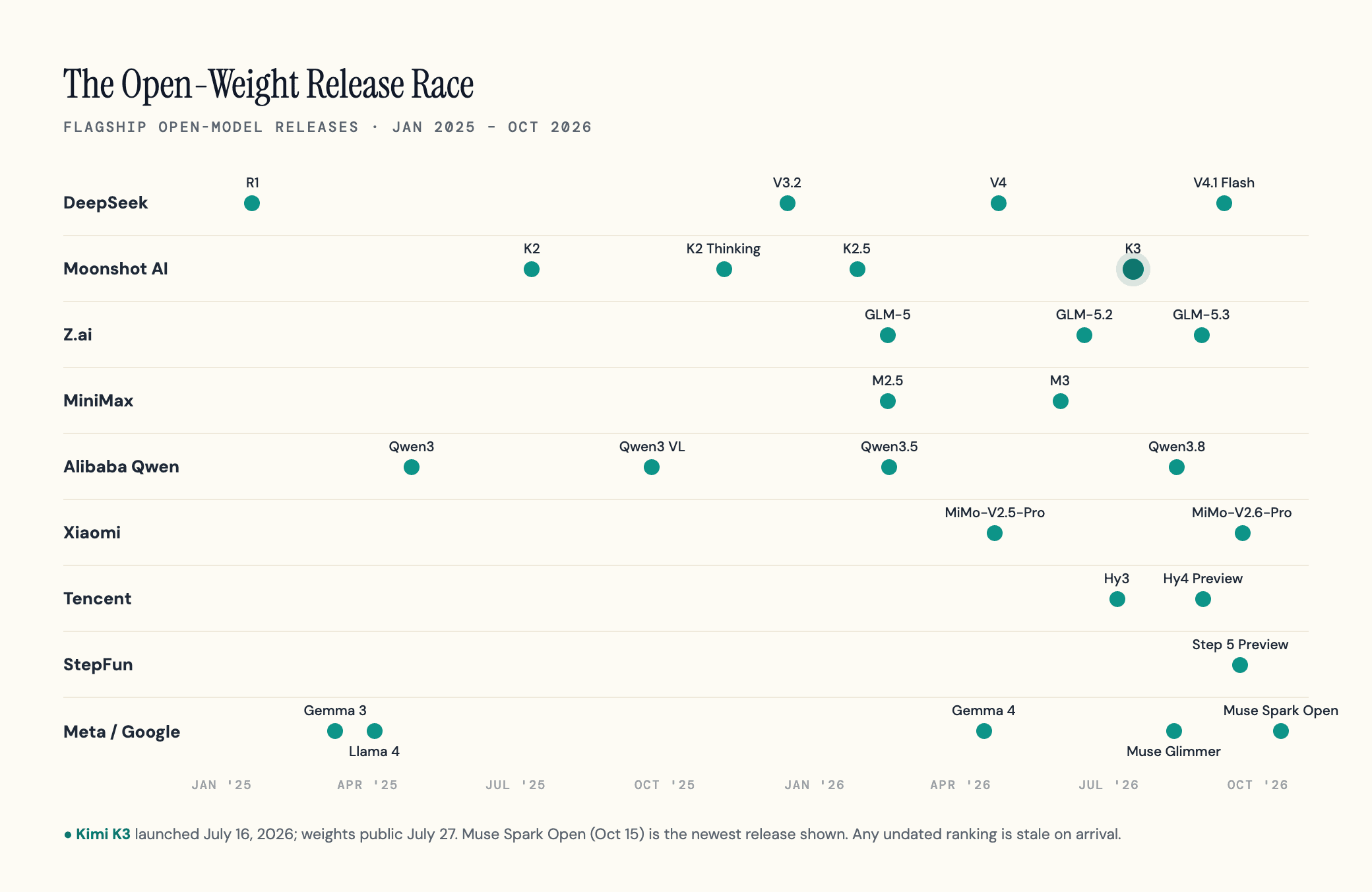
Search this topic and you will find current, well-ranked articles confidently recommending three different generations of the same model line as "the latest." One top-ranking guide's newest entry is a model two generations old. That is velocity. The open-weight field now ships a new flagship roughly every four to six weeks, and static listicles rot in months.
The lineage table below is the fix. It names the current flagship per lab, re-read October 18, 2026, next to the superseded versions you will still see recommended elsewhere.
| Lab | Current flagship (October 2026) | Superseded, still widely recommended |
|---|---|---|
| Z.ai (Zhipu) | GLM-5.3 (August 2026) | GLM-5.2, GLM-5.1 |
| Moonshot AI | Kimi K3 (July 16; weights July 27) + K2.7-Code (June 2026, coding fork) | K2.6, K2.5, K2 Thinking, K2 |
| DeepSeek | V4 Pro (GA August 13) + V4.1 Flash (Sept 10; updated Oct 17) | V4 Flash (284B), V3.2, V3-0324, R1 |
| Alibaba (Qwen) | Qwen3.8-27B (Aug 2026, newest Apache 2.0); Qwen3.5-397B stays the flagship by size* | Qwen3-Coder-480B, Qwen3 VL 235B, Qwen3 |
| MiniMax | M3 (June 2026) | M2.5, M2 |
| Meta | Muse Spark Open (Oct 15, 2026) + Muse Glimmer (Aug 2026, smaller agent model); Llama 4 (April 2025) | Llama 3.3, 3.1 |
| Gemma 4 (April 2026) | Gemma 3 | |
| Xiaomi | MiMo-V2.6-Pro (Sept 21, 2026) | MiMo-V2.5-Pro, MiMo-V2-Pro |
| Tencent | Hunyuan Hy4 Preview (Aug 28, 2026) | Hy3 (Jul 6, 2026), Hy3-Preview (Apr 2026) |
| StepFun | Step 5 Preview (Sept 2026) | n/a (first appearance here) |
*Qwen's naming runs two tracks (open-weight releases and the closed Max API line), which is itself a recurring source of listicle confusion. Case in point: the 2.4T Qwen3.8-Max shipped August 3, 2026 as the closed Max API line, with open weights delivered August 12, 2026 as a text-only variant under a bespoke license, a partial opening under a bespoke license rather than Apache 2.0.
Two data points explain the churn. Epoch AI measured frontier open-weight models trailing the best closed models by an average of about three months as of late 2025; its May 2026 update puts the lag at roughly four months. Separately, Stanford's AI Index found the open-versus-closed performance gap on some benchmarks collapsing from 8 to 1.7 percentage points in a single year, and the spread between the globally top-ranked ten models narrowing from 11.9 to 5.4 points. A field that turns over in months makes every month-old ranking partially wrong, including, eventually, this one. That is why every claim here carries a date, the same rule geotoolbox applies to its own engine scans.
What the Open-Weight Wave Means for Your AI Visibility
If you work in marketing or SEO, this model race concerns you directly. Every model on this list is also an answer engine that describes brands, recommends products, and cites sources. Open weights accelerate that in a specific way: they get embedded into products silently. When a coding tool, a CRM, or a search feature quietly ships GLM-5.3 or a Qwen fine-tune under the hood, it inherits that model's picture of your brand, and you will never see a referrer string telling you so.
The practical response is the same discipline this article applies to models: verify instead of assume. Check what the engines actually say about your brand, measure which of your pages they cite, and re-check when a new model generation lands, because a version bump swaps out the training data, the retrieval behavior, and often the citation habits in one move. A brand answer that held for Kimi K2.5 is not guaranteed to survive K3.
That monitoring is what geotoolbox is built for. If you want to know whether your site is even readable by the crawlers feeding these models, start with the free AI readiness check; it takes a minute and flags the blockers that keep your brand out of AI answers regardless of which model wins the month.
Frequently Asked Questions
What is the strongest open-source LLM right now?
It depends on what you weigh. On raw benchmarks, Kimi K3 no longer leads the open-weight field: Artificial Analysis's Intelligence Index v4.3.2 (October 2026) ranks Xiaomi's MiMo-V2.6-Pro first at 46.3, GLM-5.3 second at 44.8, Step 5 Preview third at 43.7 and Kimi K3 fourth at 43.6. But K3's 2.8-trillion-parameter size makes it effectively impossible to self-host; GLM-5.3 (753B) and MiMo-V2.6-Pro (1.02T) are the leaders a multi-GPU server can hold, and we pick GLM-5.3 for agentic coding. Note that GLM-5.3 ships under a custom license rather than GLM-5.2's MIT.
Is there a truly open-source LLM?
Yes, but not at the frontier. The OSI bar requires three things published: data information, training code, and parameters. AI2's OLMo and EleutherAI's Pythia clear it; NVIDIA's Nemotron 3 comes closest among large models. The benchmark leaders on this page, DeepSeek included, are open weight, not OSI open source.
How much does it cost to run an open-source LLM?
The weights are free; the compute is not. A 7B-12B model runs on a consumer GPU you may already own. The 24GB-GPU class covers models up to roughly 32B. Frontier models like GLM-5.3 or Kimi K2.7-Code need hundreds of gigabytes of memory, which means a multi-GPU server or a hosted API. For most workloads, per-token API pricing (from cents per million tokens for DeepSeek V4.1 Flash) is cheaper than owning hardware.
What is the best open-source LLM for coding?
GLM-5.3 for long-horizon agentic coding, on the strength of its terminal and repository-scale benchmark leads. DeepSeek V4 is among the strongest value picks, and Qwen's coder variants offer the best efficiency per active parameter under Apache 2.0. Moonshot's K2.7-Code fork and retry-friendly agent frameworks close much of any remaining gap.
Sources
- China's Moonshot AI releases Kimi K3, the largest open-source model ever - VentureBeat, July 16, 2026 -
venturebeat.com/technology/chinas-moonshot-ai-releases-kimi-k3-the-largest-open-source-model-ever-rivaling-top-u-s-systems - Kimi K3 achieves #3 in the Artificial Analysis Intelligence Index, comparable to Opus 4.8 and GPT-5.5 - Artificial Analysis, July 17, 2026 -
artificialanalysis.ai/articles/kimi-k3-achieves-3-in-the-artificial-analysis-intelligence-index-comparable-to-opus-4-8-and-gpt-5-5 - Kimi K3 model card and license - Moonshot AI on Hugging Face -
huggingface.co/moonshotai/Kimi-K3 - The Open Source AI Definition v1.0 - Open Source Initiative -
opensource.org/ai/open-source-ai-definition - How far behind are open models? - Epoch AI, October 30, 2025 -
epoch.ai/data-insights/open-weights-vs-closed-weights-models - The 2025 AI Index Report - Stanford HAI -
hai.stanford.edu/ai-index/2025-ai-index-report - GLM-5.2 official model card - Z.ai on Hugging Face -
huggingface.co/zai-org/GLM-5.2 - GLM-5.3 official model card - Z.ai on Hugging Face -
huggingface.co/zai-org/GLM-5.3 - Kimi K2.7-Code Modified MIT license text - Moonshot AI on Hugging Face -
huggingface.co/moonshotai/Kimi-K2.7-Code/blob/main/LICENSE - Mistral Large 3 675B Instruct model card - Mistral AI on Hugging Face -
huggingface.co/mistralai/Mistral-Large-3-675B-Instruct-2512 - Open models lag update (ECI gap) - Epoch AI, May 2026 -
epoch.ai/data-insights/open-closed-eci-gap - vLLM documentation -
docs.vllm.ai/en/latest/ - Ollama -
ollama.com - Kimi K2.7-Code model card - Moonshot AI on Hugging Face -
huggingface.co/moonshotai/Kimi-K2.7-Code - Tencent open-sources Hy4 preview with 770B parameters and a 1M-token context - TechNode, August 28, 2026 -
technode.com/2026/08/28/tencent-open-sources-hy4-preview-with-770b-parameters-and-a-1m-token-context - Meta returns to open source with Muse Glimmer, an Apache 2.0 licensed 30B parameter AI model - VentureBeat, August 10, 2026 -
venturebeat.com/technology/meta-returns-to-open-source-with-muse-glimmer-an-apache-2-0-licensed-30b-parameter-ai-model-optimized-for-agents-available-now - Step 5 Preview model card - StepFun on Hugging Face -
huggingface.co/stepfun-ai/Step-5-Preview - Muse Spark Open model card - Meta on Hugging Face -
huggingface.co/meta-models/Muse-Spark-Open-816B-A42B - DeepSeek-V4.1-Flash model card - DeepSeek on Hugging Face -
huggingface.co/deepseek-ai/DeepSeek-V4.1-Flash - Open-weight models, index v4.3.2 - Artificial Analysis -
artificialanalysis.ai/models/open-source - Mistral Large 4 preview - Mistral AI, October 6, 2026 -
mistral.ai/news/mistral-large-4