
Gemini 3.5 Pro is the Google model everyone is waiting for and almost no one can use. As of September 20, 2026 it still has not shipped, Google has published no specs for it, and most of what you will read about its context window, pricing, reasoning, and release date, including a report that it was cancelled outright, is either rumor formatted to look official or an unconfirmed claim.
This is a dated tracker that separates the two. One disambiguation first: Gemini 3.5 Pro is the unreleased Pro tier, separate from Gemini 3.5 Flash, which is live, and Gemini 3.1 Pro, which it succeeds in the lineup.
Is Gemini 3.5 Pro Out Yet?
No. As of September 20, 2026, Gemini 3.5 Pro is still not generally available, and most of what you can read about its specs is guesswork. (Last verified September 20, 2026. When the rollout completes, the API model-list status line covered below is the fastest way to check.)
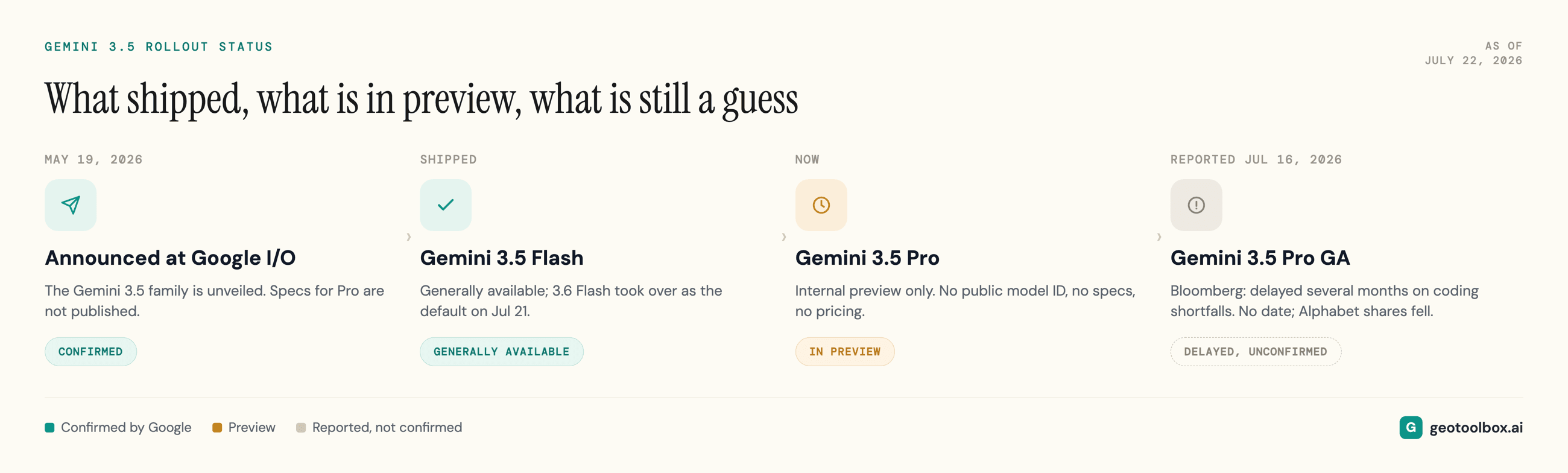
Google announced the Gemini 3.5 family at Google I/O on May 19, 2026, but only one model in that family actually shipped: Gemini 3.5 Flash. About Pro, Google said one substantive thing, "It's already being used internally, and we look forward to rolling it out next month." No model card, no specs, no pricing, no firm date. The video side of that same keynote, Gemini Omni, did ship.
Three names get tangled here, so worth separating them up front:
- Gemini 3.5 Flash is live, though on July 21, 2026 its successor Gemini 3.6 Flash took over as the default model in the Gemini app and AI Mode in Search.
- Gemini 3.5 Pro is the one everyone is waiting for. It has not shipped.
- Gemini 3.1 Pro is the current top-tier Pro model, listed as preview. It is the real predecessor to 3.5 Pro, not Gemini 2.5 Pro, which a lot of coverage gets wrong.
You can confirm the status yourself. The Gemini API model list shows gemini-3.5-flash marked Stable, and there is no gemini-3.5-pro entry at all. The next tier up is still Gemini 3.1 Pro. When a model exists on Google's API, it has an ID and a launch stage. Pro has neither yet.
On timing, the story got worse, not better. On July 16, 2026, Alphabet shares fell about 4% after Bloomberg reported that Pro is running months behind schedule. The reported cause is more than a testing pause: Pro's coding performance came in short of Google's own internal expectations, updated training data reportedly failed to close the gap, and rivals like OpenAI and Anthropic have pulled ahead on code. A Google spokesperson said only that the company is "currently testing 3.5 Pro," neither denying the delay nor giving a new date. Earlier reporting had pointed to a July 17, 2026 target and a full architectural rebuild of the scrapped 2.5 Pro base model, aimed at stronger math reasoning, SVG generation, and image quality to keep pace with GPT-5.6 and Fable 5. That July 17 date has now passed with no release, and there is still no model card, no API entry, and no pricing. Treat every date here the same way, plausible, widely repeated, and unverified until a model card exists. For the full picture of where Pro sits in Google's Gemini lineup, the short version is: announced, delayed, not arrived.
Has Gemini 3.5 Pro Been Cancelled?
Short answer: unconfirmed. Google has not denied or confirmed it. On August 7, 2026, SemiAnalysis reported that Google had silently cancelled 3.5 Pro and was "coping by hyping up Gemini 4 instead," with Gemini 3.6 Flash serving as a bridge model in the meantime. Industry chatter relayed in the same report puts Pro's capability level at roughly Claude Opus 4.5 (November 2025).
Google has not confirmed the report, and has not withdrawn its prior position either: as of September 20, 2026, its public line remains what it was before the report: 3.5 Pro is "currently testing with partners" and will ship "as soon as it's ready." Google also publicly confirmed pre-training on Gemini 4 back on July 21, 2026, so Gemini 4 itself is not "unannounced," only undated. There is still no 3.5 Pro model card, no API entry, and Google's own materials continue to describe Pro as in progress rather than shelved.
Treat the cancellation report the way this page treats the rumored specs below: a single well-sourced outlet, unconfirmed by the vendor, with no independent confirmation either way. If Pro really is dead, the tell will be Google quietly dropping the "testing with partners" language, not this report.
What Google Has Actually Confirmed
Here is the base to reason from. Almost everything Google has stated about Gemini 3.5 is about Flash, and Flash is the same generation as Pro, so its confirmed numbers are the most reliable signal we have for what Pro will be built on.
From Google's own Gemini 3.5 announcement, these are not rumors:
- Gemini 3.5 Flash is generally available and was the default model in the Gemini app and AI Mode in Search globally at the time of that announcement. (Google later shipped Gemini 3.6 Flash on July 21, 2026, which took over as the default.)
- Flash posts real benchmark scores: 76.2% on Terminal-Bench 2.1, 1656 Elo on GDPval-AA, 83.6% on MCP Atlas, and 84.2% on CharXiv Reasoning for multimodal understanding.
- Google states Flash is outperforming Gemini 3.1 Pro on its coding and agentic benchmarks, which is the headline: a Flash-tier model beating the previous Pro tier on Google's chosen hard tasks.
- Gemini 3.5 Pro is being used internally and was set to roll out the following month.
That is the confirmed set that matters for sizing up Pro. Notice what is missing: there is no Gemini 3.5 Pro model card, so its context window, its reasoning modes, its pricing, and its benchmark scores are all officially unstated.
Pro relates to Flash the way it always has: Flash is the fast, cheaper tier, Pro the slower, more expensive, higher-ceiling one. Given Flash's results against the old Pro tier, a 3.5 Pro that clears Flash would be a genuine step up. But "would be" is the operative phrase. Until Google ships a model card, every Pro specification is an estimate, and the next section is where the estimates start getting presented as facts.
Gemini 3.5 Pro: Rumored vs Confirmed
This is where most coverage quietly fails. Specs that Google has never published get listed in clean "specifications" tables as if they were official. Here is the same data with the source attached.
| Spec | What's claimed | Who's claiming it | Google official? |
|---|---|---|---|
| Context window | 2 million tokens | Third-party explainers | No. Google has published no Pro token count; the only 1M figure in circulation is for Flash, not Pro |
| Deep Think reasoning | A dedicated extended-reasoning mode | Third-party blogs | No. Not in any Google model card for 3.5 Pro |
| API pricing | ~$15 input / $60 output per million tokens (roughly 7 to 10x Flash) | ByteIota and others, labeled "estimated" | No. No published rate card. Others assume it lands near current Gemini 3.1 Pro pricing, a wide spread |
| Deep Think access | Gated to a ~$250/mo Google AI Ultra tier | Third-party reporting | No. Unconfirmed |
| Release | Delayed several months; the July 17, 2026 target passed with no release | Bloomberg, via CNBC (July 16, 2026) | No. Google confirms only that it is "currently testing" Pro; no new date, model card, or API entry |
| Architecture | Prior 2.5 Pro base scrapped for a full rebuild and fresh pre-training (math, SVG, image quality) | Third-party reporting | No. Not confirmed by Google |
| Cancelled outright | Shelved in favor of Gemini 4 | SemiAnalysis (August 7, 2026) | No. Google has not confirmed a cancellation; its public line is unchanged since before the report |
The cleanest example is the context window. Several widely-shared specs tables list "2 million tokens" for Gemini 3.5 Pro as a confirmed figure. Google's actual announcement gives no token count for Pro at all, and the 1M figure in circulation is associated with Flash, not Pro. So a spec presented as fact is, at the source level, an assumption.
Pricing tells the same story from a different angle. ByteIota's estimate puts Pro at roughly $15 input and $60 output per million tokens, about seven to ten times Flash, and is careful to label it an estimate. Others simply assume Pro will land near current Gemini 3.1 Pro pricing, several times lower. When credible guesses disagree by 5x or more, that is your signal that no one has the real number.
The Deep Think reasoning mode is real as a concept Google has discussed elsewhere, but it has not been attached to a published Gemini 3.5 Pro spec. Treat it as possible but unconfirmed until Google ties it to a 3.5 Pro model card.
Gemini 3.5 Pro vs 3.5 Flash vs 3.1 Pro
Get the lineage right and the comparison gets simpler. The model Gemini 3.5 Pro replaces is Gemini 3.1 Pro, not Gemini 2.5 Pro. That older "vs 2.5 Pro" framing shows up everywhere and skips a whole generation.
| Model | Status | Confirmed benchmarks | Where it fits |
|---|---|---|---|
| Gemini 3.5 Flash | Generally available; was the app + AI Mode default until 3.6 Flash (July 2026) | Terminal-Bench 2.1 76.2%, GDPval-AA 1656, MCP Atlas 83.6%, CharXiv 84.2% | Fast, cheaper tier you can use today; already beats 3.1 Pro on coding/agentic |
| Gemini 3.5 Pro | Not released; internal preview, reported months behind schedule (Bloomberg, July 2026); unconfirmed cancellation report (SemiAnalysis, August 2026) | None published | The higher-ceiling tier, on paper. No verified numbers exist yet |
| Gemini 3.1 Pro | Preview (current top Pro tier) | Per Google, now bettered by 3.5 Flash on coding/agentic | The real predecessor and today's Pro option until 3.5 Pro ships |
The read: the only 3.5 model you can actually compare on data is Flash, and it looks strong. Pro's row is empty by necessity. Anyone publishing a Gemini 3.5 Pro benchmark table right now is extrapolating from Flash or inventing numbers, because Google has released none.
You will also see community estimates of Pro's parameter count framed as if size settles the question. It does not. Flash already beating the previous Pro tier on hard tasks is the clearest evidence that architecture and training matter more than raw size this generation. If you are choosing a model today, the practical comparison is Flash against the alternatives you already use, which is the ground covered in Gemini vs ChatGPT and Claude vs Gemini, not a Pro model you cannot run.
How to Access Gemini 3.5 Pro (and Why You Might Not Be Able to Yet)
You cannot, not directly, and the reason is structural. A model needs a public ID and a launch stage before you can call it on the public Gemini API, and Gemini 3.5 Pro has neither. The Gemini API model list carries gemini-3.5-flash as Stable and simply has no gemini-3.5-pro line.
What you can use right now is Flash, and Google has put it across its main AI surfaces:
- The Gemini app and AI Mode in Search, where 3.6 Flash became the default in July 2026, succeeding 3.5 Flash
- Google AI Studio and the Gemini API, calling
gemini-3.5-flash
When Pro does arrive, expect the usual path rather than a flip-the-switch global launch. If it follows the pattern of past Gemini previews, it surfaces first in AI Studio and Vertex AI as an allowlisted preview, often United States first, before reaching the consumer app and broad API access. That is why "it's rolling out" and "I can use it" are weeks to months apart, and why teams with data-residency requirements outside the US should plan for a later usable date than the headline announcement implies. In practice that means watching for gemini-3.5-pro to appear in the Model Garden on Vertex AI, now branded the Gemini Enterprise Agent Platform, and the AI Studio model picker, and not hardcoding the ID until it lists a stable launch stage.
If your workflow depends on a specific model being callable in production, track the launch stage on the API model page, not the blog announcement. "Generally available" on the model list is the line that matters. A model that is "announced" or even "in preview" can still be pulled, throttled, or region-locked.
What Gemini 3.5 Pro Means for AI Search Visibility
Here is the part that affects your traffic whether or not Pro ever ships on your timeline: the Gemini Flash shift is already live in Google's AI surfaces. Google says the current Flash model, now Gemini 3.6 Flash (which succeeded 3.5 Flash as the default on July 21, 2026), is the default in AI Mode, and AI Overviews, the AI answers in regular Search, run on Gemini models too. The model upgrade reached your audience the day it shipped, not on Pro's launch day.
That surface is not niche. At I/O, Sundar Pichai said AI Overviews has over 2.5 billion monthly users. And those answers change behavior. Pew Research found that when an AI summary appears, people click a traditional result in only 8% of visits, versus 15% without one, and they click a link inside the summary in just 1% of visits. More of the click is staying inside the answer rather than reaching your page, and those answers are generated by Gemini models.
So the question is not "should I migrate to Gemini 3.5 Pro." It is "when Google's AI summarizes my topic, does it pull from my page." That is a retrieval problem, and it rewards specific habits: state facts in clean, liftable sentences, put the real answer near the top of each section, use question-shaped headings, and keep an FAQ that answers the obvious follow-ups directly.
In our experience scanning sites for AI visibility, which is what geotoolbox does, the pages that get cited are rarely the longest ones. They tend to be the ones that state a fact plainly enough that a model can lift a single sentence without rewriting it. That is the same discipline whether the engine is Flash today or Pro next quarter, and it is the core of getting cited in AI Overviews and the wider practice of Gemini SEO.
What People Are Hitting on 3.5 Flash While They Wait
Since Pro does not exist yet, most people reaching for a current-generation Gemini land on a Flash model (3.5 Flash, and now its successor 3.6 Flash). It is worth knowing what they have run into, both because it is your practical alternative and because one theme lines up suspiciously well with the reported reason Pro slipped.
Thinking tokens are the cost story. They bill at the output rate, and developers report 3.5 Flash spending far more of them than a task warrants. The most carefully instrumented report logged a call with thinking level explicitly set to low that burned 63,853 thought tokens on a trivial prompt and returned zero output, fully billed. That is one very well-evidenced data point rather than a measured average, but the broader complaint recurs across several forum threads.
Flash is no longer the cheap tier. At $1.50 in and $9.00 out per million tokens, 3.5 Flash costs exactly three times the Gemini 3 Flash Preview it succeeds ($0.50 / $3.00). If you want cheap, 3.1 Flash-Lite at $0.25 / $1.50 is the tier that now plays that role. One correction on a claim circulating in those threads: 3.5 Flash does not cost more than 3.1 Pro on list price, since 3.1 Pro Preview is $2.00 / $12.00. The argument people are actually making is about effective cost per completed task once thinking verbosity is counted, which is a different and harder-to-verify claim. Google has since shipped Gemini 3.6 Flash and a new 3.5 Flash-Lite, which reshuffle this low-cost lineup again, then Gemini 3.7 Flash on August 13 and Gemini 3.8 Flash on September 2, 2026, now the top Flash model (Stable). All of 3.6, 3.7, and 3.8 Flash currently share the same introductory pricing of $0.75 input / $3.75 output per million tokens through December 31, 2026, doubling to $1.50 / $7.50 after.
Tool calling regressed. Three independently filed breakages share the same shape, working on the older model and failing on 3.5 Flash: Google Search grounding combined with custom function declarations fails outright, with the model insisting it has no Search access; streaming with automatic function calling can end with empty content after the tool runs; and a contract change now requires clients to echo back a thought_signature from the tool call, returning a hard 400 to hand-rolled agent loops that do not. Google staff acknowledged the first with "looking into this" and no timeline.
That last cluster is the interesting one. Reporting on Pro's delay says Google found structural failures in recursive tool calling and ordered a rebuild. Whatever is happening in Flash's tool handling appears to rhyme with it, which is at least a hint that the delay is about something real rather than schedule slippage.
Should You Wait for Gemini 3.5 Pro?
For most people, no. Reorganizing your stack around a model you cannot call, with specs Google has not published, is planning on rumor. Gemini 3.5 Flash is available today and already beats the previous Pro tier on coding and agentic work, which covers a lot of real use cases without waiting.
Two things are worth holding in mind while you wait. First, cost. The reporting on the delay points at Pro's coding falling short of Google's internal bar, and if Pro lands anywhere near the rumored 10x pricing, the gap between "more capable" and "more expensive per task" will be the number that decides whether it is worth it. Model your budget on the real rate card when it ships, not the estimates.
Second, do not build around the headline specs yet. A 2-million-token context window and a Deep Think mode would change how you design prompts and pipelines, but neither is confirmed. If you re-architect now and Google ships something different, you redo the work.
The disciplined move is the one we took with Grok 5: track what is confirmed, ignore what is guessed, and act when the model card exists. Anticipation is not availability.
The Model Already Changed Under You
Gemini 3.5 Pro is still a waiting game, but the model behind Google's AI answers changed the day Flash shipped. The useful question this week has little to do with which model to chase. It comes down to whether your pages get pulled into AI answers at all, on the surfaces that are already live.
That is what geotoolbox checks. You can run an AI readiness scan to see whether the crawlers feeding Gemini and the other engines can actually reach and read your content, and whether the page carries the signals that make a citation more likely, before the next model lands and the gap widens. geotoolbox is the AI bot debugger for SEOs: it tells you why an engine is skipping your page, not just that it is.
Frequently Asked Questions
Is Gemini 3.5 Pro released yet?
No. As of September 20, 2026, Gemini 3.5 Pro is still not generally available. Google announced the Gemini 3.5 family at I/O on May 19, 2026, but only Gemini 3.5 Flash shipped. On July 16, 2026, Bloomberg reported the rollout is months behind schedule and Alphabet shares fell about 4% that day; on August 7, 2026 SemiAnalysis reported it had been silently cancelled in favor of Gemini 4; Google has not confirmed this and its public materials still describe Pro as in partner testing, not cancelled.
When will Gemini 3.5 Pro come out?
Google originally pointed to June 2026, then reporting pointed to a July 17, 2026 target. That date has now passed with no release. On July 16, 2026, Bloomberg reported Pro is months behind schedule, tied to coding performance that fell short of Google's internal bar, with no new date given. Earlier reporting also said Google rebuilt Pro from a new base model rather than the earlier 2.5 Pro one. An August 7, 2026 SemiAnalysis report claims the model was cancelled outright in favor of Gemini 4; Google has not confirmed a cancellation. Expect a limited preview first if it does ship, not an immediate global launch.
Does Gemini 3.5 Pro have a 2 million token context window?
That figure is widely repeated but not confirmed by Google. The official announcement gives no context window for Pro at all, and the 1-million-token figure in circulation is associated with Gemini 3.5 Flash. Treat 2M as a rumor until Google publishes a model card.
What is Deep Think in Gemini 3.5?
Deep Think is described in third-party coverage as an extended-reasoning mode that spends more compute on hard problems. It is plausible and consistent with Google's direction, but it has not been attached to a published Gemini 3.5 Pro specification, so its exact behavior and availability are unconfirmed.
Gemini 3.5 Pro vs Gemini 3.5 Flash, what's the difference?
Flash is the fast, lower-cost tier; the current Flash model, 3.6 Flash, is the default in the Gemini app and AI Mode as of July 2026. Pro is the higher-ceiling tier and is not released. The notable confirmed fact is that 3.5 Flash already outperforms the previous Gemini 3.1 Pro on coding and agentic benchmarks.
How much will Gemini 3.5 Pro cost?
Unknown. Estimates range widely, from about $15 input and $60 output per million tokens down to roughly current Gemini 3.1 Pro pricing. Google has published no rate card, and the size of the disagreement is the clearest sign the real price is not public yet.