
"AI SEO" gets used for two completely different jobs, and most articles never say which one they mean. One is using AI tools to do ordinary SEO faster. The other is optimizing so that AI search engines like ChatGPT, Perplexity, and Google's AI Overviews mention and cite you. They need different work and different metrics.
This guide separates the two, then answers the question underneath most of the confusion: is any of this new, or is "AI SEO" just regular SEO with a markup? The short version is that the craft barely changed, but the goalposts did.
What Is AI SEO?
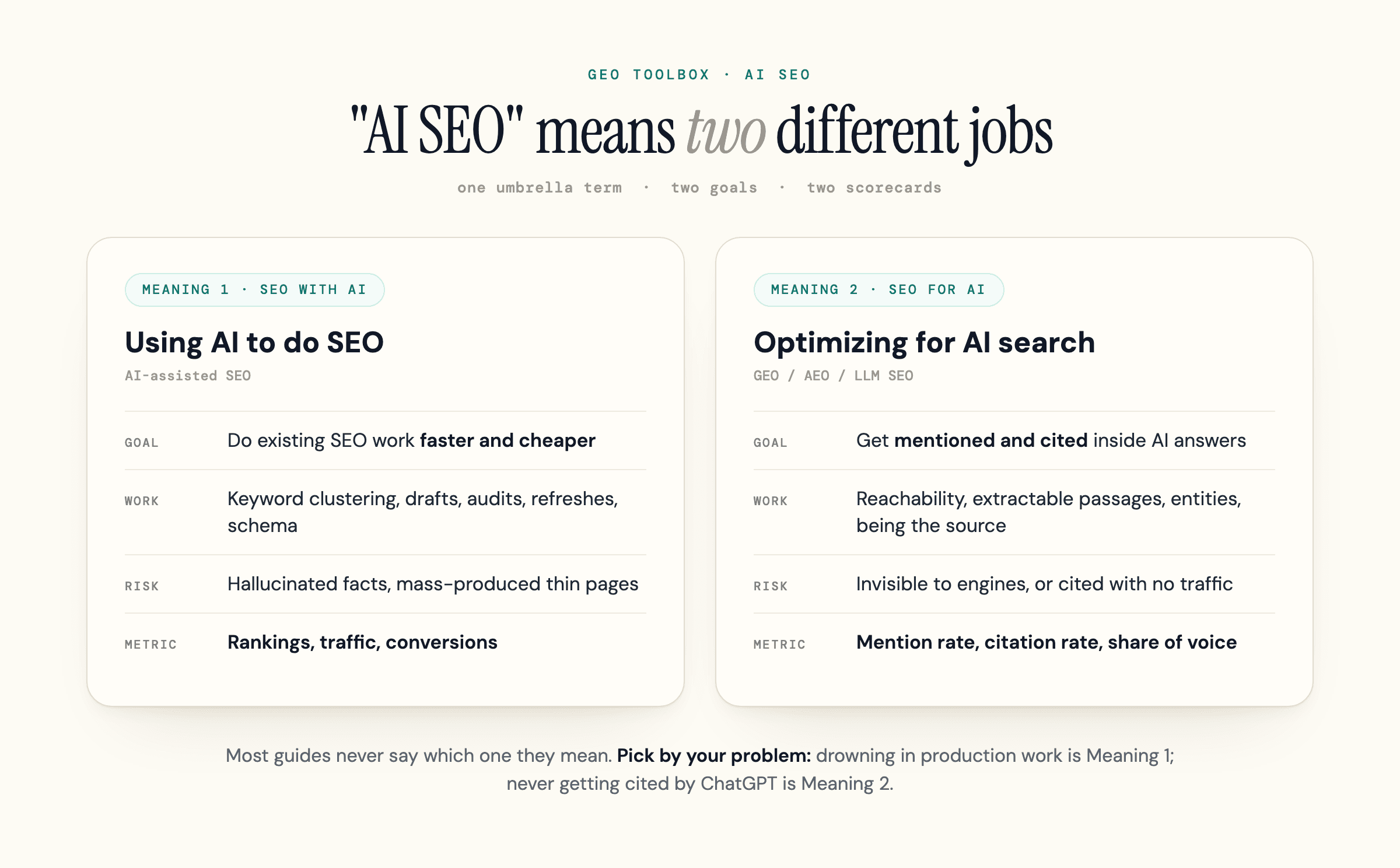
AI SEO is an umbrella term for two related but distinct practices:
- Using AI to do SEO (also called AI-assisted SEO, or "SEO with AI"): pointing large language models and machine-learning tools at your existing SEO work so it goes faster. Keyword clustering, content briefs, technical audits, internal-link suggestions, content refreshes.
- Optimizing to be found by AI search (usually called generative engine optimization (GEO), answer engine optimization (AEO), or LLM SEO): shaping your content and your wider web presence so AI answer engines discover, trust, and cite you as a source.
The first is a workflow question. The second is a visibility question. Here is the split at a glance:
| Using AI to do SEO | Optimizing for AI search (GEO/AEO) | |
|---|---|---|
| Goal | Do existing SEO work faster and cheaper | Get mentioned and cited inside AI answers |
| Typical work | Keyword clustering, drafts, audits, refreshes, schema | Reachability, extractable structure, entities, being the primary source |
| Main risk | Hallucinated facts, mass-produced thin content | Invisible to the engines, or cited by them without any traffic |
| Primary metric | Rankings, organic traffic, conversions | Mention rate, citation rate, share of voice |
Which one you need depends on your problem. If your team is drowning in production work, you want meaning one. If you have noticed ChatGPT recommending competitors and never you, you want meaning two. Most serious operators end up doing both.
What "SEO for AI" Is Called Now
If you have seen a dozen acronyms and assumed they are competing standards, they are mostly the same idea seen from different angles. GEO vs AEO vs SEO breaks the distinctions down, but in practice: AEO leans toward giving direct answers to specific questions, GEO and LLM SEO lean toward getting synthesized and cited by generative models, and "AI search optimization" is the plain-language catch-all. Google's own AI Overview for "ai seo" (observed August 2026) defined the term as both automating SEO tasks and optimizing for generative engines, a sign that the single label now covers both jobs.
Is AI SEO Just Rebranded SEO?
Mostly yes on the craft, genuinely no on the goal. This is worth being clear about, because a lot of what gets sold as "AI SEO" is a fundamentals package wearing a new label, and the fastest way to spot a weak pitch is that it cannot tell you what is actually different.
Here is what did not change. The work that makes you visible to AI engines is, to a first approximation, the work that already made you a good search result: helpful content, clear structure, semantic depth, real entity signals, and the experience and expertise that make a page trustworthy. If your SEO was sloppy, no amount of "GEO" fixes it. Rand Fishkin put the tension well when he argued that "your SEO still matters as much or more than ever before, it just won't earn you traffic the way it once did."
Three things did change, and they are what make the label more than marketing:
- The objective. The old goal was to rank so a person clicks. The new goal is to be the answer, or the source behind it, whether or not anyone clicks through.
- The unit. Traditional SEO optimizes the page. AI engines pull passages and claims. The winning unit is now a self-contained, quotable statement, not a whole document.
- The measurement. Rankings and clicks miss most of what is happening inside an AI answer, so the scorecard has to change too.
So when a vendor pitches "AI SEO" as a bolt-on retainer, the fair question is which of those three they are actually addressing. If the answer is "we will use ChatGPT to write more blog posts," that is meaning one dressed up as meaning two, and on its own it does not amount to a visibility strategy.
What Actually Changed: the Search Data
The reason AI SEO exists as a category is that an answer layer now sits between your page and the searcher, and it is absorbing the click you used to earn. The numbers are stark.
Pew Research analyzed 68,879 searches from 900 U.S. adults in March 2025. About one in five searches produced an AI summary, and 88% of those summaries cited three or more sources. But when an AI summary appeared, users clicked a traditional result only 8% of the time, versus 15% without one. They also left more often: 26% ended their browsing session right after a page with an AI summary, compared with 16% on a normal results page.
Zoom out and the trend is the same. SparkToro's clickstream analysis found that 68.01% of U.S. Google searches ended without a click to an outside site in early 2026, up from 60.45% in 2024. The pure AI platforms barely link out at all: SparkToro estimates they send less than 1% of their traffic back to the web.
Two conclusions follow, and they are the whole reason the discipline splits from classic SEO:
- Being seen no longer means being visited. An AI Overview can put your name in front of someone who never clicks. That exposure can still be worth something (brand, trust, influence on the answer itself), but your analytics will not show it as traffic.
- You have to optimize for the answer, not just the ranking. This is the same shift we cover in is SEO dead in 2026 and, mechanically, in how AI search actually works: one query gets fanned out into many, and the engine assembles an answer from whatever sources it trusts.
None of this means SEO stopped working. It means the payoff is shifting from the click toward the citation, and your strategy has to follow it.
Using AI to Do SEO: What Works, What's Risky
This is the meaning most people reach for first, and it is genuinely useful. AI is good at the high-volume, low-judgment parts of the job: clustering a messy keyword list, drafting content briefs, summarizing what the top-ranking pages cover, generating FAQ answers and schema, and flagging pages that have gone stale. That frees you to spend time on the parts that actually differentiate a page. If you want the tools themselves, our AI SEO tools guide sorts them by job.
Where it goes wrong is when people hand it the judgment too. Two failure modes show up again and again:
- Hallucination. Models state wrong facts with total confidence, invent statistics, and cite studies that do not exist. On anything a reader will act on, every AI-supplied fact needs a human check against a real source.
- Scaled thin content. It is trivial to generate a thousand near-identical pages. It is also a reliable way to get demoted.
That second risk raises the question people ask most: does Google penalize AI-generated content? The plain answer is no, not for being AI-made. Google's own guidance says it rewards high-quality content "however it is produced," and that appropriate use of AI is not against its rules. What it does target, under its spam policies, is "scaled content abuse": using automation to produce many pages primarily to game rankings rather than help people. The operative phrase is "without adding value," not "using AI."
The practical rule that keeps you on the right side of this is a clean division of labor. Let the machine handle volume, and keep a human on judgment:
| Let AI do it | Keep a human on it |
|---|---|
| Keyword clustering and grouping | Deciding the angle and what to leave out |
| First-draft outlines and FAQ structure | Firsthand experience, original data, real examples |
| Parsing competitor pages for gaps | Fact-checking every claim before it ships |
| Generating schema and meta tags | Voice, editorial standards, and the final read |
If you want the full workflow for the visibility side rather than the production side, our step-by-step playbook for optimizing for AI search goes deeper than we can here.
Getting Cited by AI Engines: the Real Work
This is the harder, newer half, and it has a prerequisite almost every guide skips: the AI engines have to be able to fetch your pages before any of the clever optimization matters. When we audit sites for AI visibility, one of the most common problems we find is not weak content, it is that the AI crawler that fetches pages for answers was blocked before it could read the page, usually by a robots.txt rule the owner never meant to apply to it. The bot that matters here is the retrieval crawler each engine uses to build answers, like OAI-SearchBot or PerplexityBot, not the separate training crawler such as GPTBot. Reachability comes first. (And no, an llms.txt file is not the fix; there is still no evidence it earns you citations.)
Once the engines can read you, the work is about being the thing they want to quote:
- Extractable structure. Clear headings, and passages that answer one question completely on their own, so a model can lift a self-contained chunk without losing the meaning.
- Entities and authority. Consistent, well-defined entities and schema markup that tell engines who you are and what you are an authority on.
- Being the source, not a summary. Original data, firsthand testing, and specific numbers are more likely to get cited. Content that only restates what is already on the web is easy for a model to pass over in favor of the page that said it first.
The part that makes this a real discipline rather than a rebrand: the surfaces do not agree with each other. Ahrefs found that in July 2025, 76% of the pages cited in Google's AI Overviews also ranked in Google's traditional top 10, but a March 2026 update across 863,000 SERPs cut that to 38%: even on the surface closest to classic SEO, ranking well counts for less than it used to. But ChatGPT and Perplexity draw from very different source sets: one analysis of 680 million AI citations found only about 11% of domains are cited by both. In practice, ranking well on Google, getting cited by ChatGPT, and getting cited by Perplexity are distinct outcomes you measure separately when those surfaces matter to your audience. The same is true for getting cited in Gemini.
How to Measure AI SEO
If most citations never produce a click, your old dashboard is blind to the thing you are now optimizing for. Rankings and organic traffic still matter, but they miss the answer layer entirely. The fix is a second set of metrics built around presence in AI answers rather than position on a page.
| Metric | What it measures | How to track it |
|---|---|---|
| Mention rate | How often you appear in AI answers for prompts you care about | Run a fixed prompt set across engines on a schedule |
| Citation rate | How often you are the linked source, not just named | Same prompt set, count linked citations |
| Share of voice | Your mentions versus competitors for the same prompts | Track the same prompts for rival brands |
| AI referral sessions | Actual visits from AI surfaces | GA4 traffic from chatgpt.com, perplexity.ai, gemini.google.com |
| Branded-search lift | People who saw you in an answer and searched you later | Search Console brand queries and direct traffic trend |
The mention, citation, and share-of-voice numbers are the ones that map onto everything above: they tell you whether you are being quoted at all, even when nobody clicks. The referral and branded-search lines are how you connect that visibility back to revenue, which matters because last-click attribution will always undercount an answer that never sent a click. We go deeper on the mechanics in how to measure your AI visibility, the AI visibility score that rolls these into one number, and tracking brand mentions in AI search.
Do You Actually Need AI SEO?
Not every business needs to act on this today. The deciding question is whether your audience has started using AI to research what you sell.
You should be working on AI visibility now if your buyers ask research-heavy or comparison questions (most B2B, software, finance, health, and considered purchases), because those are exactly the queries AI engines answer directly. You can afford to wait, and lean on classic SEO plus the budget split we lay out in GEO vs SEO, if you win mostly on local or transactional intent where people still click through to buy, book, or call.
The bottom line: for most brands the right move in 2026 is not to pour a budget into "AI SEO" as a separate line item, it is to keep doing strong SEO and add the visibility work and the measurement above on top. If you would rather hand it off, compare your options with our guides to AI SEO agencies and AI visibility tools before signing anything, and hold any vendor to the "what is actually different" test from earlier.
Where to Start
If all of this feels like a lot, start with the cheapest, highest-impact move: find out whether AI engines can even see you. Before any content strategy, before any tooling budget, a page a retrieval crawler cannot fetch is very unlikely to be cited, no matter how good it is. That is the check we built geotoolbox to run. Our free AI readiness tool shows you which AI crawlers can reach your site and where they are being blocked, so you fix the invisible problem before you spend on the visible one. Get reachability right first, then work down the list above.
Frequently Asked Questions
What is SEO for AI called now?
There is no single name yet. The common ones are generative engine optimization (GEO), answer engine optimization (AEO), LLM SEO, and AI search optimization. They overlap heavily and mostly describe the same goal: getting your content mentioned and cited by AI answer engines rather than just ranked in a list of links.
Can ChatGPT do SEO?
ChatGPT can do the tasks: keyword ideas, outlines, meta descriptions, drafts, and audits of existing pages. It cannot do the judgment reliably, and it invents facts, so anything it produces needs a human check. It also cannot reliably tell you what has real search demand, since it has no keyword-volume or rank-tracking data. Treat it as a fast assistant, not a strategist. If your goal is the reverse, getting cited inside ChatGPT, see our guide to SEO for ChatGPT.
Does Google penalize AI-generated content?
No, not for being AI-generated. Google's guidance says it judges content on quality and helpfulness however it was produced. What it penalizes is scaled content abuse: mass-producing low-value pages to manipulate rankings, whether a human or a model wrote them. Original, accurate, genuinely useful content is fine regardless of how you drafted it.
Is AI SEO worth it for a small business?
It depends on whether your customers use AI to research what you sell. If they ask AI assistants comparison or how-to questions in your category, being cited is worth pursuing now. If you win on local or transactional searches where people still click to buy, solid traditional SEO covers most of your upside and AI visibility can wait.
Is SEO dead because of AI?
No. The click you used to earn by ranking is shrinking fast, but the work of getting found is very much alive; it is just being paid out in citations and mentions instead of guaranteed clicks. We cover the data behind this in is SEO dead in 2026.
More Questions
Can I do AI SEO myself?
Yes, especially the parts that matter most. Start with reachability, which is a free check anyone can run: confirm the retrieval crawlers can fetch your key pages. From there, the on-page work (clear structure, self-contained answers, real expertise) is the same craft as good SEO, and you can use AI tools to speed up the drafting. The judgment (what to say, whether a claim is true, your firsthand angle) is the part you keep for yourself, whether you hire help or not.
How is AI SEO different from regular SEO?
The craft is largely the same: helpful content, clean structure, and real topical authority. What changed is the objective (be the answer, not just rank), the unit (a quotable passage, not the whole page), and the measurement (mentions and citations, not just clicks and positions).
Sources
- Google users are less likely to click on links when an AI summary appears - Pew Research Center, July 22, 2025 -
pewresearch.org/short-reads/2025/07/22/google-users-are-less-likely-to-click-on-links-when-an-ai-summary-appears-in-the-results - In 2026, Less Than One Third of Google Searches Still Send a Click - SparkToro, 2026 -
sparktoro.com/blog/in-2026-less-than-one-third-of-google-searches-still-send-a-click - 76% of AI Overview Citations Pull From the Top 10 - Ahrefs, July 21, 2025 -
ahrefs.com/blog/search-rankings-ai-citations - Update: only 38% of AI Overview citations come from the top 10 - Ahrefs, March 2026 (863,000-SERP study) -
ahrefs.com/blog/ai-overview-citations-top-10 - The State of AI Citations 2026 (680M-citation analysis) - 5WPR -
5wpr.com/research/state-of-ai-citations-2026 - Google Search's guidance about AI-generated content - Google Search Central, February 8, 2023 -
developers.google.com/search/blog/2023/02/google-search-and-ai-content - Spam Policies for Google Web Search - Google Search Central -
developers.google.com/search/docs/essentials/spam-policies