
China's Zhipu AI shipped a frontier-grade open-weight model just days after the US forced Anthropic to take its most powerful Claude models offline, and nearly all the coverage has been about coding benchmarks and price. Here is the plain version of what GLM 5.2 actually is, who builds it, whether it is safe, and where it stands, current as of mid-2026. And then the part the developer write-ups skip: why a model most marketers will never touch directly is still worth a few minutes of your attention, and what the open-weight wave it belongs to means for your visibility in AI answers.
Zhipu has since shipped GLM-5.3
On August 14, 2026, Zhipu released GLM-5.3 on the same GLM Coding Plan tiers covered below, built on the same base as 5.2 through extended post-training rather than a new pretraining run. It claims roughly a 50% jump in coding over 5.2 on its internal bench, ties Kimi K3 at the top of the open-weight field on Artificial Analysis's Intelligence Index, and developed a notable emergent cyber capability. The open weights landed about two weeks after launch, but under a new custom "GLM-5.3 license" rather than MIT (the smaller GLM-5.3-Flash kept MIT). Everything below about GLM 5.2's specs, pricing, and safety profile still applies to 5.2 itself; see our full What Is GLM 5.3 writeup for the newer sibling.
What Is GLM 5.2?
GLM 5.2 is an open-weight model from Zhipu AI, the Chinese lab that operates internationally as Z.ai; it was the flagship through mid-2026, until GLM-5.3 succeeded it in August. It launched on June 13, 2026 as a coding-first frontier model with a one-million-token context window and an MIT license, with the downloadable weights and a standalone API following within days. That license means anyone with the hardware can run it. GLM stands for General Language Model, the name Zhipu has used for its large language models since the series began.
Like other open models, GLM 5.2 is really three things, and keeping them straight clears up most of the confusion. There are the open weights, which Zhipu publishes so anyone can download, run, and adapt the model. There is the hosted Z.ai chatbot and API, which Zhipu runs on its own servers. And there is the wider ecosystem of third-party tools that have wired GLM 5.2 in. The model is open; the service around it is Zhipu's.
That split matters because the answer to most questions about GLM 5.2 is different depending on which version you mean. Where it earned its reputation is doing frontier-grade coding and agent work at a fraction of what the closed American models cost, which is why its arrival made the industry pay attention to a name most marketers had never heard.
GLM the AI model, not the statistics one
If you search the bare term "GLM," most results are about the generalized linear model, a staple of statistics. That is a different thing entirely. The AI model is always written with its version number, "GLM 5.2" or "GLM-5.2," and that is what this article is about.
Who Makes GLM 5.2? Zhipu AI and Z.ai
GLM 5.2 comes from Zhipu AI, a Beijing-based lab founded in 2019 as a spinout from Tsinghua University's Knowledge Engineering Group. Internationally it goes by Z.ai, and it has become one of China's most aggressive publishers of open-weight models, shipping new flagships every couple of months. That cadence is the backdrop for GLM 5.2: it is the third release in the GLM-5 line in four months.
The market noticed. When Zhipu announced GLM 5.2 would be released with open weights, its shares jumped. The South China Morning Post reported that the stock surged as much as 48 percent intraday and closed up 32.8 percent on June 15, 2026. Investors read a giveaway as a strategic win, not a cost, which tells you how the open-weight race is being valued right now.
It helps to place Zhipu against the other Chinese labs you have probably seen in headlines, because they are easy to blur together. Zhipu and Z.ai are the GLM company, out of Beijing and rooted in Tsinghua. That is a different outfit from DeepSeek, the Hangzhou lab funded by a quant hedge fund, and from Moonshot, the company behind Kimi. All three publish open weights, all three operate under Chinese law, and all three are part of the same wave putting cheap, capable models within everyone's reach. If you want them lined up side by side, our comparison of the major Chinese AI models does exactly that.
The Specs: What Actually Changed in 5.2
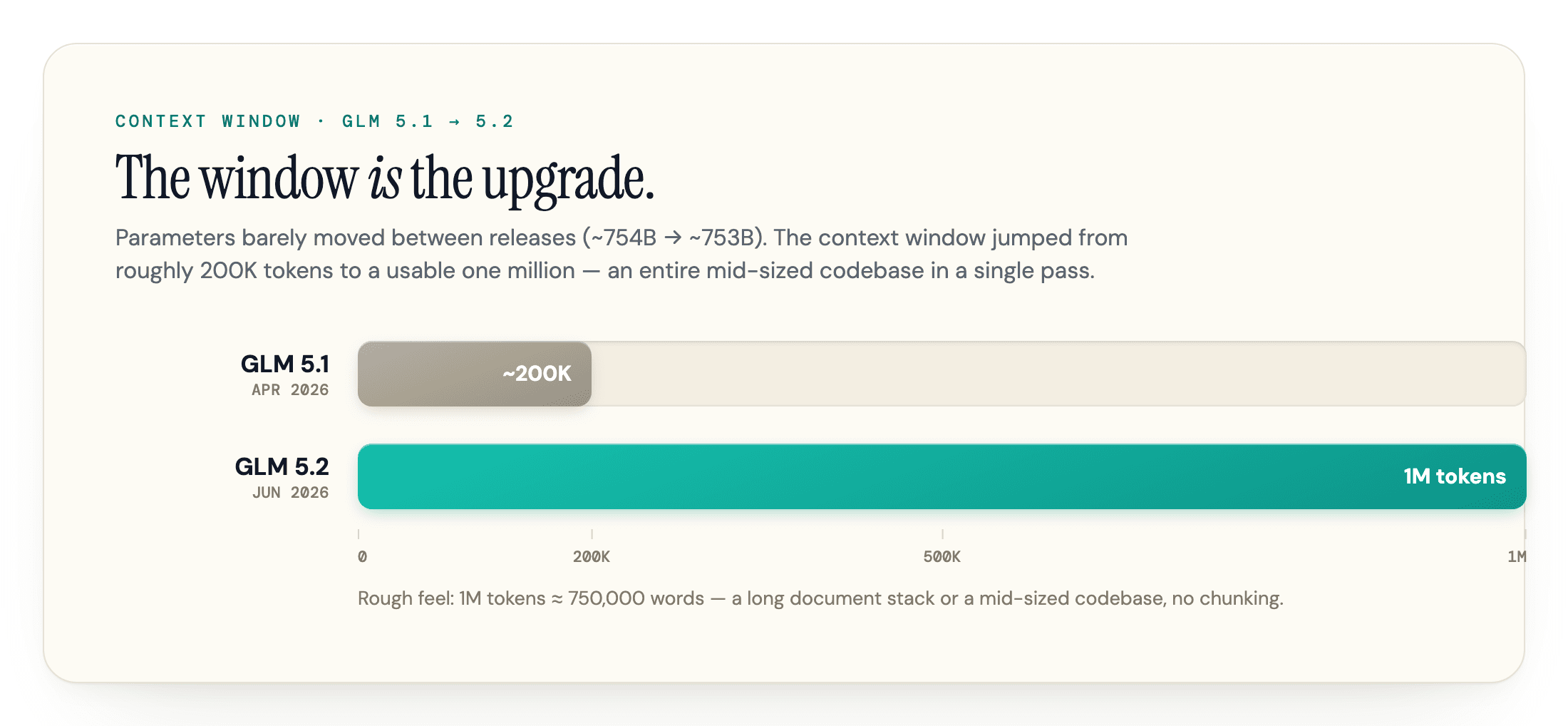
The headline change in GLM 5.2 is not a bigger brain, it is a bigger window. Zhipu pushed the context window from roughly 200,000 tokens in GLM 5.1 to a usable one million, and it describes that capacity as engineering-usable rather than a number on a spec sheet. In plain terms, you can hand the model an entire mid-sized codebase or a long stack of documents at once, around 750,000 words, and it can reason over the whole thing without chunking.
Under the hood, GLM 5.2 is a Mixture-of-Experts model with around 753 billion total parameters, of which only about 40 billion are active for any given token, per its Hugging Face model card. (Some write-ups cite roughly 744 billion; the count from the published weights is a little higher.) That total is barely changed from GLM 5.1, so the jump is in the context window, not the model's size. The Mixture-of-Experts design is the trick behind the low running cost: it activates only a slice of those parameters per token, so each token takes far less compute than the headline size suggests, even though the full model is still heavy to host. The release also adds two thinking-effort levels, High and Max, so you can trade speed for deeper reasoning when a task needs it.
One correction worth making, because a few early write-ups got it wrong: GLM 5.2 is a text model. It reads and writes text and code, and the launch materials and model card cover only that. Treat it as text-only until Zhipu publishes anything saying otherwise. Here is how it compares to the model it replaces.
| Spec (as of July 2026) | GLM 5.2 | GLM 5.1 |
|---|---|---|
| Released | June 13, 2026 | April 7, 2026 |
| Total parameters | ~753 billion | ~754 billion |
| Active per token | ~40 billion | ~40 billion |
| Context window | 1,000,000 tokens | ~200,000 tokens |
| Max output | 131,072 tokens | ~128,000 tokens |
| Reasoning modes | High and Max | Single mode |
| License | MIT (open weights) | MIT (open weights) |
| Modality | Text only | Text only |
Is GLM 5.2 Open Source? Open Weights vs Open Source
GLM 5.2 is open weights, not open source, and the difference is worth getting right. Zhipu released the model under the MIT License, one of the most permissive there is. You can download the weights, run them on your own hardware, fine-tune them on your own data, and ship the result commercially, with essentially no strings attached. That is genuinely open, and more permissive than some rivals whose licenses add conditions.
What you cannot do is rebuild it. Open weights means the finished model files are public. Open source, in the strict sense, would also mean publishing the training data and enough of the recipe to reproduce the model from scratch. Zhipu does not release its training data, so you can use the model freely without being able to fully audit or recreate how it was made. "Open weights" is the accurate term, even though plenty of coverage calls it open source.
That distinction is not pedantry, because it changes where GLM 5.2 ends up. Since the weights are public and the license is permissive, the model does not only answer questions inside Zhipu's own app. It gets downloaded, fine-tuned, rebranded, and quietly built into other products you will never see. Hold onto that point. It is the part that actually matters for your brand, and we come back to it at the end.
How Good Is It, Really? The Honest Benchmark Picture
By the benchmarks that have landed, GLM 5.2 is one of the strongest open-weight models available, and it is still not the strongest model overall. Both things are true, and the gap between them is the whole story. The picture shifted in late July 2026: Kimi K3's weights went public on July 27, and its score on Artificial Analysis's Intelligence Index moved ahead of GLM 5.2's among open models. But at 2.8 trillion parameters K3 is out of self-hosting reach, so GLM 5.2 held the #1 spot in our best open-source LLMs ranking as the strongest open model you could actually download and run, until GLM-5.3 took that spot in August 2026. It is worth being skeptical of the launch hype, because Zhipu actually shipped GLM 5.2 with no published benchmarks at all. As MarkTechPost noted, there were no SWE-bench, Terminal-Bench, or Code Arena numbers at release, which left the early "beats GPT-5" claims as vendor assertions until the technical card and independent tests filled the gap days later.
When the numbers landed, they told a consistent story. On its headline coding benchmarks, like SWE-bench Pro, GLM 5.2 edges out GPT-5.5 and lands within a few points of Claude Opus 4.8, though the two trade places on other coding tests. On harder, more abstract reasoning, it trails both. Here is the picture using Zhipu's own reported scores against the closed-source leaders as they stood at the time of testing. These are vendor-reported numbers rather than an independent cross-lab run, and benchmark setups differ, so read them as directional.
| Benchmark (as of July 2026) | GLM 5.2 | Claude Opus 4.8 | GPT-5.5 | Gemini 3.1 Pro |
|---|---|---|---|---|
| SWE-bench Pro (coding) | 62.1 | 69.2 | 58.6 | 54.2 |
| Terminal-Bench 2.1 (agentic) | 81.0 | 85.0 | 84.0 | 74.0 |
| FrontierSWE (long-horizon) | 74.4 | 75.1 | 72.6 | 39.6 |
| HLE (hard reasoning) | 40.5 | 49.8 | 41.4 | 45.0 |
The pattern is clear: a coding and agents specialist that leads the open field on coding but sits behind the closed frontier on raw reasoning. Independent platform Artificial Analysis scored it 51 on its Intelligence Index in mid-2026, the top open-weight model it tracked until Kimi K3 arrived that July, but flags a real catch. GLM 5.2 is token-hungry: it generated 140 million tokens to complete the same evaluation that the average comparable model finished in 110 million, so the cheap sticker price buys a model that talks more to get there. Early testers piled on a second caveat, noting it can stumble on deceptively simple tasks and sometimes emulates reasoning rather than achieving it. Strong, cheap, and genuinely useful, then, but not magic.
Is GLM 5.2 Safe? The China and Data Question
This is the question GLM 5.2 gets asked most, and the honest answer turns on one distinction: who makes the model versus who hosts your data. A model's national origin matters for your privacy only when the maker is also the company running your prompts. Get that straight and most of the worry sorts itself out.
When you use the hosted Z.ai chatbot or API, your prompts travel to Zhipu's servers, which puts them under Chinese jurisdiction and the data-access laws that come with it. For sensitive code or proprietary documents, that is a genuine consideration, and it is the reason some companies will not route that work through the hosted service at all. The same caution applies to any Chinese-hosted model, which is why we walk through it the same way for DeepSeek.
Here is the part that changes the math. Because the weights are public and MIT-licensed, you do not have to use Zhipu's servers. A team can download GLM 5.2 and run it on its own infrastructure, so prompts never leave the building at all. Or it can use a non-Chinese provider that hosts the open weights, which keeps the traffic off Zhipu's servers, though your data then sits with that provider instead. Self-hosting shifts the security burden onto you, but it is the clearest answer to the China question for sensitive work: self-host rather than send. There is also a content angle. Like other Chinese-hosted assistants, the official app follows local content rules on politically sensitive topics, and that filtering is heaviest in the hosted product and lighter in the raw weights you run yourself.
How Much GLM 5.2 Costs and How to Access It
Cost is GLM 5.2's sharpest edge. The fastest way in is the GLM Coding Plan, a subscription that runs about $10 a month for the Lite tier, $30 for Pro, and $80 for Max, billed quarterly. For developers building on it directly, the standalone API is priced around $1 per million input tokens and roughly $4 per million output, a small fraction of what the leading closed models charge. Depending on which comparison you draw, that lands GLM 5.2 at somewhere between a sixth and a tenth of the cost of comparable frontier access, against the roughly $200 a month a top Claude plan runs.
The one asterisk is the token appetite from the benchmark section. Because GLM 5.2 generates roughly a quarter more tokens to finish a job, heavy agentic use eats into that headline saving, so the real cost depends on your workload, not just the rate card. It narrows the gap rather than erasing it. Here are the main ways to reach it.
| How you use it | Cost (as of July 2026) | What you get |
|---|---|---|
| Z.ai chatbot | Free | Web chat, no setup, quickest way to try it |
| GLM Coding Plan (Lite) | ~$10/month | Use it inside a coding tool, roughly 400 prompts/week |
| GLM Coding Plan (Max) | ~$80/month | Heavy agentic use, roughly 8,000 prompts/week |
| Standalone API | ~$1 in / ~$4 out per 1M tokens | Build GLM 5.2 into your own product |
| Self-host (open weights) | Free license, your own GPUs | Data stays on your servers; the model is over 1.5 TB, so plan for serious hardware |
The open weights live on Hugging Face and ModelScope, and because Zhipu built it to work with the major AI tooling, developers can drop GLM 5.2 into the coding tools they already use with close to a one-line change.
That 1.5 TB is also starting to feel less absolute. In July 2026 an open-source engine called Colibri showed GLM 5.2 running on a consumer machine with about 25 GB of RAM, by keeping the model's dense layers in memory and streaming its thousands of routed experts from disk on demand. It is a proof-of-concept, not a usable tool, glacially slow at around a token per second at best, but it points at the direction of travel: the hardware bar for a frontier open-weight model is dropping, which only widens the long tail of tools and services that can quietly run one, and that widening is the part that matters for your brand.
What Actually Bites When You Deploy It
A month of real use has surfaced friction that the launch benchmarks do not capture. None of it is fatal, but all of it costs somebody a day.
The 1M-context speed story does not survive llama.cpp. GLM 5.2's long-context efficiency comes from sparse attention with a shared indexer layer. Stock llama.cpp originally refused to load the converted weights at all because it expected an indexer tensor on every layer; the fix made those tensors optional, with the commit itself noting the indexer is not yet supported. So llama.cpp loads the model and produces coherent output, but falls back to full attention. You get the model without the mechanism that makes its context window affordable, and long-context prefill costs far more than the spec sheet implies. The feature request has been open since four days after launch.
Tool calling breaks across serving stacks. On vLLM, setting tool_choice: required makes the tool call come back as raw text in content instead of tool_calls; auto works. In Cursor, GLM 5.2 tool calls have been printing as raw XML and terminating the conversation, which Cursor staff confirmed as a GLM-5.2 parsing problem and warned may take some time to fix. This is a repeat of an identical GLM-5.1 issue that Z.ai patched with a chat-template update, so anyone reusing a 5.1-era template or parser config inherits the old failure. The workaround people report is --chat-template-content-format=string.
The shipped chat template defaults reasoning effort to max. The template resolves anything that is not explicitly high to max, which means an unset or misspelled value silently picks the most expensive setting, the opposite of the OpenAI and Anthropic convention. That matters because High reportedly delivers roughly 95% of Max's quality at about half the output tokens. The default costs you roughly double for a few percent.
That last point connects to a wider complaint: GLM 5.2 is token-hungry. Users report burning through subscription quota far faster than expected, in one case at around five times the rate of a comparable Claude plan. Treat the direction as well-attested and the magnitude as anecdotal, since other users push back and attribute it to workflow rather than the model.
The Coding Plan has multipliers the price tag does not mention. Quota burns at 3x during peak hours (14:00 to 18:00 UTC+8) and 2x off-peak, with a promotion dropping off-peak to 1x through the end of September 2026, so the cheap era has a published expiry. Quotas are weekly on a rolling cycle from your purchase date, not calendar-monthly, and the MCP tool quota is a separate and much smaller allowance that people routinely confuse with the prompt quota. Subscriptions are non-refundable once purchased. And the error you will most likely hit, 1113 Insufficient Balance, is a catch-all thrown for calling a non-whitelisted model or the wrong endpoint, not necessarily an actual balance problem.
GLM 5.2 vs Claude, GPT-5.5, DeepSeek and Kimi
So which should you actually use? For most teams the answer is not one model but a split: a frontier model like Claude or GPT for the hardest tenth of the work, and GLM 5.2 for the cheap, high-volume rest. It earns that role honestly, leading the open field on coding and beating GPT-5.5 on benchmarks like SWE-bench Pro, while the closed leaders keep their edge on the hardest reasoning.
| Model | What it is | Strongest at | Open weights? | Rough cost |
|---|---|---|---|---|
| GLM 5.2 (Zhipu / Z.ai) | Open-weight model + app | Coding, agents, huge context, low cost | Yes (MIT) | Very low; self-host free |
| Claude Opus 5 (Anthropic) | Product fronting a closed model | Hardest reasoning, long documents, writing | No | Premium |
| GPT-5.5 (OpenAI) | Product fronting a closed model | Broad general use, reasoning, ecosystem | No | Premium |
| DeepSeek V4 (High-Flyer) | Open-weight model + app | Reasoning, math, very low cost | Yes (MIT) | Very low; self-host free |
| Kimi (Moonshot) | Open-weight model + app | Agentic work, long context | Yes (Modified MIT on K2; custom on K3) | Low on the K2 line; K3 is priced at the frontier |
The timing of the release said as much as the specs. GLM 5.2 went public a day after Anthropic pulled its Fable 5 and Mythos 5 models offline (a suspension later lifted, with Fable 5 restored globally on July 1, 2026) to comply with a US export-control order aimed at foreign nationals. Zhipu framed its launch as a direct counter: a frontier-class model under an MIT license with no regional limits, pitched as insurance against any one nation or vendor controlling foundational AI. Whatever you make of the politics, it is part of a broader wave of capable Chinese open releases, alongside DeepSeek, Kimi, and Qwen, and that wave is the thing with real consequences for your brand.
What GLM 5.2 Means for Your Brand's AI Visibility
Here is the question most marketers actually have when a model like this lands: do I need to do something about it? The short answer is no, not directly, and the reason is a distinction worth holding onto. GLM 5.2 is a model, not a destination. You do not "optimize for GLM 5.2" the way you optimize a page for Google. Z.ai does run a chatbot, but for most teams it is not where customers research vendors, the way they increasingly use ChatGPT, Perplexity, Gemini, and Claude. Those products are what you track, and a single model launching changes none of that playbook on its own. It is worth saying plainly, because the myth runs deep: ranking number one on Google does not mean an AI engine will mention you. That is a separate system with its own logic, and a new model does not move it either way.
So why bring it up at all? Because the open-weight wave GLM 5.2 belongs to does change one thing: the number of places an answer about you can appear. Two effects are real. First, because the weights are public and the price is near zero, models like this get downloaded, fine-tuned, and built into a long tail of downstream tools, chatbots, and features you will never audit one by one, and each is another surface where your brand can be mentioned or mangled. GLM 5.2 itself is a weak example of that, since a model wired into a developer's editor rarely gets asked which CRM is best, so the concern is really about the wave, not this one coding-focused model. Second, like any model, GLM 5.2 has a fixed knowledge cutoff and the raw weights do not browse the live web, so whether an engine built on it can even see your newest page depends on the product wrapped around it. And because its training data is undisclosed, it may draw on a different mix of sources and regional coverage than a US-built model, which can shade how it describes your market.
We watched this play out firsthand. Nine days after GLM 5.2 launched, as an informal check, we asked two AI models with web search off what it was. The newest, GPT-5.5, was honest about its limits and said it had no reliable information, noting the model "may be a model released after sources I can verify." An older model, GPT-4o, confidently invented an answer: it told us GLM 5.2 was built by Alibaba's DAMO Academy, released in September 2023, with 10 trillion parameters and multimodal features. Every one of those details is wrong. When we then checked which brands ChatGPT pulls in around the term, it cross-wired the Z.ai model with an "Alibaba flagship model" and an "Anthropic frontier model."
There are two failure modes there, and your brand can hit either. A model that has never heard of you leaves you out, or, like GPT-4o here, makes you up wholesale. A model that half-knows you, recognizing the name but missing clean facts, is the more insidious case: it fills the gaps with confident guesses. That second mode is the same mechanism behind AI hallucinations about your company, and it is why how an AI engine chooses its sources matters more to you than your Google rank does. You cannot touch the weights, and you cannot tune for any single model. What you can do is make sure every engine and crawler can actually reach your site, and that your facts line up across the pages a model is likely to read. That combination, reachability plus consistency, is the foundation of generative engine optimization. In our experience at geotoolbox, the businesses that surface well in AI answers are rarely the ones with the prettiest homepage; they are the ones a model can find, parse, and trust without tripping over a contradiction. Our guides on what GEO is and tracking your AI visibility go deeper, and since being cited by one engine never guarantees the next, that work pays off across all of them.
GLM 5.2 is worth understanding, but the open-model wave it belongs to does not change your job so much as widen the field, more places an answer about you can show up, and more places it can be wrong. The first move is also the cheapest one, and it is the same no matter which model launches next: find out whether the AI crawlers can even reach and read your site, because everything else depends on it. You can run a free AI Readiness check from geotoolbox to see where those gaps are before the next model launches and the question comes around again.
Frequently Asked Questions
Is GLM 5.2 the same as a "generalized linear model"?
No. GLM the AI model stands for General Language Model and comes from the Chinese lab Zhipu AI (Z.ai). The generalized linear model is an unrelated statistics method that shares the initials. The version number is the tell: when people say "GLM 5.2," they mean the AI model.
Who makes GLM 5.2, and is it Chinese?
Zhipu AI, a Beijing-based lab that operates internationally as Z.ai and was founded in 2019 as a spinout from Tsinghua University. Yes, it is a Chinese company, and it operates under Chinese law. That mainly matters for the hosted API, which is run by a Chinese company and puts your prompts under Chinese jurisdiction.
Is GLM 5.2 safe to use for business?
It depends on how you use it. The hosted Z.ai API routes your prompts to servers under Chinese jurisdiction, which is a real consideration for sensitive or proprietary work. Because the weights are MIT-licensed, a safer route for that work is to self-host so data never leaves your infrastructure. As with any model, it has guardrails and can still be confidently wrong, so verify anything that matters.
Is GLM 5.2 free, and how much does it cost?
The Z.ai chatbot is free to use. The GLM Coding Plan starts at about $10 a month for Lite and runs to about $80 for Max, and the standalone API lists at $1.40 per million input tokens and $4.40 per million output on Z.ai as of July 2026, though third-party providers often run cheaper. Note that Coding Plan quota burns at 2x off-peak and 3x during peak hours, with a promotional 1x off-peak rate running through the end of September 2026. The open weights are free to download and run under the MIT License if you have the hardware, since the full model is over 1.5 TB.
Is GLM 5.2 better than ChatGPT or Claude?
On coding, it is competitive: it beats GPT-5.5 on SWE-bench Pro and lands within a few points of Claude Opus 4.8 on agentic tasks. On the hardest abstract reasoning it trails both. It was the strongest open-weight model you could realistically self-host through mid-2026, though not the overall best; Kimi K3 passed it on raw benchmark scores in late July, and its own successor GLM-5.3 took the runnable-open crown in August. Many teams still use GLM 5.2 for high-volume work and keep a closed model for the toughest problems.
Does GLM 5.2 power an AI search engine I need to show up in?
Not directly. GLM 5.2 is a coding-and-agents model with a chatbot, not a consumer AI-search engine like Perplexity, so there is nothing to "optimize for." You track the products your buyers actually use, ChatGPT, Perplexity, Gemini, and Claude, and you keep your brand reachable and consistent across the web so any engine, including ones built on open models like this, can describe you correctly.
Sources
- GLM-5.2: Built for Long-Horizon Tasks - Z.ai (official announcement), June 2026 -
z.ai/blog/glm-5.2 - GLM-5.2 model card - Zhipu AI (Hugging Face) -
huggingface.co/zai-org/GLM-5.2 - Z.ai GLM 5.2 API pricing - OpenRouter -
openrouter.ai/z-ai/glm-5.2 - GLM-5.2 model analysis - Artificial Analysis -
artificialanalysis.ai/models/glm-5-2 - Zhipu AI's stock rockets after it makes GLM-5.2 open source - South China Morning Post, June 2026 -
scmp.com/tech/tech-trends/article/3357115/zhipu-ais-stock-rockets-after-chinese-firm-makes-glm-52-open-source - Z.ai launches GLM-5.2 with a usable 1M-token context and no benchmarks at launch - MarkTechPost, June 2026 -
marktechpost.com/2026/06/14/z-ai-launches-glm-5-2-with-a-usable-1m-token-context-two-thinking-effort-levels-and-no-benchmarks-at-launch - Colibri proof-of-concept runs GLM-5.2's 1.5-TB model on 25GB of RAM - Tom's Hardware, July 2026 -
tomshardware.com/tech-industry/artificial-intelligence/colibri-proof-of-concept-gains-frontier-level-1-5-tb-ai-model-novel-approach-runs-on-only-25gb-of-ram-and-shows-promise-for-local-ai-setups