
Ask an AI about the newest AI models and you can get an answer that is months out of date. On October 18, 2026 we asked four engines, with web search switched on, to compare Kimi K3 with Opus 5.5, Sonnet 5.5, Haiku 5.5 and Fable 5.1. ChatGPT and Gemini found the current lineup. Claude Opus 5.5 ran one search, reported that the sources it found did not mention any of those Claude models, and said it could fill in little of the comparison. Perplexity found current data and cited this page as a source, but it also relayed our old cost-per-task figure, labeled as an older run, next to the current one.
That last result is why this page was rewritten on October 18. Below is the comparison as of October 18, 2026, built on independent leaderboards and vendor price pages, with every number labeled by who measured it. Moonshot released Kimi K3.1 Pro on October 23; the section after the short answer covers it, and the rest of the page compares K3.
The short version: since July, Anthropic's Claude 5.5 family has taken first place on the frontend coding board from K3 and kept its lead on the independent intelligence index and on output speed. K3's case now rests on open weights and on a cost advantage that depends on which Claude you pick and how hard each model thinks.
Correction to earlier versions of this page
Until October 18, 2026 this page reported Kimi K3 as first on the Frontend Code Arena and as the cheapest model per task. The Arena board dated October 16 has K3 in 14th place, and on the Artificial Analysis cost-per-task measure Claude Haiku 5.5 and GPT-6.1 Sol both run cheaper. The $0.95 cost per task we quoted came from an earlier Artificial Analysis run; its current measure puts K3 at $2.00. The comparison set also moved from Opus 5 and Fable 5 to the Claude 5.5 family.
Kimi K3 vs Claude: The Short Answer
Claude leads. As of October 18, 2026, Claude Opus 5.5 beats Kimi K3 on the Artificial Analysis Intelligence Index (57.6 against 43.6), on Arena's frontend coding board (first against fourteenth on the October 16 board) and on output speed (97 against 43 tokens per second). K3 keeps open weights and, with both at maximum effort, a lower cost per task. Kimi K3.1 Pro, released October 23, closes most of the index gap (55 against 57.6) but stays ninth on Arena's October 22 frontend board, and its weights are not out yet.
The cost edge is narrower than it looks. Opus 5.5 at its default medium effort costs $1.34 per task against K3's $2.00, and scores 51 against 44. GPT-6.1 Sol scores 8.2 points higher than K3 for about a third of its cost per task. Open-weight MiMo-V2.6-Pro, from Xiaomi, is cheaper still at $0.13 per task with a higher score than K3. So the useful questions are whether you need open weights, which open model fits, and which Claude at which effort you are comparing against.
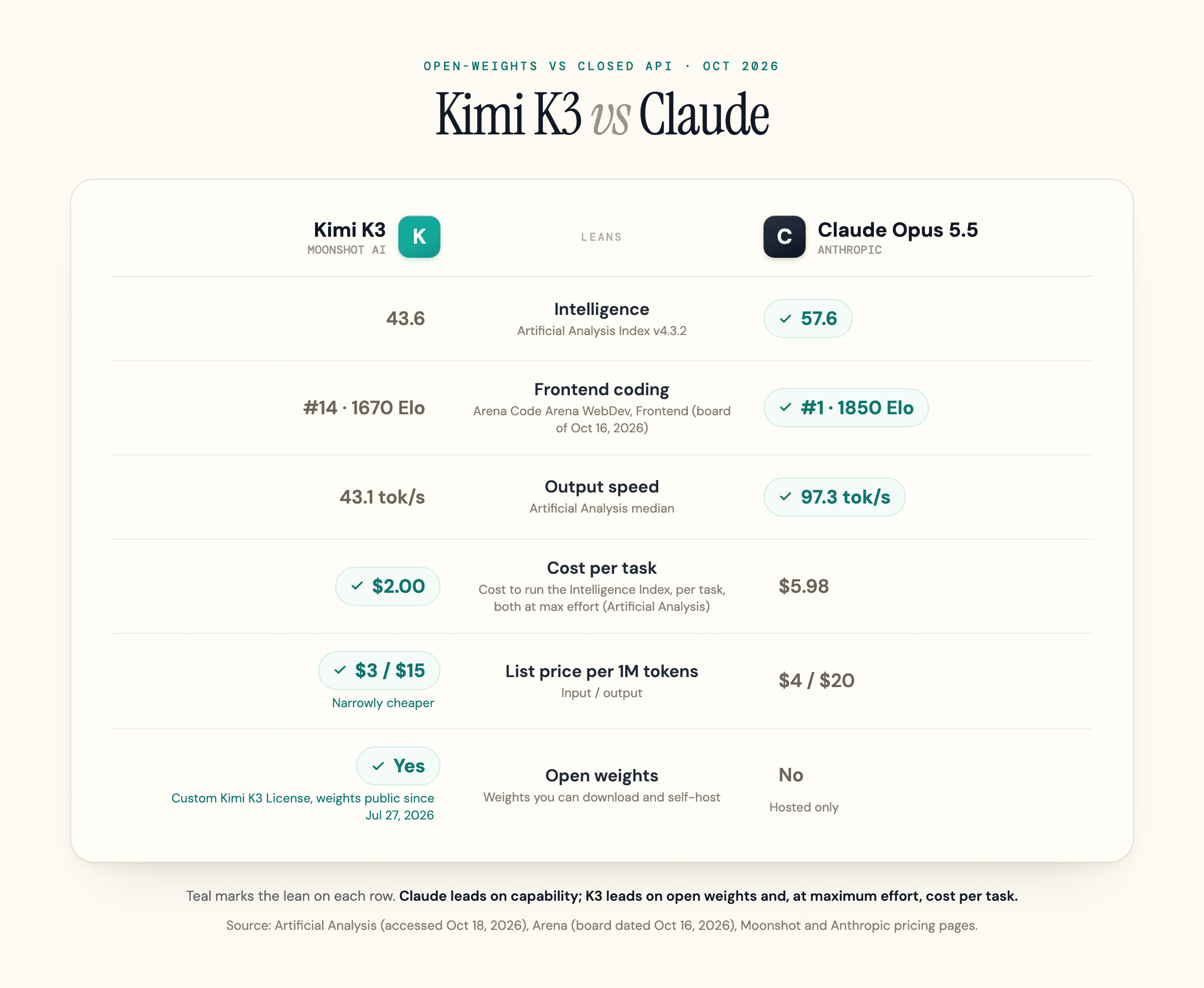
| Dimension | Leans | Why |
|---|---|---|
| General intelligence | Claude Opus 5.5 | Artificial Analysis Intelligence Index v4.3.2: 57.6 against K3's 43.6 |
| Frontend / visual coding | Claude | Arena Frontend board (October 16): Opus 5.5 first at 1850, Sonnet 5.5 second, K3 fourteenth at 1670 |
| Hard reasoning | Claude | Humanity's Last Exam, measured by Artificial Analysis: Opus 5.5 61.4%, K3 46.9% |
| Agentic terminal work | Claude | Terminal-Bench 4.0 on Artificial Analysis: Opus 5.5 59.6%, K3 12.6% (K3.1 Pro now tops this test at 67%) |
| Output speed | Claude | Median tokens per second: Opus 5.5 97.3, Sonnet 5.5 139.8, K3 43.1 |
| Cost per task, K3 against Opus 5.5 | Depends on effort | Both at maximum effort: K3 $2.00, Opus 5.5 $5.98. Opus 5.5 at its default medium effort: $1.34 and a score of 51, against K3's $2.00 and 44. At low effort: $0.55 against $1.15 |
| Cost per task, cheaper Claude and OpenAI models | Haiku 5.5, GPT-6.1 Sol | $0.21 and $0.72 per task, against K3's $2.00 (index runs at maximum effort); open-weight MiMo-V2.6-Pro is $0.13 |
| Open weights | Kimi K3 | Weights public since July 27, 2026 under a custom license; Claude is closed and hosted by Anthropic and its cloud partners |
Kimi K3.1 Pro vs Claude: The October 23 Release
Moonshot released Kimi K3.1 Pro on October 23, 2026, calling it "a post-trained version of Kimi K3" and "the first model in our new K3.1 series". K3 is still sold, but Artificial Analysis now marks K3 deprecated and points to K3.1 Pro.
K3.1 Pro narrows the gap without closing it. Artificial Analysis ranks it fourth on its index, behind Claude Opus 5.5, Claude Sonnet 5.5 and Meta's Muse Wonder Full, and gives it the highest Terminal-Bench 4.0 score of any model. Moonshot's own run, on a different harness, puts it narrowly behind Opus 5.5.
| Measure | Kimi K3.1 Pro | Opus 5.5 | Sonnet 5.5 | Measured by |
|---|---|---|---|---|
| AA Intelligence Index (v4.3.2) | 55 | 57.6 | 56.0 | Artificial Analysis (Claude scores accessed October 18) |
| Terminal-Bench 4.0 | 67% | 59.6% | 63.6% | Artificial Analysis (Claude scores accessed October 18) |
| Terminal-Bench 4.0, vendor-reported | 65.7% | 66.4% | not listed | Moonshot blog: K3.1 Pro on the Claude Code harness; Opus figure is the higher of Anthropic's published score and the Terminal-Bench leaderboard |
| Humanity's Last Exam | 52% | 61.4% | 55.0% | Artificial Analysis (Claude scores accessed October 18) |
| Long-horizon work (GDPval-AA Elo) | 1846 | 1866 | 1838 | Artificial Analysis (Claude scores accessed October 18) |
| Arena Frontend (board of October 22) | 1704 (#9, preliminary) | 1849 (#1) | 1808 (#2, xHigh) | Arena |
| Output speed (tokens per second, October 24) | 73.5 | 96.3 | 132.7 | Artificial Analysis |
| List price (input / output per 1M) | $2 / $10 | $4 / $20 | $2 / $10 | Moonshot, Anthropic |
| Cost per index task (max effort) | $1.98 (launch article) or $2.11 (model page) | $5.98 | $5.46 | Artificial Analysis |
| Open weights | Promised by November 4, not yet published | No | No | Moonshot, Hugging Face |
K3.1 Pro costs about what K3 did per task for an 11-point higher score, at Sonnet 5.5's list price. On Arena's October 22 board, K3 has slipped to 17th, behind an MIT-licensed DeepSeek-V4.1-Flash build.
The caveat: K3.1 Pro is not open-weight yet. Moonshot says "The full model weights will be released by Nov 4"; until then Artificial Analysis and Arena list it as proprietary. Everything below about open weights applies to K3, and the rest of this page compares K3 as of October 18.
Which Claude Are You Comparing Against?
"Claude" is not one model. A benchmark that says "Claude scored well" means nothing unless you know whether it is Fable 5.1, Opus 5.5, Sonnet 5.5 or Haiku 5.5, because they sit at very different points on both the capability curve and the price curve. K3 can beat one of them on a measure and lose to another on the same measure.
Anthropic replaced its whole lineup in the past 7 weeks. Fable 5.1 arrived on September 1, Opus 5.5 on September 22 (the successor to Opus 5) at $4 per million input tokens and $20 per million output tokens (20% below Opus 5, per Anthropic's price list), Sonnet 5.5 on September 28 and Haiku 5.5 on October 7. Opus 5, Fable 5 and Sonnet 5 are still billable but superseded, and Artificial Analysis now lists all three as deprecated. When a July headline says K3 "beats Claude", it is comparing against that older set.
| Claude model | Built for | API price (input / output per 1M) | AA Intelligence Index |
|---|---|---|---|
| Opus 5.5 | Long-running agentic coding and knowledge work | $4 / $20 | 57.6, first on the whole index |
| Sonnet 5.5 | Anthropic's "best combination of speed and intelligence" | $2 / $10 | 56.0 |
| Fable 5.1 | Demanding reasoning and long-horizon agentic work; the priciest tier | $10 / $50 | 53.4 |
| Haiku 5.5 | Speed and low cost | $0.10 / $0.50 up to 100K tokens of prompt | 43.4 |
The pairing that matters is K3 (now K3.1 Pro) against Opus 5.5, because that is the model Anthropic itself recommends as its daily driver for coding and the model Claude Code now defaults to. Our Fable 5.1 guide covers when the top tier is worth paying for.
The Benchmarks: Who Wins What
On models this new, sort every number by who measured it. Independent evaluators run one test setup across all models; labs run their own. Both appear below, labeled.
On the Artificial Analysis Intelligence Index (v4.3.2, ten evaluations), Claude Opus 5.5 leads the whole field at 57.6, Sonnet 5.5 follows at 56.0 and Fable 5.1 scores 53.4. Kimi K3 scores 43.6. On October 18 that put K3 fourth among open-weight models, behind Xiaomi's MiMo-V2.6-Pro (46.3), GLM-5.3 (44.8) and StepFun's Step 5 Preview (43.7). Scores quoted in July launch coverage come from an older version of the index and are not comparable with today's.
The frontend picture changed more. On the Frontend category of Arena's Code Arena, a human-preference vote on generated interfaces, the board dated October 16 has Opus 5.5 first at 1850, Sonnet 5.5 second at 1807, GPT-6 Astra third and Fable 5.1 fourth at 1775. Kimi K3 is fourteenth at 1670. It was still the highest-ranked open-weight model on that board, and it sat ahead of Grok 4.7 and Muse Wonder, but it no longer led the board overall.
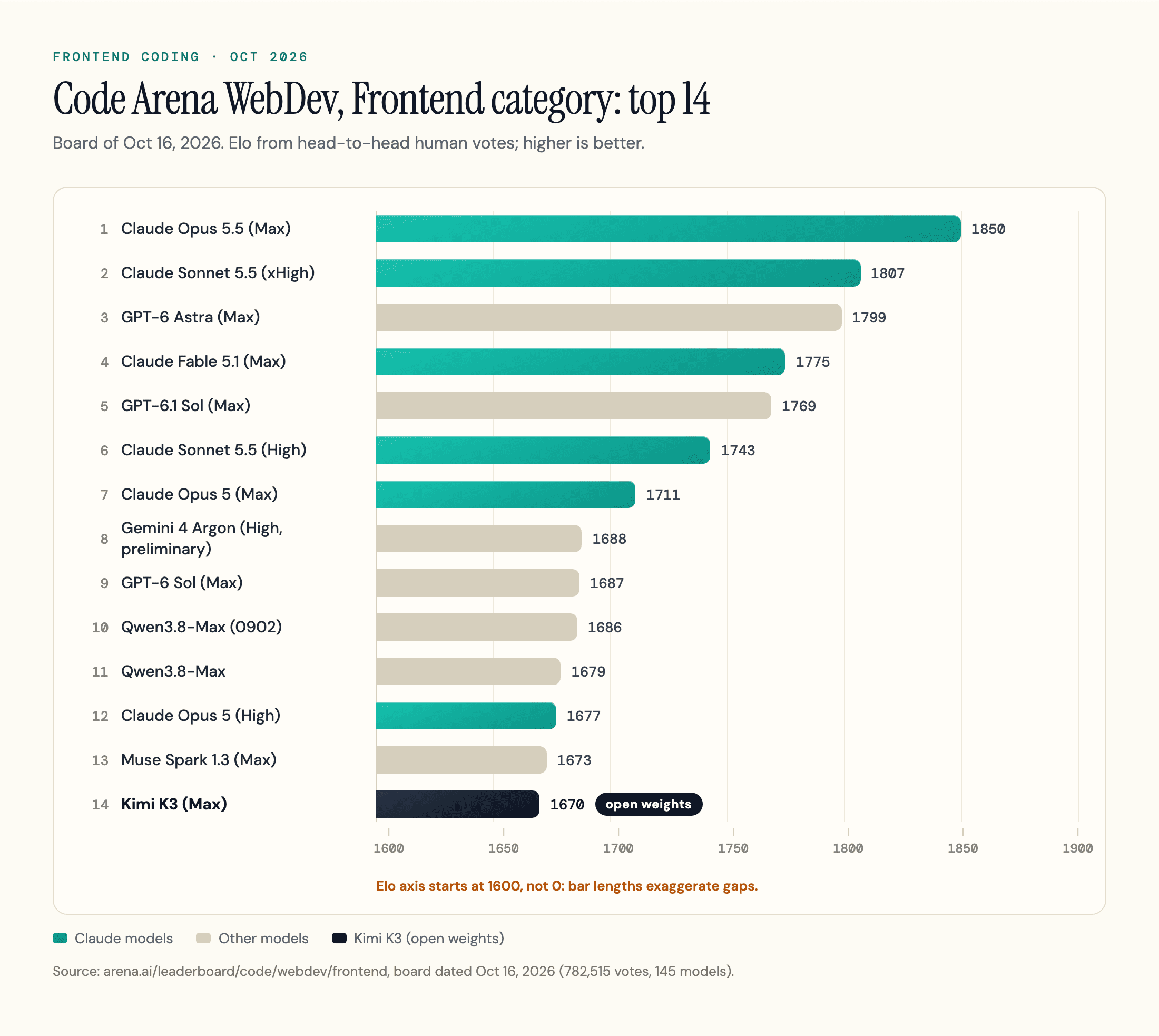
| Benchmark | Kimi K3 | Opus 5.5 | Sonnet 5.5 | Fable 5.1 | Measured by |
|---|---|---|---|---|---|
| AA Intelligence Index (v4.3.2) | 43.6 | 57.6 | 56.0 | 53.4 | Independent (Artificial Analysis) |
| Arena Frontend (Elo, rank) | 1670 (#14) | 1850 (#1) | 1807 (#2, xHigh) | 1775 (#4) | Independent (Arena, October 16) |
| Humanity's Last Exam | 46.9% | 61.4% | 55.0% | 59.1% | Independent (Artificial Analysis) |
| Long-horizon work (GDPval-AA Elo) | 1533 | 1866 | 1838 | 1754 | Independent (Artificial Analysis) |
| Terminal-Bench 4.0 | 12.6% | 59.6% | 63.6% | 52.0% | Independent (Artificial Analysis) |
| AA-Omniscience accuracy | 47.6% | 66.2% | 53.9% | 67.2% | Independent (Artificial Analysis) |
| AA-Omniscience hallucination rate (lower is better) | 53.2% | 58.6% | 47.0% | 72.6% | Independent (Artificial Analysis) |
| AA-LCR (long-context reasoning) | 88.7% | 84.7% | 82.7% | 85.3% | Independent (Artificial Analysis) |
Vendor and independent numbers can differ: Moonshot's own model card lists K3 at 88.3 on Terminal-Bench 2.1, while Artificial Analysis measured 85.0 on the same test and then replaced it in its Intelligence Index with Terminal-Bench 4.0. Use the independent figure when they disagree. K3 does win one index evaluation: on AA-LCR, Artificial Analysis's long-context reasoning test, it scores 88.7% against 84.7% for Opus 5.5. Its Terminal-Bench 4.0 score is the same 12.6% at low and at maximum effort, an unusual result, so weigh that row lightly.
Accuracy and hallucination rate are also different things. Of the models compared here, Fable 5.1 and Opus 5.5 answer the most hard questions correctly, but Artificial Analysis puts K3's hallucination rate at 53.2%, against 58.6% for Opus 5.5 and 72.6% for Fable 5.1. Sonnet 5.5 (47.0%) and Haiku 5.5 (40.4%) are lowest among the Claude models. Verify anything that matters, whichever model produced it. For the full K3 architecture and its launch-day caveats, see our Kimi K3 explainer.
Price: Why the Sticker Is Misleading
On the price list, K3 is cheaper than the Claude flagships, though by less than it used to be. Moonshot's Kimi K3 price page lists $3 per million input tokens and $15 per million output, with cache hits at $0.30; K3.1 Pro, on the same page, lists $2 and $10. Anthropic's rate card has Claude Opus 5.5 at $4 and $20, a third more than K3, with cache hits at $0.20.
Cache writes are priced separately: K3 charges $3.00 for a 5-minute entry and $6.00 for a 1-hour entry, Opus 5.5 $5 and $8. Fable 5.1 is the expensive outlier at $10 and $50. Sonnet 5.5 undercuts K3 at $2 and $10, and Haiku 5.5 costs a thirtieth as much on input at $0.10 and $0.50 for prompts up to 100,000 tokens; above that length Haiku 5.5 charges $0.50 and $2.50, with cache hits at $0.05.
The list price is not what a task costs. Artificial Analysis reports a weighted average cost per task across its Intelligence Index, which captures how many tokens each model burns thinking, and at maximum effort the order reshuffles. Your own cost per task will differ with your prompts.
| Model | Input / 1M | Output / 1M | Cached input | Cost per index task (AA, max effort) | Output tokens for the index |
|---|---|---|---|---|---|
| Claude Haiku 5.5 | $0.10 | $0.50 | $0.01 | $0.21 | 440M |
| GPT-6.1 Sol | $2.00 | $10.00 | $0.10 | $0.72 | 67M |
| Kimi K3 | $3.00 | $15.00 | $0.30 | $2.00 | 160M |
| Claude Sonnet 5.5 | $2.00 | $10.00 | $0.10 | $5.46 | 420M |
| Claude Opus 5.5 | $4.00 | $20.00 | $0.20 | $5.98 | 260M |
| Claude Fable 5.1 | $10.00 | $50.00 | $0.25 | $7.63 | 190M |
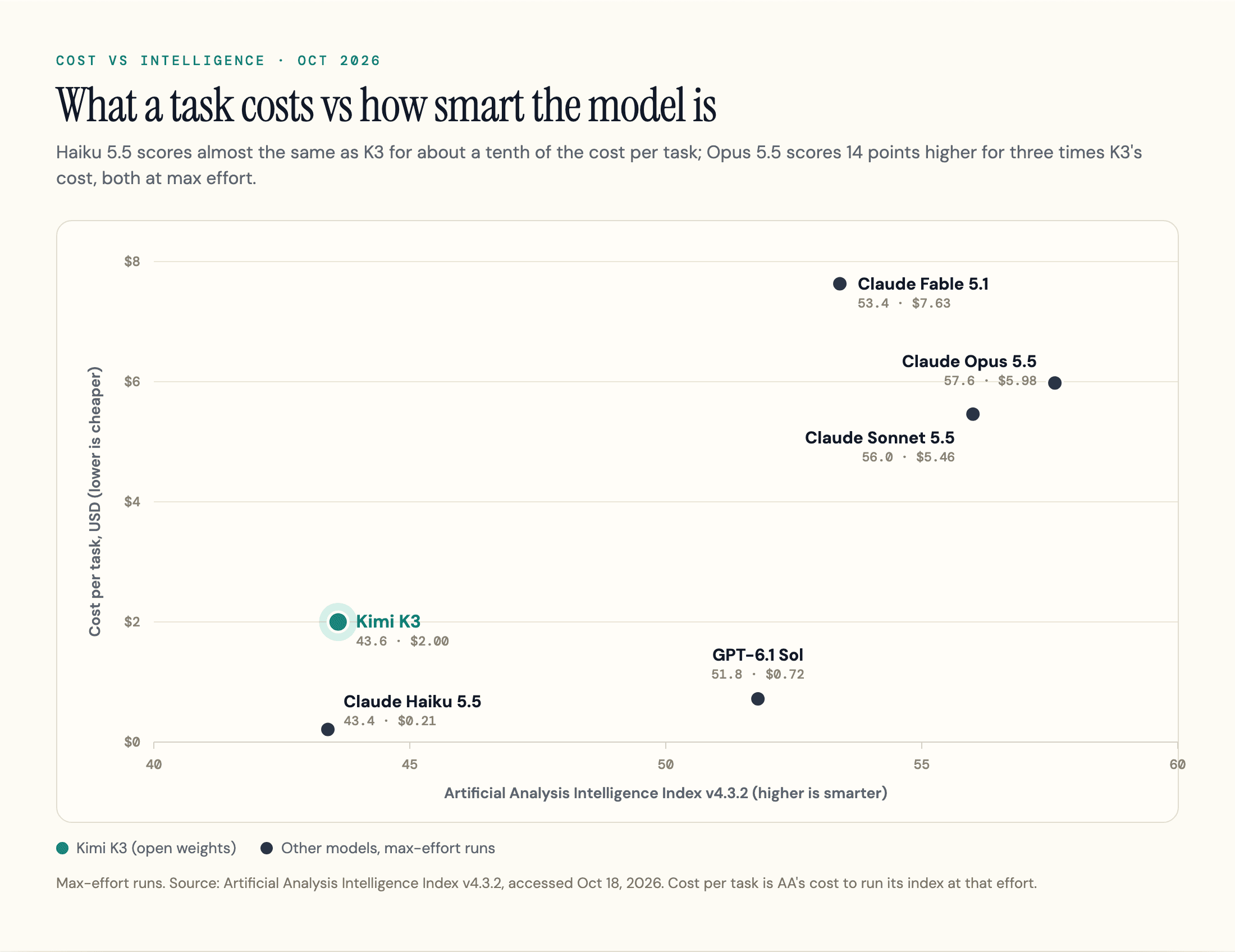
Token price and task cost diverge. Sonnet 5.5 lists below K3 at $2 and $10, yet costs $5.46 per task at maximum effort, in part because it writes about 420 million output tokens to K3's 160 million. K3 writes fewer tokens than every Claude model in that table, though Artificial Analysis still rates it somewhat verbose against other open-weight models (160 million against a 130 million median).
Effort settings also flip the result. K3's API accepts low, high and max reasoning effort and defaults to max, while Anthropic defaults Opus 5.5 to medium. At maximum effort on both, K3 costs $2.00 per task against $5.98 for Opus 5.5. With Opus 5.5 at its default medium effort, Artificial Analysis measures $1.34 per task and an index score of 51, cheaper and higher than K3 at its default (44). At low effort it is $0.55 against $1.15, with scores of 42 and 30, and Sonnet 5.5 at high effort scores 47 for $0.88 per task. So the cheaper model depends on how hard you ask each one to think.
Hosts differ too. Because the weights are public, outside providers sell K3 at their own prices, and OpenRouter's K3 page shows figures that differ from Moonshot's. Every K3 price on this page is Moonshot's first-party rate.
One comparison error makes K3 look many times cheaper than Claude. People compare K3's per-token API price to their flat monthly Claude subscription and conclude K3 is far cheaper. Those are different products. A $20 Claude Pro plan is not billed per token. A fair comparison is API against API, where K3 undercuts Opus 5.5 by a quarter but costs more than Sonnet 5.5 per token, or subscription against subscription, where Kimi's current plans (Plus at $19, Pro at $39, Max at $99 and Ultra at $199 a month) have their own quotas.
Our Kimi API pricing and Kimi plans guides cover the Moonshot side, and the Claude pricing guide does the same on the Anthropic side. Compare like with like and the gap shrinks from "many times" to "real but workload-dependent".
Kimi Code vs Claude Code: The Agentic Head-to-Head
This section compares setup, measured model speed and access, not a paired test of the two agents: we did not run one, and the leaderboards cited on this page score models rather than agents. For many developers the real comparison is the coding agent wrapped around the model, and the practical differences are speed, quota clarity and whether you can get access at all.
You do not have to choose the tool to test the model. Moonshot's own documentation has a guide titled "Use Kimi in Claude Code": it points Claude Code at Moonshot's Anthropic-compatible endpoint and sets the main, Opus, Sonnet and Fable tiers to K3 (its example keeps the Haiku tier on K2.7 Code), so you can run K3 inside the tool you already know and A/B it against Claude on the same task. Moonshot also ships its own agent, Kimi Code, with its own subscription tiers; its changelog lists a K2.8 Preview inside Kimi Code since September 11 that is not on Moonshot's pay-per-token model list.
Kimi Work is a separate Moonshot product: a desktop agent for Windows and Apple-silicon Macs, aimed at local files and browser automation for knowledge workers, so a Kimi Work comparison is about desktop agents rather than the model-to-model test on this page.
Speed is where the tools feel most different. Artificial Analysis measures K3 at 43 output tokens per second, against 97 for Opus 5.5, 140 for Sonnet 5.5, 235 for Haiku 5.5 and 71 for Fable 5.1.
Artificial Analysis also measures the median time to the first answer token, which includes the model's thinking time. At maximum effort K3 takes about 50 seconds against roughly 557 seconds for Opus 5.5, 380 for Sonnet 5.5 and 174 for Fable 5.1, so a maximum-effort Claude run can spend minutes thinking before it answers. Lower effort changes that for Claude but not for K3: at low effort Artificial Analysis measures about 10 seconds for Opus 5.5, 1 second for Sonnet 5.5 and 9 seconds for Haiku 5.5, while K3 stays at about 53 seconds. Over a whole task the order flips back: Artificial Analysis times K3 at just over 1000 seconds per index task at maximum effort, longer than Opus 5.5 (790), Sonnet 5.5 (889), Fable 5.1 (716) or Haiku 5.5 (425).
Artificial Analysis lists K3 as taking text and image input; Moonshot's documentation also describes video input. Both models offer a 1M-token context window, and Anthropic lists Opus 5.5's maximum output at 128K tokens.
Some practical pitfalls come before any test, and none concern capability:
- Access was the blocker at launch, and may have reopened. As of October 18 all the paid plans (Plus, Pro, Max and Ultra) display a Subscribe button on Kimi's pricing page; we did not test checkout or capacity.
- Silent misconfiguration ruins the test. Pointing a tool at the wrong model ID, or leaving stale
ANTHROPIC_*variables in your settings, quietly changes which model answers. Moonshot's guide includes a cleanup script for existing installs for exactly this reason. Confirm the model string and your context ceiling first. - Subscription quotas are hard to read on both sides. Kimi's plans meter usage as a quota with a progress bar rather than a token count, and Claude's Pro and Max plans show usage the same way, so neither shows what one task cost. If bill control is the goal, test on the API, where both meter per token; our notes on the Claude Code context window and cutting Claude Code token costs cover the Claude side.
- K3 needs the whole assistant message back. For multi-turn and tool-call conversations, Moonshot's documentation requires passing the complete assistant message returned by the API, including
reasoning_contentandtool_calls, back as-is.
A practical setup is routing: keep Claude Code as the daily driver and call K3 for the jobs where open weights or price per token matter. The same daily-driver logic shows up when you weigh Claude Code against GitHub Copilot.
Open Weights vs Closed: What You Actually Get
This is the axis where K3 clearly wins, and it is easy to misread. K3.1 Pro does not count here until its weights ship. Kimi K3 is an open-weight model: Moonshot published the weights on July 27, 2026 to its Hugging Face repository, under a custom Kimi K3 License. The license has conditions: a company that runs a "Model as a Service" business, selling third parties access to inference or fine-tuning, and has more than 20 million US dollars in revenue over any 12 consecutive months must sign a separate agreement with Moonshot first, and a product with more than 100 million monthly users or 20 million US dollars in monthly revenue must display "Kimi K3" in its interface. Internal use, and use through Moonshot's own products or certified inference partners, is exempt from both.
Claude is closed. You reach it only through Anthropic's apps and API, or through cloud partners such as Amazon Bedrock, Google Cloud and Microsoft Foundry, and you never hold the model.
The trap is assuming "open weights" means "I can run this myself". For almost everyone, you cannot. K3 has 2.8T parameters, with 104 billion active per token. It is a mixture-of-experts model that routes each token to 16 of its 896 experts, built on what Moonshot calls Kimi Delta Attention. The repository is about 1.56 TB in K3's native 4-bit format, and full-speed inference needs at least that much accelerator memory; for inference efficiency Moonshot recommends a supernode of 64 or more accelerators. That is data-center hardware, not a workstation with a good graphics card.
Community GGUF quantizations for llama.cpp exist, and the smallest Unsloth builds still need 466 GB or more (the recommended 1-bit one 594 GB), but they shrink the hardware bill without erasing it. Our guide to running K3 locally covers the self-hosting side.
So what does open buy you against Claude, if not laptop inference? Mostly optionality. Because the weights are public, competing providers can host K3 and compete on price. You can keep data in your own jurisdiction if you self-host, fine-tune on your own domain, and stay insulated from a provider changing terms or prices or retiring a model. The residency point carries a caveat: the hosted K3 API is operated by Moonshot AI Pte. Ltd., whose terms are governed by Singapore law and whose privacy policy says its servers are in Singapore. The documents do not say where inference runs, so self-hosting is the only route that gives you direct control over location; for a hosted option, check the provider's regional terms. Separately, Anthropic's September 2026 threat-intelligence report alleges that Moonshot silently relayed Kimi customer requests to Claude, almost 300,000 of them in one ten-day period, and also names DeepSeek and Xiaomi in a wider finding about feeding user conversations into Claude to distill it; that is Anthropic's allegation about competitors, not an independent finding.
K3 is also no longer the only serious option in this category: MiMo-V2.6-Pro, GLM-5.3 and Step 5 Preview all have public weights and score at or above it on Artificial Analysis, so "open" is a reason to shortlist K3, not to stop looking. We rank the field in best open-source LLMs and cover another open rival in what is GLM-5.3. If none of the open-weight benefits apply to you, "open" is a transparency feature rather than a practical one, and Claude's closed, hosted convenience is the better trade.
Cheaper Than K3: Haiku 5.5 and GPT-6.1 Sol
The model that most changes the "should I use K3 to save money" decision is not a flagship.
Claude Haiku 5.5 (October 7) scores 43.4 on the Artificial Analysis index against K3's 43.6 and costs $0.21 per task against $2.00. It is also the fastest Claude in the set at about 235 tokens per second. Its price rises above 100,000 tokens of prompt, to $0.50 and $2.50 per million. What it gives up is depth on the hardest work: its Humanity's Last Exam score is 44.4% against Opus 5.5's 61.4%, and on Arena's frontend board Haiku 5.5 (High) ranks 29th at 1603, against K3's 14th on the October 16 board.
GPT-6.1 Sol, OpenAI's $2 and $10 model from late September (our AI token cost guide compares the price lists), scores 51.8 on the index, 8.2 points above K3, at $0.72 per task. On Arena's frontend board it ranks fifth at 1769, above K3 and below only Opus 5.5, Sonnet 5.5, GPT-6 Astra and Fable 5.1. The trade-off is the one every closed model carries: you cannot hold the weights. Artificial Analysis measures it at 64 tokens per second, faster than K3's 43.
If you must have open weights, shortlist K3 alongside MiMo-V2.6-Pro and GLM-5.3: K3 ranks higher on Arena's frontend board, while Xiaomi's MiMo-V2.6-Pro scores 46.3 on the index at $0.13 per task, so being open and being cheap are no longer unique to K3. If you are choosing on cost per task and do not care about weights, Haiku 5.5 and GPT-6.1 Sol both beat K3 on price, and GPT-6.1 Sol beats it on capability as well. At maximum effort on both, K3 costs less per task than Opus 5.5, Sonnet 5.5 and Fable 5.1. For Fable 5.1 that holds at every effort level Artificial Analysis measured; against Opus 5.5 and Sonnet 5.5 it reverses at lower effort settings.
Which Should You Use? A Decision Framework
For frontend generation, hard reasoning and faster streaming, use Claude, and start with Opus 5.5 or Sonnet 5.5. Choose Kimi K3 when you need open weights, self-hosting or control of where your data goes, or when you want to avoid a single vendor.
| If your job is... | Reach for | Because |
|---|---|---|
| Building or restyling a frontend / UI | Claude Opus 5.5 or Sonnet 5.5 | First and second on Arena's Frontend board (Sonnet 5.5 at xHigh effort); on the October 22 board K3.1 Pro is ninth and K3 17th |
| Hard reasoning | Claude Opus 5.5 or Fable 5.1 | Opus 5.5 leads the index and tops Humanity's Last Exam among these models; Fable 5.1 is second there |
| A confident wrong answer is costly | Claude Sonnet 5.5, and verify | Lowest hallucination rate of the larger models here (47.0%, against 53.2% for K3, 58.6% for Opus 5.5 and 72.6% for Fable 5.1), though Fable 5.1 and Opus 5.5 answer more questions correctly |
| Interactive, latency-sensitive work | Claude Sonnet 5.5 or Haiku 5.5, at lower effort settings | 140 and 235 output tokens per second at maximum effort, against 43 for K3; at low effort Sonnet 5.5 and Haiku 5.5 reach the first answer token in about 1 and 9 seconds, K3 in about 53 |
| Low cost per task matters more than open weights | Haiku 5.5 or GPT-6.1 Sol | $0.21 and $0.72 per index task, against $2.00 for K3 |
| You need open weights, fine-tuning or self-hosting | Kimi K3, or another open model | K3 weights public under a custom license; K3.1 Pro weights promised by November 4, not yet published |
| Data must stay in your jurisdiction | Kimi K3, self-hosted | Only self-hosting gives full control. Moonshot's privacy policy puts its servers in Singapore but does not say where inference runs; Claude through a cloud partner's regional deployment is the hosted alternative to check |
| You want one everyday model | Claude Opus 5.5 at its default medium effort, or Sonnet 5.5 to spend less per token | Anthropic's recommended daily driver and Claude Code's default; at medium effort Opus 5.5 scores 51 for $1.34 per task. Sonnet 5.5 at high effort scores 47 for $0.88 |
Do not pick on any leaderboard, including this page: in under 90 days its own headline claim about K3 had to be reversed. Pilot instead: run K3 and your current Claude model on one real, measurable task, look at accepted output and how much supervision each needed, and keep whichever leaves less total friction. For where K3 fits among the other open Chinese models, our Chinese AI models comparison is the wider map.
What This Means for Your AI Visibility
In the test we ran at geotoolbox on October 18, three of four engines found the current lineup. Claude Opus 5.5, after one search, could not find the Claude models we named, and one of the three that did, Perplexity, still relayed this page's old cost-per-task figure next to the current one. A single failed answer and a single stale figure cannot tell us why, but both fit the same mechanism: an answer is only as current as the pages the engine reads.
Model launches are not special here. Any assistant has the same blind spot for anything newer than its training, including your business. A product you shipped last month, a price change, a corrected fact about what you do: an assistant may miss all of it unless it receives current information through a live page, a connected source or the user. And when an assistant does read it live, it quotes whatever your page says today, including any number you forgot to update.
That makes reachability and freshness the levers you control. Assistants that update faster than training do so by fetching live pages, so pages that AI crawlers cannot reach and parse are less likely to be used in answers. This is the core of AI visibility and of getting cited by AI: the businesses that surface well are the ones a model can find, read and trust without tripping over contradictions.
You cannot control what Kimi K3 or the next model learns about you. You can control whether it can reach you at all. Run geotoolbox's free AI Readiness check to see whether AI crawlers can fetch and parse your site, and close the gaps before the next launch makes the question urgent.
Frequently Asked Questions
Is Kimi K3 better than Claude?
Not today. On the independent Artificial Analysis index Claude Opus 5.5 scores 57.6 to K3's 43.6, and on Arena's frontend coding board dated October 16 Opus 5.5 was first while K3 was fourteenth. Kimi K3.1 Pro, released October 23, scores 55 on the same index, still behind Opus 5.5, though it posts the top Terminal-Bench 4.0 score in Artificial Analysis's run. K3's advantages are open weights and, at maximum effort on both models, a lower cost per task than the Claude flagships, not raw capability.
Is Kimi K3 cheaper than Claude?
With all models at maximum effort, yes: K3 costs $2.00 per Artificial Analysis index task against $5.46 to $7.63 for Sonnet 5.5, Opus 5.5 and Fable 5.1, and its $3 and $15 list price undercuts Opus 5.5's $4 and $20. The result depends on the effort pairing: Opus 5.5 at its default medium effort costs $1.34 per task and Sonnet 5.5 at high effort $0.88, while Fable 5.1 costs more than K3 even at low effort ($2.37). Claude Haiku 5.5 is cheaper still at $0.21 per task. Comparing K3's API price to a flat Claude subscription is not like for like.
Can I use Kimi K3 in Claude Code?
Yes. Moonshot documents it: point Claude Code at Moonshot's Anthropic-compatible endpoint, set the main model tiers to K3 (its example keeps Haiku on K2.7 Code), and run it in the tool you already use. You can use this to test K3 against your usual Claude model on one task before deciding anything.
Is Kimi K3 open source?
K3 is open-weight rather than open source. Moonshot published the weights on July 27, 2026 under a custom Kimi K3 License, and the model is about 1.56 TB, so most people use it through an API or a hosting provider rather than running it themselves. The weights are free to download; using K3 through Moonshot's API costs $3 per million input tokens and $15 per million output tokens.
Sources
- Kimi K3 - Intelligence, Performance and Price Analysis - Artificial Analysis, accessed October 18, 2026 -
artificialanalysis.ai/models/kimi-k3 - Claude Opus 5.5, Sonnet 5.5, Haiku 5.5 and Fable 5.1 - model pages and Intelligence Index v4.3.2 - Artificial Analysis, accessed October 18, 2026 -
artificialanalysis.ai/models/claude-opus-5-5 - Kimi K3 vs Claude Opus 5.5 - release comparison - Artificial Analysis, accessed October 18, 2026 -
artificialanalysis.ai/models/releases/comparisons/claude-opus-5-5-vs-kimi-k3 - MiMo-V2.6-Pro - Intelligence, Performance and Price Analysis - Artificial Analysis, accessed October 18, 2026 -
artificialanalysis.ai/models/mimo-v2-6-pro - Code Arena WebDev, Frontend category - Arena, boards dated October 16 and October 22, 2026 -
arena.ai/leaderboard/code/webdev/frontend - Kimi K3.1 Pro launch post - Moonshot AI, October 23, 2026 -
kimi.ai/blog/kimi-k3-1-pro - Kimi K3.1 Pro launch benchmarks and model page - Artificial Analysis, October 23, 2026, accessed October 24 -
artificialanalysis.ai/articles/kimi-k3-1-pro-launch-benchmarks - Claude API pricing and model rate card - Anthropic, accessed October 18, 2026 -
platform.claude.com/docs/en/about-claude/pricing - Claude Opus - product page and recommendation - Anthropic, accessed October 17, 2026 -
anthropic.com/claude/opus - Model configuration (default model) - Anthropic Claude Code docs, accessed October 17, 2026 -
code.claude.com/docs/en/model-config - API pricing - OpenAI, captured October 17, 2026 -
openai.com/business/pricing - Use Kimi in Claude Code - Moonshot AI platform documentation, accessed October 18, 2026 -
platform.kimi.ai/docs/guide/claude-code-kimi - Kimi K3 API pricing - Moonshot AI platform documentation, accessed October 18, 2026 -
platform.kimi.ai/docs/pricing/chat - Kimi membership pricing - Moonshot AI, accessed October 18, 2026 -
kimi.ai/membership/pricing - Kimi membership plans and monthly prices - Moonshot AI help center, accessed October 18, 2026 -
kimi.ai/help/membership/membership-pricing - Moonshot API terms and privacy policy - Moonshot AI platform documentation, accessed October 18, 2026 -
platform.kimi.ai/docs/agreement/userprivacy - Kimi K3 - supernode deployment recommendation - Moonshot AI, accessed October 18, 2026 -
kimi.ai/blog/kimi-k3 - Kimi K3 GGUF builds and storage sizes - Unsloth, accessed October 18, 2026 -
unsloth.ai/docs/models/kimi-k3 - Claude pricing and plans - Anthropic, accessed October 18, 2026 -
claude.com/pricing - Kimi-K3 model repository (open-weights release) - Hugging Face / Moonshot AI, July 2026 -
huggingface.co/moonshotai/Kimi-K3 - Kimi-K3-GGUF builds - Unsloth on Hugging Face, accessed October 18, 2026 -
huggingface.co/unsloth/Kimi-K3-GGUF - Effort levels and defaults - Anthropic Claude API docs, accessed October 18, 2026 -
platform.claude.com/docs/en/build-with-claude/effort - Kimi K3 on OpenRouter - OpenRouter, accessed October 18, 2026 -
openrouter.ai/moonshotai/kimi-k3 - Model use agreement - Moonshot AI platform documentation, accessed October 18, 2026 -
platform.kimi.ai/docs/agreement/modeluse - Usage limit best practices - Anthropic support, accessed October 18, 2026 -
support.claude.com/en/articles/9797557-usage-limit-best-practices - Threat intelligence report, September 2026 - Anthropic, accessed October 19, 2026 -
anthropic.com/threat-intelligence-report-september-2026 - Kimi Work - Moonshot AI, accessed October 19, 2026 -
kimi.ai/products/kimi-work